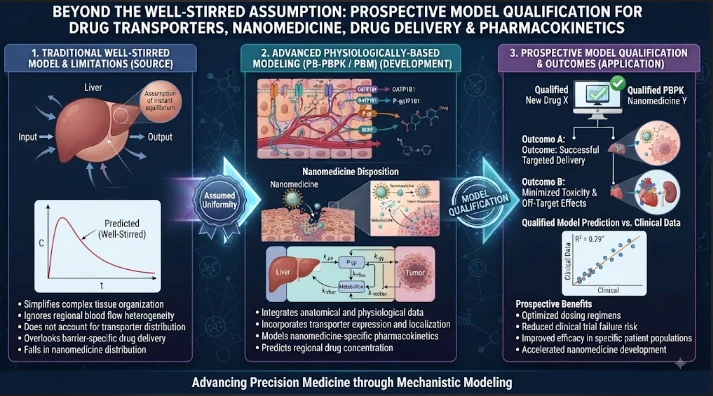
This article challenges the well-stirred assumption in pharmacokinetic modeling and argues for prospective qualification of models that include transport-limited and nanomedicine-specific behavior. Drug distribution may be constrained by membrane permeability, transporter abundance, tissue architecture, intracellular sequestration, immune uptake, nanoparticle trafficking, and local release, producing nonuniform tissue exposure even when plasma concentrations appear well described. The article links blood concentration to membrane transport, tissue entry, partitioning, intracellular distribution, metabolism, nanoparticle uptake, release, and elimination. PBPK models with permeability-limited compartments, mechanistic nanoparticle modules, virtual populations, sensitivity analysis, and Bayesian calibration are presented as tools for testing these processes. Prospective dose studies, transporter inhibition, formulation modification, organ-impairment cohorts, imaging, and tissue concentration measurements provide challenge data. The framework emphasizes parameter identifiability, interval coverage, tissue-level prediction accuracy, subgroup performance, and predefined qualification criteria. Manufacturing variability in particle size, loading, surface chemistry, aggregation, and release is also incorporated. The central message is that mechanistic models should demonstrate transport assumptions prospectively before they are trusted for real dosing or safety decisions.
It is an assumed convenience with pharmacokinetic simplicity, but there are many systems of transporters and nanomedicine systems that do not follow the underlying picture presented by the well-stirred assumption. Prospective model qualification for drug transporters, nanomedicine, drug delivery and pharmacokinetics has progressed beyond merely identifying hits due to the fact that permeability can be limited, the concentration of the drug transporters, the architecture of the tissue, sequestration and intracellular trafficking of nanoparticles and local drug release can create nonuniform exposure. The more intriguing question is whether a model that has been previously validated using experimental data that tests the assumptions about distribution and transport in an experiment still holds true in realistic biological and developmental conditions. The transition from a ranking exercise to a mechanistic program, based on exposure, causation, and reproducibility, defines that shift in discovery. As the deadline nears for publication, the importance of correlating molecular design to experiments that provide insight into the mechanism of action, failures of action, and priorities of constraints for progress in mechanistic pharmacokinetic qualification is growing.
PBPK models offer a pathway to explicitly model organ blood flow, tissue volume, transporters, permeability, disposition, uptake by mononuclear phagocytes, and formulation. The history and recent development experience indicates that with the growth of biological complexity, an attractive laboratory signal is unlikely to remain unchanged. A good research approach is then to retain the original activity signal while varying the test conditions in increasingly realistic ways to see which features are critical.
The first step in mechanistically developing a concept is to relate the concentration of a chemical in the blood to transport across the membrane, entry into tissue, partitioning inside, local release, metabolism, and elimination. This structure could be masked by simple endpoint assays since similar readouts can result from different causal pathways. Gaining additional detail is obtained from transporter kinetics, perfused tissue studies, imaging, microphysiological systems, tissue concentration measurements and clinical pharmacokinetics, which allow for direct action from downstream adaptation, nonspecific stress, or delivery failure to be separated. Such measurements make an appealing answer a testable link between chemistry, biological state, and functional outcome.
The design variables should also be considered in groups (interactions) instead of individually. Together, all factors that influence performance—from permeability, blood flow, abundance of transporters, binding, tissue composition, particle size, opsonization, uptake, release rate and clearance—have an impact on performance, and an improvement in one dimension can lead to a penalty in another. A sensible optimization scheme is thus one that considers a compromise rather than a maximum. Multi-parameter profiles are particularly useful when potency, selectivity, stability, tissue exposure, and manufacturability are all factors in translating a chemical into a drug.
Computational leverage, in the form of PBPK, permeability-limited compartments, mechanistic models of nanoparticles, sensitivity analysis, Bayesian calibration and virtual populations, can be very helpful, but prediction is effective only when there is some visible uncertainty. When dealing with novel scaffolds, unusual materials or underrepresented patient states, models trained on familiar chemical or biological regions are often found to be unreliable. Calibration, prospective testing, checks on the domains of applicability, and disagreement across model families is used to uncover fragile predictions in advance of costly experiments.
The experimental design could be orthogonal validated. Prospective dose studies, transporter inhibitors, formulation modification, organ impairment cohorts, imaging data and predefined prediction criteria address various aspects of the causal question and minimize reliance on a single assay technology. If you can get everyone in the group on the same page, with consensus on chemistry, imaging, omics, genetics and functional biology, then you have a stronger mechanistic argument than repeated measurements of the same endpoint. Disagreement is also informative as the result of different studies can be some hidden exposure limits, assay artifacts, compensatory pathways, or context-dependent pharmacology.
The problem of biological diversity is added to this. Target abundance, barrier properties, metabolism, immune tone or pathway dependence can vary as a result of organ function, genotype of the transporter, inflammation, age, protein levels, immune clearance, disease state or particle batch, but without changing the nominal treatment. Average response values may fail to pick up subgroups that have varying exposure-response relationships. Biological variation is part of the design and not an afterthought for lack of consistency.
Resistance and adaptation is an issue that needs to be addressed early, as model assumptions could become "adaptive" to new observations if the model is calibrated for the missing mechanisms with fitted parameters. Mechanism challenge experiments, parameter-identifiability analysis, out-of-sample prediction, scenario testing and model revision rules allow the determination of whether activity is found to be evolutionary or compensatory. A candidate who may be slightly less potent, but blocks off common escape routes may be more valuable in the long-term than a high potency, but weak candidate. Resistance-aware development also contributes to mechanism sharpening by recurrent escape changes often highlighting key proteins, pathways, and/or exposure processes.
Molecular promise to reachable biology through delivery and pharmacokinetics. To ensure that the active form is delivered to a target site in a concentration and time sufficient for the proposed mechanism to be achieved, organ inlet concentration, membrane transport, tissue binding, intracellular distribution, uptake and release of nanoparticles, drug metabolism and excretion play a role. This is because the Abs, D, B, T, clearance and local barriers modify the effective exposure, which cannot be captured on a nominal dose basis. Mechanistic exposure measures should then be placed in conjunction with efficacy data from its earliest development cycles.
Assessment of safety is enhanced with the inclusion of mechanism. Target-linked pharmacology is characterized by tissue accumulation, exposure through interaction, renal/hepatic insufficiency, immune sequestration, complement activation, and high dose sub-populations, which serve to separate it from general cellular injury, immune activation, reactive chemistry, or formulation-driven toxicity. Comparative testing in disease-relevant and healthy systems determines if there is therapeutic activity that is separated from unwanted effects.
Manufacturing is not a logistics issue, it's a scientific one. Product quality, biological activity and exposure can change, despite the nominal product composition, due to the particle attributes, drug loading, surface chemistry, release kinetic, aggregation, storage and lot comparability. Quality by design thinking correlates the important properties of the materials and parameters required to process the materials into measurable performance, rather than just end-of-line specification testing. Both raw material variability, larger equipment, storage, transport and independent production runs have to be overcome for laboratory success to gain credibility in terms of scalability.
Realistic models of the clinical use of the translation are also needed for translation. Treatment timing, dose frequency, route, diagnostic requirements and acceptable complexity are influenced by dose selection, route, interaction management, organ impairment, therapeutic monitoring and formulation substitution. A technically beautiful platform, if it requires significant administration burden, has to be stored in awkward conditions, or the burden of monitoring exceeds the need, or it is cost prohibitive in the setting in which it is required for treatment, is not a very useful one in practice. Thus, at the point of development decision, it is helpful to have the best of both worlds, namely, having the best of the mechanisms and the best of the deployment.
Data integration serves as the key, linking these layers together. Virtually all in vitro kinetics, tissue data, imaging data, plasma data, transporter data, particle attributes, and clinical covariates can be integrated around a common causal model as opposed to being separate assay outputs. Iterative learning is reproducible with traceable metadata, versioned models, standardized controls and prospective decision rules. This allows for a development record that indicates which candidate placed the highest score and the reasons for making each of these decisions, along with uncertainties that were not resolved.
Predicative accuracy (predefined prediction error), interval coverage, tissue-level accuracy, parameter identifiability, sensitivity stability, successful challenge predictions and subgroup performance are among the prospective qualification needs. The quality of the decision can be enhanced by the inclusion of durability, reproducibility, exposure margin, biological breadth, manufacturing robustness, along with potency. These types of measures bias towards optimizing for a narrow assay and incentivize candidates that are plausible under independent assays. A clear scorecard also explains the logic behind a less dramatic outcome being the better development option.
A robust program also provides a positive definition of failure. The negative result of retrospective over-fitting, unidentifiable parameters, compensating errors, untested assumptions of the transporter, and plasma fits which are incorrect in prediction the tissue means outlines boundaries of the mechanism, and reduce repeated investments in weak hypotheses. If the synthesis was recorded incorrectly, target engagement was not recorded, exposure was too unstable, resistance was detected or there is a loss of effect for a particular subgroup, future models will have more realistic view of search space. When unfruitful trials make as much discovery as fruitful ones do, discovery will be speeded.
It is important to move beyond the "assumed" well-stirred assumption and demonstrate that a model contains mechanisms of transport required for real dosing decisions. The key benefit of the central advantage is that it is based on a series of linked arguments rather than isolated performance-based arguments, covering mechanism, exposure, biological diversity, safety, and production. That structure aids improved candidate selection as each important claim in the development has a test. Progress isn't so much due to spectacular individual experiments, but on a logical sequence of results that is convincing as complexity increases from laboratory systems to real clinical conditions.
CITE THIS ARTICLE
Kabir, M. H. (2025). Beyond the Well-Stirred Assumption: Prospective Model Qualification for Drug Transporters, Nanomedicine, Drug Delivery and Pharmacokinetics. https://researchbykabir.com/article/efb82a2b-9fbc-516c-baa9-92215bf94696
M. H. Kabir, “Beyond the Well-Stirred Assumption: Prospective Model Qualification for Drug Transporters, Nanomedicine, Drug Delivery and Pharmacokinetics,” 2025. [Online]. Available: https://researchbykabir.com/article/efb82a2b-9fbc-516c-baa9-92215bf94696
Kabir, M. H. (2025) ‘Beyond the Well-Stirred Assumption: Prospective Model Qualification for Drug Transporters, Nanomedicine, Drug Delivery and Pharmacokinetics’. Available at: https://researchbykabir.com/article/efb82a2b-9fbc-516c-baa9-92215bf94696
Kabir, Md. Humayan. “Beyond the Well-Stirred Assumption: Prospective Model Qualification for Drug Transporters, Nanomedicine, Drug Delivery and Pharmacokinetics.” 2025, https://researchbykabir.com/article/efb82a2b-9fbc-516c-baa9-92215bf94696.
Md. Humayan Kabir. “Beyond the Well-Stirred Assumption: Prospective Model Qualification for Drug Transporters, Nanomedicine, Drug Delivery and Pharmacokinetics.” (2025). https://researchbykabir.com/article/efb82a2b-9fbc-516c-baa9-92215bf94696.
Kabir MH. Beyond the Well-Stirred Assumption: Prospective Model Qualification for Drug Transporters, Nanomedicine, Drug Delivery and Pharmacokinetics. 2025. https://researchbykabir.com/article/efb82a2b-9fbc-516c-baa9-92215bf94696
@misc{article_efb82a2b9fbc516cbaa992215bf94696,
  title = {Beyond the Well-Stirred Assumption: Prospective Model Qualification for Drug Transporters, Nanomedicine, Drug Delivery and Pharmacokinetics},
  author = {Md. Humayan Kabir},
  year = {2025},
  url = {https://researchbykabir.com/article/efb82a2b-9fbc-516c-baa9-92215bf94696},
}
TY  - GEN
AU  - Md. Humayan Kabir
TI  - Beyond the Well-Stirred Assumption: Prospective Model Qualification for Drug Transporters, Nanomedicine, Drug Delivery and Pharmacokinetics
PY  - 2025-11-09
UR  - https://researchbykabir.com/article/efb82a2b-9fbc-516c-baa9-92215bf94696
ER  -
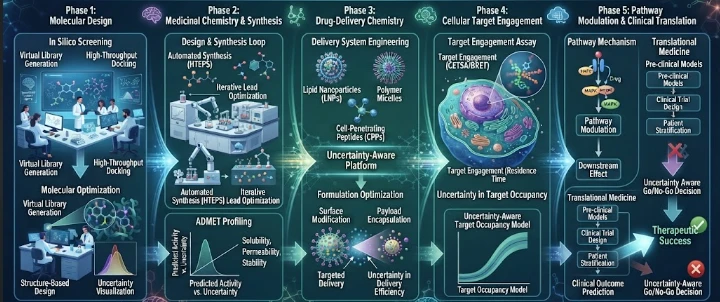
This article describes an uncertainty-aware platform for moving from predicted molecular binding to validated cellular target engagement in medicinal chemistry and drug-delivery research. Docking and machine-learning predictions can rapidly prioritize compounds, but they do not establish that a molecule reaches, occupies, and functionally modulates a target inside relevant cells. The article therefore separates predicted affinity from free intracellular concentration, subcellular localization, t
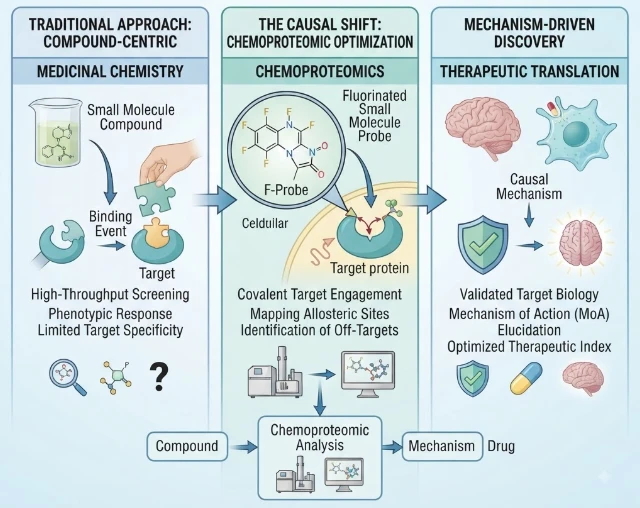
This article explores fluorinated medicinal chemistry through causal chemoproteomics, emphasizing that fluorine substitution can alter far more than potency. A single positional change can modify conformation, pKa, lipophilicity, metabolic stability, target interactions, intracellular exposure, and off-target biology. The article therefore tests whether fluorinated analogues change cellular phenotype through intended target engagement rather than hidden polypharmacology. Matched molecular pairs
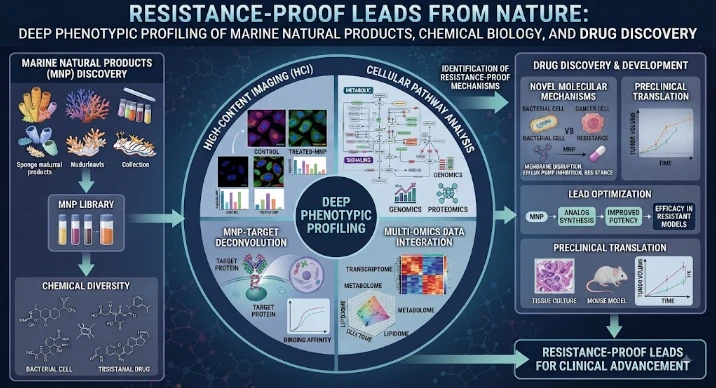
This article presents resistance-aware marine natural-product discovery as a mechanistic process rather than a search for isolated high-potency hits. It explains how activity from marine extracts or fractions can disappear during purification or fail under resistance pressure, making deep phenotypic profiling essential. Morphology, viability kinetics, organelle function, transcriptional state, metabolism, and recovery after washout are combined to connect phenotype with mechanism. The article em