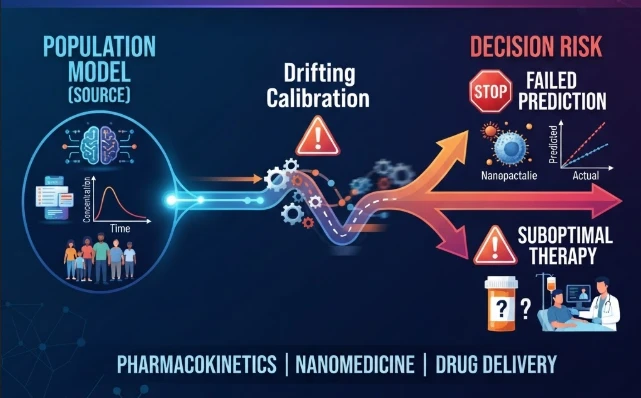
This article examines how population pharmacokinetic models can lose reliability when transported to new patients, formulations, or healthcare settings. Transporter activity, organ function, disease state, co-medication, formulation behavior, and population composition can all shift exposure relationships and create calibration drift. The article links transporter kinetics, organ physiology, particle characteristics, clearance pathways, and concentration–time profiles using transporter assays, clinical pharmacokinetics, imaging, organ-function measurements, in vitro disposition studies, population PK, PBPK, nonlinear mixed-effects models, Bayesian updating, and calibration diagnostics. External populations, drug–drug interaction datasets, renal or hepatic impairment groups, and formulation changes are proposed as stress tests. Age, ancestry, genotype, inflammation, organ function, and batch variation are treated as important sources of heterogeneity. The article emphasizes interval coverage, subgroup bias, decision-threshold accuracy, external validity, and stability after covariate shift rather than relying only on internal model fit. Safety concerns include high-exposure tails, tissue accumulation, interactions, and formulation-specific toxicity. Overall, the article frames calibration drift as a decision and patient-safety problem that requires explicit monitoring whenever population models travel.
Population pharmacokinetic models are usually stable until a change occurs in the drug, the transporter environment, formulation or patient population. To overcome the mismatch of models calibrated to one system and the prediction of exposure when transporter activity or organ function changes, as in disease state and population composition, or when formulation behavior changes, calibration-drift analysis for drug transporters, nanomedicine, drug delivery and pharmacokinetics has evolved beyond the basic hit finding. The more interesting one is whether a population model that has been calibrated and the performance is acceptable (and decisions are made using it) when it is transported to a new setting is stable over realistic biological and development conditions. The transition from a ranking exercise to a mechanistic program, based on exposure, causation, and reproducibility, defines that shift in discovery. By the time of scheduled publication, the development of transportable pharmacokinetic modelling more and more relies on the ability to relate molecular design to experiments that clarify the reasons for a candidate's efficacy, failure and the constraints that need to be focused on.
Transporter-mediated uptake/efflux processes, which are linked to metabolism, protein binding, renal function, hepatic function, nanoparticle disposition and route-specific delivery, are different in different systems. The history and recent development experience indicates that with the growth of biological complexity, an attractive laboratory signal is unlikely to remain unchanged. A valuable research tool is then to leave the activity signal as it is and to progressively test which features are essential under increasingly realistic conditions.
Mechanistic depth begins by relating transporter kinetic parameters, organ physiology, formulation properties, clearance routes and concentration-time relationships. This structure could be masked by simple endpoint assays since similar readouts can result from different causal pathways. The impact of direct action and subsequent adaptation, nonspecific stress or delivery failure is removed by using transporter assays, clinical pharmacokinetics, imaging, organ function measurements, in vitro disposition studies and formulation characterization. These measurements provide a path to a testable connection between chemistry, biological state, and functional outcome, an attractive response.
The design variables should also be considered in groups (interactions) instead of individually. Performance is affected by the abundance of transporters, their genotype, their inhibition and induction, blood flow to the organ, renal function, properties of the particles, dose and route.All these factors affect performance together and a gain in one dimension can incur a loss in some other dimension. A sensible optimization scheme is thus one that considers a compromise rather than a maximum. Multi-parameter profile (potency, selectivity, stability, tissue exposure, manufacturability) is particularly useful in cases where all of these factors drive translational value.
Prediction becomes relevant when there is uncertainty to see, and is useful as a computational tool, such as population PK, PBPK, nonlinear mixed effects, Bayesian updating, covariate models, and calibration diagnostics. Models that are developed based on well-known chemical or biological patterns can fail to perform well on novel scaffolds, less common materials, or states of the disease. Calibration, future testing, domain of applicability and disagreement between model families reveal sensitive predictions at an early stage, without incurring costly experiments.
The experimental design could be orthogonal validated. These external populations, drug-drug interaction datasets, formulation changes, renal or hepatic impairment groups provide different answers to the causal question and less reliance on any particular assay technology. If you can get everyone in the group on the same page, with consensus on chemistry, imaging, omics, genetics and functional biology, then you have a stronger mechanistic argument than repeated measurements of the same endpoint. Disagreement is also informative as the result of different studies can be some hidden exposure limits, assay artifacts, compensatory pathways, or context-dependent pharmacology.
The problem of biological diversity is added to this. Target abundance, barrier function, metabolism, immune tone or pathway dependence can vary with age, ancestry, genotype, disease, co-medication, and organ function, or due to batch-to-batch variation in formulation without changing the nominal treatment. Average response values may fail to pick up subgroups that have varying exposure-response relationships. Biological variation is an integrated part of design and not an explanation for nonconforming results in the end.
Earlier treatment focus needs to be given on resistance and adaptation as clinical decision rules may fail if there is a drift in the exposure mechanism without any change in the molecular target biology. Scenario stress testing, transporter perturbation, covariate shifts, sensitivity analysis, and repeated model recalibration indicate if activity is able to withstand evolutionary and/or compensatory stress. A candidate who may be slightly less potent, but blocks off common escape routes may be more valuable in the long-term than a high potency, but weak candidate. Resistance-aware development also contributes to mechanism sharpening by recurrent escape changes often highlighting key proteins, pathways, and/or exposure processes.
Molecular promise to reachable biology through delivery and pharmacokinetics. The extent to which the active form is absorbed, taken up, transported out of the blood, reaching tissues, metabolized, excreted in the kidneys, sequestered in nanoparticles, and released to the tissues determines whether it will reach the intended site at the concentration and duration required for the proposed mechanism. It is impossible to capture this relationship with just the nominal dose as it is absorbed, distributed, bound to protein, transformed, cleared from the body, and modified by local barriers to create effective exposure. Mechanistic exposure measures should then be placed in conjunction with efficacy data from its earliest development cycles.
Assessment of safety is enhanced with the inclusion of mechanism. Target linked pharmacology can be distinguished from widespread cellular damage, immune activation, reactive chemistry or formulation toxicity through high exposure tails, organ effect, interaction risk, tissue accumulation, immunologic reactions and formulation-specific toxicity. Comparative testing in disease-relevant and healthy systems determines if there is therapeutic activity that is separated from unwanted effects.
Manufacturing is not a logistics issue, it's a scientific one. When the nominal composition seems to be the same, particle size, drug loading, release rate, excipient composition, batch consistency, container effects, and storage can all impact the quality, biological activity and exposure of the product. Quality by design thinking correlates the important properties of the materials and parameters required to process the materials into measurable performance, rather than just end-of-line specification testing. The more successful the lab is, the more credible the scaling up process becomes as the success is not dependent on raw material variation, but also larger machines, storage, transport, independent production runs, etc.
Realistic models of clinical use also are needed for translation. The treatment timing, dose frequency (dose interval), route, diagnostic requirements, and acceptable complexity of treatment are determined by dose adjustment, therapeutic window, interaction burden, organ impairment, route, monitoring access, and population diversity. A technically beautiful platform, if it requires significant administration burden, has to be stored in awkward conditions, or the burden of monitoring exceeds the need, or it is cost prohibitive in the setting in which it is required for treatment, is not a very useful one in practice. Thus, at the point of development decision, it is helpful to have the best of both worlds, namely, having the best of the mechanisms and the best of the deployment.
A layer that spans the layers is data integration. Concentration-time data, covariates, transporter measurements, formulation attributes, organ function, response and adverse events can be linked in a common causal model in contrast to being pure assay outputs. Iterative learning is reproducible due to traceable metadata, versioned models, standardized controls and prospective decision rules. This allows for a development record that indicates which candidate placed the highest score and the reasons for making each of these decisions, along with uncertainties that were not resolved.
The transportable models must be calibrated, have prediction error, interval coverage, have no subgroup bias, have decision threshold accuracy, be externally valid, and be stable following covariate shift. Quality of the decision will be enhanced if durability, reproducibility, exposure margin, biological breadth and manufacturing robustness are added to the traditional potency measures. These types of measures bias towards optimizing for a narrow assay and incentivize candidates that are plausible under independent assays. A clear scorecard also makes it clear why a less flashy result may be the better development option.
A good program is also one that specifies what failure is. The boundaries of the mechanism and the reduction in repeated investment in weak hypotheses are identified via negative results of good internal fit, transporter assumptions borrowed across populations, irrelevant formulation changes and unmodeled interaction effects. Future models have a more realistic search space when they fail to synthesize, when they don't engage a target, when they are not exposed or when a resistance emerges. Experiments succeed when they succeed and when they fail they teach, discovery is faster when unsuccessful experiments teach as much as successful ones.
Calibration drift is a patient-safety issue when population models go on the road as dosing decisions are based on predictions beyond the original development environment. The key benefit of the central advantage is that it is based on a series of linked arguments rather than isolated performance-based arguments, covering mechanism, exposure, biological diversity, safety, and production. The structure helps to make better selections of candidates, as there is a test for every important development claim. Progress isn't so much due to spectacular individual experiments, but on a logical sequence of results that is convincing as complexity increases from laboratory systems to real clinical conditions.
CITE THIS ARTICLE
Kabir, M. H. (2026). When Population Models Travel: Calibration Drift and Decision Risk in Drug Transporters, Nanomedicine, Drug Delivery and Pharmacokinetics. https://researchbykabir.com/article/803ec884-3a70-51da-a24b-8f16a55217d3
M. H. Kabir, “When Population Models Travel: Calibration Drift and Decision Risk in Drug Transporters, Nanomedicine, Drug Delivery and Pharmacokinetics,” 2026. [Online]. Available: https://researchbykabir.com/article/803ec884-3a70-51da-a24b-8f16a55217d3
Kabir, M. H. (2026) ‘When Population Models Travel: Calibration Drift and Decision Risk in Drug Transporters, Nanomedicine, Drug Delivery and Pharmacokinetics’. Available at: https://researchbykabir.com/article/803ec884-3a70-51da-a24b-8f16a55217d3
Kabir, Md. Humayan. “When Population Models Travel: Calibration Drift and Decision Risk in Drug Transporters, Nanomedicine, Drug Delivery and Pharmacokinetics.” 2026, https://researchbykabir.com/article/803ec884-3a70-51da-a24b-8f16a55217d3.
Md. Humayan Kabir. “When Population Models Travel: Calibration Drift and Decision Risk in Drug Transporters, Nanomedicine, Drug Delivery and Pharmacokinetics.” (2026). https://researchbykabir.com/article/803ec884-3a70-51da-a24b-8f16a55217d3.
Kabir MH. When Population Models Travel: Calibration Drift and Decision Risk in Drug Transporters, Nanomedicine, Drug Delivery and Pharmacokinetics. 2026. https://researchbykabir.com/article/803ec884-3a70-51da-a24b-8f16a55217d3
@misc{article_803ec8843a7051daa24b8f16a55217d3,
  title = {When Population Models Travel: Calibration Drift and Decision Risk in Drug Transporters, Nanomedicine, Drug Delivery and Pharmacokinetics},
  author = {Md. Humayan Kabir},
  year = {2026},
  url = {https://researchbykabir.com/article/803ec884-3a70-51da-a24b-8f16a55217d3},
}
TY  - GEN
AU  - Md. Humayan Kabir
TI  - When Population Models Travel: Calibration Drift and Decision Risk in Drug Transporters, Nanomedicine, Drug Delivery and Pharmacokinetics
PY  - 2026-11-16
UR  - https://researchbykabir.com/article/803ec884-3a70-51da-a24b-8f16a55217d3
ER  -
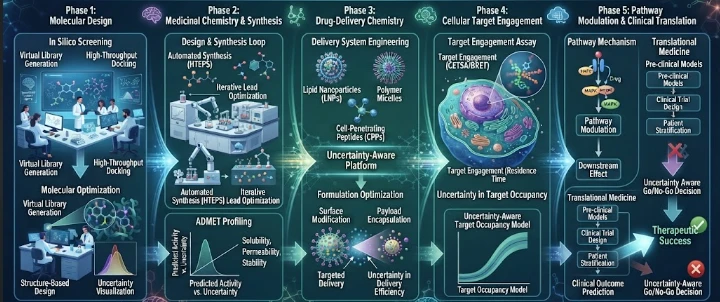
This article describes an uncertainty-aware platform for moving from predicted molecular binding to validated cellular target engagement in medicinal chemistry and drug-delivery research. Docking and machine-learning predictions can rapidly prioritize compounds, but they do not establish that a molecule reaches, occupies, and functionally modulates a target inside relevant cells. The article therefore separates predicted affinity from free intracellular concentration, subcellular localization, t
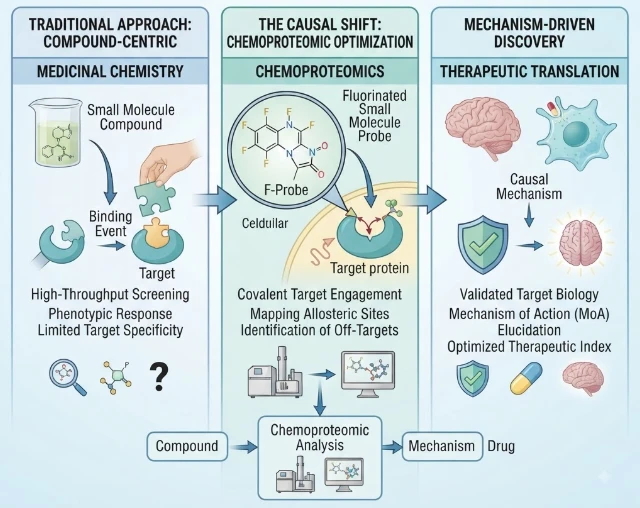
This article explores fluorinated medicinal chemistry through causal chemoproteomics, emphasizing that fluorine substitution can alter far more than potency. A single positional change can modify conformation, pKa, lipophilicity, metabolic stability, target interactions, intracellular exposure, and off-target biology. The article therefore tests whether fluorinated analogues change cellular phenotype through intended target engagement rather than hidden polypharmacology. Matched molecular pairs
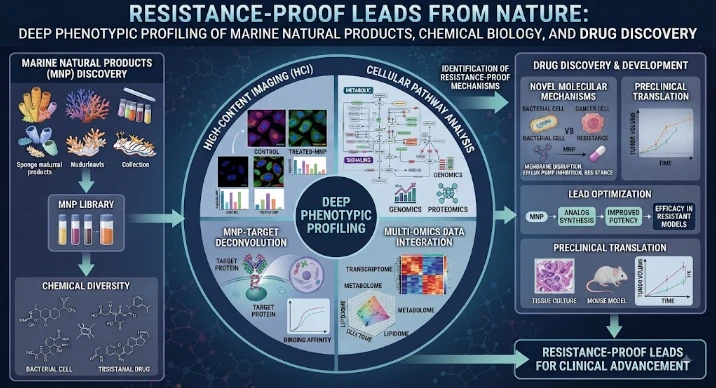
This article presents resistance-aware marine natural-product discovery as a mechanistic process rather than a search for isolated high-potency hits. It explains how activity from marine extracts or fractions can disappear during purification or fail under resistance pressure, making deep phenotypic profiling essential. Morphology, viability kinetics, organelle function, transcriptional state, metabolism, and recovery after washout are combined to connect phenotype with mechanism. The article em