From Predicted Binding to Cellular Target Engagement: An Uncertainty-Aware Platform for Medicinal Chemistry, Molecular Design and Drug-Delivery Chemistry
Md. Humayan Kabir (Master of Science in Pharmaceutical Technology)
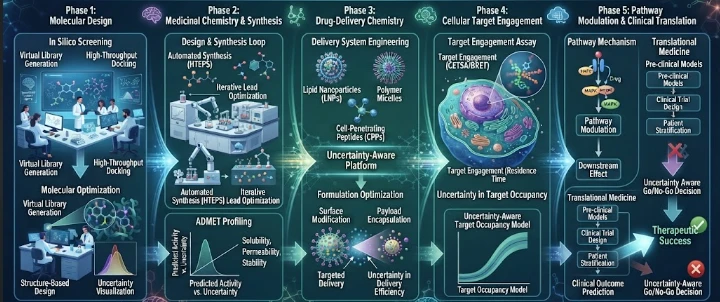
This article describes an uncertainty-aware platform for moving from predicted molecular binding to validated cellular target engagement in medicinal chemistry and drug-delivery research. Docking and machine-learning predictions can rapidly prioritize compounds, but they do not establish that a molecule reaches, occupies, and functionally modulates a target inside relevant cells. The article therefore separates predicted affinity from free intracellular concentration, subcellular localization, target occupancy, residence time, and downstream response. CETSA, thermal proteome profiling, chemoproteomics, live-cell imaging, occupancy assays, functional rescue, genetic perturbation, competition studies, and intracellular concentration measurements are used to build causal evidence. Docking, molecular dynamics, graph models, conformal prediction, ensembles, and exposure-response simulation provide computational support when uncertainty and applicability limits are explicitly reported. Resistance, transporter activity, metabolism, formulation release, off-target effects, and healthy-cell safety are integrated into target validation. Purity, stereochemistry, solid form, particle attributes, excipient compatibility, and process reproducibility are also treated as important. The article concludes that predicted binding becomes meaningful only when exposure, physical engagement, functional response, and translational feasibility converge experimentally.
Therapeutic relevance of predicted binding can only be seen after cellular exposure and target engagement are proven. Uncertainty-aware medicinal chemistry, molecular design and drug-delivery chemistry is beyond the level of hit discovery as since the prediction of the affinity, many other parameters such as protein binding, subcellular localization, metabolism, formulation release and target-state variation are often neglected. The more critical question is whether a molecular interaction validated in cells of the tissue of interest with carefully determined confidence and duration of exposure is reproducible over realistic biological and developmental conditions. It alters a ranking process to a mechanistic program geared to exposure, causality and reproducibility. As the publications date get closer and closer, it is becoming more and more important, in the development of new cellular targets, to correlate the molecular structure with the experiments that have been performed to explain the mechanism by which the molecule acts and what it does not work well, and which constraints are of paramount importance.
The docking and machine learning modules enable the rapid generation of hypotheses, whereas chemoproteomics, thermal profiling, imaging and cellular pharmacology can determine if the designed compound is able to get to and bind the target. The past and contemporary history of lab development has demonstrated that an attractive lab signal generally doesn't remain so as you add more biological complexity. An effective methodology for research, then, is to keep the signal of the activity in the same form and see what features are still necessary under increasingly realistic testing conditions.
The first step in mechanistic depth is to separate out predicted affinity from free drug concentration, localization in the cell, target occupancy, residence time, and downstream response. This can be masked by simple endpoint assays, which result from similar pathways to the same endpoint. CETSA, thermal proteome profiling, chemoproteomics, live cell imaging, occupancy assays, functional rescue, and intracellular concentration measurements provide a more nuanced view in support of direct action versus downstream adaptation or nonspecific stress or delivery failure. These types of measurements enable a beautiful answer to become a provable causal pathway from chemistry to biological state to functional outcome.
Design variables must also be considered in an interdependent manner and not as separate variables. There are performance influences, such as affinity, lipophilicity, ionization, solubility, transporter interaction, protein binding, formulation release, target abundance, and residence time, which affect performance all together and when something performs better in one aspect, it can become a penalty in another. A sensible optimization technique aims at the trade-off so it does not seek the optimum. Dynamic profile analysis of multiple parameters is particularly useful when there is translational value due to multiple factors, including potency, selectivity, stability, tissue exposure and manufacturability.
While these tools, such as docking, molecular dynamics, graph models, conformal prediction, ensembles and exposure-response simulation bring computational leverage, prediction has value only when uncertainty is apparent. Predictive models based on similar chemical or biological regions can fail to perform well if a new scaffold or strange material is used, or when the patient state is not well represented. Calibration, prospective testing, Domains of Applicability (DoA) checking and disagreement across the model families help to identify fragile predictions early, before extensive tests take place.
Orthogonal validation of experimental design is beneficial. Different answers to the causal question are provided by prospective compounds, orthogonal binding, genetic perturbation, competition assays, target mutants and dose-dependent cellular engagement, all of which minimize reliance on a single assay technology. Multi-disciplinary consensus on agreement is a more powerful mechanistic argument than repeated measurements of the same endpoint. Disagreement is also informative because discordant findings can provide clues on hidden exposure limits, assay artifacts, compensatory pathways, and/or context-dependent pharmacology.
Another challenge is caused by biological diversity. Target abundance, formulation environment, immune tone, metabolism, subcellular compartment, and target abundance can be modified by changing the nominal treatment without altering the barrier properties. The average response will therefore over-generalize subgroups that might have various exposure-response relationships. Biological variation is part of the design and not an after thought explanation of variation.
The link between predicted affinity and phenotype can be broken by target mutation, pathway redundancy, efflux, or metabolic inactivation or delivery failure, which makes resistance and adaptation a worthy consideration from the early stages. Probing for activity in the face of evolutionary pressure or compensatory adaptation is answered by mutant targets, resistant cells, transporter panels, metabolic profiling, pathway rescue and cross-resistance experiments. A candidate with lower potency, but that is a good inhibitor of escape routes, may have more value than a weak potent lead. Resistance-aware development also helps to further refine mechanism as the recurring escape changes frequently highlight the proteins, pathways, or exposure processes with the most causal influence.
The connection between delivery and pharmacokinetics brings the molecular promise to the reachable biology. To ensure that the active form reaches the intended site at the right concentration and time and is not metabolized or excreted before doing the job, the concentration, permeability, uptake, efflux, sub-cellular partitioning, formulation release, metabolism and clearance should be determined in the absence of any charge. This relationship is not captured by nominal dose alone as effective dose is modified by absorption, distribution, binding, transformation, clearance and local barriers. Mechanistic exposure assays should thus be placed in the line of efficacy measurements that are gathered during the very early development stages.
Safety assessment is more informative coupled with mechanism. Target-linked pharmacology is distinct from broad cell damage, immune activation, reactive chemistry, formulation-related toxicity or organotypic testing and exposure margins distinguish these. Comparative testing is used in disease relevant and healthy systems to determine if therapeutic activity is distinct from undesirable effects. This way, a potentially a very good efficacy signal doesn't progress through a program and the same underlying mechanism reduces the exposure window without anyone realizing it.
Manufacturing is more of a science issue than a downstream logistics issue. Product quality, biological activity and exposure can be affected by factors, such as purity, solid form, stereochemical control, particle attributes, excipient compatibility, process reproducibility, and storage, that, while nominally the same, can change product quality. Quality-by-design thinking then correlates the key material properties, process parameters, and measurable performance as a result of the process, rather than only on end-of-the-pot testing. Scalability can be more convincing after raw-material variations, with larger equipment, storage and transport and after independent production runs in the laboratory are successful.
There also need to be realistic models of clinical use for translation. These factors such as target prevalence, accessibility to the tissue, route of administration, biomarker strategy, combination use, and desired exposure level determine treatment timing, dose frequency, route of administration, tissue diagnostic needs, and tolerability for complexity. A technically sophisticated platform that is impractical due to administrative requirements, storage conditions, monitoring requirements, or cost will not be deemed to be of practical value. When decisions on development are made, it becomes difficult to change course once too many commitments have been made, so it is better to have the combination of mechanistic excellence and deployment feasibility.
Data integration is the link between these layers. Predictions, uncertainty scores, physicochemical properties, intracellular concentrations, occupancy, phenotype and safety can be brought together within a single causal model, rather than being separate outputs of an assay. Iterative learning is reproducible with traceable metadata, versioned models, standardized controls and prospective decision rules. The outcome is a development timeline which not only provides a record of the first candidate but also reveals which assumptions were made to support that choice and which uncertainties were not addressed.
High value platforms perform calibration, occupancy at realistic exposure, selectivity, phenotype rescue, prospective enrichment and agreement between predicted and measured target hierarchy. Durability, reproducibility, exposure margin, biological breadth and manufacturing robustness are added to regular potency as measures of success and enhance decision quality. This type of measurements incentivizes optimization for a specific assay, and rewards candidates who are still viable in independent assays. A clear scorecard also provides a rationale for how a less spectacular outcome can be the preferable development option.
An effective programme also gives a positive definition of failure. Negative findings in strong docking with missing cellular engagement, formulation trapped compounds, wide off-target binding, poor intracellular exposure and target binding without phenotype help establish limits to the mechanism and limit reversion on weak hypotheses. Future models have a more realistic representation of the search space if they record attempts to synthesize the compound that failed, a lack of target engagement, exposure that is unstable, emergence of resistance, and loss of effect in the subgroups. It is easier to discover when the negative experiments give the investigator as much information as the positive ones.
An uncertainty-aware platform transforms predicted binding to a series of hypotheses, ending with cellular target engagement. The key benefit of the central advantage is that it moves away from the performance advantage to one rooted in mechanism, exposure, biological diversity, safety, and production. This structure assists in the selection of candidates as each important development claim is matched with a test. Instead of spectacular single experiments, it is a series of results that is coherent and convincing, and is persuasive as the complexity of the system is incremented, from the lab to clinical practice.
CITE THIS ARTICLE
Kabir, M. H. (2026). From Predicted Binding to Cellular Target Engagement: An Uncertainty-Aware Platform for Medicinal Chemistry, Molecular Design and Drug-Delivery Chemistry. https://researchbykabir.com/article/a1d89f9c-84e7-545c-9689-bffdfd2e560b
M. H. Kabir, “From Predicted Binding to Cellular Target Engagement: An Uncertainty-Aware Platform for Medicinal Chemistry, Molecular Design and Drug-Delivery Chemistry,” 2026. [Online]. Available: https://researchbykabir.com/article/a1d89f9c-84e7-545c-9689-bffdfd2e560b
Kabir, M. H. (2026) ‘From Predicted Binding to Cellular Target Engagement: An Uncertainty-Aware Platform for Medicinal Chemistry, Molecular Design and Drug-Delivery Chemistry’. Available at: https://researchbykabir.com/article/a1d89f9c-84e7-545c-9689-bffdfd2e560b
Kabir, Md. Humayan. “From Predicted Binding to Cellular Target Engagement: An Uncertainty-Aware Platform for Medicinal Chemistry, Molecular Design and Drug-Delivery Chemistry.” 2026, https://researchbykabir.com/article/a1d89f9c-84e7-545c-9689-bffdfd2e560b.
Md. Humayan Kabir. “From Predicted Binding to Cellular Target Engagement: An Uncertainty-Aware Platform for Medicinal Chemistry, Molecular Design and Drug-Delivery Chemistry.” (2026). https://researchbykabir.com/article/a1d89f9c-84e7-545c-9689-bffdfd2e560b.
Kabir MH. From Predicted Binding to Cellular Target Engagement: An Uncertainty-Aware Platform for Medicinal Chemistry, Molecular Design and Drug-Delivery Chemistry. 2026. https://researchbykabir.com/article/a1d89f9c-84e7-545c-9689-bffdfd2e560b
@misc{article_a1d89f9c84e7545c9689bffdfd2e560b,
  title = {From Predicted Binding to Cellular Target Engagement: An Uncertainty-Aware Platform for Medicinal Chemistry, Molecular Design and Drug-Delivery Chemistry},
  author = {Md. Humayan Kabir},
  year = {2026},
  url = {https://researchbykabir.com/article/a1d89f9c-84e7-545c-9689-bffdfd2e560b},
}
TY  - GEN
AU  - Md. Humayan Kabir
TI  - From Predicted Binding to Cellular Target Engagement: An Uncertainty-Aware Platform for Medicinal Chemistry, Molecular Design and Drug-Delivery Chemistry
PY  - 2026-01-04
UR  - https://researchbykabir.com/article/a1d89f9c-84e7-545c-9689-bffdfd2e560b
ER  -
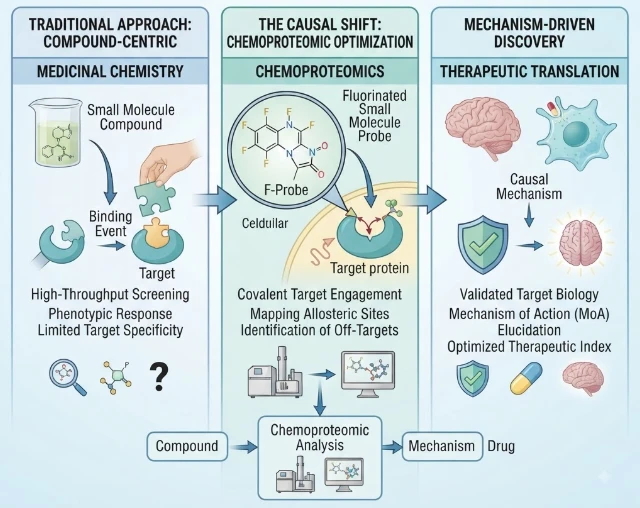
This article explores fluorinated medicinal chemistry through causal chemoproteomics, emphasizing that fluorine substitution can alter far more than potency. A single positional change can modify conformation, pKa, lipophilicity, metabolic stability, target interactions, intracellular exposure, and off-target biology. The article therefore tests whether fluorinated analogues change cellular phenotype through intended target engagement rather than hidden polypharmacology. Matched molecular pairs
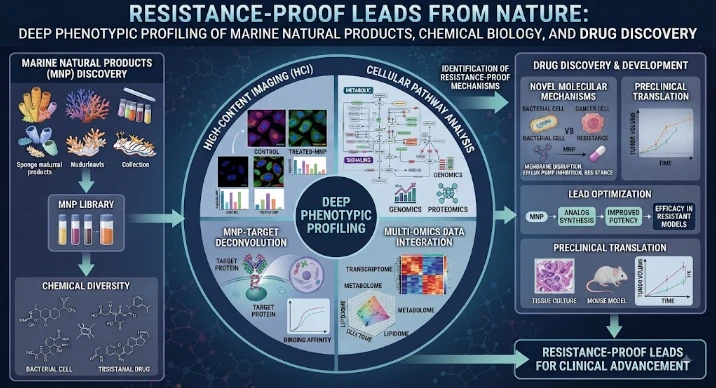
This article presents resistance-aware marine natural-product discovery as a mechanistic process rather than a search for isolated high-potency hits. It explains how activity from marine extracts or fractions can disappear during purification or fail under resistance pressure, making deep phenotypic profiling essential. Morphology, viability kinetics, organelle function, transcriptional state, metabolism, and recovery after washout are combined to connect phenotype with mechanism. The article em
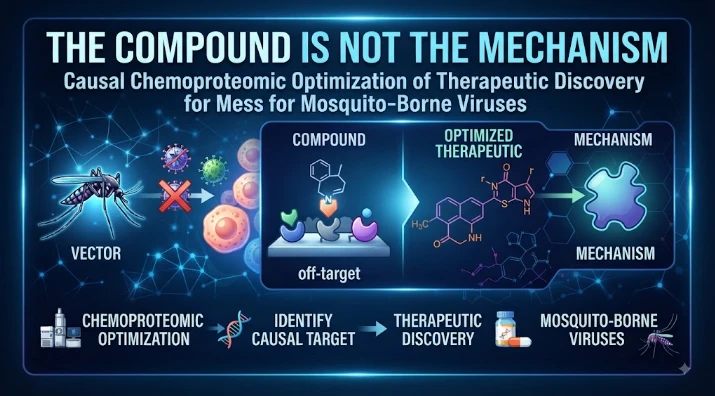
This article argues that an antiviral compound should be treated as a tool for discovering mechanism rather than as proof of mechanism itself. Focused on mosquito-borne viruses, it explains how chemoproteomics can connect phenotypic antiviral activity to direct protein interactions and then determine which interactions are causally responsible for reduced viral replication. Affinity probes, competition experiments, photo-crosslinking, thermal proteome profiling, cellular thermal shift assays, an