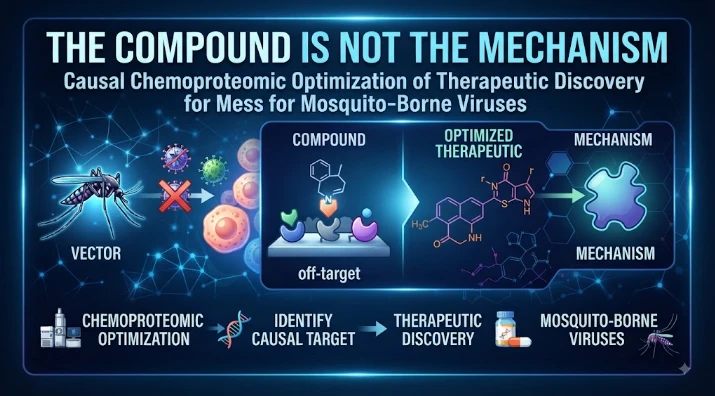
This article argues that an antiviral compound should be treated as a tool for discovering mechanism rather than as proof of mechanism itself. Focused on mosquito-borne viruses, it explains how chemoproteomics can connect phenotypic antiviral activity to direct protein interactions and then determine which interactions are causally responsible for reduced viral replication. Affinity probes, competition experiments, photo-crosslinking, thermal proteome profiling, cellular thermal shift assays, and mass spectrometry are presented as complementary approaches for mapping target engagement. Because direct binding does not automatically establish functional importance, the article emphasizes CRISPR perturbation, resistant mutations, rescue experiments, time-resolved proteomics, and pathway analysis. Probe design, intracellular exposure, proteomic selectivity, spatial localization, metabolomics, and host-target safety are also discussed as important constraints. Medicinal chemistry can then optimize target occupancy, cellular exposure, antiviral suppression, and off-target burden together. The central message is that causal chemoproteomics creates a stronger, testable chain from molecule to target, pathway, phenotype, resistance behavior, and translational biomarker.
Blocking the replication of dengue and/or Zika virus is a starting point, not a mechanism. Often, when molecules with convincing dose-response curves are discovered via phenotypic screening or repurposing, the corresponding cellular target is not known in the discovery process. The risk comes when the molecule gets used as a shortcut for a supposed pathway. Causal chemoproteomics distinguishes those notions by identifying the proteins that are directly involved, the proteins that interact in ways that affect the replication of the virus, and the observed responses that are secondary to cellular stress.
Host-cell machinery is a critical component for mosquito-borne viruses. Considering the small number of proteins encoded by viral genomes, cellular components participating in translation, lipid biosynthesis, trafficking, ubiquitination, proteostasis and membrane organization are all required for replication. The contacts between the host and the virus, as well as dependencies of pathways, have been identified through proteomic and interactome analyses of both dengue and Zika infection. This provides a good target space, but there are also many candidates and that increases the chances of associating with causal necessity.
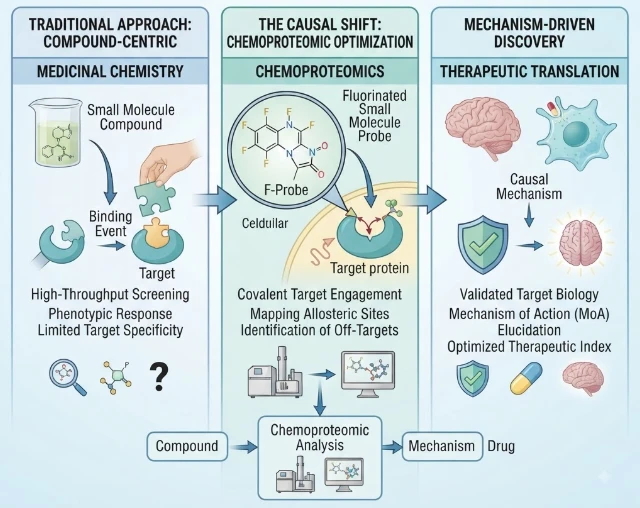
Chemoproteomics offers a way from the active molecule to the interaction map of the cell. A compound can be transformed into an affinity probe that is modified with a photo-crosslinking group or examine the compound using competition-based approaches without the need for a large tag. Then, proteins that are enriched or protected by the active compound can be identified by mass spectrometry. The best designs are designs that compare active and inactive analogues and this helps to differentiate between binding that is nonspecific versus pharmacologically relevant binding.
The design of the probe requires a chemistry expertise, the medicinal chemistry one. The introduction of a linker or reactive group can alter permeability, localization or binding, which can result in a new profile of target activity. Activity needs to be re-established following probe modification. Another control is to have competition with unmodified compound – if the excess parent compound is at the same site, then the probe enrichment should also be lowered when there is a genuine target.
Thermal proteome profiling is an alternate approach. The thermal stability of proteins can be changed by the binding of a ligand and can be detected for the entire proteome without chemical modification of the ligand. Selected proteins are then validated at more specific conditions in cellular thermal shift assays. These methods are particularly valuable if there is no apparent site for the attachment of a probe in the antiviral scaffold, or covalent labelling would change the chemistry.
Even if direct engagement doesn't show causal antiviral effect. While one or two interactions are sufficient for viral suppression, a molecule can interact with dozens of proteins. To determine if altering the proposed target results in drug resistance, the effects of CRISPR knockout, CRISPR knockdown, CRISPR overexpression, CRISPR resistance mutations, and CRISPR rescue experiments are conducted. When a target is physically engaged and genetically dependent, it leads to a similar antiviral phenotype, it becomes mechanistically persuasive.
Time is another filter of causes. Target engagement should be undertaken prior to antiviral exposure and time point in the downstream target. Changes in a protein only occur after broad stress signaling and/or significant loss of cell viability, in which case they are less likely to trigger antiviral activity. Time-resolved proteomics and phosphoproteomics aid in the reconstruction of the sequence from direct binding to pathway perturbation and diminished production of the virus.
Biological context provided by virus-host interactome data. A cellular target, which is already linked to another viral protein, or is known to support an existing replication pathway becomes plausible; but there is no requirement that the target be previously associated with another viral protein. Surprises can lead to unanticipated dependencies. It is not just about familiarization; it's about experimental convergence: engagement, perturbation, viral phenotype must converge.
The covalent inhibitors provide specific opportunities and hazards. Covalent probes are suitable for mapping the reactive residues and persistent target engagement results in good pharmacological activity at low free concentration. Concurrently, wide electrophilic reactivity is known to cause nonspecific binding to the proteome and toxicity. Quantitative chemoproteomics is a powerful tool for quantifying selectivity against thousands of candidate sites and for directing structural modification for maintaining antiviral activity but minimizing off-target interactions.
Medicinal chemistry is then causally informed. Optimization of analogue series can be done for target occupancy, proteomic selectivity, cellular exposure and viral suppression in addition to optimization of the antiviral half-maximal effective concentration. The identification of a compound that can be antiviral but not bind to the suggested target protein puts the mechanism into question. On the other hand, when occupancy and efficacy occur simultaneously, the confidence is reinforced, and there is simultaneously a structure-engagement relationship.
This method also helps to define host-target safety. Occupancy-response curves can be used to determine the amount of engagement for antiviral activity that entails partial inhibition of an essential host protein. The comparisons between an infected and uninfected cell reveal if therapeutic effects are observed prior to creating toxicity. Then organoid or tissue relevant models are used to see if the same margin is maintained in more physiological systems.
The role of chemoproteomics is different in the case of direct viral targets. Viral proteins are less prevalent than host proteins, and they are only present in infected cells; however, a targeted mass spectrometry approach or pull-down and/or activity-based probes can confirm binding. In particular, resistant viral mutants give strong mechanistic support if compound resistance and antiviral activity both are decreased by a mutation. These experiments link the interaction of molecules directly with the evolution's escape.
Since each method has its limitations, the need emerges to integrate data. Affinity probes, thermal profiling and genetic screens each select for a different aspect of the interaction, each prioritizing a different aspect of the relationship: stability, stability change, dependency, and downstream response, respectively.Thermal profiling only detects interactions that change stability; genetic screens identify dependencies, not binding, and transcriptomics most often measures downstream response. These outputs are combined within the framework of a causal one, not using just one platform to define it. Consensus over orthogonal methods decreases misattribution.
When target engagement data is available, AI can aid in analogue prioritization. Predictive models can be used to predict which changes will maintain binding to target, reduce off-target binding, or enhance cell exposure based on the structure of the molecule. Uncertainties can be used to find analogues to which the synthesis will give the most information. This is more robust than a potency-only model since each prediction is linked to a mechanistic measurement.
To the picture, resistance studies complete. Under compound pressure, long-term viral passage or adaptation of host cells will show whether escape is achieved by targeting mutation, compensation pathway adaption, transport mutation, or metabolic adaption. The next chemistry cycle follows those routes. If a host-targeted antiviral can't be rendered inactive by a host change in sequence, but can be rendered inactive by a single change in the virus, then a different approach is needed than a direct antiviral that is sensitive to a single virus change.
Spatial proteomics is another level of resolution as a protein's location can be as important as its binding. Antiviral agents may redistribute proteins from cytosol to organelles and from organelles to membrane compartments and infection reorganizes membranes to form replication organelles. Determination of whether engagement takes place in the cellular location where viral replication is dependent on the target is determined by fractionation or imaging-based proteomics. This minimizes false positive interactions from those which are only found in bulk lysates.
An orthogonal layer of mechanism can be added by metabolomics when host pathways regulate lipid synthesis, energy metabolism or nucleotide availability. A Chemoproteomic target associated with a particular metabolic switch provides a valid testable link from binding to functional consequence. Isotope tracing can reinforce that chain by demonstrating pathway flux changes, instead of concentration changes. This kind of integration can be especially useful for antivirals directed against the host, like the ones which exhibit their phenotypes through metabolic dependencies.
Eventually, there is a need to implement simpler means of representing clinical biomarkers than discovery proteomics. After a mechanism is characterized, specific protein assays, phosphorylation markers, viral-load kinetics or metabolite measurements can offer practical targets of target modulation. This requires a translation step from the large scale omics to the deployable pharmacodynamic readout in discovery platforms. That is to ensure that early clinical studies scope whether the causal mechanism that was identified in cells is achieved at tolerated human exposures.
These mechanistic relationships are further strengthened when the same relationship is obtained by independent laboratories when both are exposed under the same conditions.
The compound is thus a tool to find out the mechanism, rather than an alternative for mechanism. By converting the antiviral activity into a string of testable links, causal chemoproteomics opens the door to new antiviral strategies. This sequence is particularly useful for viruses transmitted by mosquitoes, as there are numerous possible explanations to the same phenotype due to host dependency and evolution of the virus. Chemistry that plays out after the causal interaction, rather than the initial attractive dose-response curve, leads to a more reliable optimization.
CITE THIS ARTICLE
Kabir, M. H. (2026). The Compound Is Not the Mechanism: Causal Chemoproteomic Optimization of Therapeutic Discovery for Mosquito-Borne Viruses. https://researchbykabir.com/article/4e69f618-caae-519d-90f8-b242e5f0ae1d
M. H. Kabir, “The Compound Is Not the Mechanism: Causal Chemoproteomic Optimization of Therapeutic Discovery for Mosquito-Borne Viruses,” 2026. [Online]. Available: https://researchbykabir.com/article/4e69f618-caae-519d-90f8-b242e5f0ae1d
Kabir, M. H. (2026) ‘The Compound Is Not the Mechanism: Causal Chemoproteomic Optimization of Therapeutic Discovery for Mosquito-Borne Viruses’. Available at: https://researchbykabir.com/article/4e69f618-caae-519d-90f8-b242e5f0ae1d
Kabir, Md. Humayan. “The Compound Is Not the Mechanism: Causal Chemoproteomic Optimization of Therapeutic Discovery for Mosquito-Borne Viruses.” 2026, https://researchbykabir.com/article/4e69f618-caae-519d-90f8-b242e5f0ae1d.
Md. Humayan Kabir. “The Compound Is Not the Mechanism: Causal Chemoproteomic Optimization of Therapeutic Discovery for Mosquito-Borne Viruses.” (2026). https://researchbykabir.com/article/4e69f618-caae-519d-90f8-b242e5f0ae1d.
Kabir MH. The Compound Is Not the Mechanism: Causal Chemoproteomic Optimization of Therapeutic Discovery for Mosquito-Borne Viruses. 2026. https://researchbykabir.com/article/4e69f618-caae-519d-90f8-b242e5f0ae1d
@misc{article_4e69f618caae519d90f8b242e5f0ae1d,
  title = {The Compound Is Not the Mechanism: Causal Chemoproteomic Optimization of Therapeutic Discovery for Mosquito-Borne Viruses},
  author = {Md. Humayan Kabir},
  year = {2026},
  url = {https://researchbykabir.com/article/4e69f618-caae-519d-90f8-b242e5f0ae1d},
}
TY  - GEN
AU  - Md. Humayan Kabir
TI  - The Compound Is Not the Mechanism: Causal Chemoproteomic Optimization of Therapeutic Discovery for Mosquito-Borne Viruses
PY  - 2026-06-07
UR  - https://researchbykabir.com/article/4e69f618-caae-519d-90f8-b242e5f0ae1d
ER  -
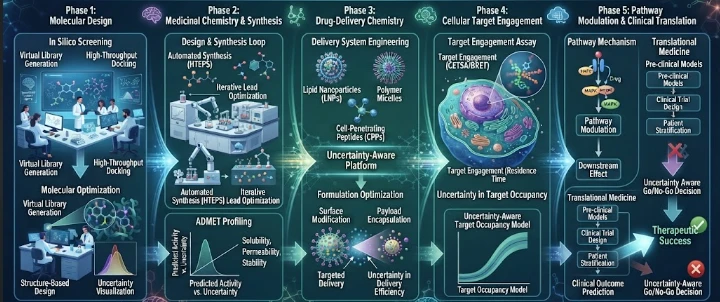
This article describes an uncertainty-aware platform for moving from predicted molecular binding to validated cellular target engagement in medicinal chemistry and drug-delivery research. Docking and machine-learning predictions can rapidly prioritize compounds, but they do not establish that a molecule reaches, occupies, and functionally modulates a target inside relevant cells. The article therefore separates predicted affinity from free intracellular concentration, subcellular localization, t
This article explores fluorinated medicinal chemistry through causal chemoproteomics, emphasizing that fluorine substitution can alter far more than potency. A single positional change can modify conformation, pKa, lipophilicity, metabolic stability, target interactions, intracellular exposure, and off-target biology. The article therefore tests whether fluorinated analogues change cellular phenotype through intended target engagement rather than hidden polypharmacology. Matched molecular pairs
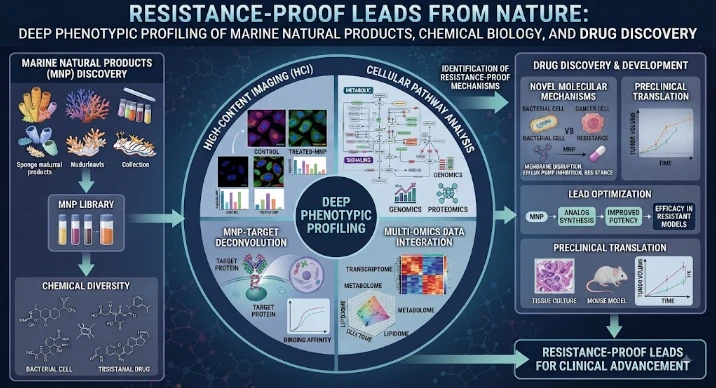
This article presents resistance-aware marine natural-product discovery as a mechanistic process rather than a search for isolated high-potency hits. It explains how activity from marine extracts or fractions can disappear during purification or fail under resistance pressure, making deep phenotypic profiling essential. Morphology, viability kinetics, organelle function, transcriptional state, metabolism, and recovery after washout are combined to connect phenotype with mechanism. The article em