The Compound Is Not the Mechanism: Causal Chemoproteomic Optimization of Synthetic medicinal chemistry, fluorinated molecules and therapeutic discovery
Md. Humayan Kabir (Master of Science in Pharmaceutical Technology)
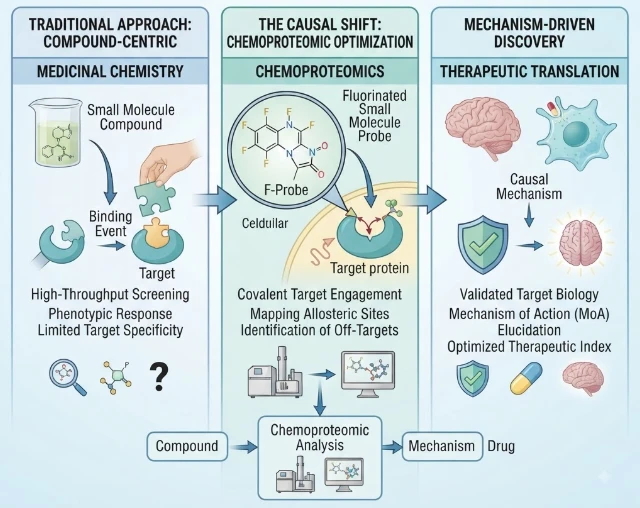
This article explores fluorinated medicinal chemistry through causal chemoproteomics, emphasizing that fluorine substitution can alter far more than potency. A single positional change can modify conformation, pKa, lipophilicity, metabolic stability, target interactions, intracellular exposure, and off-target biology. The article therefore tests whether fluorinated analogues change cellular phenotype through intended target engagement rather than hidden polypharmacology. Matched molecular pairs and positional fluorine isomers are highlighted as particularly informative controls because fluorine effects are strongly location dependent. Fluorination pattern, metabolic soft spots, target residence, cellular concentration, and conformational behavior are treated together. Failure routes include target mutation, metabolic rerouting, transporter changes, pathway compensation, off-target substitution effects, and reactive metabolite formation. Absorption, protein binding, cellular penetration, fluorinated metabolite exposure, tissue retention, and clearance define the exposure context. Safety assessment includes hERG, CYP interactions, reactive metabolites, broad proteome engagement, and persistent fluorinated products. Nonfluorinated comparators, target mutation, occupancy–response analysis, metabolite testing, and orthogonal engagement methods are required. Fluorine becomes useful when each property gain is tied to a measured cellular mechanism.
A key issue in fluorinated medicinal chemistry and causal chemoproteomics—The Compound Is Not the Mechanism—is that replacement of fluorine with other groups can alter the potency, exposure, metabolism, reactivity, conformation, and off-target biology of the drug, without the ability to represent these changes by simple SAR. The more successful development strategy focuses on a quantifiable mechanism, instead of a single 'lit' assay result. Chemistry, biology, exposure, resistance, safety and production become part of one translational argument as a result of this shift.
The scientific backbone is based on a mechanism that relies on the premise that fluorinated analogues change the phenotype of the cell by the desired target binding and not by a concealed polypharmacology. No single measurement can support all of the mechanistic claim, each component provides a separate answer to a separate question. With connected evidence, there's less risk that potency, binding, formulation performance and/or model-fitting might be confused with understanding of the therapeutic action.
The presence of the fluorine atom is often found in medicinal chemistry to affect the conformation, pKa, lipophilicity, metabolic stability and binding interactions of a molecule and is possible without adding a large steric group. Its effect is very much place dependent, and not necessarily good. A fluorine atom which is blocking oxidative metabolism at one place may change the target affinity and/or the metabolite profile at another. The matched molecular pair and the fluorinated positional isomers are thus very informative controls for chemoproteomic mechanism studies.
Fluorine variables must be treated together since performance can be affected by multiple variables, such as position, pattern, pKa, lipophilicity, conformation, soft spots in metabolism, target residence, and intra-cellular level. The ability to optimize one factor at the expense of other factors is a common disadvantage, particularly when the potency of a given molecule is compromised by its stability, selectivity, delivery or manufacturability. Multiparameter decision rules do result in a more realistic ranking of candidates than with a single numerical endpoint.
The ability to measure failure routes early is also a key component of having mechanistic confidence. Target mutation, metabolic rerouting, changes in transporters, off-target substitution effects, pathway compensation, and the formation of reactive metabolites, are all important escape mechanisms. Stress testing is used to convert the above routes into design data to be used for the next chemistry/ formulation/dosing/ model cycle.
The connection between the nominal dose and biological effect is the exposure. These include, but are not limited to, absorption, protein binding, cellular penetration, metabolic stability, exposure to fluorinated metabolites, tissue retention and clearance. A candidate that is very active on its own, but performs poorly in the simple assays at the causal site may appear to be very good, but may not be suitable for translation.
Direct interaction or disruption of the functionality must be assessed at realistic concentrations. High doses can give rise to secondary stress responses, to off target effects or to artefacts in the assay that simulate a desired response. Concentration-response relationship coupled with exposure and occupancy can be used to define the range in which the proposed causal process is in effect.
The biological context also influences the interpretation in the small-molecule therapeutic discovery as a conscious medicinal-chemistry design element using fluorine. Target dependence and effective exposure can vary depending on differences in genotype, cell state, tissue architecture, immune tone, metabolic environment, and prior treatment. The representative model panels thus offer more evidence than multiple testing in a single system.
Adaptation and/or resistance should be assessed in a prospective fashion, not in a retrospective way. Identifying those mechanisms that endure under continued stress will be done by serial passage, long-term selection, genetic perturbation, repeated dosing, or environmental stress. A less powerful candidate, yet with a higher escaping power, may have more 'translation value' than a weak screening leader.
When safety assessment is linked to mechanism, it provides more information. Liability for hERG, interactions with the CYP system, risk of reactive metabolites, extensive engagement of the proteome, long-lived fluorinated metabolites, and cell selectivity of normal cells are important issues. The comparison of desired engagement with unwanted biological responses allows for the separation of mechanism-linked pharmacology and general cell injury/ formulation-driven toxicity.
In order for manufacturing to stay 'downstream' in the logistics approach, regioselective fluorination, reagent safety, route yield, impurity separation, isotope or stereochemical control and scalable late stage functionalization all affect the product delivered to biological systems. Even with a nominal product name, slight process changes can have an impact on the composition, physical state, level of impurities, product stability, and/or dose reproducibility. Robustness is gained with development if there are direct connections between critical process attributes and mechanistic behavior.
Matched-pair analysis and quantum descriptors, conformational sampling, property prediction, integration with proteomics, and multiparameter analogue ranking give computational tools a leverage. Prediction can be most useful if there is some ambiguity and uncertainty in the response, and where the limits of applicability and uncertainty are still apparent, particularly near novel chemical structures, unusual biological states, or sparse datasets. Decisions about which experiments to select that incorporate uncertainty into models are better than those based on models that provide rankings of experiments with high levels of certainty without providing any indication that the evidence is uncertain.
To validate as a prospective, you need to have nonfluorinated comparators, positional isomers, target mutation, occupancy-response analysis, metabolite testing and orthogonal target-engagement methods. Orthogonal tests are important as repeated measurements from a single assay family may generate the same hidden bias, which does not reinforce the causality. Consensus between independent methods is strengthened from design choice to biological outcome and disagreement indicates areas for revision of assumptions.
Data integration should maintain traceability of the data from raw experiment to development decision. Chemical structures, analysis metadata from assays, exposure data, omics features, resistance data, and safety signals should be identified and analysed in a versioned manner. When such discipline is used, interpretation in the future won't stray from the actual conditions that have yielded a result.
Some of the metrics for making decisions also should be translated, not laboratory show. It is useful to have scorecards that include factors of reproducibility, exposure-normalized activity, mechanistic confidence, resistance frequency, safety margin, stability, and manufacturing robustness. This will encourage candidates who have a balanced approach and will show any compromises before embarking on costly development commitments.
In this scheme it is unusual that negative results have great value. I'm in the process of creating a boundary to a hypothesis, and so far, the following elements seem to be responsible for that failure: Failed synthesis, no target engagement, unstable exposure, lack of rescue, emergence of resistance and poor batch reproducibility, loss of activity in realistic models. By recording those failures, experimental design can be improved in future experiments and unnecessary reinvestment of time to support less appealing explanations can be avoided.
Another critical filter, reproducibility across laboratories/batches. Even if there is a high degree of statistical significance, a mechanism that relies on the operator, the preparation, the cell line or the modeling option has built in fragility. When independent repetitions are done under exposure matched conditions, durable biology is distinguished from local experimental success.
In addition, a practical perspective of clinical or deployment conditions needs to be taken into account in translation. Whether or not there is a realistic value to a product that is technically sophisticated depends on route, administrative burden, diagnostic requirements, storage, monitoring and cost, and timing of treatment. Mechanisms of excellence become effective when the product design is appropriate for the context where biological benefit needs to happen.
An additional dimension is added by temporal design, because the response of a biological system to short pulses, sustained exposure, washout and repeated dosing is different. Time resolved measurements provide a separation of primary engagement from downstream adaptation, and can show if any activity continues after the starting signal has subsided. Sampling schedules will then be tailored to the expected kinetics for fluorinated medicinal chemistry and causal chemoproteomics and not just one convenient endpoint.
An integrated development record helps with better communication throughout the medicinal chemistry, formulation science, pharmacology, computation, manufacturing, and clinical planning aspects of drug development. Rather than one single story, the record can identify certain connections, reasonable guesses, unknowns and the next experiment with maximum information value. The transparency allows the iteration process to be faster and pressures to decrease to defend on the initial assumptions in the light of the conflicting data.
Novelty is put into perspective by benchmarking to a credible reference condition. New approach is better in predicting, mechanism, durability or manufacturability defined by established compounds which are known inactive, standard formulations, baseline models or accepted analytical methods. A head-to-head comparison also reveals gains that are 'gone with the wind' (literally) after normalization for exposure, assay sensitivity, batch quality or the complexity of the experiment.
The most useful uses of fluorine are those in which each and every property gain is linked to a measured cellular mechanism, and not just considered an optimization technique. The criteria for deciding whether a candidate is accepted are not whether he wins one assay but that the proposed mechanism is coherent throughout exposure, biological variation, resistance, safety and production. That standard provides a more rigorous track through the discovery signal to a therapeutic concept that can withstand the rigors of reality.
CITE THIS ARTICLE
Kabir, M. H. (2025). The Compound Is Not the Mechanism: Causal Chemoproteomic Optimization of Synthetic medicinal chemistry, fluorinated molecules and therapeutic discovery. https://researchbykabir.com/article/c7d9f9cb-955f-5e84-b60a-8c86079bf4ed
M. H. Kabir, “The Compound Is Not the Mechanism: Causal Chemoproteomic Optimization of Synthetic medicinal chemistry, fluorinated molecules and therapeutic discovery,” 2025. [Online]. Available: https://researchbykabir.com/article/c7d9f9cb-955f-5e84-b60a-8c86079bf4ed
Kabir, M. H. (2025) ‘The Compound Is Not the Mechanism: Causal Chemoproteomic Optimization of Synthetic medicinal chemistry, fluorinated molecules and therapeutic discovery’. Available at: https://researchbykabir.com/article/c7d9f9cb-955f-5e84-b60a-8c86079bf4ed
Kabir, Md. Humayan. “The Compound Is Not the Mechanism: Causal Chemoproteomic Optimization of Synthetic medicinal chemistry, fluorinated molecules and therapeutic discovery.” 2025, https://researchbykabir.com/article/c7d9f9cb-955f-5e84-b60a-8c86079bf4ed.
Md. Humayan Kabir. “The Compound Is Not the Mechanism: Causal Chemoproteomic Optimization of Synthetic medicinal chemistry, fluorinated molecules and therapeutic discovery.” (2025). https://researchbykabir.com/article/c7d9f9cb-955f-5e84-b60a-8c86079bf4ed.
Kabir MH. The Compound Is Not the Mechanism: Causal Chemoproteomic Optimization of Synthetic medicinal chemistry, fluorinated molecules and therapeutic discovery. 2025. https://researchbykabir.com/article/c7d9f9cb-955f-5e84-b60a-8c86079bf4ed
@misc{article_c7d9f9cb955f5e84b60a8c86079bf4ed,
  title = {The Compound Is Not the Mechanism: Causal Chemoproteomic Optimization of Synthetic medicinal chemistry, fluorinated molecules and therapeutic discovery},
  author = {Md. Humayan Kabir},
  year = {2025},
  url = {https://researchbykabir.com/article/c7d9f9cb-955f-5e84-b60a-8c86079bf4ed},
}
TY  - GEN
AU  - Md. Humayan Kabir
TI  - The Compound Is Not the Mechanism: Causal Chemoproteomic Optimization of Synthetic medicinal chemistry, fluorinated molecules and therapeutic discovery
PY  - 2025-04-20
UR  - https://researchbykabir.com/article/c7d9f9cb-955f-5e84-b60a-8c86079bf4ed
ER  -
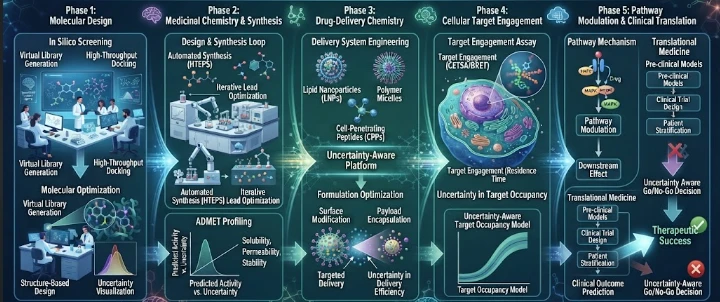
This article describes an uncertainty-aware platform for moving from predicted molecular binding to validated cellular target engagement in medicinal chemistry and drug-delivery research. Docking and machine-learning predictions can rapidly prioritize compounds, but they do not establish that a molecule reaches, occupies, and functionally modulates a target inside relevant cells. The article therefore separates predicted affinity from free intracellular concentration, subcellular localization, t
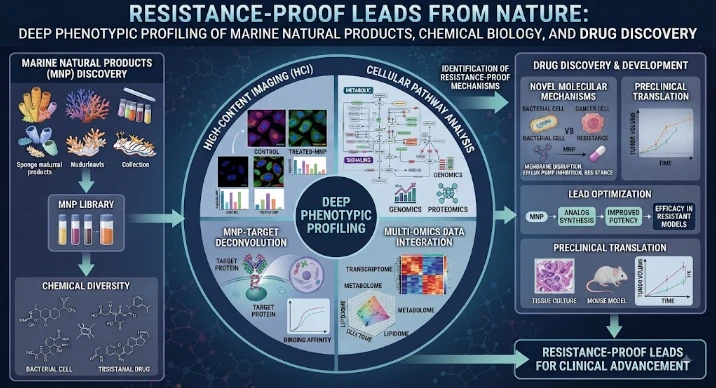
This article presents resistance-aware marine natural-product discovery as a mechanistic process rather than a search for isolated high-potency hits. It explains how activity from marine extracts or fractions can disappear during purification or fail under resistance pressure, making deep phenotypic profiling essential. Morphology, viability kinetics, organelle function, transcriptional state, metabolism, and recovery after washout are combined to connect phenotype with mechanism. The article em
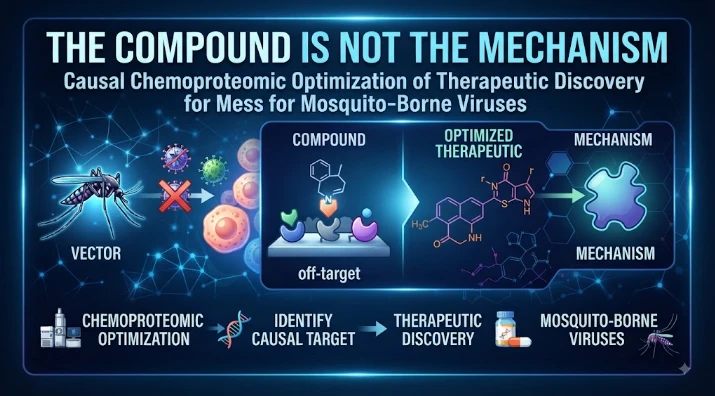
This article argues that an antiviral compound should be treated as a tool for discovering mechanism rather than as proof of mechanism itself. Focused on mosquito-borne viruses, it explains how chemoproteomics can connect phenotypic antiviral activity to direct protein interactions and then determine which interactions are causally responsible for reduced viral replication. Affinity probes, competition experiments, photo-crosslinking, thermal proteome profiling, cellular thermal shift assays, an