Closing the In Vitro–In Vivo Gap: Organ-on-Chip, Imaging, and PBPK Integration for Advanced Drug Delivery Systems, Nanomedicine, Formulation and Cancer Therapeutics
Md. Humayan Kabir (Master of Science in Pharmaceutical Technology)
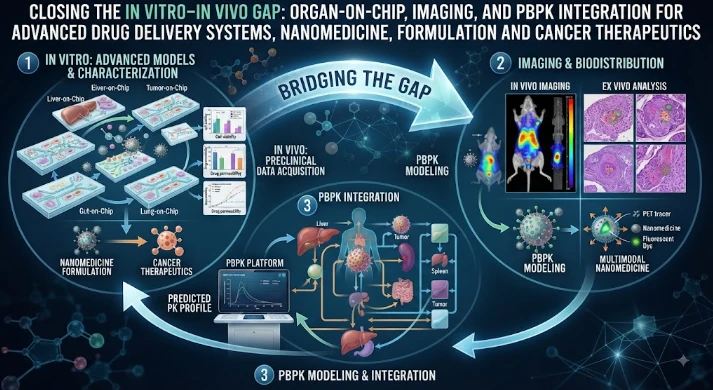
This article proposes an integrated translational framework combining organ-on-chip systems, quantitative imaging, and PBPK modeling for advanced nanomedicine. It centers on barrier transport, tissue uptake, intracellular trafficking, organ clearance, inter-organ exchange, and whole-body exposure, addressing limitations of static cell culture and species differences in animal models. Microphysiological systems can reproduce tissue barriers, flow, multicellular interactions, and disease-altered physiology, while imaging measures spatial uptake, penetration, and trafficking. PBPK models connect those local observations to organ and systemic concentration–time predictions. The article emphasizes that chip measurements should be treated as qualified mechanistic parameters rather than direct substitutes for human pharmacokinetic data. Permeability studies, tracer imaging, quantitative microscopy, parameter validation, sensitivity analysis, and prospective testing are key components. Organ function, tumor perfusion, inflammation, body composition, and clearance capacity are important context variables. Risks include chip variability, scaling assumptions, uncertain protein binding, missing immune components, and poorly identifiable parameters. Overall, translation is presented as a connected measurement-and-modeling problem rather than a sequence of isolated preclinical tests.
Nanomedicine is taking a step further away from just questions of potency, delivery and association to questions of understanding why a result is being obtained and when the result is still reliable, as modern therapeutic development increasingly relies on understanding why a result is obtained. A mechanistic network of barrier transport, tissue uptake, intracellular trafficking, organ clearance, inter-organ exchange and whole body exposure is at the core of this transition. The latter is important because the conventional cell culture system is not a physiological transport system and the animal models do not necessarily match human disposition of nanomedicine. A robust development approach consequently considers mechanism, context and uncertainty as interrelated design variables, not as distinct and sequential design activities.
Traditional static culture cannot duplicate the controlled models of tissue barrier, flow, interactions between the multiple cells, and disease altered physiology provided by organ-on-chip systems. Quantitative imaging provides spatial data of uptake, trafficking, penetration and cell responses, and PBPK modelling links local data to organ and whole-body exposure. PBPK and microphysiological integration we discussed earlier focused on the parameter estimation, scaling and validation as key challenges, not on automatic solutions. A viable translational pipeline, as such, should therefore not attempt to use chip data as a replacement to human pharmacokinetic measurements; rather, it should be used as a mechanistic input.
The result is a new discovery paradigm based on microphysiological systems, quantitative microscopy, imaging of tracers, permeability assays, PBPK modelling, and prospective validation of parameters. None of these is the only tool by which that process is defined, as each assay represents a smaller component of a larger process in biology or in the clinic. As increasingly independent measures predict the same causal narrative at different doses, different times, different model systems and different relevant biological contexts, confidence increases. Discordant results are also important because when results are not the same, there are hidden mechanisms, assay artefacts, population differences or limitation of exposure that may be investigated, but may not warrant expensive development until this information is obtained.
In the decision-making process, the primary issue is which in vitro measurements are considered to have meaningful mechanisms to relate to human exposure to tissue. To answer this question, it is necessary to make a clear comparison with the mechanism that could be involved and possible alternative mechanisms such as off-target activity, parallel pathways, differential exposure, or measurement bias. Perturbation experiments are particularly useful because it helps to determine whether the observed effect is dependent on the proposed component, by removing, blocking or restoring it. It is not therefore sufficient to have repeated confirmation within one favourable assay to build up mechanistic confidence; challenge tests are required.
We will also see that for nanomedicine, the meaning of nearly all the results in this field of organ-on-chip, imaging and PBPK integration will change with context. Organ function, disease altered barriers, body composition, tumor perfusion, inflammation, clearance capacity are all considered to be relevant variations. The same intervention that is effective with one set of these conditions may have less effect, or may be more toxic or have a different response in a different set. When applied, stratification is more useful when based on variables associated with mechanism/exposure, because the categories to describe the change in treatment performances are usually inadequate to explain the change.
Equally important is risk assessment, due to chipp-to-chip variability, scaling assumption, uncertain protein binding, lack of identification of some immune components, and poor identification of some model parameters. Early safety work is best aligned with the same mechanistic approach as efficacy to show unwanted effects originate from target biology, carrier behavior, exposure, metabolites, or analytical bias. This way the risk of safety coming up as a late item on a checklist and having been divorced from the discovery logic is minimised. It also enables better elucidation of the trade-offs if greater efficacy needs to be achieved at the cost of increased exposure, increased pathway modulation or increased persistence in sensitive tissues.
Another layer is added by the translational development as it gives a better linkage between formulation experiments and dose selection and first-in-human planning. Experiments that replicate clinically relevant timing, concentration ranges, biological barriers, treatment history and sources of heterogeneity are more informative in making their way to clinical success. Escalating from a convenient model to a more complex one isn't as informative as a series of models that can answer particular uncertainty questions. All of these steps should then have a clear decision to make: continue, redesign, restrict the target population, change the dosage, collect some other kind of mechanistic data.
The importance of formulation attributes is equally significant as it needs to be measured consistently since the PBPK inputs are only as reliable as the particle and release data provided. If the material being tested varies from batch to batch or the inputs to an assay are poorly understood, a biological explanation would be of little value. Critical attributes require therefore an a priori determination of the ranges, a high sensitivity of measurement, and a link between the process conditions and the biological performances. This discipline is particularly critical in complex molecules, nanoparticle studies, biomaterials, and studies involving large amounts of data, where small changes may result in a shift in exposure, signal or even apparent treatment response.
In addition, data analysis of organ-on-chip, imaging and PBPK integration for nanomedicine also receives a boost with a clearer distinction between prediction and confirmation. While computational models, machine learning, causal estimators, and mechanistic simulations can rank hypotheses, incorporate high-dimensional measurements and reveal uncertainty, the output of the model is not necessarily the biological truth. Helpful models make statements about the assumptions, make numbers out of calibration, identify regions that lack support, and suggest what experiment to do next to shift the decision. Retrospective fitting is a useful technique that should not be substituted by prospective fitting, since it may be patterns that have not been able to withstand new populations, batches, or biological circumstances that would be rewarded.
Another key change is related to time, as many of the processes of organ-on-chip, imaging and PBPK integration for nanomedicine occur following exposure. A favorable looking endpoint can have different early response, adaptation, clearance, immune programming, tissue remodeling, adherence or resistance pathways. The lengthwise measurement shows if an intervention creates a stable state, a temporary perturbation, as well as a delayed liability. Time-resolved data can also aid in causal interpretation by offering information on whether the proposed mechanism occurs before the downstream phenotype or only once the downstream phenotype has been reached.
Each study is connected to a specific uncertainty budget, which increases the efficiency of the experimental design. Questions can be prioritized based on their ability to provide a mechanistic understanding of tissue exposure, rather than novelty, in order to determine which in vitro measurements are likely to have sufficient mechanistic meaning for human tissue exposure predictions. Subsequent replication in complementary models then checks if the conclusion is dependent upon one assay and/or one laboratory condition and/or one population. Such discipline means wasted optimization is avoided and negative findings are valuable as they reduce the possible mechanism space and enhance the subsequent design iteration.
Traceability from claims to measurements also is key to regulatory and clinical credibility. A development package is more robust in the case of organ-on-chip, imaging, and PBPK integration for nanomedicine if there is a link, from the initial experiments to the translational studies, between the following: raw observations, processing decisions, model assumptions, protocol deviations, and material attributes. Such traceability allows for better identification of true biological variability, as well as future analysis of claims of safety or efficacy. It also provides a more clear-cut ground for revising conclusions on the basis of changing data for an earlier assumption.
More precision in communication in this field is required also. Words like targeted, selective, durable, safe, predictive, or personalized do not have much meaning without a measure, an appropriate comparison, a population, or a range of uncertainties. The negative results should be reported clearly so that it will be more useful and will not be shown as a mechanism if it is an exploratory result. For researchers, developers, clinicians, and regulators, the precision provides a common language for assessing the validity of a claim based on either direct measurement or calibrated inference or an untested assumption.
The most promising pathway for organ-on-chip, imaging and PBPK integration for the development of nanomedicine is not a single new technology, but a tighter loop between chemistry/formulation, mechanistic measurement, quantitative modeling, safety, manufacturing control, and clinically relevant context. Failing assumptions early and letting mechanisms that work survive deliberately difficult tests helps progress to move quicker. This logic is the basis of integrating translation as a measurement-and-modeling problem, instead of a series of separate tests. Overall, the ideal innovation that could benefit the field is a development system that learns from each experiment while maintaining a focus on explaining the cause, being reproducible and retain real-world relevance throughout the development process.
CITE THIS ARTICLE
Kabir, M. H. (2025). Closing the In Vitro–In Vivo Gap: Organ-on-Chip, Imaging, and PBPK Integration for Advanced Drug Delivery Systems, Nanomedicine, Formulation and Cancer Therapeutics. https://researchbykabir.com/article/e1ed36c4-a31b-5988-8e0e-5eff5ba1ffcf
M. H. Kabir, “Closing the In Vitro–In Vivo Gap: Organ-on-Chip, Imaging, and PBPK Integration for Advanced Drug Delivery Systems, Nanomedicine, Formulation and Cancer Therapeutics,” 2025. [Online]. Available: https://researchbykabir.com/article/e1ed36c4-a31b-5988-8e0e-5eff5ba1ffcf
Kabir, M. H. (2025) ‘Closing the In Vitro–In Vivo Gap: Organ-on-Chip, Imaging, and PBPK Integration for Advanced Drug Delivery Systems, Nanomedicine, Formulation and Cancer Therapeutics’. Available at: https://researchbykabir.com/article/e1ed36c4-a31b-5988-8e0e-5eff5ba1ffcf
Kabir, Md. Humayan. “Closing the In Vitro–In Vivo Gap: Organ-on-Chip, Imaging, and PBPK Integration for Advanced Drug Delivery Systems, Nanomedicine, Formulation and Cancer Therapeutics.” 2025, https://researchbykabir.com/article/e1ed36c4-a31b-5988-8e0e-5eff5ba1ffcf.
Md. Humayan Kabir. “Closing the In Vitro–In Vivo Gap: Organ-on-Chip, Imaging, and PBPK Integration for Advanced Drug Delivery Systems, Nanomedicine, Formulation and Cancer Therapeutics.” (2025). https://researchbykabir.com/article/e1ed36c4-a31b-5988-8e0e-5eff5ba1ffcf.
Kabir MH. Closing the In Vitro–In Vivo Gap: Organ-on-Chip, Imaging, and PBPK Integration for Advanced Drug Delivery Systems, Nanomedicine, Formulation and Cancer Therapeutics. 2025. https://researchbykabir.com/article/e1ed36c4-a31b-5988-8e0e-5eff5ba1ffcf
@misc{article_e1ed36c4a31b59888e0e5eff5ba1ffcf,
  title = {Closing the In Vitro–In Vivo Gap: Organ-on-Chip, Imaging, and PBPK Integration for Advanced Drug Delivery Systems, Nanomedicine, Formulation and Cancer Therapeutics},
  author = {Md. Humayan Kabir},
  year = {2025},
  url = {https://researchbykabir.com/article/e1ed36c4-a31b-5988-8e0e-5eff5ba1ffcf},
}
TY  - GEN
AU  - Md. Humayan Kabir
TI  - Closing the In Vitro–In Vivo Gap: Organ-on-Chip, Imaging, and PBPK Integration for Advanced Drug Delivery Systems, Nanomedicine, Formulation and Cancer Therapeutics
PY  - 2025-06-22
UR  - https://researchbykabir.com/article/e1ed36c4-a31b-5988-8e0e-5eff5ba1ffcf
ER  -
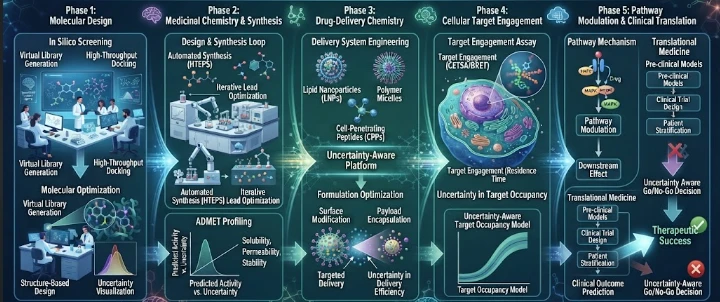
This article describes an uncertainty-aware platform for moving from predicted molecular binding to validated cellular target engagement in medicinal chemistry and drug-delivery research. Docking and machine-learning predictions can rapidly prioritize compounds, but they do not establish that a molecule reaches, occupies, and functionally modulates a target inside relevant cells. The article therefore separates predicted affinity from free intracellular concentration, subcellular localization, t
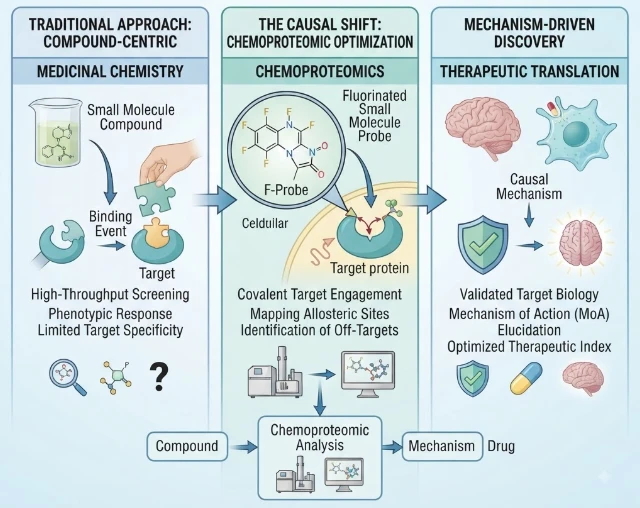
This article explores fluorinated medicinal chemistry through causal chemoproteomics, emphasizing that fluorine substitution can alter far more than potency. A single positional change can modify conformation, pKa, lipophilicity, metabolic stability, target interactions, intracellular exposure, and off-target biology. The article therefore tests whether fluorinated analogues change cellular phenotype through intended target engagement rather than hidden polypharmacology. Matched molecular pairs
This article presents resistance-aware marine natural-product discovery as a mechanistic process rather than a search for isolated high-potency hits. It explains how activity from marine extracts or fractions can disappear during purification or fail under resistance pressure, making deep phenotypic profiling essential. Morphology, viability kinetics, organelle function, transcriptional state, metabolism, and recovery after washout are combined to connect phenotype with mechanism. The article em