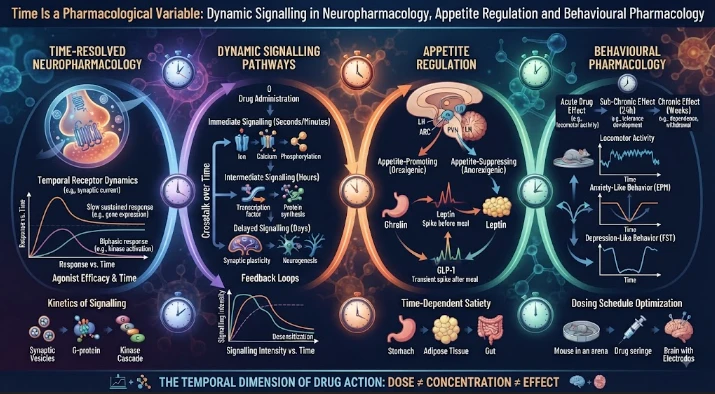
This article treats time as a core pharmacological variable in neuropharmacology, appetite regulation, and behavioral therapeutics. Receptor signaling, neural circuits, gut hormones, reward pathways, autonomic output, and metabolic feedback operate over different timescales, meaning that a single endpoint can hide onset, adaptation, desensitization, rebound, or delayed behavioral compensation. The article links receptor binding to second-messenger kinetics, neuronal firing, circuit activity, feeding behavior, energy expenditure, and long-term adaptation. Real-time biosensors, electrophysiology, calcium imaging, fiber photometry, hormone sampling, meal-pattern analysis, and longitudinal behavioral studies are presented as complementary tools. PK–PD models, dynamic systems analysis, time-series clustering, and causal mediation can help distinguish transient from durable effects. Circadian timing, diet, stress, hormonal state, neural adaptation, and disease phenotype are incorporated as sources of biological variation. Chronic dosing and withdrawal studies are used to identify compensatory responses. Safety assessment includes nausea, aversion, locomotion, cardiovascular effects, mood, and sleep. Overall, the article argues that therapeutic value depends on the trajectory of signaling and behavior across time, not merely peak response.
The dynamics of neuropharmacology take place over a period of time as receptor signaling, neural circuits, hormones and behavior exhibit different temporal dimensions. In neuropharmacology, appetite and behavioural pharmacology, it is no longer enough to rely on hit finding as it is possible that the same endpoint can fail to detect the effects of receptor desensitization, biased signaling, neural adaptation, meal timing, circadian effects, and delayed behavioural compensation. The more interesting question is whether an effect on the pharmacologic level that is commonly understood to be a time-dependent effect is still constant under realistic, biological and developmental conditions. This shift shifts the paradigm of discovery from a ranking to a mechanistic program in terms of exposure, causation and reproducibility. As the time scales of the mechanisms studied grow ever shorter, the development of new molecules in time-resolved neuropharmacology becomes more and more dependent on the ability to correlate the molecule's design with experiments that provide insights into why the molecule is effective and where it isn't, and which limitations must be considered most important.
Appetite control connects the circuits of the hypothalamus and hindbrain, gut hormones, melanocortins, reward systems, autonomic output, and peripheral metabolism, over a time frame of minutes, hours, and repeated doses. Real experience over the past 100 years has demonstrated that there has been a tendency for an attractive signal to disappear as biological complexity grows. A handy research method is thus the preservation of the original activity signal while progressively testing which features are essential under more and more realistic conditions.
The mechanistic depth begins by linking the binding of a receptor with the kinetics of second messengers, the firing of neurons, the activity of neuronal circuits, feeding behavior, expenditure of energy, and adaptation. This structure can be overlooked by simple endpoint assays since the same end point can be generated by different routes of causation. Real-time biosensors, electrophysiology, calcium imaging, fiber photometry, hormone sampling, meal-pattern analysis, and longitudinal behavior offer a more comprehensive understanding of the action of the hormone at a time when its downstream adaptation, nonspecific stress, or delivery failure can be separated out. An attractive response can be measured and it provides a testable chain between chemistry, biological state and functional outcome.
The design variables should also be considered as separate variables, not interacting. Performance is influenced by all of these interacting with each other, and a gain in one area can create a loss in another. So, a practical optimization process will be able to consider trade-offs rather than a single maximum. In cases where potency, selectivity, stability, tissue exposure and manufacturability all contribute to translational value, multi-parameter profiles are particularly useful.
Prediction is valuable where there is uncertainty that is apparent, and computational leverage can be added in the form of models such as PK-PD models, dynamic systems models, state space analysis, time series clustering, and causal mediation. If trained on familiar chemical and/or biological regions, models may be less reliable when dealing with novel scaffolds, non-representative patient states, and non-standard materials. Prior to time-consuming experiments, caliber, prospective testing, domain-of-applicability checks and disagreement across model families are ways of exposing fragile predictions.
Orthogonal validation is a useful aid in experimental design. Repeated dosing, wash out, antagonist challenge, genetic perturbation, temporal pathway blockade and independent assays of behavior provide different answers to the causal question and de-couple reliance on a given assay technology. While repeated measurements of the same endpoint provide a weaker argument, an agreement across chemistry, imaging, omics, genetics and functional biology does provide a stronger argument. Conflict is also informative in that it can provide clues to unappreciated levels of exposures, assay artifacts, compensatory pathways or context-dependent pharmacology.
Another hurdle is the existing biological diversity. Target abundance, barrier properties, metabolism, immune tone and/or pathway dependence can shift with minimal change in the actual treatment (baseline appetite, metabolic state, circadian timing, diet, stress, hormonal status, neural adaptation, and disease phenotype). The average responses may obscure groups that have different exposure/response relationships. Biological variation is built into design, not as an afterthought to explain variations in results.
Early consideration to resistance and adaptation is recommended as homeostatic circuits may be able to compensate for chronic perturbation of receptors, thus decreasing effectiveness of treatment. Chronic dosing, receptor-expression studies, receptor signaling adaptation, compensatory hormone profiling, behavioral rebound and withdrawal experiments identify the survival of activity under evolutionary and/or compensatory pressure. A candidate with a slight drop in potency but a good ability to block common escape routes may be of greater value in the long-term than a viable high potency lead that is weak in potency. Development that is resistant to escaping also helps to make mechanism sharper since the proteins, pathways or exposure processes that are most likely to escape tend to be those that have the greatest causal weight.
Molecular promise to reachable biology via delivery and pharmacokinetics. The ability of the active form to penetrate the brain, to occupy receptors, to have a plasma kinetics profile (concentration-time) that allows sufficient levels to be maintained, to have metabolites with activity (and to be inactive), to reach the target tissue at adequate concentrations and to persist long enough to support the proposed mechanism, is the basis for determining whether the active form will get to the target site at a level and duration suited to the mechanism. Absent other mechanisms affecting the actual exposure, this relationship is captured by the nominal dose. These mechanistic exposure measurements should be included with efficacy data from the very beginning of development.
Mechanism enhances safety assessment. Behavioral signs of nausea, aversion, locomotion, cardiovascular effects, mood-related effects, sleep, and off-target central activity, all help distinguish target related pharmacology from general cellular damage, activation of immunity, reactive chemistry, or formulation driven toxicity. Comparative testing in disease relevant and healthy systems determine if therapeutic activity is differentiated from unwanted activity.
Another scientific variable, in addition to manufacturing, is a downstream logistics problem. Product quality, biological activity and exposure can change even if the nominal composition does not.Despite the apparent composition of the product, changes in the product may occur due to compound stability, formulation release, dose precision, route compatibility, active-metabolite control, and storage. Quality by design thinking establishes the relationship between critical material attributes and process parameters and measures the performance rather than testing the material at the end of the process. What makes a product more credible is the fact that it has worked well with raw materials that vary, it can be made in bigger equipment, it can be stored, transported, and manufactured separately from the laboratory.
Also, realistic models of clinical use is needed for translation. Treatment timing, dose frequency, route, diagnostic requirements, acceptable complexity, tolerability, meal timing, chronic adherence, and obesity phenotype all influence treatment timing, dosing schedule, route, diagnostic requirements, acceptable complexity and tolerability. All of these features of a technically brilliant platform diminish its practical utility when administration, storage space requirements, monitoring requirements and cost considerations place constraints on its use where treatment is required. Mechanism meets deployment in development decisions is therefore advantageous to take a combination of both, rather than late stage decisions that will be hard to unwind.
These layers are connected by data integration. Pharmacokinetics, receptor signaling, neural activity, hormones, meal patterns, energy expenditure, weight, and adverse effects can all be mapped to a common causal model and not just lumped together as individual assay results. Iterative learning is reproducible with traceable metadata, versioned models, standardized controls and prospective decision rules. This will generate a development record that will showcase who won, as well as assumptions that were made in arriving at that decision, and uncertainties that were not addressed in the process.
Dynamic pharmacology requires the onset, peak, duration, desensitization rate, rebound, meal-size change, feeding frequency, energy expenditure and tolerability; not just a terminal measurement. The addition to success criteria of Durability, Reproducibility, Exposure margin, Biological breadth and Manufacturing robustness in addition to conventional Potency boosts the quality of the decision. This kind of metrics would encourage optimization for just one assay, and would favour a candidate that is not eliminated in independent assays. A clear scorecard also provides a clear understanding of why a more muted outcome may be the better development option.
A good programme also has a positive way of defining failure. Negative results that disappear over time, decreased feeding due to malaise, receptor responses uncorrelated with behaviour, and results that depend on time, all identify boundaries for the mechanism and result in less repeated effort on poorly informed hypotheses. Storing the results of synthesis failures, lack of target engagement, unsteady exposure, resistance emergence or loss of effect in a group of models provides a more realistic idea of the search space for the next model. Discovery is accelerated when unsuccessful experiments give as much information as successful experiments.
Time is a pharmacological variable because therapeutic value is related to the evolution of the signaling and behavior throughout the whole evolution of exposure. The primary benefit of the central advantage is that it provides a series of linked explanations, from mechanism through exposure, to biological diversity, safety and production. The structure helps to select good candidates as each significant development claim is supported by a test. Prosecutors are more interested in the series of experiments that culminates in a solid set of results that are convincing as complexity increases from the lab to real clinical settings.
CITE THIS ARTICLE
Kabir, M. H. (2025). Time Is a Pharmacological Variable: Dynamic Signalling in Neuropharmacology, Appetite Regulation and Behavioural Pharmacology. https://researchbykabir.com/article/919e2be5-eab7-579c-90ed-87fed9c93bb1
M. H. Kabir, “Time Is a Pharmacological Variable: Dynamic Signalling in Neuropharmacology, Appetite Regulation and Behavioural Pharmacology,” 2025. [Online]. Available: https://researchbykabir.com/article/919e2be5-eab7-579c-90ed-87fed9c93bb1
Kabir, M. H. (2025) ‘Time Is a Pharmacological Variable: Dynamic Signalling in Neuropharmacology, Appetite Regulation and Behavioural Pharmacology’. Available at: https://researchbykabir.com/article/919e2be5-eab7-579c-90ed-87fed9c93bb1
Kabir, Md. Humayan. “Time Is a Pharmacological Variable: Dynamic Signalling in Neuropharmacology, Appetite Regulation and Behavioural Pharmacology.” 2025, https://researchbykabir.com/article/919e2be5-eab7-579c-90ed-87fed9c93bb1.
Md. Humayan Kabir. “Time Is a Pharmacological Variable: Dynamic Signalling in Neuropharmacology, Appetite Regulation and Behavioural Pharmacology.” (2025). https://researchbykabir.com/article/919e2be5-eab7-579c-90ed-87fed9c93bb1.
Kabir MH. Time Is a Pharmacological Variable: Dynamic Signalling in Neuropharmacology, Appetite Regulation and Behavioural Pharmacology. 2025. https://researchbykabir.com/article/919e2be5-eab7-579c-90ed-87fed9c93bb1
@misc{article_919e2be5eab7579c90ed87fed9c93bb1,
  title = {Time Is a Pharmacological Variable: Dynamic Signalling in Neuropharmacology, Appetite Regulation and Behavioural Pharmacology},
  author = {Md. Humayan Kabir},
  year = {2025},
  url = {https://researchbykabir.com/article/919e2be5-eab7-579c-90ed-87fed9c93bb1},
}
TY  - GEN
AU  - Md. Humayan Kabir
TI  - Time Is a Pharmacological Variable: Dynamic Signalling in Neuropharmacology, Appetite Regulation and Behavioural Pharmacology
PY  - 2025-12-28
UR  - https://researchbykabir.com/article/919e2be5-eab7-579c-90ed-87fed9c93bb1
ER  -
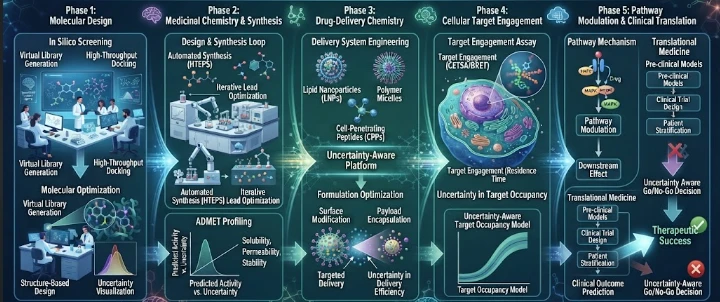
This article describes an uncertainty-aware platform for moving from predicted molecular binding to validated cellular target engagement in medicinal chemistry and drug-delivery research. Docking and machine-learning predictions can rapidly prioritize compounds, but they do not establish that a molecule reaches, occupies, and functionally modulates a target inside relevant cells. The article therefore separates predicted affinity from free intracellular concentration, subcellular localization, t
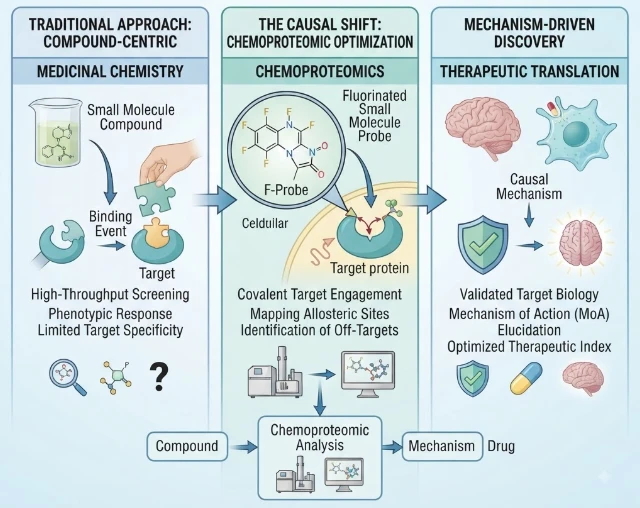
This article explores fluorinated medicinal chemistry through causal chemoproteomics, emphasizing that fluorine substitution can alter far more than potency. A single positional change can modify conformation, pKa, lipophilicity, metabolic stability, target interactions, intracellular exposure, and off-target biology. The article therefore tests whether fluorinated analogues change cellular phenotype through intended target engagement rather than hidden polypharmacology. Matched molecular pairs
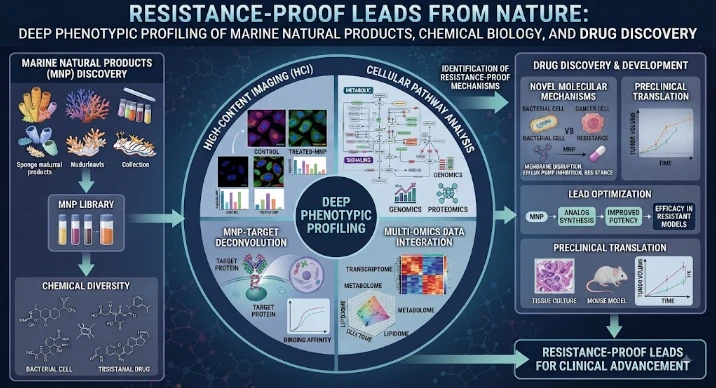
This article presents resistance-aware marine natural-product discovery as a mechanistic process rather than a search for isolated high-potency hits. It explains how activity from marine extracts or fractions can disappear during purification or fail under resistance pressure, making deep phenotypic profiling essential. Morphology, viability kinetics, organelle function, transcriptional state, metabolism, and recovery after washout are combined to connect phenotype with mechanism. The article em