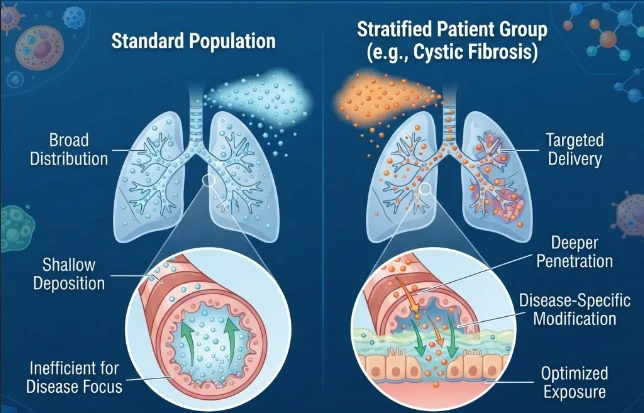
This article argues that pulmonary drug delivery should move beyond passive targeting toward patient-stratified exposure. Instead of assuming that the same emitted aerosol produces the same lung dose in everyone, it shows how airway narrowing, mucus plugging, inflammation, emphysema, inspiratory capacity, breathing technique, and disease stage create markedly different regional exposure patterns. Asthma, COPD, and cystic fibrosis are used to illustrate how identical devices and formulations can behave differently across patients. The article proposes stratification using measurable variables such as lung function, inspiratory flow, airway geometry, mucus burden, ventilation defects, inflammatory phenotype, age, and disease severity. It also links these patient factors with formulation properties including particle size, density, surface charge, hygroscopicity, dissolution, and carrier composition. Computational fluid dynamics, PBPK modeling, imaging, clinical pharmacokinetics, and digital inhaler data are presented as tools for separating pharmacological failure from delivery failure. The central message is that precision inhalation therapy requires engineering exposure around clinically relevant respiratory phenotypes.
For decades, pulmonary drug delivery has been influenced by passive targeting—alter the particle size, make drug delivery as efficient as possible, and hope the particles land close to the targeted region. The same strategy will still be applicable, however, respiratory disease does not always present as a uniform lung. Sharp differences in exposure landscapes are generally caused by airway narrowing, mucus obstruction, inflammation, emphysematous destruction, altered breathing patterns and variable inspiratory effort. Patient stratified pulmonary delivery begins with that heterogeneity and instead of being a characteristic of an inhaler, takes exposure as a phenotype.
The distinction is important since there is no equivalence between emitted dose and lung dose. But only a portion of the aerosol delivered from the aerosol delivery device reaches the lungs, and even less reaches a particular disease site. Particles are redistributed with every inhalation, via oropharyngeal impaction, exhalation, airway branching, turbulent flow, sedimentation and diffusion. With small variations in inspiratory flow, then, regional deposition can vary without affecting the nominal dose.
Asthma can be used as an example. Bronchoconstriction affects the size of conducting airways, velocity of flow in the bronchi, and deposition in the central areas, and severe bronchoconstriction decreases the access to peripheral areas. Mucus plugs create further air defects and cause air flow to be diverted to more open channels. Two people with the same diagnosis label will be exposed to different parts of the same drug formulation and device. The clinical relevant difference is masked by the average deposition value.
There is another pattern that arises with chronic obstructive pulmonary disease. Peripheral architecture is altered by emphysema, mucus burden is increased by chronic bronchitis, inspiratory capacity is often decreased by small-airway disease, and resistance is increased by all of these. Performance of the dry powder inhaler is partly dependent on inspiratory energy, the flow generation ability of the inhaler will affect the performance. There are solutions to address different aspects of the problem such as soft-mist inhalers and nebulized systems, but both remain susceptible to anatomy-related transport and clearance.
The exposure challenge is even starker in the case of CF. Glycocalyx is thick and sticky, which makes the particles less mobile, captures some of the particles and hastens the removal of material that is bound with the moving layer of glycocalyx. The alterations in the pH, enzymes and cellular composition of the airways and secretions further by infection and inflammation. Carriers with only healthy mucus rheology will not be mobile enough to arrive at epithelial cells or microbial communities in diseased secretions.
Patient stratification starts with measurable variables and not with general terms of the disease. There are several potential stratification dimensions: these include lung function, inspiratory flow, airway geometry, properties of mucus, ventilatory defects, inflammatory phenotype, age and disease stage. Imaging provides regional information which spirometry fails to provide, and device recorded inhalation profiles are increasingly assisting with the assessment of technique and inspiratory behaviour. The benefit of the practical scenario is not to make the treatment as individual as you can for all doses, but to identify subsets of patients who are sensitive to the exposure.
The other layer is formulation science. After deposition, the particles travel and what happens depends on their aerodynamic diameter, geometric size, density, surface charge, hygroscopicity, dissolution rate and carrier (composition of the particles). A low-density porous particle can have superior aerodynamic characteristics with a larger geometric diameter and a nanoparticle incorporated into a microparticle can decouple the inhalation performance from the biological transport after deposition. The up-value of these design decisions is increased when they're paired with patient barriers.
The idea also presents a novel twist to a prevalent misconception about the targeted nanomedicine. Target engagement does not necessarily mean that the ligand is attached to a carrier that can reach the target tissue compartment. Airway transport, mucous clearance, dissolution, uptake by macrophages, and epithelial access are the first challenges faced by inhaled particles. However, the biological targeting starts with exposure engineering and receptor recognition follows in the targeting sequence. An advanced system fails to deliver when it is stuck in the wrong airway region.
Mechanistic modeling is a practical approach that can connect the patient and formulation decisions. The regional deposition patterns are estimated by computational fluid dynamics and physiologically based pharmacokinetic (PBPK) models are used to relate the deposited dose to the dissolution, absorption, tissue retention, and systemic exposure. Population studies, on the other hand, look at variability, not just a representative subject. When combined with imaging and in vitro aerosol data and clinical pharmacokinetics, such models become more informative.
There is also a change in clinical trial design.Additionally, patient stratified exposure alters clinical trial design. If there is a great variation in the ability to inhale or risk of airway obstruction between the participants in a trial, then a strong response in one group will be diluted by its members. Outcomes of pharmacodynamics can be interpreted in conjunction with delivery. This does not mean that complex patients need to be excluded, but rather, by this method, development gets a clearer view of the respiratory phenotypes that are getting adequate exposure at the local level and which phenotypes are not getting enough.
Good adherence and technique continue to be a key component of that picture. Before formulation biology kicks in, the following delivery errors occur: incorrect preparation of the device, poor seal, weak inhalation, inadequate breath hold, and coordination errors. With an inhaler device equipped with digital technology and a training system, there are opportunities to separate pharmacological failure from delivery failure. Biological phenotype and use phenotype are therefore two ingredients of patient stratified therapy, because the interaction between the device and the patient will impact exposure.
This also provides safety benefits. Patients with suboptimal average lung delivery can be exposed more with a higher nominal dose. An alternative more logical approach is stratification, which is identifying the source of exposure loss. Other groups achieve improvement through treatment changes, dosing adjustments, technique assistance or use of alternative devices or treatment methods that do not require as much local deposition.
The overall message is passive targeting to exposure control. Aerosols will not be the same biological dose for all individuals, as respiratory disease creates dynamic, unequal, patient-specific environments for transport. Thus formulation, device engineering, imaging, modelling and clinical phenotyping should be part of one translational framework. Success is not based on the location where particles are predicted to be deposited in an idealized lung, but rather on whether enough drug is delivered to the proper location to affect clinically relevant sub-groups.
Spirometric values in a region are used to help with the stratification, but the same value can represent different ventilation patterns. Functional Respiratory imaging, deposition modelling and computed tomography airway reconstruction show areas of airflow restriction and areas where aerosol is likely to deposit. This data has particular importance if the disease is not widespread. Anatomical and physiological based exposure phenotypes may be added to the existing severity categories in development studies in the future.
The concept of pharmacokinetic sampling also is interpreted differently in this context. Plasma concentration after inhalation is a result of following factors: lung absorption, swallowed dose, gastrointestinal uptake, clearance and formulation behavior. These components can be further separated by linking blood data with deposition estimates and local pharmacodynamic markers.By linking blood data with deposition estimates and local pharmacodynamic markers, these components can be separated further. Population pharmacokinetic models can then be used to identify unexpected high and low exposures which can be linked to other factors—covariates—which may be used for more rational device and dose selection.
The stratification doesn't mean that for every respiratory disease there is an accompanying diagnostic. The most useful applications will probably be for strong clinically observable variables that will have a material impact on delivery. Practical starting points include inspiratory flow thresholds, severe mucus burden, recognisable anatomical phenotypes, or marked airway obstruction, and age-related device limitations. The importance of the stratification variable is determined by whether the treatment is improved by stratification or the exposure.
Exposure-based development also generates more clearly-defined failure criteria. If a correct technique is not producing an adequate regional deposition, the further dose escalation of the same formulation or device is not as tempting as changing to a different formulation or device. If the deposition is sufficient, but the response is less than optimal, the consideration of the pharmacology or disease biology of the disease becomes the focus of the discussion. The separation of these failure modes eliminates the need to keep optimising the wrong component, and allows more experimental testing of the pulmonary precision strategies.
The credibility of precision medicine for the lungs is strengthened by exposure being considered as a measurable step between the prescription and response. While the designation of disease is helpful, there are a number of factors, such as airway mechanics, mucus burden, inspiratory performance, and regional physiology that may influence whether a medicine reaches its target. The differences become design information when the patients are stratified for exposure. This yields a more realistic path to inhaled therapy in the wide variety of respiratory diseases experienced in the clinic.
CITE THIS ARTICLE
Kabir, M. H. (2026). Beyond Passive Targeting: Patient-Stratified Exposure in Pulmonary Delivery for Respiratory Disease. https://researchbykabir.com/article/e026fa04-cbb0-5bca-ae7b-8286618155ef
M. H. Kabir, “Beyond Passive Targeting: Patient-Stratified Exposure in Pulmonary Delivery for Respiratory Disease,” 2026. [Online]. Available: https://researchbykabir.com/article/e026fa04-cbb0-5bca-ae7b-8286618155ef
Kabir, M. H. (2026) ‘Beyond Passive Targeting: Patient-Stratified Exposure in Pulmonary Delivery for Respiratory Disease’. Available at: https://researchbykabir.com/article/e026fa04-cbb0-5bca-ae7b-8286618155ef
Kabir, Md. Humayan. “Beyond Passive Targeting: Patient-Stratified Exposure in Pulmonary Delivery for Respiratory Disease.” 2026, https://researchbykabir.com/article/e026fa04-cbb0-5bca-ae7b-8286618155ef.
Md. Humayan Kabir. “Beyond Passive Targeting: Patient-Stratified Exposure in Pulmonary Delivery for Respiratory Disease.” (2026). https://researchbykabir.com/article/e026fa04-cbb0-5bca-ae7b-8286618155ef.
Kabir MH. Beyond Passive Targeting: Patient-Stratified Exposure in Pulmonary Delivery for Respiratory Disease. 2026. https://researchbykabir.com/article/e026fa04-cbb0-5bca-ae7b-8286618155ef
@misc{article_e026fa04cbb05bcaae7b8286618155ef,
  title = {Beyond Passive Targeting: Patient-Stratified Exposure in Pulmonary Delivery for Respiratory Disease},
  author = {Md. Humayan Kabir},
  year = {2026},
  url = {https://researchbykabir.com/article/e026fa04-cbb0-5bca-ae7b-8286618155ef},
}
TY  - GEN
AU  - Md. Humayan Kabir
TI  - Beyond Passive Targeting: Patient-Stratified Exposure in Pulmonary Delivery for Respiratory Disease
PY  - 2026-08-02
UR  - https://researchbykabir.com/article/e026fa04-cbb0-5bca-ae7b-8286618155ef
ER  -
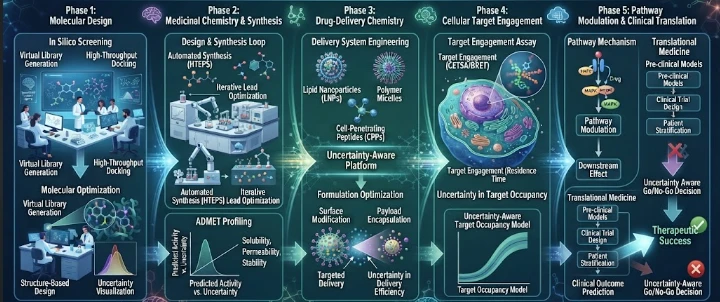
This article describes an uncertainty-aware platform for moving from predicted molecular binding to validated cellular target engagement in medicinal chemistry and drug-delivery research. Docking and machine-learning predictions can rapidly prioritize compounds, but they do not establish that a molecule reaches, occupies, and functionally modulates a target inside relevant cells. The article therefore separates predicted affinity from free intracellular concentration, subcellular localization, t
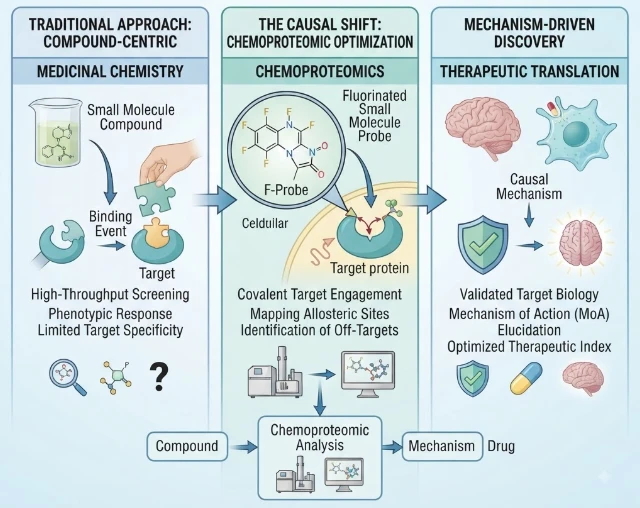
This article explores fluorinated medicinal chemistry through causal chemoproteomics, emphasizing that fluorine substitution can alter far more than potency. A single positional change can modify conformation, pKa, lipophilicity, metabolic stability, target interactions, intracellular exposure, and off-target biology. The article therefore tests whether fluorinated analogues change cellular phenotype through intended target engagement rather than hidden polypharmacology. Matched molecular pairs
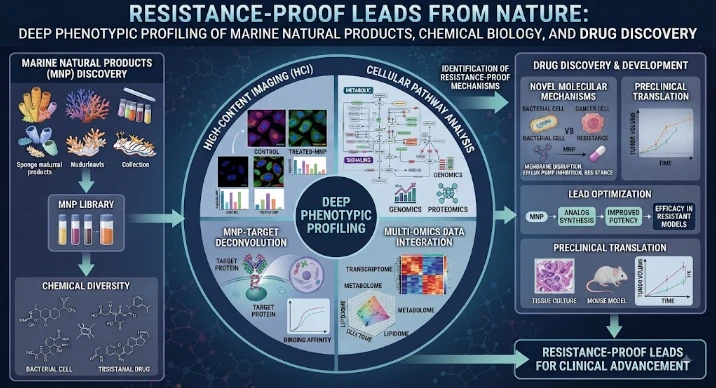
This article presents resistance-aware marine natural-product discovery as a mechanistic process rather than a search for isolated high-potency hits. It explains how activity from marine extracts or fractions can disappear during purification or fail under resistance pressure, making deep phenotypic profiling essential. Morphology, viability kinetics, organelle function, transcriptional state, metabolism, and recovery after washout are combined to connect phenotype with mechanism. The article em