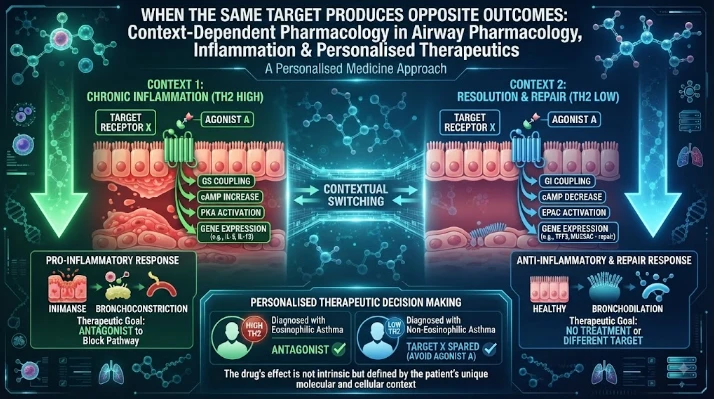
This article explores context-dependent airway pharmacology and explains why the same molecular target can produce different or even opposing outcomes across biological settings. Using beta-2 adrenergic signaling as a central example, it shows how G-protein signaling, beta-arrestin pathways, receptor density, ligand structure, inflammatory state, oxidative stress, and cell identity can alter the meaning of receptor activation. Airway smooth muscle, epithelium, immune cells, and fibroblasts contain different signaling networks, so a response observed in one experimental system cannot automatically be generalized to another. The article also discusses biased agonism, muscarinic receptors, prostaglandin pathways, cytokine signaling, asthma inflammatory phenotypes, single-cell transcriptomics, and spatial differences in drug concentration. Time and repeated exposure further modify signaling through feedback, internalization, and pathway switching. Combination therapy and mechanical or microbial context add additional layers. Mechanistic network models and clinically practical biomarkers are proposed to identify context-robust treatment responses. The overall message is that personalized airway pharmacology must match a signaling program to the biological environment in which the target operates.
The first thing to learn about pharmacology is that you activate a receptor, you get an effect, you block a receptor you get the opposite effect. Airway biology goes against that rule again and again. Within a cell type and under different inflammatory conditions, different receptor can be coupled to different pathways, and for different ligand structures and duration of exposure. The effects of a target on airway smooth muscle relaxation can vary to affect epithelial signaling, immune-cell behavior or desensitisation in different contexts. In the case of personalised respiratory therapy, context-dependent pharmacology is an issue when there is a shared molecular target that is aimed for a predictable outcome.
The beta-2 adrenergic receptor is an example of this. G-protein signaling increases cyclic AMP and causes bronchodilation, an important basis for the treatment of asthma and chronic obstructive pulmonary disease in airway smooth muscle. The same receptor is also known to recruit beta-arrestins, be phosphorylated, and to be involved in signaling pathways involved in receptor desensitization and other cellular responses. Early relaxation may be the same for two different types of ligands, but the late relaxation is not.
This is further complicated by the fact that cell types change what they mean. Signaling machinery is expressed in different ways in airway epithelial cells, smooth-muscle cells, inflammatory cells, and fibroblasts. Experimental research in human airway epithelium has shown differences in behaviour of the beta-2 receptor pathway from those predicted by cell-based engineering studies. The receptor does not have any fixed instruction; it is dependent upon the network of proteins in the surrounding that decide which downstream routes are available.
That network is reprogrammed in an inflammatory state. Cytokines may modulate the expression of receptors, the activity of kinases, the handling of second messengers and the cross-talk systems of prostanoids. The receptor proteins and signaling components can be altered by oxidative stress. A ligand will then experience a different biochemical environment in the same airway during the stable disease state compared to the acute inflammatory state.
The number of receptors is also important. Overexpression systems may give false pharmacologic results because pathway components are weak, but become amplified with high expression. Cells in culture retain more physiological numbers of receptors and interacting partners. Translational programs can be advantageous for verifying critical steps in pathway claims in primary cells and tissue as opposed to just one convenient recombinant model.
There is one more source of divergence, the ligand structure. Agonists bind to different receptor conformations, and can promote G protein, beta-arrestin, or other types of receptor signalling. This selectivity of function, sometimes referred to as biased agonism, is a path towards differentiating between desirable and undesirable pathways. The challenge is that bias can vary from assay to assay, receptor density to receptor density and time to time, thus introducing an element of context to the measurement.
The concept goes beyond adrenergic receptors. Muscarinic receptors are involved in the control of airway tone, but also expressed on epithelial and immune cells. The action of the Prostaglandin receptors is either relaxation or inflammatory depending on the cell type and the receptor. The mechanisms of cytokine pathways are also remarkably varied, as the same mediator can trigger different receptor complexes or the different intracellular states of the same receptor in different cell types.
These are clinically relevant asthma phenotypes. There are divergent cellular makeup and networks of mediators involved in type 2-high inflammation, neutrophilic disease, mucus-dominant phenotypes, obesity-associated asthma, and other patterns. One inflammatory network can have a target that is in another network, but located in the periphery of both networks. Biological context is therefore necessary in a personalised pharmacology, aside from symptom severity.
Single-cell transcriptomics has refined that perspective and identified subpopulations that were previously unknown in the airway. The communication patterns of ligands and receptors among epithelial, fibroblast, macrophage, lymphocyte and other cell states are different during asthma. A target spanning multiple populations may be a member of multiple local networks. Systemic or inhaled modulation sometimes yields mixed effects – cell-resolved data can help explain the reason for this.
Pharmacology is also affected by spatial context. There are regional differences in drug concentration because of differences in deposition, mucus, perfusion and tissue penetration. The concentration of an agonist at a receptor in central airway smooth muscle can be greater than the concentration of the same agonist at a receptor in peripheral tissue. Pathway recruitment is then pathway concentration dependent adding another source of functional variation.
The impact is amplified over time. Earlier signaling could be advantageous for one pathway, and later signaling could be through feedback, phosphorylation and/or receptor internalization or transcription. Different drugs can have different looks after repeated exposure, even when the drug is a five minute assay. Thus, temporal context is considered as a part of context-dependent pharmacology along with cellular and inflammatory context.
There are even more interactions when combination therapy is used. Corticosteroids affect the expression of inflammatory genes and may affect the sensitivity to beta-2 agonists. Bronchomotor tone is regulated by another family of receptors called muscarinic receptors, and biologics work by blocking specific cytokine signals upstream. The actions of one drug are thus partly dependent on the actions of other drugs that act on the same pathways.
This complexity is organized by mechanistic models. In network models, rather than attributing a single effect to a single receptor, cell types and pathways state, ligand bias, ligand concentration and feedback are represented. Then experiments are carried out to test the combinations that are considered to alter the direction of the outcome. The aim is not to create a realistic simulation of the lung, but to find variables that account for the discrepancies in response that are clinically relevant.
Biomarkers are needed for personalisation corresponding to those variables. These different features of the context are captured by measurements of blood eosinophils, exhaled nitric oxide, sputum profiles, imaging, airway transcriptomics and functional response measurements. No single biomarker encompasses the whole environment of the signaling. Practical treatment approaches thus rely on a few high-value indicators—rather than on comprehensive molecular characterization.
Another advantage of context testing is for drug development prior to it entering the clinical trial. These can be compared between primary smooth-muscle cells, epithelium, immune cells, inflammatory cytokine conditions and repeated dose protocols. A compound that has a desired pathway that remains stable in these different contexts has a different risk profile than a compound that changes its pathway with inflammation. The notion of context robustness is made a developability property.
Another context is the genetic variation. Even if the sequence of a receptor is not altered, changes in regulatory elements, metabolizing enzymes, or signaling proteins may alter response. Pharmacogenomic effects tend to be relatively small compared to the overall clinical setting but specific variants may be of interest when used in conjunction with inflammatory phenotype and exposure information. Thus, genetics plays a role in the cause of the disease, but not the whole story.
Mechanical state also is important. Smooth muscle cells in the airways that are stretched, but not contracted, or who have been contracted, but are now less stretched, or who have been contracted, but now stiffer, might not behave in the same way when the receptors are stimulated. In chronic asthma the physical environment around the same molecular targets is modified. Mechanobiology also has implications for receptor pharmacology and the understanding that the responses to flat plastic culture may not always reflect those of remodeled airways.
The composition of the microbes in the context can also affect inflammatory signaling. Airway microbial changes and viral/bacterial colonization impact airway cytokine patterns and epithelial state. A receptor pathway that is monitored in the stable disease state may then react differently during disease worsening associated with infection. Context-aware development is aided by testing the many inflammatory triggers (and not one single cytokine) that are relevant.
Pathway switching should be investigated in dose-ranging experiments. A low receptor occupancy will result in a higher affinity signaling pathway, whereas higher concentrations will be associated with additional pathways or off target effects. This means it is possible for a single ligand to exhibit an advantageous activity only during a specific exposure period, and an undesirable activity during all other time periods. Personalised dosing thus involves not just the dosing of the actual amount of drug, but also the pathway selectivity.
The most helpful, personalised plan is one that can be replicated and can be measured clinically. Treatment cannot be guided simply by a molecular distinction that lacks clinical relevance, and a very basic biomarker that does not have a strong causal link can be misleading. Development requires biomarkers that fall between the extremes: mechanistically related, sufficiently stable, and feasible enough to impact actual treatment selection or trial stratification.
So for all experiments of deciding the pharmacology, there is a need for measuring the context explicitly.
Receptors work within living networks and can generate contrary effects on the same target, as such. The response depends on the combination of cell identity, inflammation, ligand structure, receptor density, exposure and the time. These parameters are more predictive of airway pharmacology when they are not averaged out. Once a drug is matched to a target, personalised therapeutics is shifting its focus to a strategy of matching a signaling program to the biological milieu where that target is situated.
CITE THIS ARTICLE
Kabir, M. H. (2026). When the Same Target Produces Opposite Outcomes: Context-Dependent Pharmacology in Airway Pharmacology, Inflammation and Personalised Therapeutics. https://researchbykabir.com/article/b22b4462-5f38-53f7-8850-784eb200b103
M. H. Kabir, “When the Same Target Produces Opposite Outcomes: Context-Dependent Pharmacology in Airway Pharmacology, Inflammation and Personalised Therapeutics,” 2026. [Online]. Available: https://researchbykabir.com/article/b22b4462-5f38-53f7-8850-784eb200b103
Kabir, M. H. (2026) ‘When the Same Target Produces Opposite Outcomes: Context-Dependent Pharmacology in Airway Pharmacology, Inflammation and Personalised Therapeutics’. Available at: https://researchbykabir.com/article/b22b4462-5f38-53f7-8850-784eb200b103
Kabir, Md. Humayan. “When the Same Target Produces Opposite Outcomes: Context-Dependent Pharmacology in Airway Pharmacology, Inflammation and Personalised Therapeutics.” 2026, https://researchbykabir.com/article/b22b4462-5f38-53f7-8850-784eb200b103.
Md. Humayan Kabir. “When the Same Target Produces Opposite Outcomes: Context-Dependent Pharmacology in Airway Pharmacology, Inflammation and Personalised Therapeutics.” (2026). https://researchbykabir.com/article/b22b4462-5f38-53f7-8850-784eb200b103.
Kabir MH. When the Same Target Produces Opposite Outcomes: Context-Dependent Pharmacology in Airway Pharmacology, Inflammation and Personalised Therapeutics. 2026. https://researchbykabir.com/article/b22b4462-5f38-53f7-8850-784eb200b103
@misc{article_b22b44625f3853f78850784eb200b103,
  title = {When the Same Target Produces Opposite Outcomes: Context-Dependent Pharmacology in Airway Pharmacology, Inflammation and Personalised Therapeutics},
  author = {Md. Humayan Kabir},
  year = {2026},
  url = {https://researchbykabir.com/article/b22b4462-5f38-53f7-8850-784eb200b103},
}
TY  - GEN
AU  - Md. Humayan Kabir
TI  - When the Same Target Produces Opposite Outcomes: Context-Dependent Pharmacology in Airway Pharmacology, Inflammation and Personalised Therapeutics
PY  - 2026-04-12
UR  - https://researchbykabir.com/article/b22b4462-5f38-53f7-8850-784eb200b103
ER  -
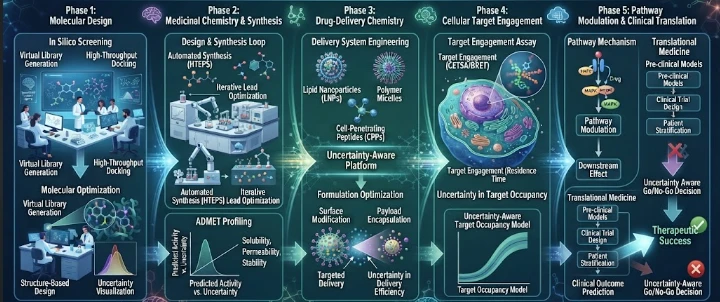
This article describes an uncertainty-aware platform for moving from predicted molecular binding to validated cellular target engagement in medicinal chemistry and drug-delivery research. Docking and machine-learning predictions can rapidly prioritize compounds, but they do not establish that a molecule reaches, occupies, and functionally modulates a target inside relevant cells. The article therefore separates predicted affinity from free intracellular concentration, subcellular localization, t
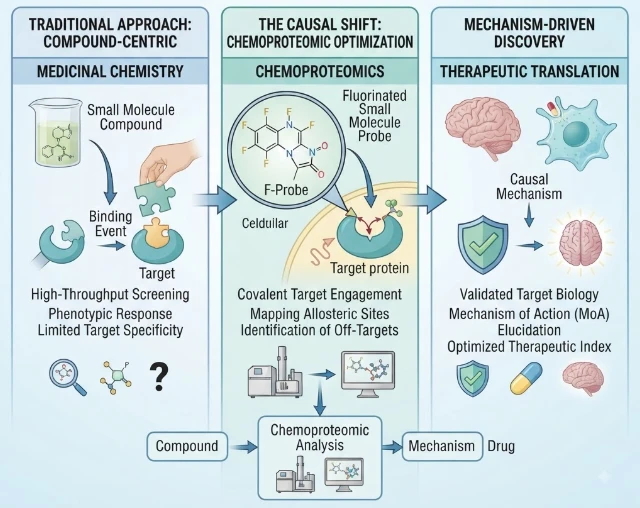
This article explores fluorinated medicinal chemistry through causal chemoproteomics, emphasizing that fluorine substitution can alter far more than potency. A single positional change can modify conformation, pKa, lipophilicity, metabolic stability, target interactions, intracellular exposure, and off-target biology. The article therefore tests whether fluorinated analogues change cellular phenotype through intended target engagement rather than hidden polypharmacology. Matched molecular pairs
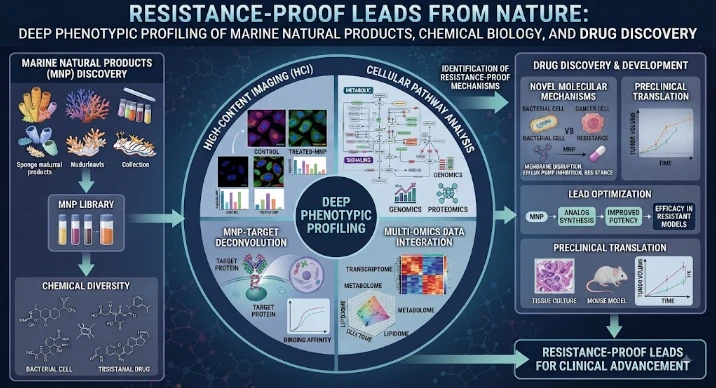
This article presents resistance-aware marine natural-product discovery as a mechanistic process rather than a search for isolated high-potency hits. It explains how activity from marine extracts or fractions can disappear during purification or fail under resistance pressure, making deep phenotypic profiling essential. Morphology, viability kinetics, organelle function, transcriptional state, metabolism, and recovery after washout are combined to connect phenotype with mechanism. The article em