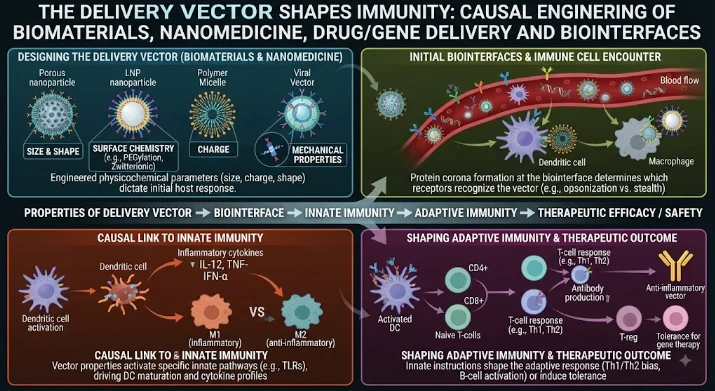
This article examines biomaterial and nanomedicine interfaces as active regulators of immune and tissue responses. Surface chemistry, stiffness, degradation, protein adsorption, complement activation, cellular uptake, and intracellular fate form the central mechanistic network. The article explains that material identity changes immediately in biological fluids as proteins adsorb, complement pathways activate, immune cells sense geometry and chemistry, and degradation products emerge. Surface libraries, protein-corona analysis, complement testing, immune-cell phenotyping, imaging, and matched payload controls are proposed for identifying which material properties improve delivery while preserving acceptable tissue compatibility. Immune status, disease microenvironment, organ function, prior exposure, and inflammatory burden are treated as context variables. Safety concerns include complement activation, inflammation, fibrotic encapsulation, anti-carrier immunity, and unexpected activity from degradation products. Polymer composition, molecular-weight distribution, residual solvent, particle morphology, and surface functionalization require reproducible manufacturing control. The article also emphasizes prospective modeling, longitudinal observation, and traceability. Overall, biointerface engineering is presented as central to pharmacology because host–material interactions directly shape delivery, efficacy, and safety.
The focus of immune-active biomaterial and nanomedicine interfaces goes beyond just the question of potency or delivery or association; in today's therapeutic development, understanding the why and when of a result is of increased importance. Heart of this change is a mechanistically linked network of surface chemistry, stiffness, degradation, protein adsorption, complement activation, cellular uptake, and intracellular fate. The network is important because the biointerface biology starts to interact with proteins and immune cells at the instant of delivery and thus cannot be separated from delivery behavior. A more robust development strategy, then, is one in which the design variables of mechanism, context and uncertainty are related design elements, not design elements to be processed in isolation at various stages of development.
The identity of materials varies almost instantaneously when they come into contact with biological fluids at a biointerface. Proteins bind to surfaces, complement pathways can be activated, immune cells can detect the chemistry and geometry of materials and degradation products may be found with the passage of time. These events are just as important in influencing uptake and tissue compatibility of those events as are the composition of the particles or the concentration of the payload. Performing parallel measurements of protein corona, complement activity, immune cell state, degradation, and biodistribution, however, renders a delivery performance that can be interpreted as an interplay between the material properties and host biology; this is where biomaterial engineering adds value.
The end result is a new approach to discovery based on surface libraries, protein-corona analysis, complement testing, immune-cell phenotyping, imaging, and matched payload controls. None of these tools can effectively tell us a definitive story because each one can only tell part of a bigger story in the case of a biological or clinical process. Independent measurements that arrive at the same causal interpretation over time, dose, model system and relevant biological context reinforce confidence that this interpretation is correct. Discordant results are also valuable because they may provide clues about hidden mechanisms, assay artifacts or population differences, or exposure limits, all of which warrant investigation prior to committing significant resources to costly development.
When it comes to decision making, one question arises: What are the desirable properties of materials which enhance delivery whilst retaining an acceptable immune and tissue response? To answer that question, one has to make explicit comparisons between the intended mechanism and the many plausible alternatives, such as off-target activity, parallel pathways, differential exposure, or measurement bias. Perturbation experiments are particularly useful because they can be used to determine if the observed effect is dependent on the proposed component by its removal, blocking or restoration. Mechanistic confidence is, therefore, gained with successful challenge tests, not by reiterating the same result in a single assay.
The meaning of nearly all of the results in the immune-active biomaterial and nanomedicine interfaces is also modified by context. Immune status, disease microenvironment, organ function, prior exposure, inflammatory burden are important variations. A successful intervention in a set of these conditions may not be as effective, more toxic, or result in a different biological outcome in another set. When applied to variables related to mechanism or exposure, stratification may help to explain how treatment performance varies; alone, descriptive categories of treatment performance are not very useful.
Risk assessment should be given the same weight for the following reasons: complement activation, inflammation, fibrotic encapsulation, anti-carrier immunity, degradation products with unexpected activity. Early safety work will be most robust if associated with the same mechanistic approach adopted for efficacy and then linked to target biology, carrier behavior, exposure, metabolites, or analytical bias. An approach to reduce the risk of safety being a late checklist that is not tied to discovery logic. It also can facilitate more sensible trade-offs if greater efficacy involves increased exposure or modulation of a wider pathway or increase in persistence in a sensitive tissue.
Another layer is added to this as the development of drug and gene delivery systems becomes more predictable with regard to compatibility, biodistribution, and repeated-dosing. Sharing a successful preclinical outcome is more informative if experiments are able to capture clinically relevant timing, concentration ranges, biological barriers, treatment history and sources of heterogeneity. It is not useful to evolve from a convenient model to a complex model, it is useful to have a series of models that help answer the uncertainty questions. For each step there must be a clear decision to either continue, redesign, reduce the target population, change the dosing or gather a different mechanistic information.
The importance of manufacturing and analytical control cannot be overstated, as it is essential to control the polymer composition, molecular-weight distribution, residual solvent, particle morphology and functionalization of the surface. A biological explanation is only valuable if the biological material tested is consistent between batches and the inputs to the assays are well characterised. Critical attributes must, therefore, have ranges of acceptability, measurable attributes and records linking process conditions to the biological performance. It is particularly crucial when studying complex molecules, nanoparticles, biomaterials, and studies involving large amounts of data – meaning that the differences in exposure, signaling, and apparent treatment response can be very fine.
There is also increasing separation between prediction and confirmation in data analysis in immune-active biomaterial and nanomedicine interfaces. Though a computational model, a machine learning algorithm, a causal estimator, a mechanistic simulation can rank hypotheses, integrate high-dimensional measurements, and highlight uncertainty, the output of the model is not biological truth. Useful models: Make explicit assumptions, quantify calibration, identify regions with weak support, inform next experiment with information altering the decision. Prospective validation is still necessary, since patterns that fit well in the past may not withhold in the future, as a result of exposure to novel populations, batches, or biological circumstances.
The second change has to do with time since many processes that are central to immune-active biomaterial and nanomedicine interfaces occur after their first exposure. When a response is favorable, whether early or later, an adaptation or clearance process may proceed in different ways, as may the programming of the immune system, remodeling of tissues, adherence to or resistance to the host. Longitudinal measure determines if an intervention leads to a stable state, a temporary disturbance, or a liability which is delayed. Time-resolved data also help to understand the causality in the relationship between the suggested mechanism and the downstream phenotype because it allows the examination of changes in the mechanism before the changes in the downstream phenotype.
An experimental design is more efficient if all studies are associated with a specific uncertainty budget. Questions about surface chemistry, stiffness, degradation, protein adsorption, complement activation, cellular uptake, and intracellular fate can be prioritized by the ability to affect material properties that would enhance delivery, but which might not affect the immune and tissue response to an unacceptable degree, not just by the novelty of the question. Complementary models are then replicated to determine if the conclusion is dependent on one assay, one laboratory condition or one population. This discipline can reduce wasted optimization and is useful for reporting negative results as they reduce the number of plausible mechanisms and enhance the following design iteration.
Traceability between the claims and measurements is also necessary for regulatory and clinical credibility. A development package is more powerful when the observations, processing choices, model hypotheses, deviations from the protocol, and material properties are maintained throughout the entire continuum of initial experiments to translational studies for immune-active biomaterial and nanomedicine interfaces. That traceability can help be sure that the biological variability is real rather than technical variability, and can also be used later to investigate a claim on safety or effectiveness. It also provides an objective foundation for revising conclusions as new data revise an earlier assumption.
There is also a need to be more accurate in communicating around this field. Some phrases like targeted, selective, durable, safe, predictive, or personalized are meaningless unless combined with a measurement, comparator, population, and uncertainty range. Negative results are more useful and exploratory results are not reported as established mechanisms if there is clear reporting. Precision provides a common metric for assessing the validity of a claim based on direct measurement, calibrated inference, or an untested assumption for researchers, developers, clinicians and regulators alike.
A tighter feedback loop between chemistry/peptide/formulation, mechanistic measurement, quantitative modeling, safety, manufacturing control, and clinically relevant context is thus the strongest direction to take in the design of immune-active biomaterial and nanomedicine interfaces. It is easier to make progress if a failed assumption is discovered early and mechanisms that work are deliberately tested by making them difficult. Biointerface engineering is not an add-on to the pharmacology, but the logic behind it. There are a few valuable innovations across the field, all of which are based on a development system that learns from each experiment, with causal understanding, real world relevance and reproducibility as core principles guiding every decision.
CITE THIS ARTICLE
Kabir, M. H. (2025). The Delivery Vector Shapes Immunity: Causal Engineering of Biomaterials, Nanomedicine, Drug/Gene Delivery and Biointerfaces. https://researchbykabir.com/article/eeb685d5-4c86-5299-86e2-ef2d651e16c1
M. H. Kabir, “The Delivery Vector Shapes Immunity: Causal Engineering of Biomaterials, Nanomedicine, Drug/Gene Delivery and Biointerfaces,” 2025. [Online]. Available: https://researchbykabir.com/article/eeb685d5-4c86-5299-86e2-ef2d651e16c1
Kabir, M. H. (2025) ‘The Delivery Vector Shapes Immunity: Causal Engineering of Biomaterials, Nanomedicine, Drug/Gene Delivery and Biointerfaces’. Available at: https://researchbykabir.com/article/eeb685d5-4c86-5299-86e2-ef2d651e16c1
Kabir, Md. Humayan. “The Delivery Vector Shapes Immunity: Causal Engineering of Biomaterials, Nanomedicine, Drug/Gene Delivery and Biointerfaces.” 2025, https://researchbykabir.com/article/eeb685d5-4c86-5299-86e2-ef2d651e16c1.
Md. Humayan Kabir. “The Delivery Vector Shapes Immunity: Causal Engineering of Biomaterials, Nanomedicine, Drug/Gene Delivery and Biointerfaces.” (2025). https://researchbykabir.com/article/eeb685d5-4c86-5299-86e2-ef2d651e16c1.
Kabir MH. The Delivery Vector Shapes Immunity: Causal Engineering of Biomaterials, Nanomedicine, Drug/Gene Delivery and Biointerfaces. 2025. https://researchbykabir.com/article/eeb685d5-4c86-5299-86e2-ef2d651e16c1
@misc{article_eeb685d54c86529986e2ef2d651e16c1,
  title = {The Delivery Vector Shapes Immunity: Causal Engineering of Biomaterials, Nanomedicine, Drug/Gene Delivery and Biointerfaces},
  author = {Md. Humayan Kabir},
  year = {2025},
  url = {https://researchbykabir.com/article/eeb685d5-4c86-5299-86e2-ef2d651e16c1},
}
TY  - GEN
AU  - Md. Humayan Kabir
TI  - The Delivery Vector Shapes Immunity: Causal Engineering of Biomaterials, Nanomedicine, Drug/Gene Delivery and Biointerfaces
PY  - 2025-08-10
UR  - https://researchbykabir.com/article/eeb685d5-4c86-5299-86e2-ef2d651e16c1
ER  -
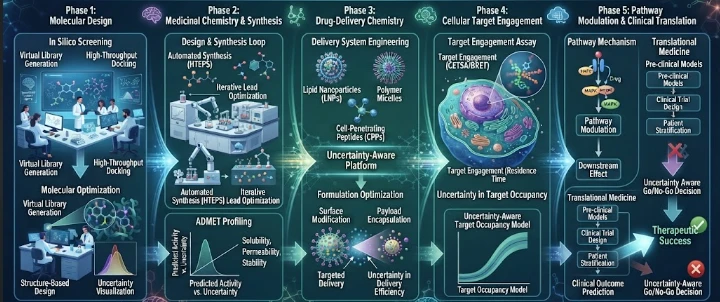
This article describes an uncertainty-aware platform for moving from predicted molecular binding to validated cellular target engagement in medicinal chemistry and drug-delivery research. Docking and machine-learning predictions can rapidly prioritize compounds, but they do not establish that a molecule reaches, occupies, and functionally modulates a target inside relevant cells. The article therefore separates predicted affinity from free intracellular concentration, subcellular localization, t
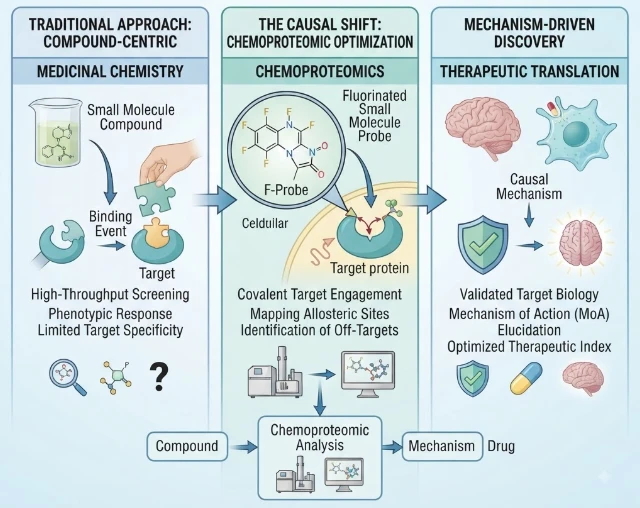
This article explores fluorinated medicinal chemistry through causal chemoproteomics, emphasizing that fluorine substitution can alter far more than potency. A single positional change can modify conformation, pKa, lipophilicity, metabolic stability, target interactions, intracellular exposure, and off-target biology. The article therefore tests whether fluorinated analogues change cellular phenotype through intended target engagement rather than hidden polypharmacology. Matched molecular pairs
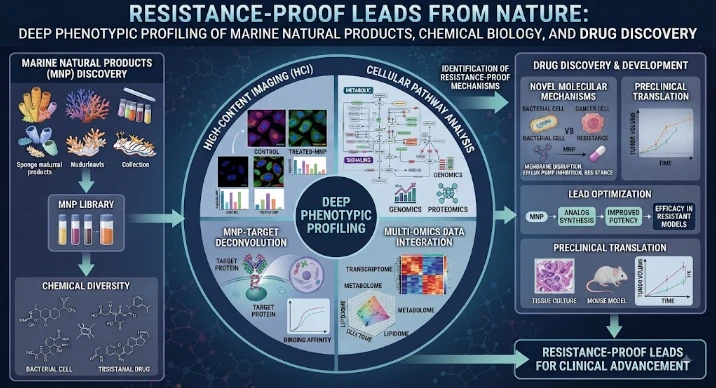
This article presents resistance-aware marine natural-product discovery as a mechanistic process rather than a search for isolated high-potency hits. It explains how activity from marine extracts or fractions can disappear during purification or fail under resistance pressure, making deep phenotypic profiling essential. Morphology, viability kinetics, organelle function, transcriptional state, metabolism, and recovery after washout are combined to connect phenotype with mechanism. The article em