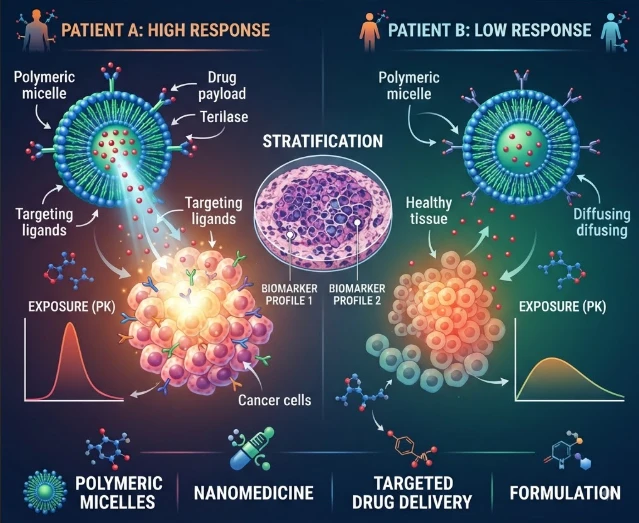
This article argues that passive targeting with polymeric micelles should be evaluated as a patient-specific exposure problem rather than a universal nanomedicine property. Vascular permeability, perfusion, stromal density, macrophage activity, lymphatic drainage, renal and hepatic function, micelle stability, and payload release determine how much intact carrier reaches a target lesion. Imaging biomarkers, pharmacokinetic sampling, mechanistic modeling, tissue profiling, exposure–response analysis, and stratified clinical studies are proposed for identifying patients likely to achieve sufficient target-site exposure. The article emphasizes that a stratification rule is defensible only when a measurable biological feature predicts delivery repeatedly. Tumor perfusion, vascular leakiness, lesion size, macrophage burden, organ function, and prior therapy are highlighted as important context variables. Risks include overreliance on enhanced-permeability assumptions, poorly validated imaging surrogates, variable clearance, and heterogeneous lesion biology. Manufacturing variation in particle size, release rate, or polymer composition can also weaken a stratification rule. Overall, the article links nanomedicine disposition to measurable patient biology so targeting becomes a testable precision-pharmacology strategy.
It is not just about how potent, how delivered or how associated a product is for patient-stratification; a result that is increasingly essential for modern therapeutic development is the understanding of why a result shows up and when that result is reliable. Amongst the more mechanistic aspects, one network of events stands out as the center of this change, which involves vascular permeability, perfusion, stromal density, macrophage activity, renal and hepatic function, micelle stability and payload release. It's that network that's important because when you do a passive targeting, you have different exposures or different cases have different exposures because of the difference in diseased tissues. The stronger development strategy, therefore, acknowledges mechanism, context and uncertainty as interconnected design variables and not as separate tasks carried out at different points in the development.
Nanomedicine exposure greatly differs across disease lesions and patient, while passive targeting has long been correlated with abnormal vascular permeability of diseased tissue. The amount of intact carrier reaching a target site is influenced by perfusion, vessel structure, stromal density, macrophage activity, lymphatic drainage, particle stability and organ clearance. Stratification is possible with imaging and pharmacokinetic measurements combined with validated exposure–response relationships. Patient selection is defensible only if there is a measurable biological feature that is a reliable predictor of delivery, not just in one case.
What this means is a new discovery paradigm that emphasizes imaging biomarkers, pharmacokinetic sampling, mechanistic modeling, tissue profiling, exposure–response relationships, and stratifying clinical studies. None of these is the only tool by which that process is defined, as each assay represents a smaller component of a larger process in biology or in the clinic. As increasingly independent measures predict the same causal narrative at different doses, different times, different model systems and different relevant biological contexts, confidence increases. Even though the results are discordant, these data can be valuable and useful because inconsistencies can often uncover hidden mechanisms, assay artifacts, population differences or exposure limitations that warrant investigation prior to the cost of further development.
The critical issue for decision making is which patients will have adequate exposure at the target site by using a particular micellar formulation. To answer this question, it is necessary to make a clear comparison with the mechanism that could be involved and possible alternative mechanisms such as off-target activity, parallel pathways, differential exposure, or measurement bias. Perturbation experiments are particularly useful since the removal, blocking or restoration of a proposed component will determine whether or not the observed effect is related to that component. Mechanistic confidence, then, is gained by conducting challenge tests, rather than by repeated confirmation in one assay that is favorable.
For the polymeric micelles, almost all the results are also context-dependent. Patients that are relevant for variation are those with tumor perfusion, vascular leakiness, tumor size, tumor burden by macrophages, liver function, kidney function, and previous therapy. One set of these conditions may result in a good intervention while another set may result in a less effective, more toxic or alternate biological response. When applied, stratification is more useful when based on variables associated with mechanism/exposure, because the categories to describe the change in treatment performances are usually inadequate to explain the change.
Risk assessment is equally important due to assumptions of increased permeability, imaging surrogate markers with no validation, variable clearance and heterogeneous lesion biology. Early safety work is best conducted when there is a clear association with the same mechanistic approach as efficacy, enabling unwanted effects to be linked to target biology, carrier behavior, exposure, metabolites, or to analytical bias. This helps to minimise the risk of safety coming last as an afterthought rather than being integrated with discovery logic. Also helps with better trade-offs between efficacy and increased exposure levels, wider modulation of pathways and longer persistence in tissues of sensitivity.
Translational development is another layer and selection strategies that tie nanomedicine disposition to measurable patient biology. It becomes more informative to pre clinically succeed if the experiments mimic clinically relevant time, concentration range, biological barriers, history of treatment, and sources of heterogeneity. It is not very useful to have a simple model which can be easily scaled up to a complex model than to have a series of models each selected to address a particular uncertainty question. For each step, a specific decision must be made about whether the process should be continued, redone, the target population should be limited, the dose should be changed, or other mechanistic information should be gathered.
Both manufacturing and analytical control are equally important because exposures can change if there is a small change in particle size, drug release or polymer composition, which can be detrimental to a stratification criterion. When the biological material under test is batch-dependent, or the input to the assay is not well-defined, a biological explanation is of little value. Critical attributes require therefore an a priori determination of the ranges, a high sensitivity of measurement, and a link between the process conditions and the biological performances. This is particularly relevant in studies involving complex molecules, nanoparticles, biomaterials and studies involving lots of data where a small change in exposure, signaling or apparent treatment response can mean the difference.
The separation between prediction and confirmation also is more significant for data analysis in patient-stratified exposure for polymeric micelles. In addition to ranking, high-dimensional measurements, and uncovering uncertainty, computational models, machine learning, causal estimators, and mechanistic simulations all can produce the model output which is not the same as biological truth. Useful models make assumptions explicit; quantify the calibration; identify regions where there is insufficient evidence; and suggest future experiments that offer information to alter a decision. Future validation is still necessary for prospective validation, since it is possible for patterns to be “retro” validated but never make it to future populations, batches, or bio conditions.
Yet another change relates to time as many processes involved in patient-stratified exposure of polymeric micelles change after the initial exposure. Response, adaptation, clearance and/or immune programming, tissue remodeling, adherence and/or resistance may go in varying directions when a single endpoint appears to be good. A longitudinal measurement shows if an intervention has a stable state, a temporary perturbation or a delayed liability. Time-resolved data enhance the causal interpretation as the suggested mechanism may change prior to the downstream phenotype instead of after the outcome is set.
An uncertainty budget for each study is added to the efficiency of experimental design. Rather than novelty, the ability to alter the fraction of patients who attain adequate exposure at the target site from a given micellar formulation can be assigned a rank for each of the question areas listed above. Replication across complementary models is then carried out to test the outcome for the one assay, the one laboratory condition, or the one population. This discipline reduces over-optimization and it makes negative results a valuable asset as each unsuccessful prediction reduces the design space for mechanisms and guides the next one.
Also traceability from claims to measurements is important for regulatory and clinical credibility. An exposure development package is more powerful if raw observations, processing decisions, model assumptions, protocol deviations, and material attributes are maintained throughout the process from initial experiments to translational studies when evaluating polymeric micelles as patient-stratified exposure. That traceability can be used to detect real biological variability in a sample, and verify the authenticity of safety or effectiveness claims at a later stage. It also provides a more clear-cut ground for revising conclusions on the basis of changing data for an earlier assumption.
More precise communication should be also done around this field. Unless combined with a measurement, comparator, population and range of uncertainty, terms like targeted, selective, durable, safe, predictive, or personalized are meaningless. Transparency in reporting enables negative results to be more useful, and exploratory findings do not get reported as established mechanisms. This precision provides a common ground for evaluating the validity of a claim based on direct measurement, calibrated inference, or an unstudied assumption, for researchers, developers, clinicians, and regulators.
It is thus not one new technology that provides the best direction for patient-stratified exposure of polymeric micelles but a closer loop between chemistry or formulation, mechanistic measurement, quantitative modelling, manufacturing control, and clinically relevant context. Failing assumptions early and letting mechanisms that work survive deliberately difficult tests helps progress to move quicker. Targeting is considered an exposure issue and not a universal property of the nanotechnology. At the field scale, the most useful innovation is a development system that is learning from each experiment and retains strong causal interpretation, reproducibility, and relevance to real world scenarios in the heart of every decision.
CITE THIS ARTICLE
Kabir, M. H. (2025). Beyond Passive Targeting: Patient-Stratified Exposure in Polymeric Micelles, Nanomedicine, Targeted Drug Delivery and Formulation. https://researchbykabir.com/article/e5a9557c-f222-5938-b735-f13cd774bb52
M. H. Kabir, “Beyond Passive Targeting: Patient-Stratified Exposure in Polymeric Micelles, Nanomedicine, Targeted Drug Delivery and Formulation,” 2025. [Online]. Available: https://researchbykabir.com/article/e5a9557c-f222-5938-b735-f13cd774bb52
Kabir, M. H. (2025) ‘Beyond Passive Targeting: Patient-Stratified Exposure in Polymeric Micelles, Nanomedicine, Targeted Drug Delivery and Formulation’. Available at: https://researchbykabir.com/article/e5a9557c-f222-5938-b735-f13cd774bb52
Kabir, Md. Humayan. “Beyond Passive Targeting: Patient-Stratified Exposure in Polymeric Micelles, Nanomedicine, Targeted Drug Delivery and Formulation.” 2025, https://researchbykabir.com/article/e5a9557c-f222-5938-b735-f13cd774bb52.
Md. Humayan Kabir. “Beyond Passive Targeting: Patient-Stratified Exposure in Polymeric Micelles, Nanomedicine, Targeted Drug Delivery and Formulation.” (2025). https://researchbykabir.com/article/e5a9557c-f222-5938-b735-f13cd774bb52.
Kabir MH. Beyond Passive Targeting: Patient-Stratified Exposure in Polymeric Micelles, Nanomedicine, Targeted Drug Delivery and Formulation. 2025. https://researchbykabir.com/article/e5a9557c-f222-5938-b735-f13cd774bb52
@misc{article_e5a9557cf2225938b735f13cd774bb52,
  title = {Beyond Passive Targeting: Patient-Stratified Exposure in Polymeric Micelles, Nanomedicine, Targeted Drug Delivery and Formulation},
  author = {Md. Humayan Kabir},
  year = {2025},
  url = {https://researchbykabir.com/article/e5a9557c-f222-5938-b735-f13cd774bb52},
}
TY  - GEN
AU  - Md. Humayan Kabir
TI  - Beyond Passive Targeting: Patient-Stratified Exposure in Polymeric Micelles, Nanomedicine, Targeted Drug Delivery and Formulation
PY  - 2025-07-06
UR  - https://researchbykabir.com/article/e5a9557c-f222-5938-b735-f13cd774bb52
ER  -
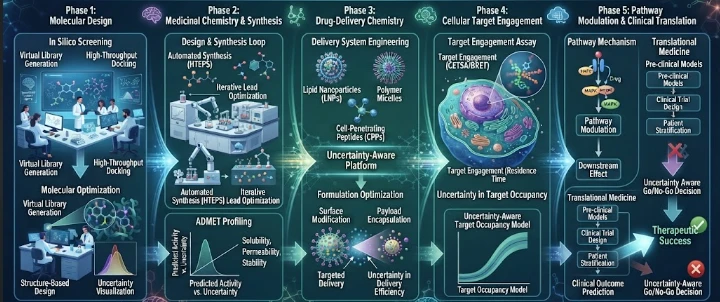
This article describes an uncertainty-aware platform for moving from predicted molecular binding to validated cellular target engagement in medicinal chemistry and drug-delivery research. Docking and machine-learning predictions can rapidly prioritize compounds, but they do not establish that a molecule reaches, occupies, and functionally modulates a target inside relevant cells. The article therefore separates predicted affinity from free intracellular concentration, subcellular localization, t
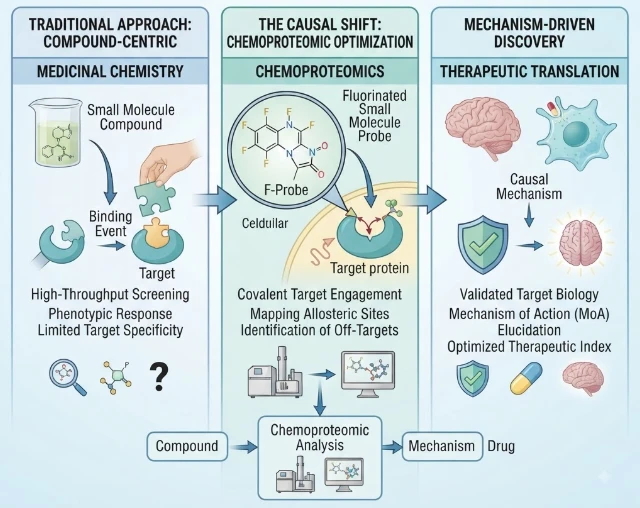
This article explores fluorinated medicinal chemistry through causal chemoproteomics, emphasizing that fluorine substitution can alter far more than potency. A single positional change can modify conformation, pKa, lipophilicity, metabolic stability, target interactions, intracellular exposure, and off-target biology. The article therefore tests whether fluorinated analogues change cellular phenotype through intended target engagement rather than hidden polypharmacology. Matched molecular pairs
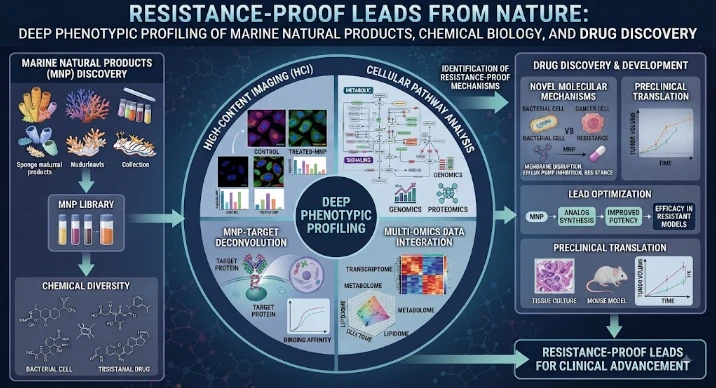
This article presents resistance-aware marine natural-product discovery as a mechanistic process rather than a search for isolated high-potency hits. It explains how activity from marine extracts or fractions can disappear during purification or fail under resistance pressure, making deep phenotypic profiling essential. Morphology, viability kinetics, organelle function, transcriptional state, metabolism, and recovery after washout are combined to connect phenotype with mechanism. The article em