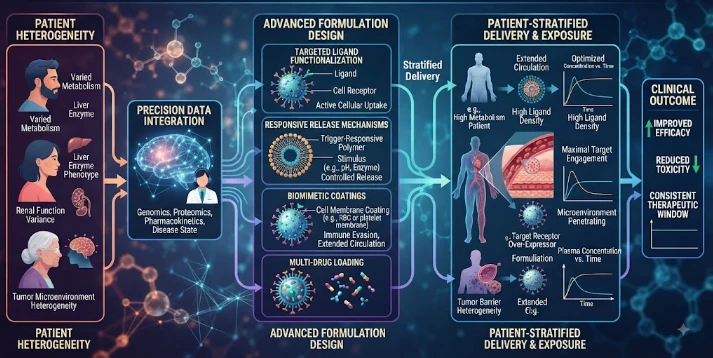
This article argues that advanced formulation science should move beyond average passive targeting toward patient-stratified exposure. Formulation behavior can vary markedly with vascular permeability, mucus properties, renal and hepatic function, mononuclear phagocyte activity, inflammatory state, body composition, and disease burden. The article therefore proposes linking patient covariates to transport, clearance, tissue accumulation, cellular uptake, and pharmacodynamic response rather than assuming that one formulation produces uniform exposure. Imaging, pharmacokinetic sampling, circulating biomarkers, organ-function tests, ex vivo tissue models, PBPK simulation, population pharmacokinetics, and Bayesian stratification are described as tools for identifying exposure-sensitive subgroups. Formulation variables such as particle size, surface chemistry, dose, release, protein corona, and drug loading are considered together with host biology. Longitudinal imaging and repeated pharmacokinetics can reveal changes caused by disease progression or treatment. The article also integrates safety margins, manufacturing consistency, and the feasibility of exposure-guided treatment decisions. Its main message is that targeting becomes more precise when formulation properties are matched to measurable biological characteristics of clinically relevant patient subgroups.
For passive targeting, this is sometimes referred to as a material property, but real exposure is dependent on much of the patient biology. Patient stratified advanced formulation science has transcended hit finding as the average biodistribution masks significant variations in organ function, inflammation, clearance, and disease microenvironment, as well as vascular permeability. The more important question is whether a formulation that is optimized for biological properties that correlate with local exposure and response is retained under realistic biological and developmental conditions. The turnover is from ranking to mechanistic program: discovery based on exposure, causality and reproducibility. As the deadline for publication nears, more and more progress depends on the ability to relate the molecular design with experiments that give insight into why a candidate agent is effective, where it is not, and what constraints should be given priority.
Formulation behavior can be modified within patients by changes in tumor permeability, properties of the mucus, renal function, hepatic clearance, mononuclear phagocyte activity, vascular disease and inflammatory state. Experience with the historical and recent development indicates that an attractive laboratory signal generally does not stand the test of increasing levels of biological complexity. It is then useful to keep the same activity signal and vary the features tested to progressively more realistic situations.
Mechanistic depth begins with correlating patient covariates with the transport, clearance, tissue accumulation, cellular uptake and pharmacodynamic response of the formulation. This structure results in similar endpoints; however, this may be hidden by simple endpoint assays. Imaging, circulating biomarkers, organ-function tests, ex vivo tissue models, pharmacokinetic sampling, and exposure-response analysis contribute to a deeper understanding by differentiating direct from downstream adaptation or unspecific stress or delivery failure. This type of measurement creates a beautiful response that can be tested and used to establish a viable link between chemistry, biological state and functional outcome.
Design variables must be considered in an interactive fashion, too. Performance depends on a combination of factors such as particle size, surface chemistry, dose, infusion rate, protein corona, vascular state, organ function, disease burden and immune phenotype – so, enhancing one aspect of these can impact another. An optimization strategy is thus pragmatic rather than aiming at a single maximum, and is one which considers trade-offs. Multi-parameter profiles are particularly useful when the translational value is driven by multiple parameters, such as potency, selectivity, stability, tissue exposure, and manufacturability.
Uncertainty is not always clear, but the computational leverage of population pharmacokinetics, PBPK simulation, mixture models, Bayesian stratification and causal exposure-response analysis can be used. Training models based on known chemical or biological structures may fail to perform well with new scaffolds, novel materials or missing patient states. The calibration, prospective testing, domain of applicability checks, and disagreement across model families, help identify weak predictions in time for costly experiments to be avoided. Uncertainty is then no longer a nuisance, but a steering principle that helps to steer experimentation.
Orthogonal validation is beneficial for experimental design. Prospective subgroup analysis, external cohorts, imaging-confirmed exposure, pharmacodynamic biomarkers and sensitivity testing provide different answers to the causal question and decrease the reliance on any single assay technology. Consensus between the chemistry, imaging, omics, genetics and functional biology builds one of the best mechanistic arguments than repeated measurement of the same endpoint. Disagreement is also informative since conflicting results can uncover hidden exposure limits, assay artifacts, compensatory pathways or context dependent pharmacology.
There are additional challenges with biological diversity. Target abundance, barrier properties, metabolism, immune tone, or pathway dependence may change in patients of the same nominal age, organ function, inflammatory status, disease location, previous treatment, body composition or genetic background. The averages will therefore mask the response to exposure within subgroups that may have different exposure-response relationships. Biological variation is a part of the design and not an explanation after the fact of inconsistent results.
Early consideration of resistance and adaptation is warranted as the state of the vessels may change over time by treatment pressure and/or disease progression, as may target expression, uptake routes, and clearance. Longitudinal imaging, repeated pharmacokinetics, resistant disease models and tracking of biomarkers, and adaptive subgroup analysis show activity persists under evolutionary/compensatory selection pressures. A lower potency, but blocking common escape routes, may be more valuable than a fragile, high potency lead. Development that is resistance-aware also helps to focus on mechanism by evasion changes often highlight the proteins, pathways or processes of exposure that are most causal.
Molecular promise to reachable biology – delivery and pharmacokinetics. The active form reaches the target tissue at a concentration and duration that is compatible with the mechanism used if it is circulated to the tissue, partitioned into tissue and/or sequestrated by the cells, released locally, filtered by the kidneys, and/or sequestrated by the liver. This relationship cannot be described using the nominal dose as it is modified by absorption, distribution, binding, transformation, clearance and barriers in the local tissue. Mechanistic exposure measurements should then be included with initial efficacy data from the earliest development stages.
Considering mechanism in safety assessment adds to the information. Exposure to organs, complement activation, infusion reactions, immune-cell uptake, hematologic effects and cumulative toxicity can all be used to differentiate target linked pharmacology from more general pharmacologic and cellular injury, immune activation, reactive chemistry, or formulation related toxicity. Drug activity is determined against disease and healthy system comparison testing to be able to distinguish therapeutic activity from unwanted effects. This method keeps a good efficacy signal from progressing through a program without any awareness of it from the exposure window being tightened.
Production also is a scientific variable not a downstream logistical issue. Even if the nominal composition is unchanged, the product quality, biological activity and exposure can be modified due to particle-size distribution, surface modification, drug loading, residual solvent, sterility, compatibility of the container, and storage stability. The quality-by-design thinking integrates critical attributes of the material and process parameters with measurable performance rather than rely on the specification test at the end of the process. Laboratory success is more believable with variations of raw material, larger equipment, storage, transportation and independent production batch runs.
But models of clinical use are also required for translation. Treatment timing, dose frequency, treatment route, diagnostic needs, and treatment complexity of biomarker utilization are determined by factors including availability, access to imaging, dosing logistics, treatment line, comorbidity, and feasibility of treatment for exposure-guided adjustment. While a technically beautiful platform is valuable, it becomes useless when it requires a great amount of administration, storage space, monitoring or costs are in conflict with the context where treatment is required. Thus, decisions about the development of the product provide a great advantage by considering both the mechanics and the deployability of the product before it is no longer easy to change course.
Data integration is a link between these layers. Patient covariates, imaging, pharmacokinetics, formulation attributes, biomarkers, response and toxicity can be structured around a common cause model instead of as stand-alone assays. Iterative learning is reproducible through traceable metadata, versioned models, standardized controls and prospective decision rules. The outcome is a development history that not only identifies who finished first, but also clarifies the issues of both assumptions that led to the winning selection and of issues that were left unconfirmed.
Stratified development is enhanced by calibration within subgroups, exposure response separation, between-patient variability, target tissue accumulation, safety margin, and by the reproducibility from clinical site to site. Success measures such as manufacturing robustness, biological breadth, exposure margin, durability, and reproducibility, as well as traditional potency, boost decision quality. These metrics discourage optimization for a single assay, and punish candidates who are not found to be credible in other assays. A clear score card too explains why a lesser dramatic outcome can be the better development option.
A good programme also sets a positive framework for failure. Hypothetical boundaries limit repeated investment in weak hypotheses provided by negative results from average response models, unvalidated enrichment rules, unstable imaging biomarkers, subgroup overfitting and formulations with exposure variation greater than efficacy. If the synthesis fails or the target is not engaged, exposure cannot be guaranteed, resistance emerges and/or the effects are lost for a particular subpopulation, then the search space will be better represented going forward. Successful experiments teach as much as unsuccessful ones; and thus discovery is made more quickly.
Patient-stratified exposure is a new paradigm of targeting, where the process of targeting is seen as an interaction between the properties of the formulation and measurable host biology. The main strength of the central advantage is that it is built on a series of explanations that are integrated across the issues of mechanism, exposure, biological diversity, safety, and production. That structure helps to improve the selection of candidates, as each development claim has a test. Progress is more about an unbroken string of results that is convincing rather than spectacular single experiments, and as complexity increases from the laboratory to clinical settings, so does the power of the results.
CITE THIS ARTICLE
Kabir, M. H. (2026). Beyond Passive Targeting: Patient-Stratified Exposure in Advanced Formulation Science. https://researchbykabir.com/article/c4a09b9f-fe8e-5559-a658-88dbe934d932
M. H. Kabir, “Beyond Passive Targeting: Patient-Stratified Exposure in Advanced Formulation Science,” 2026. [Online]. Available: https://researchbykabir.com/article/c4a09b9f-fe8e-5559-a658-88dbe934d932
Kabir, M. H. (2026) ‘Beyond Passive Targeting: Patient-Stratified Exposure in Advanced Formulation Science’. Available at: https://researchbykabir.com/article/c4a09b9f-fe8e-5559-a658-88dbe934d932
@misc{article_c4a09b9ffe8e5559a65888dbe934d932,
  title = {Beyond Passive Targeting: Patient-Stratified Exposure in Advanced Formulation Science},
  author = {Md. Humayan Kabir},
  year = {2026},
  url = {https://researchbykabir.com/article/c4a09b9f-fe8e-5559-a658-88dbe934d932},
}
TY  - GEN
AU  - Md. Humayan Kabir
TI  - Beyond Passive Targeting: Patient-Stratified Exposure in Advanced Formulation Science
PY  - 2026-02-15
UR  - https://researchbykabir.com/article/c4a09b9f-fe8e-5559-a658-88dbe934d932
ER  -
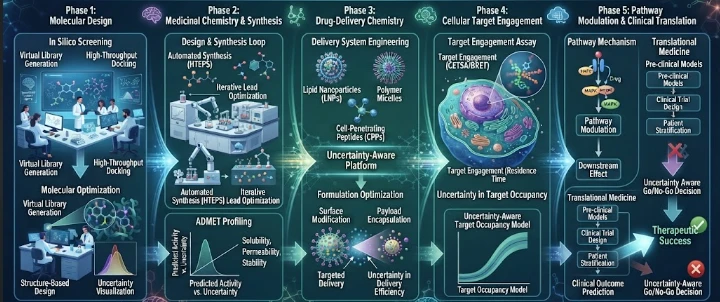
This article describes an uncertainty-aware platform for moving from predicted molecular binding to validated cellular target engagement in medicinal chemistry and drug-delivery research. Docking and machine-learning predictions can rapidly prioritize compounds, but they do not establish that a molecule reaches, occupies, and functionally modulates a target inside relevant cells. The article therefore separates predicted affinity from free intracellular concentration, subcellular localization, t
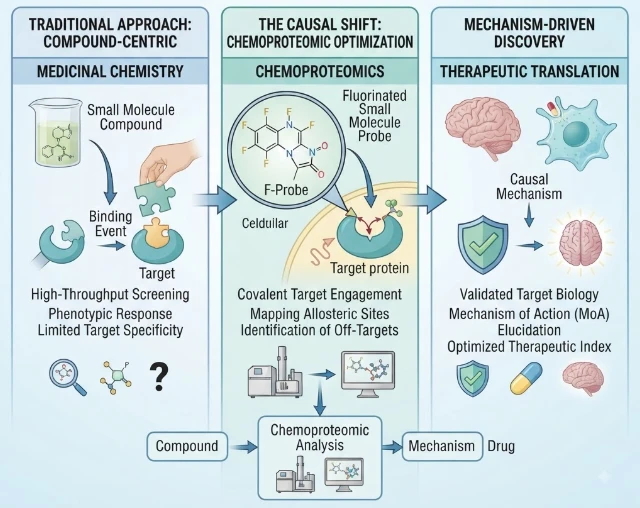
This article explores fluorinated medicinal chemistry through causal chemoproteomics, emphasizing that fluorine substitution can alter far more than potency. A single positional change can modify conformation, pKa, lipophilicity, metabolic stability, target interactions, intracellular exposure, and off-target biology. The article therefore tests whether fluorinated analogues change cellular phenotype through intended target engagement rather than hidden polypharmacology. Matched molecular pairs
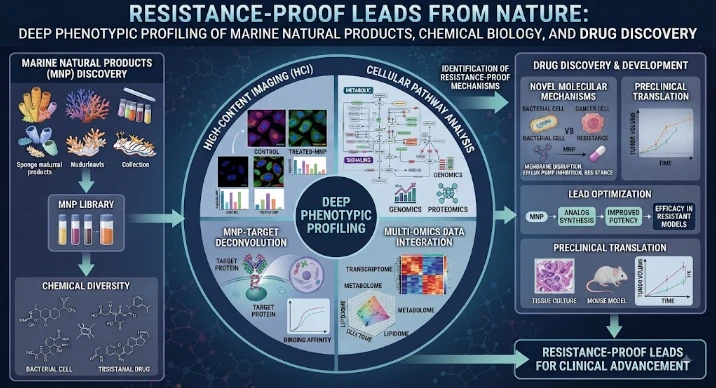
This article presents resistance-aware marine natural-product discovery as a mechanistic process rather than a search for isolated high-potency hits. It explains how activity from marine extracts or fractions can disappear during purification or fail under resistance pressure, making deep phenotypic profiling essential. Morphology, viability kinetics, organelle function, transcriptional state, metabolism, and recovery after washout are combined to connect phenotype with mechanism. The article em