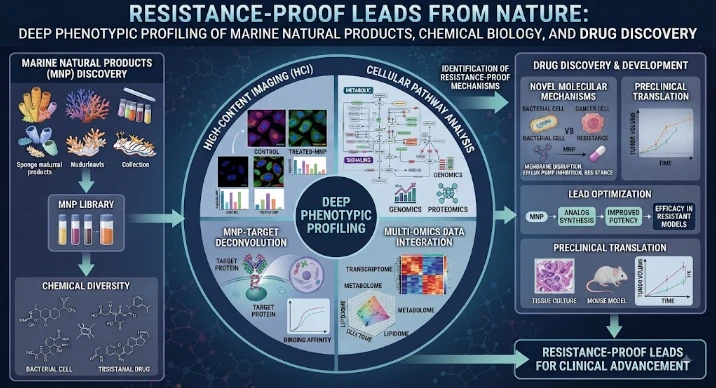
This article presents resistance-aware marine natural-product discovery as a mechanistic process rather than a search for isolated high-potency hits. It explains how activity from marine extracts or fractions can disappear during purification or fail under resistance pressure, making deep phenotypic profiling essential. Morphology, viability kinetics, organelle function, transcriptional state, metabolism, and recovery after washout are combined to connect phenotype with mechanism. The article emphasizes joint treatment of source organism, cultivation conditions, extraction method, fraction composition, stereochemistry, concentration, exposure time, and cellular genotype because improvements in one dimension can reduce stability, selectivity, delivery, or manufacturability elsewhere. Resistance routes such as target mutation, transporter upregulation, pathway bypass, stress adaptation, altered metabolism, and reduced intracellular accumulation are tested prospectively. Exposure, safety, scalable production, computational clustering, molecular networking, independent batches, and orthogonal validation are integrated into candidate selection. The central message is that marine novelty becomes therapeutically valuable only when mechanism, exposure, resistance, reproducibility, and production remain coherent together.
Resistance-Proof Leads from Nature reports one of the main challenges in marine natural products and chemical biology: the activity of a natural product extract, or an extract from the marine environment, when subjected to fractionation or to a selection pressure of resistance, may vanish. The more successful development strategy is based upon a measurable mechanism and not just an impressive assay result. Thus chemistry, biology, exposure, resistance, safety, and production become a part of one argument of translation.
The scientific underpinning is based on a process that couples deep phenotypic profiling of the morphology, viability kinetic, organelle function, transcriptional state, metabolism and recovery following washout. The mechanistic claim must be expressed in terms of each individual component, otherwise no isolated measurement could carry the entire mechanistic claim. When potency, binding, formulation performance and model fit are confused with understanding of the therapeutic action, the likelihood of such error is minimised with connected evidence.
The same is true of phenotypes and mechanisms, which must go hand in hand, and this is already evident in marine natural-products programs. The marine bacterial fraction libraries have been profiled using imaging, metabolomics and functional annotation, and older NCI-style cell panels have shown that structurally unusual marine metabolites are frequently found to have selective phenotypes prior to the identification of a target. Target mapping can be employed with modern chemical-genetic methods, after the phenotype emerges, thus maintaining the discovery value without having to preface all screens with a hypothesis about which target to screen.
Design variables need to be treated together as if they are all affecting the performance at the same time, due to the possibility of their changing, such as: performance of source organisms, cultivation conditions, extraction methods, fraction composition, scaffold stereochemistry, concentration, exposure time and cellular genotype. The optimization of one factor will often result in a hidden penalty for another factor, particularly if potency is linked to stability, selectivity, delivery or manufacturability. Multiparameter decision rules are thus a more realistic criterion for ranking candidates than a single number.
The ability to measure failure routes early is also a key aspect of mechanistic confidence. Target mutation, an increase in the number of transporters, pathway bypass, stress adaptation, changed metabolism and decreased intracellular accumulation are all important mechanisms of escape. Deliberate stress testing transforms these routes into design information which can be used for the next chemistry cycle, formulation, dosing or more model cycles.
Exposure is the link between the nominal dose and the biological effect. The following quantities are relevant: solubility, protein binding, permeability of membranes, intracellular retention, metabolic stability and tissue distribution. Strong intrinsic activity and weak exposure at the causal site may present a candidate with a great performance in simplified assays, but be unsuitable for translation.
The interpretation of direct engagement or functional perturbation should be at realistic concentrations. High doses may lead to secondary stress responses, endogenously occurring broad off-target effects or assay artifacts that simulate the desired mechanism. Concentration-response analysis, coupled with exposure and occupancy, can be used to pinpoint a range where the proposed causal process is thought to have an action.
Bacterial, fungal, spongelike, tunicate, algal and associated microbiomes are also influenced by interpretation in the biological context. Target dependence and effective exposure can vary between individuals due to differences in genotype, cell state, tissue architecture, immune tone, metabolic environment and previous treatment. Repeated testing in a single system is not as compelling as representative model panels.
Retrospective explanations should be deferred until the time for prospective measurements of resistance and adaptation. Mechanisms can be identified by serial passage or long term selection, genetic perturbation, repeated dosing or environmental stress. A candidate who is not quite as strong but easier to lose is not quite as valuable as a wimpy screening leader.
The combination of safety assessment with mechanism provides a more informative assessment. Selectivity of malignant, infected, healthy and primary cell systems, as well as mitochondrial, membrane and genotoxicity signals, are all important concerns. The desirable, as well as the undesirable, biological effects can be compared to determine pharmacology versus general cellular damage or formulation toxicity.
The downstream logistics of manufacturing should not be a repeatable cultivation, taxonomic traceability, dereplication, scaling up isolation, fermentation and stable analytical fingerprint of the product that is fed into the biological systems. Even if the product name is the same, a small change in the process could result in a change in the product's composition, physical state, impurity load, stability, or dose reproducible. Enhancing the robustness of development is facilitated by having critical process attributes be directly tied to mechanistic performance.
Phenotypic clustering, similarity-network fusion, image embeddings, metabolomic molecular networking and uncertainty-aware ranking are the four types of computational tools that provide leverage. There is most usefulness in prediction when there is ambiguity and applicability limits still present, particularly where there are new chemical structures, unusual biological states or where there is little data. Confident models with no indication of uncertainty for ranking experiments do not benefit experiment selection well.
The following methods are required for prospective validation: resynthesis or reisolation, inactive-analogue controls, genetic perturbation, target rescue, independent batches and exposure-normalized replication. Orthogonal tests are important because if repeated, tests from the same assay family can give the same hidden bias which doesn't strengthen the causality. When two or more independent methods agree there is greater confidence in the link from design to biological effect; when they disagree, then the assumptions must be changed.
Data should be traceable from raw experiment to development decision in data integration. Chemical structures, assay conditions, assay metadata, exposure data, omics data and resistance data and safety signals must be identified and versioned. This discipline will keep the interpretation from straying from the actual circumstances that created a result later on.
Decision metrics also must incorporate translation and not laboratory show. Helpful scorecards include: Reproducibility, Exposure-normalized Activity, Mechanistic confidence, Resistance frequency, Safety margin, Stability, Manufacturing robustness. This will encourage balanced candidates and allow for better trade-offs to be seen before major development investments are made.
In this context, negative result is a special value. The edge of a hypothesis is determined by: Failed synthesis, missing target engagement, unstable exposure, absence of rescue, emergence of resistance, poor batch reproducibility, loss of activity in realistic models. Documenting failures helps to enhance the design of future experiments, and avoids reinvestments in appealing, but unsupported explanations.
Another key filter is the reproducibility across laboratories and batches. When it appears the results are significant, a mechanism relying on a single operator, single preparation, single cell line, or single modeling option is inherently fragile. When conditions are repeated independently, and with exposure matched, it is then a matter of durable biology or local experimental success.
The clinical or deployment environment also needs to be taken into account for translation. The value of a technically advanced product may depend on the route, administrative requirements, diagnostic needs, storage requirements, monitoring requirements, costs and timing of treatment. Mechanistic excellence has impact when the product design is appropriate in the context in which biological benefit needs to happen.
Temporal design also comes into play since biological systems react differently to short exposure (pulse) and long exposure, washout and repeated dose. Time-resolved measurements are able to distinguish between primary engagement and downstream adaptation and can provide information on the continued activity in the downstream after the initiating activity has ceased. Sampling schedules will thus require one that is compatible with the expected kinetics of marine natural products and chemical biology, rather than one convenient endpoint.
An integrated development record (IDR) helps to facilitate better communication among medicinal chemistry, formulation science, pharmacology, computation, manufacturing and clinical planning. Rather than giving just one final story, the record can differentiate between known connections, reasonable guesses, unanswered questions, and the next experiment with the greatest amount of information. With that transparency, iteration becomes quicker and there's less pressure to stick to initial assumptions in the face of conflicting data.
Novelty is held in check by reference to credible reference conditions. Whether a new approach is an improvement in prediction, mechanism, durability or manufacturability is determined by established compounds, inactive compounds, standard formulation, baseline models or accepted analytical methods. Head-to-head comparison also allows a comparison of gains that are lost after normalizing the data for exposure, assay sensitivity, batch quality, or experimental complexity.
The greater the quality of the decision, the more the quality of the synthesis and test is improved when predefined stopping rules prevent the use of a weak hypothesis for repeated cycles of synthesis and test. Resources are targeted specifically to mechanisms and show clear progression criteria, which allow mechanisms to be repeated with increasing biological and operational complexity.
When novelty is used as the starting point, not the end, of the screening process, resistance-aware marine discovery is best. The criteria are not whether a candidate wins one assay, but whether proposed mechanism is coherent across all exposure, biological variation, resistance, safety and production. That standard puts in place a more "disciplined" way to go from discovery signal to a therapeutic concept that will be able to stand the complexity of the real world.
CITE THIS ARTICLE
Kabir, M. H. (2025). Resistance-Proof Leads from Nature: Deep Phenotypic Profiling of Marine natural products, chemical biology and drug discovery. https://researchbykabir.com/article/c3af49d6-8c48-5270-825e-d34b0520b089
M. H. Kabir, “Resistance-Proof Leads from Nature: Deep Phenotypic Profiling of Marine natural products, chemical biology and drug discovery,” 2025. [Online]. Available: https://researchbykabir.com/article/c3af49d6-8c48-5270-825e-d34b0520b089
Kabir, M. H. (2025) ‘Resistance-Proof Leads from Nature: Deep Phenotypic Profiling of Marine natural products, chemical biology and drug discovery’. Available at: https://researchbykabir.com/article/c3af49d6-8c48-5270-825e-d34b0520b089
Kabir, Md. Humayan. “Resistance-Proof Leads from Nature: Deep Phenotypic Profiling of Marine natural products, chemical biology and drug discovery.” 2025, https://researchbykabir.com/article/c3af49d6-8c48-5270-825e-d34b0520b089.
Md. Humayan Kabir. “Resistance-Proof Leads from Nature: Deep Phenotypic Profiling of Marine natural products, chemical biology and drug discovery.” (2025). https://researchbykabir.com/article/c3af49d6-8c48-5270-825e-d34b0520b089.
Kabir MH. Resistance-Proof Leads from Nature: Deep Phenotypic Profiling of Marine natural products, chemical biology and drug discovery. 2025. https://researchbykabir.com/article/c3af49d6-8c48-5270-825e-d34b0520b089
@misc{article_c3af49d68c485270825ed34b0520b089,
  title = {Resistance-Proof Leads from Nature: Deep Phenotypic Profiling of Marine natural products, chemical biology and drug discovery},
  author = {Md. Humayan Kabir},
  year = {2025},
  url = {https://researchbykabir.com/article/c3af49d6-8c48-5270-825e-d34b0520b089},
}
TY  - GEN
AU  - Md. Humayan Kabir
TI  - Resistance-Proof Leads from Nature: Deep Phenotypic Profiling of Marine natural products, chemical biology and drug discovery
PY  - 2025-06-15
UR  - https://researchbykabir.com/article/c3af49d6-8c48-5270-825e-d34b0520b089
ER  -
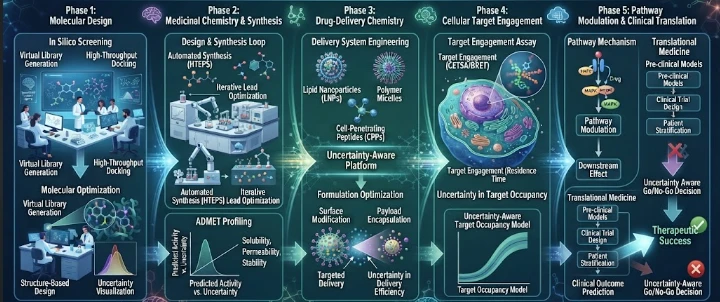
This article describes an uncertainty-aware platform for moving from predicted molecular binding to validated cellular target engagement in medicinal chemistry and drug-delivery research. Docking and machine-learning predictions can rapidly prioritize compounds, but they do not establish that a molecule reaches, occupies, and functionally modulates a target inside relevant cells. The article therefore separates predicted affinity from free intracellular concentration, subcellular localization, t
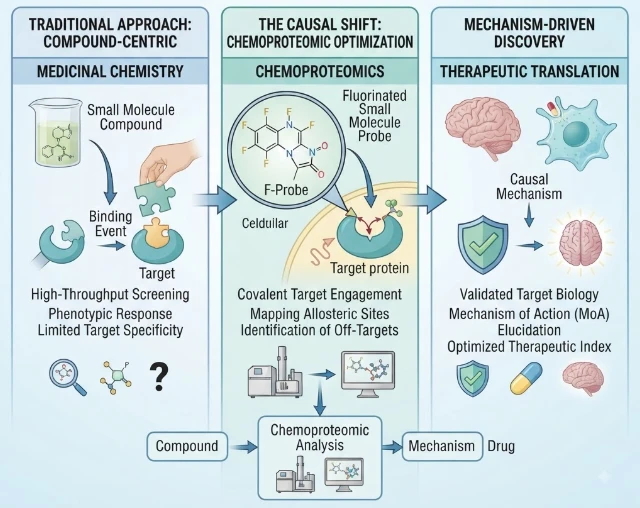
This article explores fluorinated medicinal chemistry through causal chemoproteomics, emphasizing that fluorine substitution can alter far more than potency. A single positional change can modify conformation, pKa, lipophilicity, metabolic stability, target interactions, intracellular exposure, and off-target biology. The article therefore tests whether fluorinated analogues change cellular phenotype through intended target engagement rather than hidden polypharmacology. Matched molecular pairs
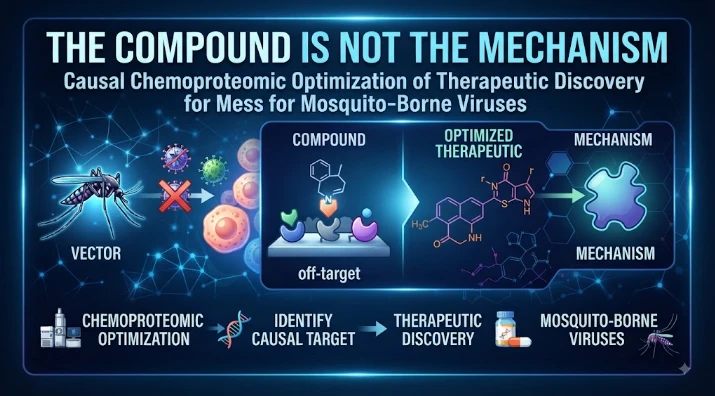
This article argues that an antiviral compound should be treated as a tool for discovering mechanism rather than as proof of mechanism itself. Focused on mosquito-borne viruses, it explains how chemoproteomics can connect phenotypic antiviral activity to direct protein interactions and then determine which interactions are causally responsible for reduced viral replication. Affinity probes, competition experiments, photo-crosslinking, thermal proteome profiling, cellular thermal shift assays, an