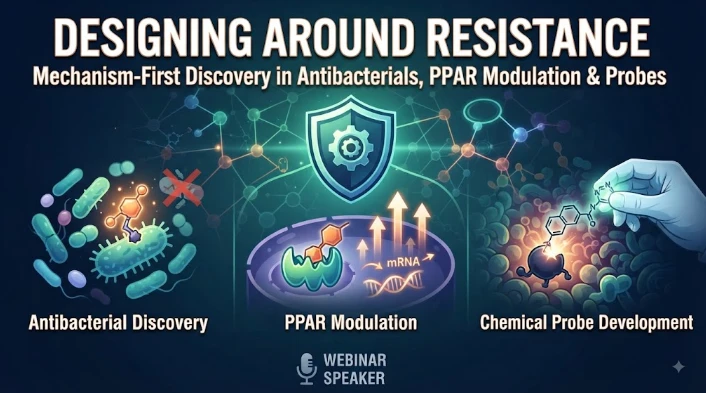
This article integrates antibacterial discovery, PPAR modulation, and chemical probe development within a resistance-aware mechanistic framework. It emphasizes that infection-model activity can arise from direct bacterial killing, host metabolic modulation, anti-inflammatory effects, or combinations of these processes. Chemical probes, bacterial genetics, and isoform-selective receptor assays are therefore needed to keep bacterial and host mechanisms distinct. Bacterial species, growth state, target essentiality, host-cell context, PPAR isoform activity, probe concentration, uptake, and combination partner are treated as interacting variables. Escape mechanisms include target mutation, efflux, permeability loss, enzymatic inactivation, metabolic bypass, persister formation, biofilm protection, and host-pathway compensation. Intracellular and extracellular drug concentration, bacterial penetration, host-cell uptake, tissue distribution, protein binding, and dose duration define exposure. Safety assessment includes microbiome disruption, mitochondrial injury, host nuclear-receptor selectivity, hepatic effects, immune modulation, and off-target reactivity. Structure-guided design, chemogenomic similarity, pathway modeling, QSAR, resistant-mutant reconstruction, PPAR isoform controls, inactive probes, and rescue experiments support validation. The article argues that durable antibacterial therapy requires bacterial evolution and host pharmacology to be measured in the same decision framework.
Designing Around Resistance shows a central issue in the field of antibacterial discovery, PPAR modulation, and the development of chemical probes: the power to kill bacteria can be lost due to very rapid resistance, and the ability to modulate the PPAR or other host-directed chemistry brings additional mechanism and safety complexities. The better development strategy focuses on a quantifiable mechanism instead of one great assay result. That change puts chemistry, biology, exposure, resistance, safety and production as part of one translation argument.
This scientific basis is based on a process that dissects the direct killing role of the bacteria, the modulation of host metabolism, the anti-inflammatory activity and the pathway interrogation in the context of the probe. The mechanistic claim needs to be supported by each component, and no single measurement can support the entire claim. By linking evidence, the risk of misinterpreting potency, binding, formulation performance or model fit as evidence of therapeutic knowledge is decreased.
There are different biological layers between the discovery of antibacterials and PPAR modulation - separation of mechanism is necessary. Direct antibiotics affect the processes of the bacteria, while the PPAR ligands modify the host's transcriptional programs associated with metabolism and inflammation. A compound that has been shown to have an effect in an infection model can thus lower the number of bacteria in the infection by killing bacteria or by changing the immune system of the host, or by both. Chemical probes, bacterial genetics and isoform selective receptor assays serve to maintain those explanations separate prior to the interpretation of combination strategies.
Joint treatment of design variables is necessary since the performance of the different bacterial species can vary as a function of the growth state, the essentiality of the target, the context of the host-cell, the activity of the different PPARs, the concentration of the probe, the uptake of the probe, and the combination of the probe with the target. When there is a tradeoff between potency and another factor, optimizing one factor alone may result in an un-explicit penalty that arises in the other.When there is a tradeoff between one factor and another, such as potency and stability, potency optimized alone may result in an un-explicit penalty on the other factor, such as stability, in the case of potency and stability. A multi-parameter decision rule is thus more realistic for candidate ranking than is a single numeric decision value.
Mechanistic confidence is also related to early failure route measurements. Target mutation, efflux, loss of permeability, enzymatic inactivation, metabolic bypass, persister formation, biofilm protection and host-pathway compensation are important escape mechanisms. When deliberately stress testing, these routes turn into design information to inform the next chemistry/ formulation/dosing/ model cycle.
There is a link between the nominal dose and the biological effect through the exposure. Important parameters are intracellular drug concentration, drug penetration, host-cell uptake, tissue distribution, protein binding and drug duration. In simplified assays, a candidate, which is very active in itself, but not exposed at the causal site, can appear very good, but is not good for translation.
Any interpretation will require direct engagement or functional perturbation to be done at realistic concentrations. High doses may lead to secondary stress response, off-target effects or assay artefacts which simulate a desired mechanism. The concentration-response analysis related to exposure and occupancy can be used to determine the concentration range in which the proposed causal process is thought to operate.
Products developed in pathogen-directed antibiotics with a chemical biology approach targeting host metabolic or inflammatory pathways are also influenced by biological context. Target dependence and effective exposure can vary depending on differences in genotype, cell state, tissue architecture, immune tone, metabolic environment and previous treatments. Representative model panels thus offer more convincing evidence than do repeated tests in a single system.
Adaptation and resistance should be measured in the future not explained in the past. When subjected to repeated pressure, such as serial passage, long-term selection, genetic perturbation, repeated dosing or environmental stress, the mechanisms that survive the pressure will be revealed. It's better to have a slightly less effective candidate with a better chance of getting away with it than a delicate screening leader.
Information on safety assessment is enhanced by association with mechanism. Some issues of concern are: disruption of the microbiome, damage to mitochondria, host nuclear-receptor selectivity, liver effects, immune modulation and off-target chemical reactivity. Relative to the desired engagement, there are unwanted biological responses that can be compared to determine if it is mechanism linked to pharmacology and/or broad cellular injury or formulation driven toxicity.
The downstream logistics of manufacturing products can no longer be achieved because the synthetic route, probe quality, stereochemistry, purity, scale, formulation and stability of antibacterial and host-directed compounds impact the compound presented to the biological system. Changes in process can lead to composition changes, changes in the physical state of the product, increase in levels of impurities or stability issues, or change in dose reproducibility, even with the same nominal product name. The robustness of development is increased when critical aspects of the process are directly tied to the process's mechanistic action.
Resistance network analysis, structure-guided design, chemogenomic similarity, pathway modeling, QSAR and multiparameter selectivity scoring are computational tools that add leverage. Prediction is most useful where uncertainty and applicability limits are still apparent, particularly in the vicinity of novel chemical structures, unusual biological states or sparse data sets. Models which reveal uncertainty will lead to better experiment selections than models whose results are confident rankings without explicit statements of the location of the weakness in the evidence.
Prospective validation involves the use of resistant-mutant reconstruction, target rescue, PPAR isoform controls, inactive probes, orthogonal binding, infection models, and exposure-matched comparisons. Orthogonal tests are important because the same hidden bias can be replicated by repeated measurements of the same family of assays but not be more convincing of the causal effect. Consistency in independent approaches leads to better links between design choice and biological impact, and inconsistencies indicate potential changes in design assumptions.
Data integration should maintain the traceability of the data from the experiment stage to the development decision-making stage. Chemical structures, process conditions, assay metadata, exposure measurements, omics features, resistance observations and safety signals should be identified and analyzed in a stable manner (versioning). This discipline helps to avoid later interpretations going “off-piste” from the actual circumstances of a result.
Translation should not be a laboratory show, either, with decision metrics having to capture that. The scorecards that are useful include reproduction, exposure normalized activity, mechanistic confidence, resistance frequency, safety margin, stability and manufacturing robustness. This allows both a balanced offer and trade-offs to be revealed up front prior to costly development investments.
In this context, the negative results have a significantly higher value. The edge of a hypothesis is determined by the failure in synthesis, failure to find target engagement, instable exposure, lack of rescue, emergence of resistance, failure of a batch, or loss of activity in realistic models. The documentation of these failures enables better experimental design in future experiments and eliminates reinvestment into appealing, but not confirmed, explanations.
Another critical filter is reproducibility from lab to lab, and batch to batch. Believing that a mechanism works when there seems to be strong statistical evidence is not good science, even if the test is a single operator, a single preparation, a single cell line, or a single modeling. Exposure-matched independent repetition allows for a separation of durable biology from local experimental success.
There also needs to be a pragmatic perspective on clinical or deployment context in order to translate. A technically complex product may be worthless if it needs to be routed, is too burdensome to administer, requires complex diagnostics, is incompatible with storage, is too cumbersome to monitor, is too expensive, or if it can be used only at a certain time. Mechanism is important when it comes to product design, and impact is greater when it's used in the context where biological benefit needs to be realized.
The temporal design is an extra layer since biological systems will react differently to short pulses, prolonged exposure, washout and multiple dosing. The time resolved measurements can distinguish between primary engagement and adaptations downstream; and can show whether activity continues after the initiating one subsides. Sampling schedules are thus required to reflect the anticipated discovery, PPAR modulation, and chemical probe kinetics of antibacterials, and not be based on just one convenient endpoint.
An integrated development record facilitates better communication between medicinal chemistry, formulation science, pharmacology, computation, manufacturing and clinical planning. The record can include multiple links that have been established, potential hypotheses, holes in the knowledge, and next experiment with the most information value rather than just one definitive story. It eliminates the need to justify initial guesses as soon as they are challenged with data, and it makes iteration quicker.
Creative reference conditions provide a perspective on novelty when benchmarking. Whether a new approach is better at predicting, mechanism, durability, and/or manufacturability is determined by established compounds (known inactive controls), standard formulations, baseline models or accepted analytical methods. Head-to-head comparison also reveals advantages that would be masked by normalisation attempts for exposure, assay sensitivity, batch quality or experiment complexity.
When thinking about the mechanism first, the process of antibacterial discovery is more durable when the evolution of the bacteria and the pharmacology of the host are evaluated within the same framework of decision making. The deciding criterion is not being successful in one assay, it is the proposed mechanism not losing coherence throughout the four assays of exposure, biological variation, resistance and safety, as well as during production. That standard develops a more disciplined way from discovery signal to a therapeutic concept that will work in the real world.
CITE THIS ARTICLE
Kabir, M. H. (2025). Designing Around Resistance: Mechanism-First Discovery in Antibacterial discovery, PPAR modulation and chemical probe development. https://researchbykabir.com/article/a0946425-02dd-53be-bf72-118e23695cb0
M. H. Kabir, “Designing Around Resistance: Mechanism-First Discovery in Antibacterial discovery, PPAR modulation and chemical probe development,” 2025. [Online]. Available: https://researchbykabir.com/article/a0946425-02dd-53be-bf72-118e23695cb0
Kabir, M. H. (2025) ‘Designing Around Resistance: Mechanism-First Discovery in Antibacterial discovery, PPAR modulation and chemical probe development’. Available at: https://researchbykabir.com/article/a0946425-02dd-53be-bf72-118e23695cb0
Kabir, Md. Humayan. “Designing Around Resistance: Mechanism-First Discovery in Antibacterial discovery, PPAR modulation and chemical probe development.” 2025, https://researchbykabir.com/article/a0946425-02dd-53be-bf72-118e23695cb0.
Md. Humayan Kabir. “Designing Around Resistance: Mechanism-First Discovery in Antibacterial discovery, PPAR modulation and chemical probe development.” (2025). https://researchbykabir.com/article/a0946425-02dd-53be-bf72-118e23695cb0.
Kabir MH. Designing Around Resistance: Mechanism-First Discovery in Antibacterial discovery, PPAR modulation and chemical probe development. 2025. https://researchbykabir.com/article/a0946425-02dd-53be-bf72-118e23695cb0
@misc{article_a094642502dd53bebf72118e23695cb0,
  title = {Designing Around Resistance: Mechanism-First Discovery in Antibacterial discovery, PPAR modulation and chemical probe development},
  author = {Md. Humayan Kabir},
  year = {2025},
  url = {https://researchbykabir.com/article/a0946425-02dd-53be-bf72-118e23695cb0},
}
TY  - GEN
AU  - Md. Humayan Kabir
TI  - Designing Around Resistance: Mechanism-First Discovery in Antibacterial discovery, PPAR modulation and chemical probe development
PY  - 2025-03-23
UR  - https://researchbykabir.com/article/a0946425-02dd-53be-bf72-118e23695cb0
ER  -
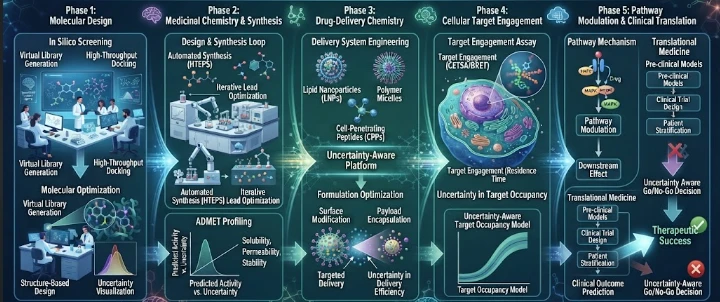
This article describes an uncertainty-aware platform for moving from predicted molecular binding to validated cellular target engagement in medicinal chemistry and drug-delivery research. Docking and machine-learning predictions can rapidly prioritize compounds, but they do not establish that a molecule reaches, occupies, and functionally modulates a target inside relevant cells. The article therefore separates predicted affinity from free intracellular concentration, subcellular localization, t
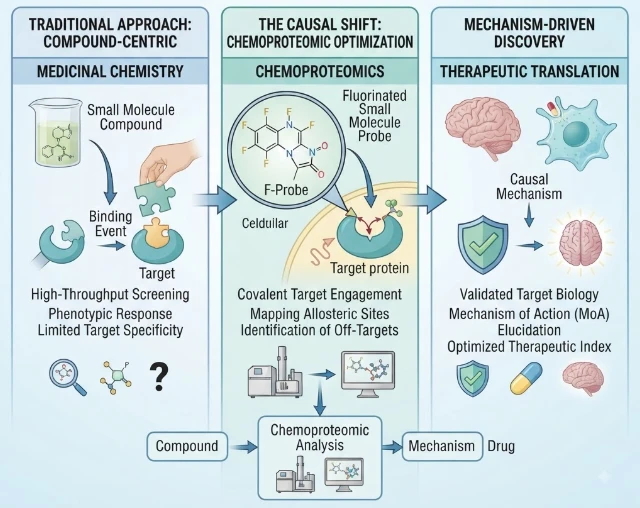
This article explores fluorinated medicinal chemistry through causal chemoproteomics, emphasizing that fluorine substitution can alter far more than potency. A single positional change can modify conformation, pKa, lipophilicity, metabolic stability, target interactions, intracellular exposure, and off-target biology. The article therefore tests whether fluorinated analogues change cellular phenotype through intended target engagement rather than hidden polypharmacology. Matched molecular pairs
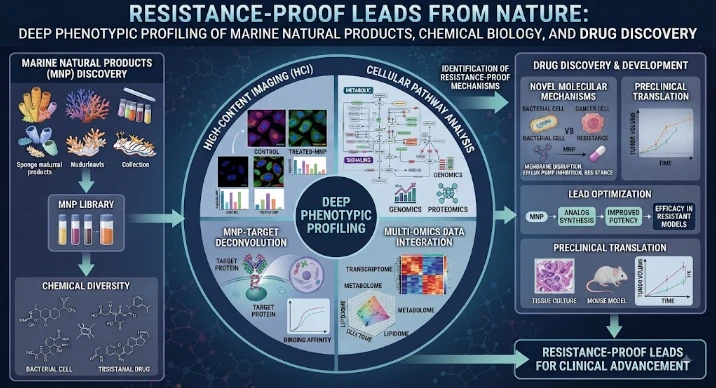
This article presents resistance-aware marine natural-product discovery as a mechanistic process rather than a search for isolated high-potency hits. It explains how activity from marine extracts or fractions can disappear during purification or fail under resistance pressure, making deep phenotypic profiling essential. Morphology, viability kinetics, organelle function, transcriptional state, metabolism, and recovery after washout are combined to connect phenotype with mechanism. The article em