Resistance-Proof Leads from Nature: Deep Phenotypic Profiling of Drug-Delivery Devices, Pharmaceutical Formulation, Medicinal Cannabis and Natural Products
Md. Humayan Kabir (Master of Science in Pharmaceutical Technology)
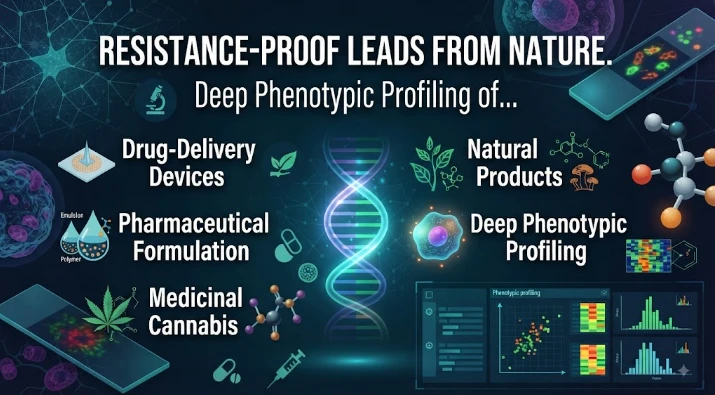
This article argues that natural-product and formulation discovery should progress beyond simple phenotypic hit finding toward deeper profiling of mechanism, exposure, resistance, and reproducibility. It treats natural products, medicinal-cannabis chemistry, delivery devices, and pharmaceutical formulations as systems in which composition, release behavior, tissue exposure, and biological state interact. High-content imaging, transcriptomics, proteomics, metabolomics, viability kinetics, and rescue experiments are presented as complementary tools for distinguishing direct pharmacology from downstream adaptation, nonspecific stress, or delivery failure. The article emphasizes multi-parameter optimization across potency, selectivity, stability, exposure, and manufacturability, supported by uncertainty-aware computational models. Biological diversity, resistance evolution, pharmacokinetics, safety margins, and manufacturing robustness are integrated early rather than addressed after lead selection. It also highlights the importance of realistic clinical-use conditions, data provenance, and constructive use of negative results. The core message is that durable natural-product leads emerge from connected evidence across mechanism, delivery, adaptation, safety, and scalable production rather than from isolated high-potency screening signals.
Natural products are still a very fertile source of chemical diversity. Simple hit finding has evolved past the phenotypic discovery of drugs delivered by devices, pharmaceuticals, medicinal cannabis, and natural products, as these can all yield apparent biological effects without providing lasting mechanisms. The more important question is, does a phenotype associated with a natural scaffold or a formulated product, maintain its stability under realistic biological and developmental conditions? That transition moves discovery from a ranking to a computational program that is designed around the notions of exposure, causation, and reproducibility. As the publication deadline nears the development of a phenotype becomes more and more dependent on relating molecular design to experiments which elucidate why a candidate is effective, where it fails, and which constraints are likely to be important.
Both composition and formulation characteristics of natural products, cannabis-based chemistry, delivery systems and advanced formulations can significantly affect the biological response. Observations over the history of the earth and in recent times demonstrate that an attractive laboratory signal quickly doesn't stand the test of increasing biological sophistication. Every successive layer (formulation to tissue exposure) is a new chance for the apparent mechanism to change. This is a good research procedure, then, to keep the original activity signal and test progressively more realistic conditions to see which features are necessary.
The first step in mechanistic depth is to map the cellular phenotype to target engagement, pathway response and formulation dependent exposure. This structure can be hidden in a simple endpoint assay due to similar endpoints from different causal pathways. The holistic approach of high content imaging, transcriptomics, proteomics, metabolomics, viability kinetics and rescue experiments allow to distinguished direct action from downstream adaptation, unspecific stress, or delivery failure. These types of measurements can transform an appealing reaction into an assessable link between chemistry, biological state, and functionality.
Design variables also have to be considered as interacting instead of as independent variables. The performance of an identity, stereochemistry, excipient choice, particle properties, cannabinoid composition, dose, release kinetics and state of the cell is an interplay and an improvement in one dimension may come at a cost in another. Therefore a practical optimization strategy will consider a trade-off between the different values rather than seeking the highest value. Multi-parameter profiles are particularly useful when potency, selectivity, stability, tissue exposure and manufacturability are all factors in the translational value.
Machine learning, morphological profiling, chemical similarity mapping and network analysis provide computational support, but prediction is only useful when there is uncertainty. Using models trained on known chemicals or biological structures, may result in poor performance on new scaffolds, unusual materials and underrepresented patient states. Expensive experiments don't build up until calibration, prospective testing, domain-of-applicability checks, and disagreement across model families are able to surface fragile predictions. Uncertainty no longer is a footnote, but a guide for experimental selection.
Orthogonal validation is beneficial to experimental design. Different types of answers to the causal question are provided by target-engagement assays, genetic perturbation studies, matched analogues, orthogonal imaging, and concentration-time studies, and all of these decrease reliance on any particular assay technology. A single experiment measuring the same endpoint multiple times is not as compelling as agreement across the various disciplines involving chemistry, imaging, omics, genetics and functional biology. Disagreement is also informative since conflicting results can show exposure limits that have not yet been detected, assay artifacts, compensatory pathways or context-dependent pharmacology.
Added complexity is the presence of biological diversity. The nominal treatment may be unaffected by changes in species origin, chemotype, extraction method, batch composition, patient biology, or tissue context that affect target abundance and/or barrier properties, metabolism, immune tone, or pathway dependence. This makes it difficult to detect subgroups that may have different exposure-response relationships by averaging the responses. Biological variation is part of design not an afterthought to explain inconsistent results with stratified analysis, representative model panels and explicit covariate testing.
Phenotypic activity may be lost after mutation of the target, rewiring of the pathway, efflux or changes in uptake; making resistance and adaptation important aspects to consider from the start. When activity is eliminated by evolutionary or compensatory pressure, serial exposure, resistant clones, cross-resistance panels, sequencing and pathway-rescue studies can be used to determine this. A weaker, but more potent inhibitor of common escape routes may be a better candidate than a weak, high potency lead. Additionally, resistance-aware development can help to refine mechanism since frequent escape changes tend to highlight the proteins, pathways, or exposure processes with the highest causal impacts.
Molecular promise to reachable biology through delivery and pharmacokinetics. The release rate, solubility, permeability, tissue retention, protein binding, device performance, and metabolic conversion dictates whether the active form is present at the target site at appropriate levels for an appropriate amount of time, and at a time when the proposed mechanism is expected to be present. This cannot be captured in a nominal dose since absorption, distribution, binding, transformation, clearance and local barriers are all important in altering effective exposure. Mechanistic exposure measures should then be included with efficacy measures from the earliest development stages.
Mechanism enhances the information provided by safety assessment. Additional tools include counter-screening, barrier integrity assays, inflammatory markers, organotypic models, and exposure-margin analysis, which can differentiate target-linked pharmacology from broad, non-targeted cellular injury, immune activation, reactive chemistry, and/or formulation-driven toxicity. Testing in disease relevant and healthy systems provides a comparator to determine if therapeutic activity is separable from unwanted effects. This will keep a potential signal of efficacy from progressing through a program, while the very same mechanism will suppress the window of exposure, without being noticed.
Another scientific variable other than a downstream logistics issue is manufacturing. Product quality, biological activity and exposure may change despite the fact that the nominal composition remains the same, if the source of the product is changed, conditions for extraction, formulation mixing, particle formation, tolerances and storage conditions. Quality-by-design thinking is based on the concept that a set of important material properties and process parameters are correlated with measurable performance, rather than solely end-stage specification testing. Scalability gains traction when the lab is successful despite raw-material differences, larger equipment, storage and transport, and independent production runs.
Realistic models of clinical use are also required for the translation. Timing of treatment, dose frequency, route, diagnostic needs, acceptable complexity, are influenced by route convenience, dose consistency, regulation, product standardization, and population heterogeneity. A technically attractive platform is not necessarily a useful platform if the administration requirements, storage considerations, monitoring requirements or cost of the platform preclude its use in the treatment context. Thus, a decision in the development process that has the advantage of mechanical efficiency and deployment viability is advantageous before it is too late to go back on a commitment.
The layers are connected by data integration. The chemical profile, formulation characteristics, imaging, omics signatures, pharmacokinetics, and phenotypic results can be connected to a common causal model, instead of being saved as distinct assay results. It is possible to learn iteratively and repeat the process with the help of traceable metadata, versioned models, standardized controls and prospective decision rules. The outcome is a development record which shows which candidate achieved the top ranking, and why they did so, but also which assumptions were made and which uncertainties were not resolved.
Phenotypic reproducibility across the batches of the compound, morphological signature stability, exposure-normalized activity, resistance frequency, release behavior and consistency of target engagement are useful decision metrics for this domain. Success metrics are enhanced by incorporating durability, reproducibility, exposure margin, biological breadth and manufacturing robustness as well as conventional potency into decision quality when considering success. These benchmarks prevent optimization for a single assay, and benefit candidates who are still viable with different tests. A clear score card also makes it easier to understand how a less significant outcome can sometimes be the better development option.
A good program also provides a constructive notion of failure. Negative results of inactive fractions, repeatable and reproducible batches, mechanistically ambiguous hits and exposure limited prototypes provide boundaries of the mechanism and help to limit repeated investment in weak hypotheses. If a synthesis fails, or it is not possible to achieve the target, or the exposure is unstable, or the resistance emerges, or the model indicates that the exposure in a subgroup is not effective, then the space searched by future models will be more realistic. Unsuccessful experiments are more likely to teach as much as successful experiments, so discovery is quicker.
Deeper phenotypic screening is thus required as opposed to larger screening collections to discover resistances from nature. The key strength of the central advantage is that it is a connected explanation to support mechanism, exposure, biological diversity, safety, and production. That organization helps with taking away the guesswork when selecting candidates for development, since each and every important development claim has an appropriate test. Instead of dazzling single experiments, progress will be judged by the consistency of a string of results that will be convincing as the complexity of the conditions change from laboratory to clinical.
CITE THIS ARTICLE
Kabir, M. H. (2026). Resistance-Proof Leads from Nature: Deep Phenotypic Profiling of Drug-Delivery Devices, Pharmaceutical Formulation, Medicinal Cannabis and Natural Products. https://researchbykabir.com/article/931b6d46-8f67-5c1e-b41e-596114cd9bb8
M. H. Kabir, “Resistance-Proof Leads from Nature: Deep Phenotypic Profiling of Drug-Delivery Devices, Pharmaceutical Formulation, Medicinal Cannabis and Natural Products,” 2026. [Online]. Available: https://researchbykabir.com/article/931b6d46-8f67-5c1e-b41e-596114cd9bb8
Kabir, M. H. (2026) ‘Resistance-Proof Leads from Nature: Deep Phenotypic Profiling of Drug-Delivery Devices, Pharmaceutical Formulation, Medicinal Cannabis and Natural Products’. Available at: https://researchbykabir.com/article/931b6d46-8f67-5c1e-b41e-596114cd9bb8
Kabir, Md. Humayan. “Resistance-Proof Leads from Nature: Deep Phenotypic Profiling of Drug-Delivery Devices, Pharmaceutical Formulation, Medicinal Cannabis and Natural Products.” 2026, https://researchbykabir.com/article/931b6d46-8f67-5c1e-b41e-596114cd9bb8.
Md. Humayan Kabir. “Resistance-Proof Leads from Nature: Deep Phenotypic Profiling of Drug-Delivery Devices, Pharmaceutical Formulation, Medicinal Cannabis and Natural Products.” (2026). https://researchbykabir.com/article/931b6d46-8f67-5c1e-b41e-596114cd9bb8.
Kabir MH. Resistance-Proof Leads from Nature: Deep Phenotypic Profiling of Drug-Delivery Devices, Pharmaceutical Formulation, Medicinal Cannabis and Natural Products. 2026. https://researchbykabir.com/article/931b6d46-8f67-5c1e-b41e-596114cd9bb8
@misc{article_931b6d468f675c1eb41e596114cd9bb8,
  title = {Resistance-Proof Leads from Nature: Deep Phenotypic Profiling of Drug-Delivery Devices, Pharmaceutical Formulation, Medicinal Cannabis and Natural Products},
  author = {Md. Humayan Kabir},
  year = {2026},
  url = {https://researchbykabir.com/article/931b6d46-8f67-5c1e-b41e-596114cd9bb8},
}
TY  - GEN
AU  - Md. Humayan Kabir
TI  - Resistance-Proof Leads from Nature: Deep Phenotypic Profiling of Drug-Delivery Devices, Pharmaceutical Formulation, Medicinal Cannabis and Natural Products
PY  - 2026-03-22
UR  - https://researchbykabir.com/article/931b6d46-8f67-5c1e-b41e-596114cd9bb8
ER  -
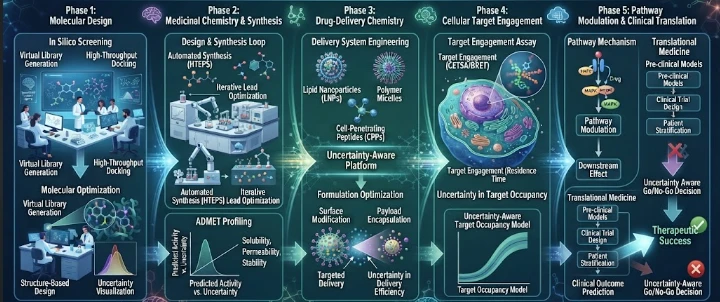
This article describes an uncertainty-aware platform for moving from predicted molecular binding to validated cellular target engagement in medicinal chemistry and drug-delivery research. Docking and machine-learning predictions can rapidly prioritize compounds, but they do not establish that a molecule reaches, occupies, and functionally modulates a target inside relevant cells. The article therefore separates predicted affinity from free intracellular concentration, subcellular localization, t
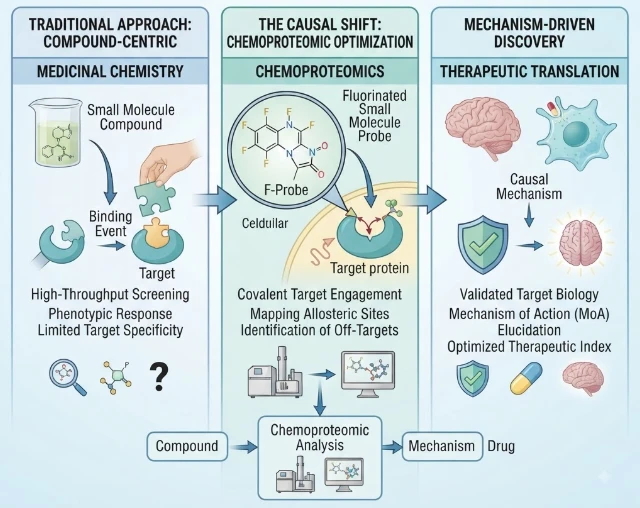
This article explores fluorinated medicinal chemistry through causal chemoproteomics, emphasizing that fluorine substitution can alter far more than potency. A single positional change can modify conformation, pKa, lipophilicity, metabolic stability, target interactions, intracellular exposure, and off-target biology. The article therefore tests whether fluorinated analogues change cellular phenotype through intended target engagement rather than hidden polypharmacology. Matched molecular pairs
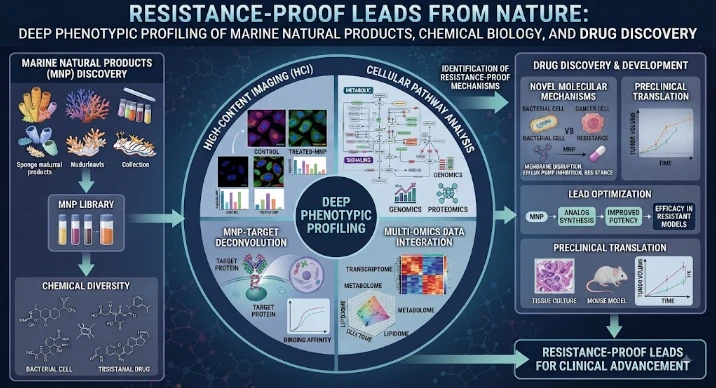
This article presents resistance-aware marine natural-product discovery as a mechanistic process rather than a search for isolated high-potency hits. It explains how activity from marine extracts or fractions can disappear during purification or fail under resistance pressure, making deep phenotypic profiling essential. Morphology, viability kinetics, organelle function, transcriptional state, metabolism, and recovery after washout are combined to connect phenotype with mechanism. The article em