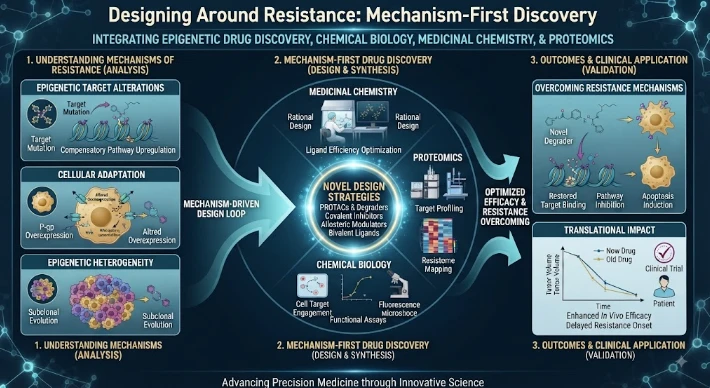
This article treats epigenetic drug resistance as an adaptive biological process that should be engineered around from the beginning of discovery. It centers on chromatin state, DNA methylation, histone modification, transcriptional plasticity, and clonal selection, showing how initially sensitive tumor cells can reorganize regulatory programs under treatment pressure. Longitudinal perturbation studies, resistant-clone sequencing, chromatin profiling, quantitative proteomics, and orthogonal target-engagement assays are presented as the main tools for distinguishing temporary suppression from disruption of relapse pathways. The article emphasizes explicit testing of alternative explanations such as off-target activity, parallel pathways, exposure differences, and measurement bias. Tumor lineage, prior therapy, co-mutation pattern, and baseline chromatin state are treated as important context variables. Safety, combination design, dosing sequence, biomarker timing, manufacturing consistency, and prospective model validation are integrated into the same framework. Overall, the article argues that resistance should become a design constraint, with mechanistic confidence built through longitudinal, reproducible challenge experiments rather than one favorable endpoint.
While traditional ideas of potency, delivery, or ‘association' are essential to the development of modern drugs, epigenetic drug resistance is shifting to the question of how and why it happens, and how and when this phenomenon can be relied upon. The mechanistic hub of this transition is a chromatin state, DNA methylation, histone modification, transcriptional plasticity and clonal selection network. That network is important because it's possible for an initially sensitive population of tumor cells to reorganize regulatory programs that enable them to become tolerant, rather than obviously resistant, to the drug. A more robust development strategy will then recognize mechanism, context and uncertainty as co-dependent design variables, rather than different design activities carried out at different points in the development.
In 2024, another study was published that further supported the idea that epigenetic resistance is an adaptive response, not just a failure to be sensitive to the drug. Histone methylation targeted therapy (HMT) highlighted the possibility of development of resistance via changes in target biology and compensatory regulation of differentiation and/or proliferation. Cancer studies were also conducted that showed the cancer treatment pressure is associated with reversible changes in DNA methylation and clonal expansion, further highlighting the significance of plasticity. For discovery programs, these findings support the use of longitudinal study designs to measure the chromatin state before and during treatment, and after the development of resistance, rather than just at a single endpoint after resistance has occurred.
The real-world implication is a new discovery paradigm of longitudinal perturbation experiments, resistant-clone sequencing, chromatin profiling, quantitative proteomics and orthogonal target-engagement assays. None of these tools can be used for a specific decision in isolation – each only measures a portion of a larger biological or clinical process. Confidence increases with consistent conclusions drawn from independent measurements across the dose, time, model system and relevant biological context. It is important to note that discordant results do not necessarily mean that they are of no value, as the lack of consistency can sometimes be due to hidden mechanisms, assay artefacts, population differences or exposure constraints, and should be explored before further development of the assay becomes too costly.
In the context of decision making, the issue is whether the lead has just a single inhibitory effect at a single time point or whether it is interfering with the adaptive pathway leading to relapse. In order to answer this question, you have to make a clear comparison between the intended mechanism and possible alternative mechanisms such as off-target activity, alternative pathways, differential exposure, or measurement bias. The perturbation experiments of this kind are particularly informative as they determine whether the observed effect is due to the proposed one or not. The confidence should be based on the successful challenge testing and not on repeated confirmation in a single favourable assay.
Almost all results are different in epigenetic drug resistance when the context is changed. Relevant variation includes tumor lineage, previous treatment, co-mutation pattern and baseline chromatin state. A good intervention for one set of these factors can be less effective or more dangerous or have a different biological effect for a different set. Stratification is more useful when based on variables that relate to mechanism or exposure, rather than on descriptions of the causes of variation in treatment performance.
Broad chromatin disruption, context dependent target function, and fast compensatory signaling are all equal, as are risks. Early safety work is at its best when it follows the same mechanism as efficacy, enabling unwanted effects to be attributed to target biology, carrier behavior, exposure, metabolites or analytical bias. This not only minimizes risk that safety is a last-minute check list disconnected from discovery logic, but it also helps to avoid that risk. It also allows for more transparent trade-offs for more effective efficacy when either more exposure is needed, more pathway modulation is needed, or a longer persistence in sensitive tissue is required.
Another layer is presented by translational development including combination design, dosing sequence, timing of the biomarkers and patient selection of those who are genetically dependent for the specific biomarker. Experiments that replicate clinically relevant timing, concentration, biological barrier, treatment history and sources of heterogeneity are more informative of preclinical success. It is not especially helpful to obtain a "complex" model from a "simple" model, but it is helpful to obtain a series of models that will provide answers to specific uncertainty questions. A decision is needed for each step, whether to continue, redesign, reduce target population, change the dose, or get a different kind of mechanistic information.
It is important to note that both manufacturing and analytical control are equally crucial since the mechanism experiments are to be carried out simultaneously, and medicinal chemistry must maintain selectivity, exposure and tractable physicochemical properties. If the material tested is different from one batch to the next, or if the inputs to the assay are poorly characterized, then a biological explanation is of limited value. Critical attributes must thus have defined ranges, stringent measurements and documentation of the relationship between process parameters and biological performance. This is particularly crucial for complex molecules, nanoparticles, biomaterials, and studies involving large amounts of data for which small changes in exposure, signaling, and apparent treatment response can mean big differences.
The distinction between prediction and confirmation is also strengthened in the context of data analysis in the case of epigenetic drug resistance. While computational models, machine learning, causal estimators and mechanistic simulations can rank hypotheses, combine high-dimensional measurements, and quantify uncertainties, the output of models is not a form of truth. Useful models explicitly presume, calculate calibration, mark regions with insufficient evidence, and indicate information that will tip the next experiment toward a decision change. Prospective validation is still crucial as retrospective fit can be beneficial for a pattern that doesn't take hold in new populations, new batches, or new biotic conditions.
Another significant change has to do with time, as numerous processes crucial to epigenetic drug resistance develop following the first exposure. Depending on the single end point of "favorable", early response, adaptation, clearance, immune programming, tissue remodeling, adherence, or resistance might proceed on different paths. Longitudinal measurement determines if an event creates a state or a perturbation or a liability in the future. Time resolved data is also helpful when interpreting the cause of the proposed mechanism, since this data indicates if the proposed mechanism changes prior to the establishment of the downstream phenotype or occurs only after the outcome is set.
Efficient experimental design when all studies are associated with an actual uncertainty budget. Novelty alone is not the only factor to consider for ranking questions around chromatin state, DNA methylation, histone modification, transcriptional plasticity, and clonal selection by their ability to alter the adaptive trajectory that is capable of causing relapse, rather than just simply suppressing it at one time point. Complementary models are then replicated to determine if the conclusion is specific to an assay, laboratory conditions, or a population. This discipline helps to prevent unnecessary optimization, and can be helpful in cases where the experiment turns out negative, as each incorrect prediction reduces the number of possible mechanisms, which enhances the following optimization cycle.
Traceability between claims and measurements also is vital to regulatory and clinical credibility. However, for epigenetic drug resistance, the more robust a development package, the more connected are the raw observations, processing decisions, model assumptions, protocol deviations, and material attributes starting in early experiments and continuing to translational studies. This traceability can help weed out technical noise and aid in the subsequent review of any safety or effectiveness claims. It also provides a more solid foundation for revising conclusions with new data when they affect an earlier assumption.
There is a need to communicate more precisely with this field. Unless accompanied by a measurement, a comparator, population, and uncertainty range, the word is not helpful.Words like targeted, selective, durable, safe, predictive, or personalized are meaningless unless qualified by a measurement, comparator (such as set-point), population (such as all individuals in the population), and uncertainty range (such as if the measurement is between A and B). Negative results are more useful when it's easy to report, and exploratory results should not be reported as mechanisms. This precision provides a common ground for making judgments among researchers, developers, clinicians, and regulators whether a claim is based on actual measurement, calibrated inference, or an assumption that has not been tested.
The best answer to epigenetic drug resistance is in fact a more closed circuit between chemistry, or formulation, and mechanistic measurement, quantitative modeling, safety, manufacturing control and clinically relevant context. Bad assumptions that lead to failure are easier to uncover early and good mechanisms that are successful are subjected to deliberate hard tests so that they are more readily available for progress. That reasoning pumps resistance up to be a late design shock. The most valuable innovation is one that is the development system that learns from all the experiments and which places the interpretation of the causal mechanisms at the heart of all decisions, ensuring reproducibility and relevance to the real world.
CITE THIS ARTICLE
Kabir, M. H. (2025). Designing Around Resistance: Mechanism-First Discovery in Epigenetic Drug Discovery, Chemical Biology, Medicinal Chemistry and Proteomics. https://researchbykabir.com/article/71dd6c50-b719-5b6b-b8fb-0b5c57e8f569
M. H. Kabir, “Designing Around Resistance: Mechanism-First Discovery in Epigenetic Drug Discovery, Chemical Biology, Medicinal Chemistry and Proteomics,” 2025. [Online]. Available: https://researchbykabir.com/article/71dd6c50-b719-5b6b-b8fb-0b5c57e8f569
Kabir, M. H. (2025) ‘Designing Around Resistance: Mechanism-First Discovery in Epigenetic Drug Discovery, Chemical Biology, Medicinal Chemistry and Proteomics’. Available at: https://researchbykabir.com/article/71dd6c50-b719-5b6b-b8fb-0b5c57e8f569
Kabir, Md. Humayan. “Designing Around Resistance: Mechanism-First Discovery in Epigenetic Drug Discovery, Chemical Biology, Medicinal Chemistry and Proteomics.” 2025, https://researchbykabir.com/article/71dd6c50-b719-5b6b-b8fb-0b5c57e8f569.
Md. Humayan Kabir. “Designing Around Resistance: Mechanism-First Discovery in Epigenetic Drug Discovery, Chemical Biology, Medicinal Chemistry and Proteomics.” (2025). https://researchbykabir.com/article/71dd6c50-b719-5b6b-b8fb-0b5c57e8f569.
Kabir MH. Designing Around Resistance: Mechanism-First Discovery in Epigenetic Drug Discovery, Chemical Biology, Medicinal Chemistry and Proteomics. 2025. https://researchbykabir.com/article/71dd6c50-b719-5b6b-b8fb-0b5c57e8f569
@misc{article_71dd6c50b7195b6bb8fb0b5c57e8f569,
  title = {Designing Around Resistance: Mechanism-First Discovery in Epigenetic Drug Discovery, Chemical Biology, Medicinal Chemistry and Proteomics},
  author = {Md. Humayan Kabir},
  year = {2025},
  url = {https://researchbykabir.com/article/71dd6c50-b719-5b6b-b8fb-0b5c57e8f569},
}
TY  - GEN
AU  - Md. Humayan Kabir
TI  - Designing Around Resistance: Mechanism-First Discovery in Epigenetic Drug Discovery, Chemical Biology, Medicinal Chemistry and Proteomics
PY  - 2025-11-02
UR  - https://researchbykabir.com/article/71dd6c50-b719-5b6b-b8fb-0b5c57e8f569
ER  -
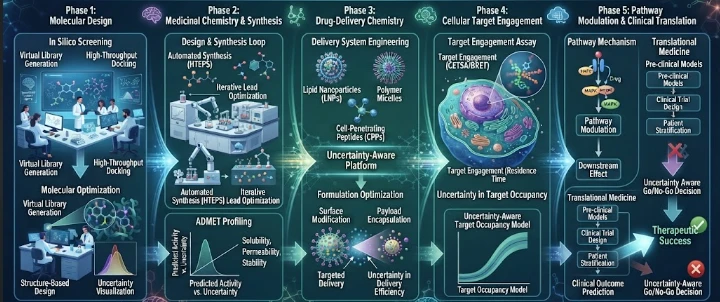
This article describes an uncertainty-aware platform for moving from predicted molecular binding to validated cellular target engagement in medicinal chemistry and drug-delivery research. Docking and machine-learning predictions can rapidly prioritize compounds, but they do not establish that a molecule reaches, occupies, and functionally modulates a target inside relevant cells. The article therefore separates predicted affinity from free intracellular concentration, subcellular localization, t
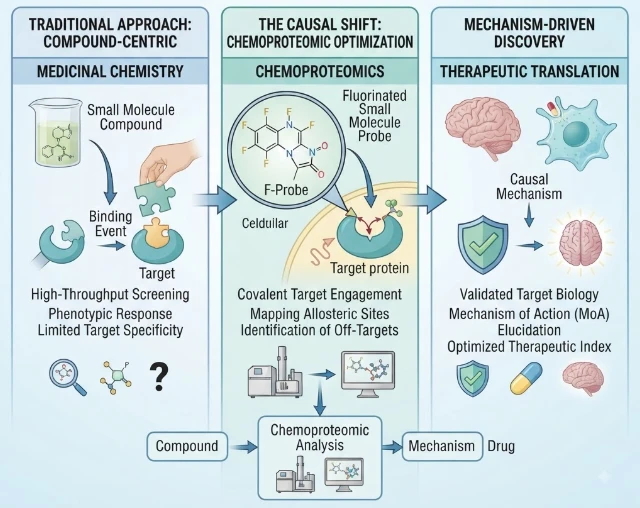
This article explores fluorinated medicinal chemistry through causal chemoproteomics, emphasizing that fluorine substitution can alter far more than potency. A single positional change can modify conformation, pKa, lipophilicity, metabolic stability, target interactions, intracellular exposure, and off-target biology. The article therefore tests whether fluorinated analogues change cellular phenotype through intended target engagement rather than hidden polypharmacology. Matched molecular pairs
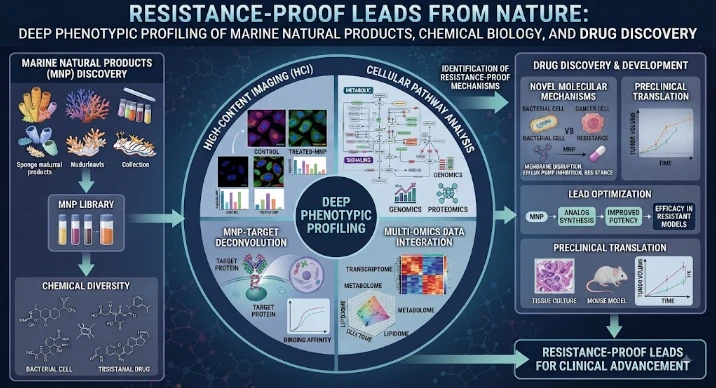
This article presents resistance-aware marine natural-product discovery as a mechanistic process rather than a search for isolated high-potency hits. It explains how activity from marine extracts or fractions can disappear during purification or fail under resistance pressure, making deep phenotypic profiling essential. Morphology, viability kinetics, organelle function, transcriptional state, metabolism, and recovery after washout are combined to connect phenotype with mechanism. The article em