From Biodiversity to Mechanism: Activity-Directed Discovery in Drug-Delivery Devices, Pharmaceutical Formulation, Medicinal Cannabis and Natural Products
Md. Humayan Kabir (Master of Science in Pharmaceutical Technology)
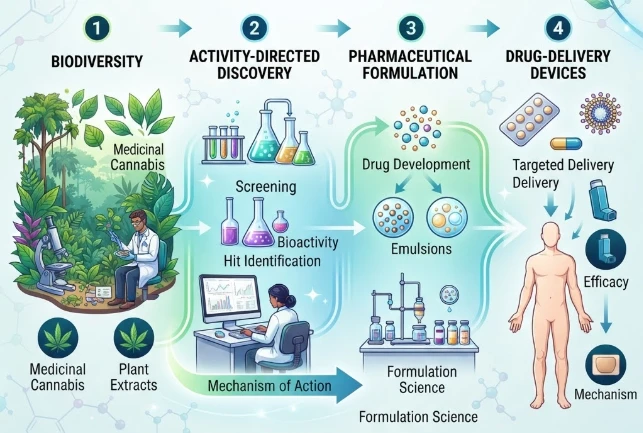
This article presents activity-directed discovery as a rigorous path from biodiversity to mechanism. It explains that an active plant, microbial, marine, or other natural-source extract does not automatically reveal a therapeutic mechanism because activity may arise from mixtures, multiple constituents, or formulation effects. Modern discovery therefore combines taxonomy, metabolomics, bioassay-guided fractionation, molecular networking, genome-guided approaches, high-resolution mass spectrometry, NMR, imaging, and target-engagement studies to trace activity from source material to a defined chemical and biological cause. The article stresses that design variables such as chemotype, extraction conditions, dose, formulation, and biological context interact and should be optimized together. It also integrates uncertainty-aware computation, orthogonal validation, resistance testing, pharmacokinetics, safety, manufacturing reproducibility, and realistic clinical-use considerations. Batch consistency, source authentication, scalable yield, and data provenance are treated as essential translational criteria. Overall, the article argues that biodiversity becomes therapeutically useful only when chemical diversity is converted into a reproducible, causally supported, scalable mechanism with credible exposure and development potential.
Although there is great opportunity in biodiversity for finding drugs, it is not enough to find an active ingredient in a plant or animal to indicate a therapeutic mechanism. Activity-directed discovery has gone beyond hit finding, as extracts, fractions, mixtures and formulated materials may contain multiple compounds, or presentation effects, which result in activity. A more interesting question is whether an activity signal, that can be followed from source material to a specific molecular and delivery mechanism, is stable under realistic biological and developmental conditions. This change in the way people discover shifts the focus from a ranking system to a mechanistic program of discovery that focuses on exposure, causality, and reproducibility. As activity-directed natural-product research becomes more advanced, progress becomes more reliant on the correlation of molecular design to experiments designed to elucidate why a candidate is successful, where its performance breaks down, and which constraints are most important.
Comprehensive natural-product programs in the modern era use a combination of taxonomy, metabolomics, bioassay and fractionation, molecular networking, and genome guided discovery to correlate biodiversity to testable chemistry. Observations over the history of the earth and in recent times demonstrate that an attractive laboratory signal quickly doesn't stand the test of increasing biological sophistication. A good research method is then to maintain the original activity signal while varying the features that are required with increasing fidelity.
Mechanistic depth begins by connecting the source organism, chemical property, biological target, pathway response and formulation dependent exposure. This structure can be hidden in a simple endpoint assay due to similar endpoints from different causal pathways. Bioassay-guided fractionation, high resolution mass spectrometry, NMR, metabolomics, imaging and target engagement studies give a more complete picture that allows for the distinction of direct action from downstream adaptation, nonspecific stress, or delivery failure. These types of measurements can transform an appealing reaction into an assessable link between chemistry, biological state, and functionality.
Design variables also have to be considered as interacting instead of as independent variables. All of these factors impacting on performance interact with each other and, improving one aspect of performance may lead to a degradation of another. Therefore a practical optimization strategy will consider a trade-off between the different values rather than seeking the highest value. Multi-parameter profiles are particularly useful when the following all influence the translational value of a compound: potency, selectivity, stability, tissue exposure, manufacturability.
But when uncertainty is apparent, molecular networking, chemoinformatics, multivariate statistics, and structure-based hypothesis generation provide computational leverage to prediction. Using models trained on known chemicals or biological structures, may result in poor performance on new scaffolds, unusual materials and underrepresented patient states. Fragile predictions are exposed by calibration, prospective testing, checking the domain-of-applicability and by disagreement across model families before costly experiments are performed. Uncertainty can then be a compass to guide experimental selection, rather than an inconvenient footnote.
Orthogonal validation is a plus in experimental design. Re-isolation, standard preparation, orthogonal target assays and loss of function approaches and controls for formulations address various aspects of the causal question and helps to minimize reliance on any particular assay technology. A single experiment measuring the same endpoint multiple times is not as compelling as agreement across the various disciplines involving chemistry, imaging, omics, genetics and functional biology. Disagreement is also informative since conflicting results can show exposure limits that have not yet been detected, assay artifacts, compensatory pathways or context-dependent pharmacology.
Added complexity is the presence of biological diversity. The nominal treatment may not change, but target abundance, barrier properties, metabolism, immune tone, or pathway dependence can change because of ecological source, season, cultivation conditions, chemotype, microbiome contribution, processing history, and/or tissue state. Average responses thus have the potential for obscuring subgroups that have varying exposure-response relationships. Biological variation is part of the design, not the explanation of inconsistent results, using stratified analysis and representative model panels, and explicit covariate testing.
Resistance and adaptation must be addressed early as the complex activity may fail when one target, transport pathway or metabolic step is targeted. Activity can be lost through evolutionary (or compensatory) pressure and can be detected using cross-resistance panels, serial passage, resistant isolate sequencing, combination testing, and mechanism-rescue experiments. A weaker, but more potent inhibitor of common escape routes may be a better candidate than a weak, high potency lead. Resistance-aware development also fines tunes mechanism as recurrent escape changes frequently reveal the proteins, pathways or process of exposure that have the greatest causal role.
Molecular promise to reachable biology through delivery and pharmacokinetics. Whether the active form is delivered to the desired site in a concentration and duration appropriate for the proposed mechanism depends on the bioavailability, solubility, formulation release, membrane transport, tissue partitioning, metabolism and delivery via the device. This is not possible with a single dose number, as absorption, distribution, binding, transformation, clearance and barriers in the tissues affect effective exposure. Mechanistic exposure measures should then be included with efficacy measures from the earliest development stages.
Mechanism enhances the information provided by safety assessment. Pharmacology on the target compared to off-target panels, inflammation readouts, organotypic models and impurity assessment allow for distinction between target-driven pharmacology and broad cellular injury, immune activation, reactive chemistry, or formulation-driven toxicity. Testing in disease relevant and healthy systems provides a comparator to determine if therapeutic activity is separable from unwanted effects. This will keep a potential signal of efficacy from progressing through a program, while the very same mechanism will suppress the window of exposure, without being noticed.
Another scientific variable, not a downstream logistics issue is manufacturing. Changes in the nominal composition of the product can lead to changes in product quality, biological activity, and exposure, depending on the method used to source, botanical or microbial authentication, extraction control, reproducibility of the fraction, purification or scale up of the formulation. Quality-by-design thinking is based on the concept that a set of important material properties and process parameters are correlated with measurable performance, rather than solely end-stage specification testing. Laboratory success is achieved and even more believable when it passes raw-material variations, larger equipment, storage and transport, and independent production runs.
There is also a need for realistic models of clinical use in the process of translation. The treatment timing, treatment dose, route of administration, requirements for suitable diagnostics, and treatment complexity are influenced by product standardization, rout, dose reproducibility, regulatory pathway, indication, and access to suitable diagnostics. The ability to administer a technically perfect platform is not the same as the ability to do so in a way that is clinically useful in the setting where the treatment is required.A technically elegant platform that requires a lot of administration, or is not easy to store, monitor, or causes a cost conflict with the setting where the treatment is needed, loses some of its clinical value. Thus, a decision in the development process that has the advantage of mechanical efficiency and deployment viability is advantageous before it is too late to go back on a commitment.
The layers are connected by data integration. Numerous taxonomic records, chromatographic fingerprints, spectrum features, bioactivity maps, target data, pharmacokinetics, formulation properties and other outputs of an assay can be tied to a common causal model, instead of being isolated as outputs from the assay. It is possible to learn iteratively and repeat the process with the help of traceable metadata, versioned models, standardized controls and prospective decision rules. The end outcome is a development record that provides an explanation of which candidate ranked-1, as well as assumptions that were made to reach that conclusion and uncertainties that were not addressed.
Tracking enrichment factor, chemical novelty, target confirmation, batch reproducibility, exposure-normalized potency, resistance frequency and scalable yield are advantages of activity-directed programs. Success metrics are enhanced by incorporating durability, reproducibility, exposure margin, biological breadth and manufacturing robustness as well as conventional potency into decision quality when considering success. These benchmarks prevent optimization for a single assay, and benefit candidates who are still viable with different tests. It is also helpful to have a clear scorecard, and understand why a less dramatic result might be the better development option.
A good program also provides a constructive notion of failure. Failure of inactive purified constituents, unstable fractions, batch-dependent signals, false target assignments and non-scalable source materials as negative results provide boundaries of the mechanism and limit the need for repeated investment of weak hypotheses. Future models are better informed of the search space by recording the failure to synthesize, no search of target, unstable exposure, emergence of resistance, and loss of effect in the subgroups. Discovering is quickened if failure teaches more than success.
Biodiversity is made therapeutically useful when there is an activity-directed discovery that transforms the diversity of chemicals found in nature into a reproducible causal mechanism. The key strength of the central advantage is that it is a connected explanation to support mechanism, exposure, biological diversity, safety, and production. That organization helps with taking away the guesswork when selecting candidates for development, since each and every important development claim has an appropriate test. Instead of dazzling single experiments, progress will be judged by the consistency of a string of results that will be convincing as the complexity of the conditions change from laboratory to clinical.
CITE THIS ARTICLE
Kabir, M. H. (2026). From Biodiversity to Mechanism: Activity-Directed Discovery in Drug-Delivery Devices, Pharmaceutical Formulation, Medicinal Cannabis and Natural Products. https://researchbykabir.com/article/6ef0c612-98e3-5588-bdc8-472abb3d1dba
M. H. Kabir, “From Biodiversity to Mechanism: Activity-Directed Discovery in Drug-Delivery Devices, Pharmaceutical Formulation, Medicinal Cannabis and Natural Products,” 2026. [Online]. Available: https://researchbykabir.com/article/6ef0c612-98e3-5588-bdc8-472abb3d1dba
Kabir, M. H. (2026) ‘From Biodiversity to Mechanism: Activity-Directed Discovery in Drug-Delivery Devices, Pharmaceutical Formulation, Medicinal Cannabis and Natural Products’. Available at: https://researchbykabir.com/article/6ef0c612-98e3-5588-bdc8-472abb3d1dba
Kabir, Md. Humayan. “From Biodiversity to Mechanism: Activity-Directed Discovery in Drug-Delivery Devices, Pharmaceutical Formulation, Medicinal Cannabis and Natural Products.” 2026, https://researchbykabir.com/article/6ef0c612-98e3-5588-bdc8-472abb3d1dba.
Md. Humayan Kabir. “From Biodiversity to Mechanism: Activity-Directed Discovery in Drug-Delivery Devices, Pharmaceutical Formulation, Medicinal Cannabis and Natural Products.” (2026). https://researchbykabir.com/article/6ef0c612-98e3-5588-bdc8-472abb3d1dba.
Kabir MH. From Biodiversity to Mechanism: Activity-Directed Discovery in Drug-Delivery Devices, Pharmaceutical Formulation, Medicinal Cannabis and Natural Products. 2026. https://researchbykabir.com/article/6ef0c612-98e3-5588-bdc8-472abb3d1dba
@misc{article_6ef0c61298e35588bdc8472abb3d1dba,
  title = {From Biodiversity to Mechanism: Activity-Directed Discovery in Drug-Delivery Devices, Pharmaceutical Formulation, Medicinal Cannabis and Natural Products},
  author = {Md. Humayan Kabir},
  year = {2026},
  url = {https://researchbykabir.com/article/6ef0c612-98e3-5588-bdc8-472abb3d1dba},
}
TY  - GEN
AU  - Md. Humayan Kabir
TI  - From Biodiversity to Mechanism: Activity-Directed Discovery in Drug-Delivery Devices, Pharmaceutical Formulation, Medicinal Cannabis and Natural Products
PY  - 2026-03-15
UR  - https://researchbykabir.com/article/6ef0c612-98e3-5588-bdc8-472abb3d1dba
ER  -
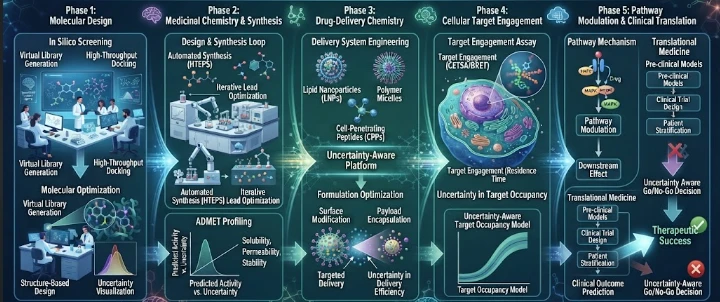
This article describes an uncertainty-aware platform for moving from predicted molecular binding to validated cellular target engagement in medicinal chemistry and drug-delivery research. Docking and machine-learning predictions can rapidly prioritize compounds, but they do not establish that a molecule reaches, occupies, and functionally modulates a target inside relevant cells. The article therefore separates predicted affinity from free intracellular concentration, subcellular localization, t
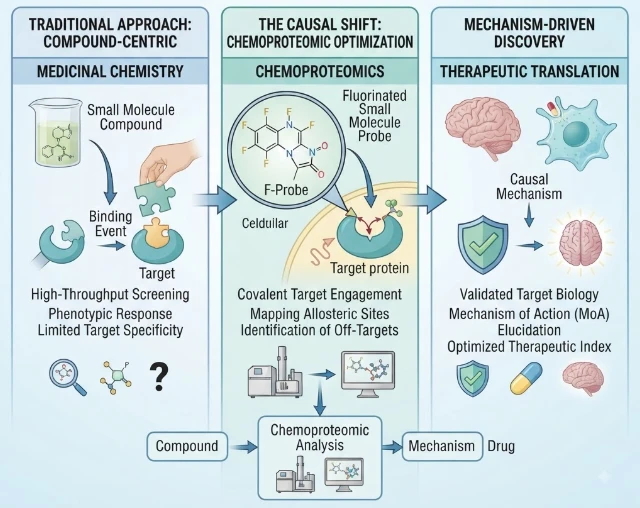
This article explores fluorinated medicinal chemistry through causal chemoproteomics, emphasizing that fluorine substitution can alter far more than potency. A single positional change can modify conformation, pKa, lipophilicity, metabolic stability, target interactions, intracellular exposure, and off-target biology. The article therefore tests whether fluorinated analogues change cellular phenotype through intended target engagement rather than hidden polypharmacology. Matched molecular pairs
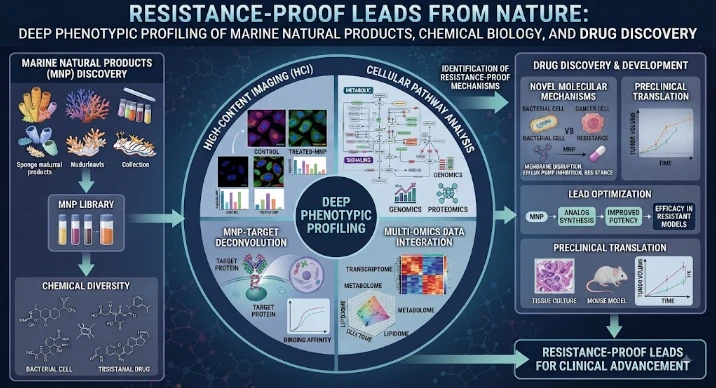
This article presents resistance-aware marine natural-product discovery as a mechanistic process rather than a search for isolated high-potency hits. It explains how activity from marine extracts or fractions can disappear during purification or fail under resistance pressure, making deep phenotypic profiling essential. Morphology, viability kinetics, organelle function, transcriptional state, metabolism, and recovery after washout are combined to connect phenotype with mechanism. The article em