From Predicted Binding to Cellular Target Engagement: An Uncertainty-Aware Platform for Medicinal Chemistry, Infectious-Disease Drug Discovery and Enzyme-Targeted Therapeutics
Md. Humayan Kabir (Master of Science in Pharmaceutical Technology)
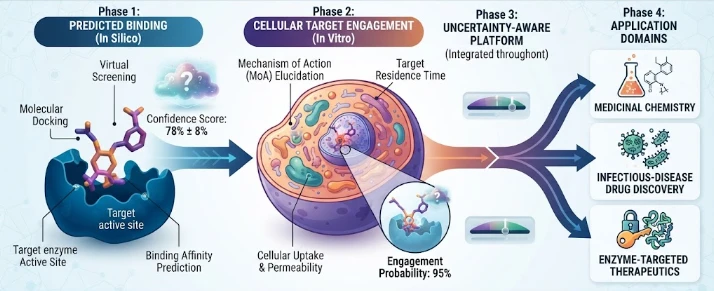
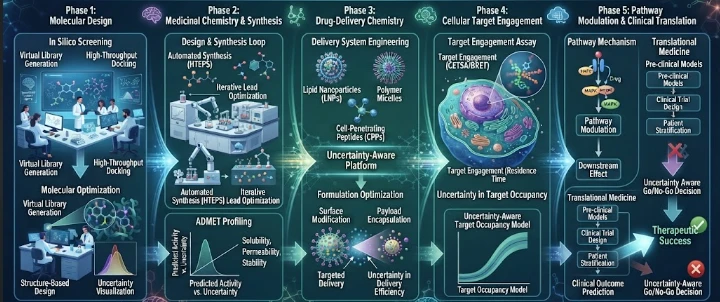
This article examines how enzyme-targeted infectious-disease drug discovery can move from predicted binding to validated cellular target engagement. Strong biochemical affinity is not sufficient if a compound cannot cross pathogen barriers, reach the intracellular target, maintain free concentration, or avoid efflux and metabolic inactivation. The article links enzyme inhibition to pathogen penetration, target occupancy, pathway disruption, metabolic consequences, growth inhibition, and killing. Enzyme kinetics, cellular target-engagement assays, metabolomics, resistant-mutant sequencing, microscopy, kill curves, and intracellular infection models are proposed as complementary evidence. Docking, molecular dynamics, free-energy methods, graph models, metabolic-network analysis, and uncertainty calibration can prioritize hypotheses, but prospective validation is required. Biological variation across species, strains, growth states, intracellular niches, biofilms, and resistance genotypes is treated as a central design factor. Serial passage, mutation-frequency studies, whole-genome sequencing, fitness testing, and combination experiments map escape routes. Pharmacokinetics, host selectivity, mitochondrial safety, microbiome effects, synthesis robustness, and scalable formulation are also integrated. The preferred lead is therefore one with credible intracellular exposure, causal engagement, durable activity, and a manageable resistance profile.
Often the search for an anti-infective that targets an enzyme starts with a strong binding model, but for the pathogen to be killed, it needs to be much more. Uncertainty-aware medicinal chemistry applied to enzyme targets of infectious diseases has transcended the basic hit identification stage, as predicted binders may have problems with penetration into the pathogen, differences in the target-state, efflux, metabolic stability, or failure to engage the target inside the pathogen. The more important question is whether an enzyme interaction that has been established in the pathogen under conditions that correlate with growth inhibition or elimination of the pathogen is maintained in real-life biotic and developmental environments. This shift shifts the paradigm of discovery from a ranking to a mechanistic program in terms of exposure, causation and reproducibility. As the discovery of anti-infective enzymes turns increasingly into a molecular design process accompanied by experiments that explain the activity of the candidate, its failure, and which constraints should be prized, the correlation of these two aspects is becoming increasingly important by the time of scheduled publication.
While structure-based design is a great approach for conserved enzymes, infectious-disease systems come with membranes, cell walls, intracellular locations, host metabolism, and rapid evolutionary pressure to the target-engagement problem. Real experience over the past 100 years has demonstrated that there has been a tendency for an attractive signal to disappear as biological complexity grows. A good research strategy is then to maintain the original activity signal while varying increasingly the conditions to determine which features are still critical.
The first layer of mechanism depth in the context of connecting enzyme affinity with pathogen penetration, target occupancy, pathway inhibition, metabolic consequence and antimicrobial phenotype. This structure can be hidden by simple endpoint assays due to the fact that similar readouts can occur by different causal pathways. A better picture can be found in enzyme kinetics, cellular target engagement, metabolomics, resistant-mutant sequencing, microscopy, kill curves, and intracellular infection models, which account for other influences on the cell, such as downstream adaptation, nonspecific stress, or delivery failure. An attractive response can be measured and it provides a testable chain between chemistry, biological state and functional outcome.
Also, design variables must be considered as interacting variables or not. The performance is determined by a combination of the above and a gain in one dimension may result in a penalty in another. A pragmatic optimisation approach thus considers compromises rather than the ultimate optimum. Multi-parameter profiles are particularly important if potency, selectivity, stability, tissue exposure and manufacturability all influence the translational value.
Prediction is important only when uncertainty is apparent, but other computational tools such as docking, molecular dynamics, free-energy methods, graph models, uncertainty calibration, and metabolic-network analysis bring computational leverage. If trained on familiar chemical and/or biological regions, models may be less reliable when dealing with novel scaffolds, non-representative patient states, and non-standard materials. Prior to time-consuming experiments, caliber, prospective testing, domain-of-applicability checks and disagreement across model families are ways of exposing fragile predictions.
Orthogonal validation is a useful aid in experimental design. Different parts of the causal question are answered by different types of assay technologies, including: target mutants, biochemical rescue, orthogonal binding, resistant isolates, pathway metabolites, and exposure-response studies. Consensus on the chemistry, imaging, omics, genetic and functional biology builds a better case for mechanism than multiple measurements of the same endpoint. Conflict is also informative in that it can provide clues to unappreciated levels of exposures, assay artifacts, compensatory pathways or context-dependent pharmacology.
Biological diversity is an added complication. Target abundance, barrier properties, metabolism, immune tone or resistance genotype/pathway dependence may vary in a species or strain, as well as depending on the growth phase, intracellular niche, nutrient state, biofilm status, or host-cell environment without changing the nominal treatment. The average responses may obscure groups that have different exposure/response relationships. Biological variation is built into design, not as an afterthought to explain variations in results.
Early considerations for resistance and adaptation are important as microbial populations can quickly acquire target mutations, bypass, efflux, permeability changes or drug inactivating mechanisms. Activity is determined to be resistant to evolutionary or compensatory pressure through serial passage, mutation-frequency assays, resistant-isolate panels, whole genome sequencing, fitness studies and combination experiments. A candidate with a slight drop in potency but a good ability to block common escape routes may be of greater value in the long-term than a viable high potency lead that is weak in potency. Development that is resistant to escaping also helps to make mechanism sharper since the proteins, pathways or exposure processes that are most likely to escape tend to be those that have the greatest causal weight.
Molecular promise to reachable biology via delivery and pharmacokinetics. To ensure that the active form arrives at the target site at the correct concentration and for the correct length of time to fit the proposed mechanism of action, the drug must penetrate the cell, be concentrated in the cell and be free of drug binding, metabolized, and distributed to the tissue. This relationship cannot be described with nominal dose alone, because absorption, distribution, binding, transformation, clearance and barriers have an impact on the effective dose. Hence, mechanistic exposure measures must be included with efficacy data from the initial developmental stages.
Mechanism gives additional information to safety assessment. Selectivity to human, mitochondrial, cytotoxicity, microbiome, off-target enzymes and exposure margins separate target-linked pharmacology from widespread cellular damage, immune activation, reactive chemistry and formulation-related toxicity. Comparative testing in disease relevant and healthy systems determine if therapeutic activity is differentiated from unwanted activity.
Another scientific variable, not a downstream logistics concern, is manufacturing. Product quality, biological activity and exposure may change for various reasons, even if the product's nominal composition remains the same, such as route robustness, availability of starting materials, control of impurities, form in which the product is administered, stability and formulation as well as cost of goods. Quality by design thinking is a relationship between the critical material attributes and process parameters and measurable performance, rather than end stage specification testing. When the laboratory success remains consistent with the fluctuations of the raw material, the use of larger equipment, in storage, transport and independent production runs, then the credibility of the concept of scalability is increasingly made true.
Also, realistic models of clinical use is needed for translation. Timing, dose frequency, route, diagnostic requirements, and acceptable complexity of therapy are influenced by site of infection, treatment length of time, prevalence of resistance, combination therapy, route, diagnostic speed and adherence. All of these features of a technically brilliant platform diminish its practical utility when administration, storage space requirements, monitoring requirements and cost considerations place constraints on its use where treatment is required. Mechanism meets deployment in development decisions is therefore advantageous to take a combination of both, rather than late stage decisions that will be hard to unwind.
These layers are connected by data integration. A common causal model can be used to structure the data from these assays, rather than storing as independent assay outputs: structures, enzyme kinetics, intracellular exposure, target engagement, kill kinetics, resistance genotype, and host safety. Iterative learning is reproducible with traceable metadata, versioned models, standardized controls and prospective decision rules. This will generate a development record that will showcase who won, as well as assumptions that were made in arriving at that decision, and uncertainties that were not addressed in the process.
There are strong programs that focus on biochemical-to-cellular shift, target occupancy, kill rate, resistance frequency, mutant coverage, tissue exposure, and selectivity over host homologs. The addition to success criteria of Durability, Reproducibility, Exposure margin, Biological breadth and Manufacturing robustness in addition to conventional Potency boosts the quality of the decision. This type of measurement creates incentives to optimize towards a single assay and it penalizes candidates that are not confirmed by independent tests. A clear scorecard also helps to explain the rationale behind a less dramatic outcome being the better development option.
A good program also provides a positive definition of failure. Negative results from nanomolar enzymes that are not well-expressed in cells, are not permeable, have very fast efflux, cannot reach targets, are toxic to the host, and predict binding too confidently set boundaries to the mechanism, thereby decreasing unnecessary investment in the weak hypotheses. Storing the results of synthesis failures, lack of target engagement, unsteady exposure, resistance emergence or loss of effect in a group of models provides a more realistic idea of the search space for the next model. Discovery is accelerated when unsuccessful experiments give as much information as successful experiments.
In the case of enzyme-targeted therapeutic products for infectious diseases, barriers such as pathogen escape and evolution to the molecular recognition need to be overcome to ensure that binding is made cellular target engagement. The key strength is the shift from performance statements to linking the key elements of the mechanisms, exposure, biological diversity, safety, and production. The structure helps to select good candidates as each significant development claim is supported by a test. Prosecutors are more interested in the series of experiments that culminates in a solid set of results that are convincing as complexity increases from the lab to real clinical settings.
CITE THIS ARTICLE
Kabir, M. H. (2025). From Predicted Binding to Cellular Target Engagement: An Uncertainty-Aware Platform for Medicinal Chemistry, Infectious-Disease Drug Discovery and Enzyme-Targeted Therapeutics. https://researchbykabir.com/article/5290216f-f55d-5ab1-b0dc-8502aa2b91a2
M. H. Kabir, “From Predicted Binding to Cellular Target Engagement: An Uncertainty-Aware Platform for Medicinal Chemistry, Infectious-Disease Drug Discovery and Enzyme-Targeted Therapeutics,” 2025. [Online]. Available: https://researchbykabir.com/article/5290216f-f55d-5ab1-b0dc-8502aa2b91a2
Kabir, M. H. (2025) ‘From Predicted Binding to Cellular Target Engagement: An Uncertainty-Aware Platform for Medicinal Chemistry, Infectious-Disease Drug Discovery and Enzyme-Targeted Therapeutics’. Available at: https://researchbykabir.com/article/5290216f-f55d-5ab1-b0dc-8502aa2b91a2
Kabir, Md. Humayan. “From Predicted Binding to Cellular Target Engagement: An Uncertainty-Aware Platform for Medicinal Chemistry, Infectious-Disease Drug Discovery and Enzyme-Targeted Therapeutics.” 2025, https://researchbykabir.com/article/5290216f-f55d-5ab1-b0dc-8502aa2b91a2.
Md. Humayan Kabir. “From Predicted Binding to Cellular Target Engagement: An Uncertainty-Aware Platform for Medicinal Chemistry, Infectious-Disease Drug Discovery and Enzyme-Targeted Therapeutics.” (2025). https://researchbykabir.com/article/5290216f-f55d-5ab1-b0dc-8502aa2b91a2.
Kabir MH. From Predicted Binding to Cellular Target Engagement: An Uncertainty-Aware Platform for Medicinal Chemistry, Infectious-Disease Drug Discovery and Enzyme-Targeted Therapeutics. 2025. https://researchbykabir.com/article/5290216f-f55d-5ab1-b0dc-8502aa2b91a2
@misc{article_5290216ff55d5ab1b0dc8502aa2b91a2,
  title = {From Predicted Binding to Cellular Target Engagement: An Uncertainty-Aware Platform for Medicinal Chemistry, Infectious-Disease Drug Discovery and Enzyme-Targeted Therapeutics},
  author = {Md. Humayan Kabir},
  year = {2025},
  url = {https://researchbykabir.com/article/5290216f-f55d-5ab1-b0dc-8502aa2b91a2},
}
TY  - GEN
AU  - Md. Humayan Kabir
TI  - From Predicted Binding to Cellular Target Engagement: An Uncertainty-Aware Platform for Medicinal Chemistry, Infectious-Disease Drug Discovery and Enzyme-Targeted Therapeutics
PY  - 2025-12-14
UR  - https://researchbykabir.com/article/5290216f-f55d-5ab1-b0dc-8502aa2b91a2
ER  -
This article describes an uncertainty-aware platform for moving from predicted molecular binding to validated cellular target engagement in medicinal chemistry and drug-delivery research. Docking and machine-learning predictions can rapidly prioritize compounds, but they do not establish that a molecule reaches, occupies, and functionally modulates a target inside relevant cells. The article therefore separates predicted affinity from free intracellular concentration, subcellular localization, t
This article explores fluorinated medicinal chemistry through causal chemoproteomics, emphasizing that fluorine substitution can alter far more than potency. A single positional change can modify conformation, pKa, lipophilicity, metabolic stability, target interactions, intracellular exposure, and off-target biology. The article therefore tests whether fluorinated analogues change cellular phenotype through intended target engagement rather than hidden polypharmacology. Matched molecular pairs
This article presents resistance-aware marine natural-product discovery as a mechanistic process rather than a search for isolated high-potency hits. It explains how activity from marine extracts or fractions can disappear during purification or fail under resistance pressure, making deep phenotypic profiling essential. Morphology, viability kinetics, organelle function, transcriptional state, metabolism, and recovery after washout are combined to connect phenotype with mechanism. The article em