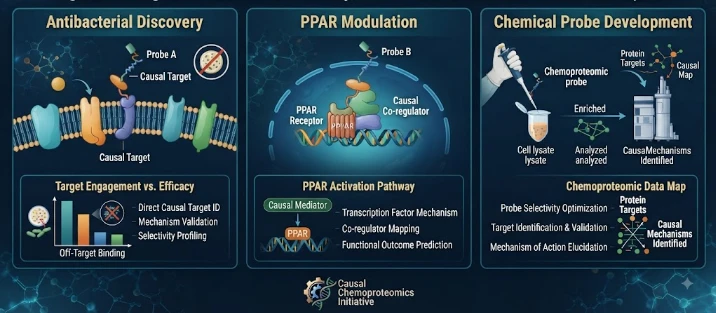
This article uses causal chemoproteomics to distinguish binding from mechanism in antibacterial and PPAR chemical-probe research. A probe can produce a useful phenotype while engaging multiple bacterial or host proteins, so target labels are unreliable without direct functional evidence. Activity-based profiling can identify covalent bacterial targets, while thermal or affinity approaches can test noncovalent engagement. In host cells, receptor-reporter systems and occupancy measurements help separate PPAR-dependent signaling from unrelated stress responses. Parent-compound competition and genetic perturbation are emphasized because enrichment establishes binding but not causal efficacy. Probe linker, covalency, concentration, species, host-cell state, PPAR isoform, target abundance, subcellular location, and exposure time are treated jointly. Failure routes include probe artifacts, off-target binding, bacterial target mutation, efflux, host pathway compensation, receptor cross-reactivity, and metabolic conversion. Free drug concentration, bacterial uptake, host-cell penetration, intracellular distribution, target residence, and active metabolites define exposure. Parent competition, inactive analogues, target mutation, knockout or knockdown, rescue, orthogonal occupancy, and matched infection phenotypes are required before a proposed interaction is accepted as causal.
Propelled by a central problem in causal chemoproteomics for antibacterial and PPAR chemical probes, the Compound Is Not the Mechanism documents the fact that a chemical probe may induce a useful phenotype with multiple interactions with a host or bacterial protein, rendering pathway labels less than reliable without direct evidence. A robust development strategy focuses on a quantitative platform instead of one eye-catching assay finding. That change puts chemistry, biology, exposure, resistance, safety and production as part of one translation argument.
The scientific underpinning is based on a process of mapping the protein engagements by causal chemoproteomics and subsequently verifying which interaction is responsible for antibacterial activity or PPAR mediated cell response. No individual measurement can be used to support the whole mechanistic assertion. By linking evidence, the risk of misinterpreting potency, binding, formulation performance or model fit as evidence of therapeutic knowledge is decreased.
Chemoproteomic analysis is especially valuable when the probes used for antibacterial or host directed are reactive groups, or have a wide physiological/physical activity. Activity-based profiling provides means to determine covalent protein target(s) in a bacterial proteome, and thermal or affinity approach can be used to determine noncovalent engagement. Receptor reporter systems and PKC occupancy measurements help to differentiate PPAR-mediated signaling from other stress responses in the host cells. Probe enrichment is not enough to infer binding, and it is important to use parent-compound competition and genetic perturbation to confirm this.
Joint treatment is needed for design variables as performance can change at the same time for probe linker, covalency, concentration, species, state of the host-cell, PPAR isoform, abundance of target, localization of target, and exposure time. When optimizing one aspect only results in an implicit cost for another, such as potency vs stability, selectivity, delivery or manufacturability, this hidden cost can be significant. A multi-parameter decision rule is thus more realistic for candidate ranking than is a single numeric decision value.
Mechanistic confidence is also related to early failure route measurements. Oftentarget binding, probe artifacts, bacterial target mutation, efflux of the probe, compensation by the host pathway, receptor cross-reactivity, and metabolic conversion are important escape mechanisms. When deliberately stress testing, these routes turn into design information to inform the next chemistry/ formulation/dosing/ model cycle.
Exposure is the link between dose and effect. These include the free drug concentration, the uptake by bacteria, penetration of the host cells, intracellular distribution, target residence, active metabolites, and tissue exposure. The candidate might be an excellent performer in simplified assays but not be a good performer at the causal site, and therefore not good for translation.
The interpretation of direct engagement and/or functional perturbation should be done at realistic concentrations. High doses may lead to secondary stress response, off-target effects or assay artefacts which simulate a desired mechanism. The concentration-response analysis related to exposure and occupancy can be used to determine the concentration range in which the proposed causal process is thought to operate.
Biological context also influences understanding of the pathways and leads that fall under the umbrella of antibacterial agents and host-directed chemical probes with a focus on PPAR signaling and related metabolic pathways. Target dependence and effective exposure can vary depending on differences in genotype, cell state, tissue architecture, immune tone, metabolic environment and previous treatments. Representative model panels thus offer more convincing evidence than do repeated tests in a single system.
Resistance and adaptation should be measured and interpreted in the future, not in the past. When subjected to repeated pressure, such as serial passage, long-term selection, genetic perturbation, repeated dosing or environmental stress, the mechanisms that survive the pressure will be revealed. It's better to have a slightly less effective candidate with a better chance of getting away with it than a delicate screening leader.
Information on safety assessment is enhanced by association with mechanism. Host selective, receptor-family cross-reactive side effects, as well as effects on mitochondria, hepatic signaling, immune modulation and formation of reactive metabolites are key concerns. Relative to the desired engagement, there are unwanted biological responses that can be compared to determine if it is mechanism linked to pharmacology and/or broad cellular injury or formulation driven toxicity.
The synthesis of probes cannot be a downstream logistics problem, as the synthesis of parent compounds, the placement of the linker, the purity of the compound, the stability of the compound, the stereochemical identity of the compound, and the reproducible synthesis of the chemical labeling affect the compound presented to the biological systems. Even when the nominal product name is not affected, minor change in the process will affect the composition, physical state, level of impurities, stability or dose reproducibility. The critical process attributes are directly connected to the mechanistic performance, which enhances robustness in development.
Target deconvolution, competition curves, network analysis, proteomic dose response, genetic integration and causal ranking of candidate mechanisms are all used to add leverage to the computational tools. The utility of prediction is most useful where there is uncertainty and applicability limits, particularly near novel chemical structures, unusual biological states, and sparse datasets. Models which reveal uncertainty will lead to better experiment selections than models whose results are confident rankings without explicit statements of the location of the weakness in the evidence.
For prospective validation, the following factors should be taken into account: parent competition, inactive analogues, target mutation, knockout/knockdown, rescue, orthogonal occupancy, and matched infection phenotypes. Why orthogonal tests are important: repeated testing using the same assay family can be capable of yielding the same bias without reinforcing the causality. When there are several independent methods that agree, it means that the assumption from design choice to biological consequence is strong, and when they disagree, it means that there is an assumption that needs to be revised.
Data integration should maintain the traceability of the data from the experiment stage to the development decision-making stage. Chemical structures, process conditions, assay metadata, exposure measurements, omics features, resistance observations and safety signals should be identified and analyzed in a stable manner (versioning). This discipline will make it difficult for subsequent interpretation to go off track from the conditions that lead to a result.
Translation should not be a laboratory show, either, with decision metrics having to capture that. The scorecards that are useful include reproduction, exposure normalized activity, mechanistic confidence, resistance frequency, safety margin, stability and manufacturing robustness. This allows both a balanced offer and trade-offs to be revealed up front prior to costly development investments.
In this context, the negative results have a significantly higher value. The edge of a hypothesis is determined by the failure in synthesis, failure to find target engagement, instable exposure, lack of rescue, emergence of resistance, failure of a batch, or loss of activity in realistic models. If these failures are recorded, they will lead to better experimental design in future and the investment of more resources in explanatory models that are attractive but not supported.
Another filter is reproducibility across laboratories/batches. Even in the event of apparent strong statistical significance, a mechanism depending on one operator, one preparation, one cell line or one modeling choice is fragile. Exposure-matched independent repetition allows for a separation of durable biology from local experimental success.
There also needs to be a pragmatic perspective on clinical or deployment context in order to translate. A technically complex product may be worthless if it needs to be routed, is too burdensome to administer, requires complex diagnostics, is incompatible with storage, is too cumbersome to monitor, is too expensive, or if it can be used only at a certain time. Mechanism is important when it comes to product design, and impact is greater when it's used in the context where biological benefit needs to be realized.
This temporal design also must be taken into consideration due to the different effects of short pulses, repeated dosing, washout and sustained exposure in the biological system. Time-resolved measurements can be used to distinguish between primary engagement from downstream adaptation and can detect if activity occurs after the initiating signal subsides. Taking these samples will then be scheduled accordingly to the expected kinetics of the causal chemoproteomics of the chemical probes for antibacterial and PPAR, instead of relying on one convenient endpoint.
An integrated development record aids in better communication between medicinal chemistry, formulation science, pharmacology, computation, manufacturing and clinical planning. Rather than a single definitive story, the record can highlight known connections, hypotheses that seem likely, and gaps in understanding and next steps in experiments with the highest information value. It eliminates the need to justify initial guesses as soon as they are challenged with data, and it makes iteration quicker.
Creative reference conditions provide a perspective on novelty when benchmarking. Whether a new approach is better at predicting, mechanism, durability, and/or manufacturability is determined by established compounds (known inactive controls), standard formulations, baseline models or accepted analytical methods. By head-to-head comparison, you also see gains that are lost following normalization by exposure, assay sensitivity, batch quality, or experimental complexity.
Mechanically useful probes do not occur when one or more of the following conditions are not met: target engagement, genetic dependence, exposure and phenotype converge on a causal explanation. Whether a candidate can win one assay or not is not the determining standard but whether the proposed mechanism is coherent throughout exposure, biological variation, resistance, safety and production. That standard generates a more disciplined route in the process of discovery signal to a therapeutic concept that can withstand actual complexity.
CITE THIS ARTICLE
Kabir, M. H. (2025). The Compound Is Not the Mechanism: Causal Chemoproteomic Optimization of Antibacterial discovery, PPAR modulation and chemical probe development. https://researchbykabir.com/article/49175883-cdce-5164-8434-906a764bfcce
M. H. Kabir, “The Compound Is Not the Mechanism: Causal Chemoproteomic Optimization of Antibacterial discovery, PPAR modulation and chemical probe development,” 2025. [Online]. Available: https://researchbykabir.com/article/49175883-cdce-5164-8434-906a764bfcce
Kabir, M. H. (2025) ‘The Compound Is Not the Mechanism: Causal Chemoproteomic Optimization of Antibacterial discovery, PPAR modulation and chemical probe development’. Available at: https://researchbykabir.com/article/49175883-cdce-5164-8434-906a764bfcce
Kabir, Md. Humayan. “The Compound Is Not the Mechanism: Causal Chemoproteomic Optimization of Antibacterial discovery, PPAR modulation and chemical probe development.” 2025, https://researchbykabir.com/article/49175883-cdce-5164-8434-906a764bfcce.
Md. Humayan Kabir. “The Compound Is Not the Mechanism: Causal Chemoproteomic Optimization of Antibacterial discovery, PPAR modulation and chemical probe development.” (2025). https://researchbykabir.com/article/49175883-cdce-5164-8434-906a764bfcce.
Kabir MH. The Compound Is Not the Mechanism: Causal Chemoproteomic Optimization of Antibacterial discovery, PPAR modulation and chemical probe development. 2025. https://researchbykabir.com/article/49175883-cdce-5164-8434-906a764bfcce
@misc{article_49175883cdce51648434906a764bfcce,
  title = {The Compound Is Not the Mechanism: Causal Chemoproteomic Optimization of Antibacterial discovery, PPAR modulation and chemical probe development},
  author = {Md. Humayan Kabir},
  year = {2025},
  url = {https://researchbykabir.com/article/49175883-cdce-5164-8434-906a764bfcce},
}
TY  - GEN
AU  - Md. Humayan Kabir
TI  - The Compound Is Not the Mechanism: Causal Chemoproteomic Optimization of Antibacterial discovery, PPAR modulation and chemical probe development
PY  - 2025-03-16
UR  - https://researchbykabir.com/article/49175883-cdce-5164-8434-906a764bfcce
ER  -
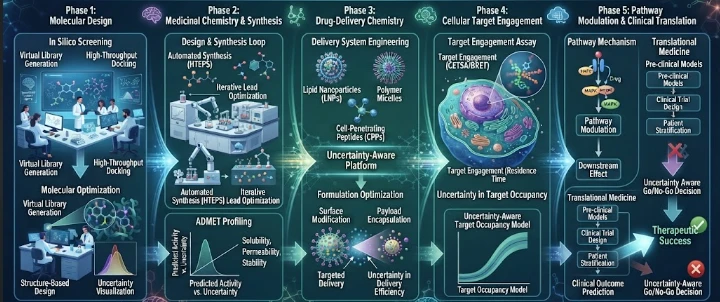
This article describes an uncertainty-aware platform for moving from predicted molecular binding to validated cellular target engagement in medicinal chemistry and drug-delivery research. Docking and machine-learning predictions can rapidly prioritize compounds, but they do not establish that a molecule reaches, occupies, and functionally modulates a target inside relevant cells. The article therefore separates predicted affinity from free intracellular concentration, subcellular localization, t
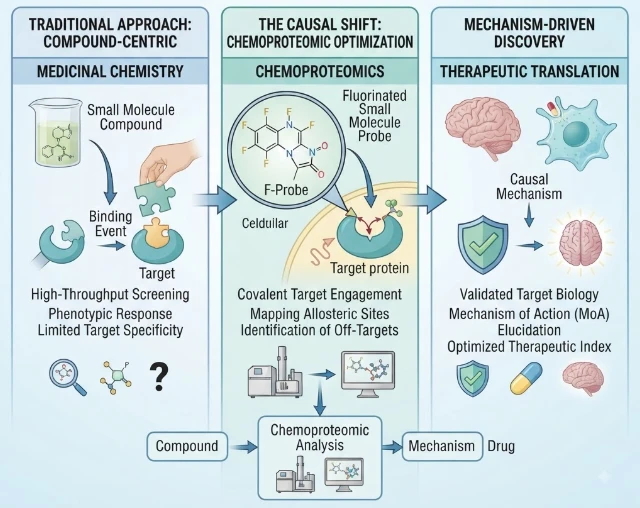
This article explores fluorinated medicinal chemistry through causal chemoproteomics, emphasizing that fluorine substitution can alter far more than potency. A single positional change can modify conformation, pKa, lipophilicity, metabolic stability, target interactions, intracellular exposure, and off-target biology. The article therefore tests whether fluorinated analogues change cellular phenotype through intended target engagement rather than hidden polypharmacology. Matched molecular pairs
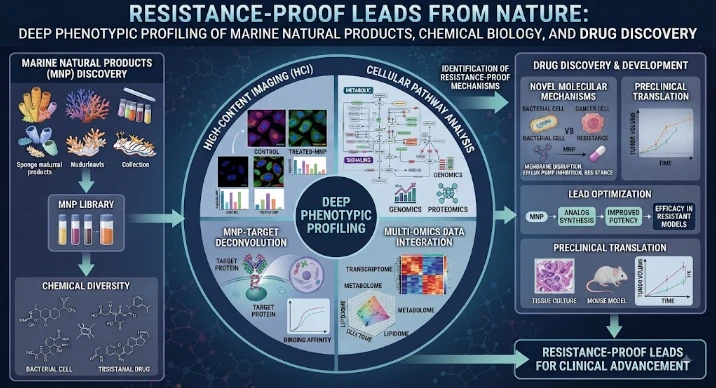
This article presents resistance-aware marine natural-product discovery as a mechanistic process rather than a search for isolated high-potency hits. It explains how activity from marine extracts or fractions can disappear during purification or fail under resistance pressure, making deep phenotypic profiling essential. Morphology, viability kinetics, organelle function, transcriptional state, metabolism, and recovery after washout are combined to connect phenotype with mechanism. The article em