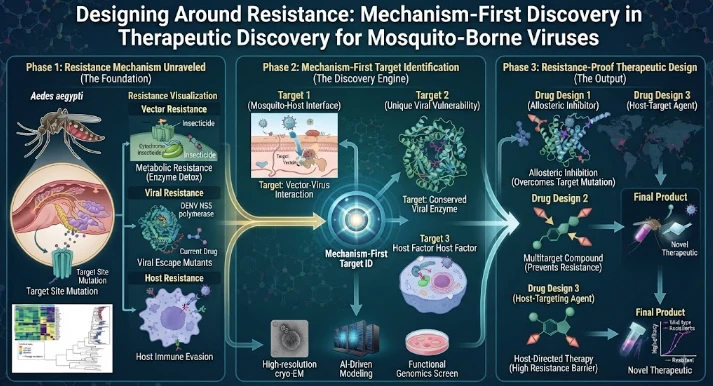
This article presents resistance-aware, mechanism-first discovery as a more durable strategy for developing therapeutics against mosquito-borne viruses such as dengue, Zika, chikungunya, and West Nile virus. It argues that antiviral activity in a screening assay is only a starting point because the observed phenotype may result from direct viral inhibition, host-pathway disruption, membrane effects, cytotoxic stress, or assay artifacts. Time-of-addition studies, washout experiments, serotype testing, structural biology, and deep mutational scanning are described as early tools for clarifying mechanism and potential escape routes. The article compares direct-acting antivirals with host-targeted strategies and emphasizes the need to evaluate both viral fitness constraints and host safety. Intracellular exposure, target engagement, mechanistic biomarkers, resistance-selection experiments, genotype diversity, and realistic treatment timing are integrated into candidate selection. AI and structure-based design are positioned as useful when informed by resistance, exposure, and mechanism data. The overall framework prioritizes potency together with genetic barrier, mechanistic coherence, viral breadth, safety, pharmacokinetics, and outbreak readiness.
Viruses transmitted by mosquitoes pose a challenging drug-discovery problem because their replication is rapid, and outbreaks of infections with them occur with no warning, and they have small RNA viral genomes, which adapt under selective pressure. In addition to the vector-mediated transmission, Dengue, Zika, chikungunya, West Nile virus and related viruses have different replication biology. The mechanism-first discovery approach doesn't start with the resistance as a requirement, it's just a constraint in the design process. The aim is not just to identify compounds that inhibit a viral signal in a screening plate but to identify interventions that are likely to have a durable causal mechanism due to changes in viral and/or host systems.
Even though phenotypic screening has fallen out of favour in recent years it is still useful because there are many aspects of viral biology that defy simple assumptions. Cell entry and replication, assembly and host response integrate to reduce infectious virus in cells. However, a positive phenotype does not provide clues as to whether the effect is due to a viral enzyme, host dependency, cytotoxic stress, disruption of the membranes or assay interference. Activity confirmation is thus followed by a process of discovery that begins by establishing a mechanism.
Experiments on time of addition are a good first approximation. Activity prior to the time of infection indicates a possible involvement in the attachment or entry stage; activity during the later stages indicates a possible role in replicating, assembling, or releasing. Washout experiments can be used to differentiate reversible vs persistent cellular effects. Testing of viral serotypes or related flaviviruses also determines whether the mechanism is targeted to a broad process or a narrow feature of the virus.
Direct-acting antivirals provide clear-cut targets of action, including viral polymerases, viral proteases, helicases or structural proteins. The targets are selective since the viral proteins are different from the host proteins, however resistance can develop when mutations occur which decrease binding of the drug, while at the same time maintaining the viral function. Structural biology and deep mutational scanning identify residues that are flexible and escape routes during evolution. Medicinal chemistry can then focus on those interactions that involve conserved catalytic or structural motifs with a greater fitness cost of mutation.
The resistance of host-targeted antivirals is different. Viruses require cellular pathways for translation, membrane modification, protein degradation, trafficking and metabolism. Proteomic, genetic screens and systems-biology studies have been used to identify host factors in studies of dengue and Zika virus and suggest that disruption of selected cellular machinery can lead to decrease in virus replication. Therapeutic selectivity is the main challenge when targets are genetically stable in the virus point of view.
To design resistance, one needs to have parallel fitness maps for virus and host. In the case of direct antivirals, it is the mutations that allow the virus to replicate that make it less susceptible to the antiviral drugs. In cases of host targeting, it's about whether there is enough pathway modulation for the cells and if viruses reroute through other host pathways. Multiple constraint means that there are multiple constraints in effect at the same time, which can decrease escape probability through multiple mechanisms.
Chemistry must also predict that the interior of cells will be exposed. The biochemical activity in the nanomolar range is of little benefit to a compound if it cannot be delivered to infected cells due to transport, metabolism, protein binding or efflux. The determination of free intracellular exposure and target engagement helps to differentiate between pharmacological weakness and delivery failures. This distinction has particular significance when comparing antiviral activity between different cell types which have different transporter or metabolic profile.
Mechanistic biomarkers support the translation process. Beyond a single infectious titer is reduced viral RNA, altered nonstructural-protein processing, blocked replication-complex formation or disruption of a defined host pathway. Orthogonal readouts minimise the risk of assay artifacts. The more convincing the candidate, the more the antiviral activity is dose-dependent and parallels a dose-dependent change in the cell that is related to the mechanism.
A direct stress test is achieved by performing resistance selection experiments. Escape variants can be enriched by serial viral passage in submaximal drug pressure and sequenced and phenotyped. A high number of mutations occurring in the same general area of a proposed binding site support the target attribution, whereas mutations that are found in other locations or do not result in resistance would indicate a different mechanism. The absence of resistance does not rule it out; rather it may be a strong indication of a high genetic barrier that needs to be explored further.
Consideration should also be given to the diversity of viruses that can be transmitted by mosquitoes. There are four serotypes of dengue and intra-serotypic sequence changes may be associated with changes in susceptibility. Discovery program optimized for one laboratory strain is likely to overestimate breadth. Clinically relevant panels of genotypes identify compounds that have a mechanism which can tolerate natural viral variation before resistance will be selected.
Another filter is applied due to the disease biology. Antiviral treatment is generally started after symptoms are present, thus making entry inhibitors that have only a small window for prophylaxis impractical to use unless combined with early diagnosis or post-exposure therapy. Inflammatory responses of the host can persist after reducing the viral burden and compounds that act during replication have a greater therapeutic window. Selection of the mechanism must, therefore, match with real time treatment.
Restrictions on safety are tightened even further for host-targeted strategies. Cellular pathways that are essential can be ‘palatable’ because viruses rely heavily on them, but since they take only a bit from this pathway, the resulting toxicity can be unacceptable. To assess possible benefit without host damage, genetic dosage studies, selective chemical probes, organotypic models and therapeutic-window analysis are used. Mechanism-first discovery discards targets which do not have a reasonable safety margin that is biologically dependent.
This is where the use of artificial intelligence and structure-based design are useful and when combined with experimental feedback. While conserved pockets, prediction of resistance sensitive interactions and selection of chemical analogues is achievable from the structure, viral evolution and cellular context is not straightforward. Active learning is best used in conjunction with resistance, exposure and target-engagement data flowing into the training loop. The model then considers robustness as the optimization criteria instead of raw antiviral activity.
Mechanistic diversity is a benefit to combination development. Combining two inhibitors of a single weak point provides less protection than is possible with two different steps with different resistance mechanisms. In the process of synergy studies, it is necessary to differentiate between a real synergism and a general toxicity. There are more reliable measures of viral suppression, mutation frequency and resistance trajectories than just one combination index.
A final translational aspect of outbreak preparedness exists. Broad-spectrum activity against related mosquito-borne viruses is attractive as outbreaks are unpredictable in the future, but it is also essential that broad activity is also mechanistically coherent. Logical starting points can be conserved viral enzymes or shared host dependencies. The safety attributes, the presence of a stable manufacturing process, and oral administration are also advantages.
The same care should be used with the animal models. The specific species susceptibility and immune interactions of mosquito-borne viruses can vary, and the extent of the viruses' relevance to humans is not necessarily confirmed by its efficacy in a mouse model. Mechanistic biomarkers can help fill that gap by providing evidence of the extent to which the same target pathway is activated in different systems. Human primary cells and organoid models are used as other filters prior to major investments in in vivo efficacy and toxicology.
The acute use of antiviral is especially dependent on pharmacokinetics. The effective concentration should be achieved within a short time and maintained throughout the time of active viral replication. Although long half-life is desirable in some cases, it is not always the case when there is a sub-optimal tissue distribution, whereas a short half-life can be effective when the target tissue is covered by oral dosing. Dose projections are done on a logical basis using targets obtained from studies on the cellular mechanism.
Post clinical entry resistance surveillance can be performed. If a treatment failure occurs, sequencing of the virus may be able to detect emerging substitutions before widespread resistance is present. The observations are then fed back into the structural and/or phenotypic testing. A discovery programme based on resistance thus goes beyond optimisation of leads to the creation of a framework for understanding therapeutic performance following deployment.
It is also necessary to have further standardization of the early virological endpoints in the laboratories. Cross-program learning is much more likely to be reliable when the screening platforms are the same in terms of infectious-virus assays, sequencing depth, exposure conditions, and resistance definitions.
In designing against resistance, the discovery process is therefore altered. Potency is measured in addition to the other criteria (mechanism, target engagement, viral diversity, escape pathways, host tolerance, and treatment timing) that are assessed prior to lead selection. This is a discipline that is required for mosquito-borne virus therapeutics due to the rapidity of evolutionary pressure and the short window of opportunity that exists in the clinic. A mechanism-first program aims to identify compounds with efficacy in the initial experiment, but that are also effective in the biological variation and adaptive pressure that are seen in real antiviral use.
CITE THIS ARTICLE
Kabir, M. H. (2026). Designing Around Resistance: Mechanism-First Discovery in Therapeutic Discovery for Mosquito-Borne Viruses. https://researchbykabir.com/article/40465ccc-0fa9-5122-baad-f00f65899736
M. H. Kabir, “Designing Around Resistance: Mechanism-First Discovery in Therapeutic Discovery for Mosquito-Borne Viruses,” 2026. [Online]. Available: https://researchbykabir.com/article/40465ccc-0fa9-5122-baad-f00f65899736
Kabir, M. H. (2026) ‘Designing Around Resistance: Mechanism-First Discovery in Therapeutic Discovery for Mosquito-Borne Viruses’. Available at: https://researchbykabir.com/article/40465ccc-0fa9-5122-baad-f00f65899736
Kabir, Md. Humayan. “Designing Around Resistance: Mechanism-First Discovery in Therapeutic Discovery for Mosquito-Borne Viruses.” 2026, https://researchbykabir.com/article/40465ccc-0fa9-5122-baad-f00f65899736.
Md. Humayan Kabir. “Designing Around Resistance: Mechanism-First Discovery in Therapeutic Discovery for Mosquito-Borne Viruses.” (2026). https://researchbykabir.com/article/40465ccc-0fa9-5122-baad-f00f65899736.
Kabir MH. Designing Around Resistance: Mechanism-First Discovery in Therapeutic Discovery for Mosquito-Borne Viruses. 2026. https://researchbykabir.com/article/40465ccc-0fa9-5122-baad-f00f65899736
@misc{article_40465ccc0fa95122baadf00f65899736,
  title = {Designing Around Resistance: Mechanism-First Discovery in Therapeutic Discovery for Mosquito-Borne Viruses},
  author = {Md. Humayan Kabir},
  year = {2026},
  url = {https://researchbykabir.com/article/40465ccc-0fa9-5122-baad-f00f65899736},
}
TY  - GEN
AU  - Md. Humayan Kabir
TI  - Designing Around Resistance: Mechanism-First Discovery in Therapeutic Discovery for Mosquito-Borne Viruses
PY  - 2026-06-14
UR  - https://researchbykabir.com/article/40465ccc-0fa9-5122-baad-f00f65899736
ER  -
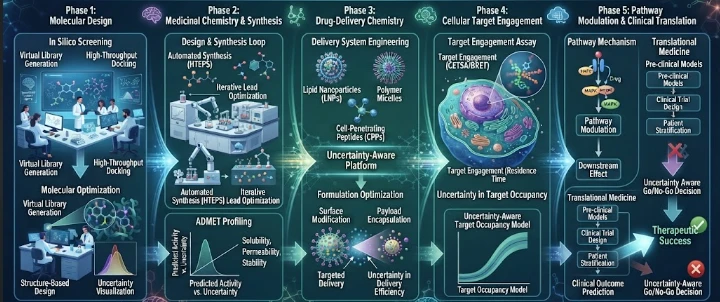
This article describes an uncertainty-aware platform for moving from predicted molecular binding to validated cellular target engagement in medicinal chemistry and drug-delivery research. Docking and machine-learning predictions can rapidly prioritize compounds, but they do not establish that a molecule reaches, occupies, and functionally modulates a target inside relevant cells. The article therefore separates predicted affinity from free intracellular concentration, subcellular localization, t
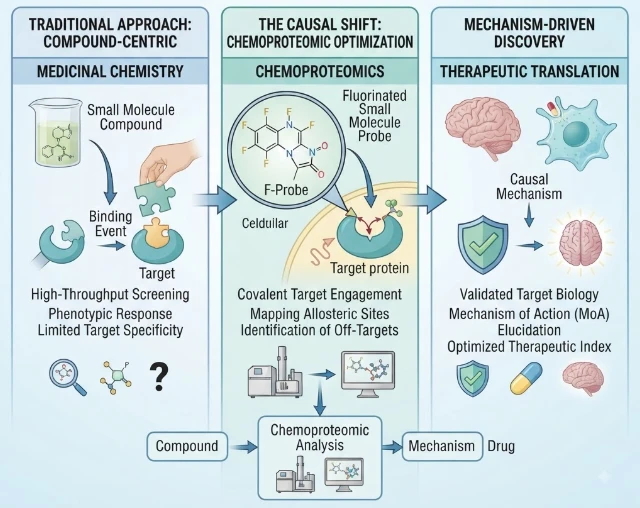
This article explores fluorinated medicinal chemistry through causal chemoproteomics, emphasizing that fluorine substitution can alter far more than potency. A single positional change can modify conformation, pKa, lipophilicity, metabolic stability, target interactions, intracellular exposure, and off-target biology. The article therefore tests whether fluorinated analogues change cellular phenotype through intended target engagement rather than hidden polypharmacology. Matched molecular pairs
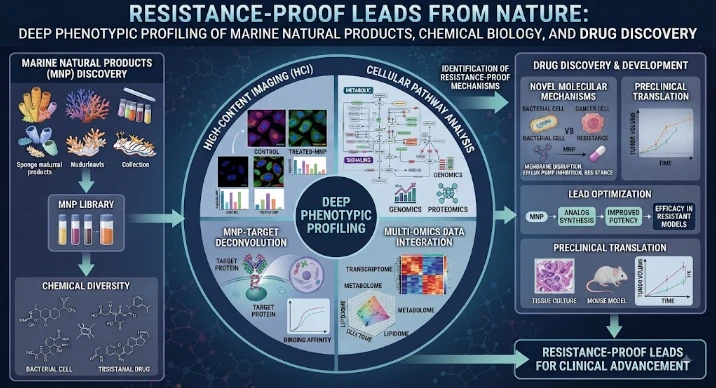
This article presents resistance-aware marine natural-product discovery as a mechanistic process rather than a search for isolated high-potency hits. It explains how activity from marine extracts or fractions can disappear during purification or fail under resistance pressure, making deep phenotypic profiling essential. Morphology, viability kinetics, organelle function, transcriptional state, metabolism, and recovery after washout are combined to connect phenotype with mechanism. The article em