This article reframes pulmonary drug delivery as a barrier-engineering problem rather than a simple aerosol-deposition task. It explains how inhaled medicines must navigate airway geometry, mucus, mucociliary clearance, epithelial transport, alveolar macrophages, airway surface liquid, and disease-specific changes before therapeutic exposure is achieved. Particle size, density, shape, hygroscopicity, surface charge, dissolution, and carrier design are presented as linked variables that determine regional deposition and post-deposition behavior. The article also contrasts mucoadhesive and mucus-penetrating strategies and shows how immune-cell uptake can be either a liability or a deliberate targeting mechanism. It highlights particle-engineering approaches such as spray drying, porous particles, liposomes, polymeric nanoparticles, and nano-in-micro systems. More realistic testing through air–liquid interface cultures, airway replicas, imaging, computational fluid dynamics, and mechanistic models is emphasized. Overall, the piece argues that successful respiratory formulation requires matching device performance and formulation properties to real biological barriers, patient-specific lung phenotypes, and clinically meaningful local exposure patterns.
Pulmonary drug delivery seems like such a simple process: Give the medication in an inhaler, make an aerosol and get the medicine into the lungs. In reality, every puff is deposited in the highly protected organ that is designed to capture, transport, dissolve, ingest and expel foreign matter. Thus, modern science of respiratory formulation addresses lung defenses as measurable design variables and not as hindrances. The transition is altering the approach for the development of inhaled pharmaceuticals for conditions such as asthma, chronic obstructive pulmonary disease, infection, cystic fibrosis, and other respiratory diseases.
The first barrier is in front of any diseased tissue that the drug has to pass through. Aerosol particles have to pass through the mouth, throat, branching airways, varying airflow, humidity, and patient's breathing pattern. Aerodynamic diameter is very important for destination – larger particles have a higher tendency to impact on the upper airways, smaller particles are more likely to impact deeper into peripheral areas. The final deposition map is different in device resistance, inspiratory flow, formulation density, particle shape and hygroscopic growth.
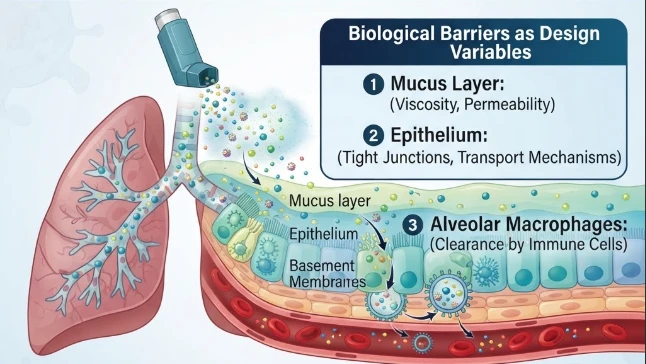
Just because something is deposited it doesn't mean that it will be of any benefit for exposure. The lining of the conducting airways is covered by mucus which traps inhaled particles and facilitates the removal of mucus from the conducting airways towards the throat by the mucociliary mechanism. It is an environment which is dramatically altered in disease situations such as cystic fibrosis where there is increased mucus thickness, chronic bronchitis, where there is increased secretion, airway geometry during inflammation and obstruction, which leads to uneven ventilation. Optimization in a healthy airway model thus creates a particle that is quite different to the one in diseased lungs.
There are two conflicting implications of the mucus for formulation design. Favored drugs that must remain in contact with the epithelial surface have extended contact times in a mucoadhesive system, but the system can also have too much adhesion to be swept away by the flowing mucus layer. The particles that penetrate mucus are coated with a hydrophilic material, carry a controlled surface charge and have a controlled size, all of which helps to decrease adhesion to the mucus and to get through the mesh. The appropriate approach will be determined by the location of the target, disease condition, frequency of application and duration of exposure.
In addition to mucus, epithelial barriers dictate the fate of a molecule (airway residence, tissue penetration and systemic circulation). Absorption is influenced by the tight junctions, activity of transporters, composition of lining fluid, and pH. High systemic uptake is desirable for some inhaled treatment, while for some it is helpful to have a high lung residence time with limited exposure to the systemic circulation. The design of the formulation involves more than just maximizing the solubility, however; the balance is between dissolution and persistence.
Macrophages further add a biological selectivity in the alveolar area. These immune cells roam the airspaces and swallow up particulate matter, particularly particles that have features including dimensions and surface characteristics that indicate their foreign origin. A carrier may be taken up by the macrophage allowing a therapeutic payload to reach the epithelial or interstitial target. On the other hand, this advantage is provided when the intracellular pathogens or inflammatory macrophage population is a part of the therapeutic target of the disease.
The point of the barrier proof is the reversal. Not all biological processes are beneficial or harmful; their therapeutic uses rely on whether their formulation properties fit the mechanism of action. Some of the strategies deliberately taking advantage of immune-cell recognition include fucose-modified liposomal systems, the use of nano-in-microparticle approaches, and surface-engineered carriers. The same reasoning goes for the interaction with mucus, dissolution and transport to the epithelial surfaces, creating clearance pathways that can be targeted.
These mechanisms are related to aerosol physics by the concept of particle engineering.The concept of particle engineering now links these mechanisms with aerosol physics. It is possible to control the aerodynamic behavior by spray drying, controlled crystallization, porous particles, lipid carriers, polymeric nanoparticles, liposomes, and nano-in-micro formulations while tuning some nanoscale biological properties separately. A microparticle may be capable of furnishing efficient dispersion of the inhaler and release smaller particles once they are deposited. Such multiscale design is useful to find a balance between the conflicting requirements such as deep lung delivery, colloidal stability, mucus transport and cellular uptake.
There also needs to be more realistic testing for mechanistic development. Simple submerged cell cultures offer valuable screening information, but lack layered barriers and breathing airflow. These complementary Air-liquid interface cultures, mucus-producing epithelial models, realistic airway replicas, cascade impactors, ex vivo tissues and advanced imaging systems offer a thorough understanding of the problem. The use of these tools allows failure modes to be detected earlier, particularly if there is good aerosol performance but low biological transport.
Imaging has been found to be valuable especially as regional deposition and clearance are a spatial problem. Estimation of total and regional deposition in the lungs has been supported by gamma scintigraphy and other techniques for a long time; newer imaging and computational techniques enhance connections between device output and tissue exposure. The computational fluid dynamics brings another dimension as it can predict airflow, impaction, sedimentation and local deposition at varying breathing conditions. These techniques can help to understand the variation of lung distribution following equal doses emitted from the same aerosol source in different airway anatomies.
However, the variability of patients is at the heart of pulmonary formulation design. Delivered exposure depends on age, inspiratory capacity, severity of disease, mucus burden, narrowing of airways, changes related to smoking, ventilation heterogeneity and technique of the device. A formulation based around average physiology may not work out well within clinically relevant sub-groups. Mechanistic models provide a pathway towards developing models that are matched with the particle properties, device characteristics and dosing instruction that correspond to realistic phenotypes of the respiratory system.
The increasingly powerful development programmes more strongly relate the formulation properties to a series of causal events: aerosol formation, regional deposition, interaction with barrier, local dissolution, cellular interaction, pharmacological response, clearance. Every link is accompanied by uncertainty, and a failure at any link will hamper the therapeutic effectiveness. The principles of quality by design are well suited to this as critical attributes of the materials and critical process parameters are linked to biological outcomes. Development does not ask if the particle is just small enough, it asks what size distribution is needed for the desired exposure in the target area of the lungs.
This viewpoint also changes the way in which the translation is made. The use of a conventional assay, in which there is a high potency, is only reassuring if few molecules of the inhaled drug actually reach the relevant cells. Another compound that is slightly less active with better retention, transport or cellular uptake may result in better performance in clinical use. In respiratory drug development, the ability to assess pharmacology and delivery as a single development system is therefore beneficial rather than considering formulation as a last stage packaging exercise.
Another design parameter is the airway surface liquid. The stability of the particles and the release of the drugs after deposition are affected by the ionic strength, the presence of surfactant, proteins, extracellular DNA, and disease-associated enzymes. If a formulation buffer is used, nanocarriers can aggregate and lose payload or get a biomolecular corona in the lung fluid. Testing under physiologically relevant fluid conditions is thus useful for identifying systems that are genuine carriers from those that can only be performed on the basis of reduced media provided in the laboratory.
Barriers also have a dose timing interaction. Inhaled medicine might change the caliber of the airways or the movement of mucus from the lungs before it reaches the airway.The caliber of the airways or the movement of mucus from the lungs may be modified by the use of mucolytics, bronchodilators, airway-clearance techniques, and changes in hydration before the arrival of the inhaled medicine. Sequential therapy provides a mechanistic opportunity: a time-limited shift in the barrier landscape to another therapy. Development studies must not ignore treatment sequence, particularly when studying clinically important differences in exposure in chronic respiratory diseases treated with multiple inhaled and non-inhaled therapies.
This mechanistic language is gaining more and more use in regulatory translation as product features can be correlated with clinically relevant performance. Aerodynamic particle-size distribution, delivered dose, device robustness, dissolution and local tolerability are all important quality parameters, while carrier stability and biological interaction are added with the advanced products. Defensible control strategy defines which attributes are in fact important for deposition and exposure to tissue, and sets manufacturing limits to ensure that these attributes are maintained throughout the batches.
Also, a mechanistic approach facilitates the comparison of inhaled products. The difference in fine-particle fraction of two formulations may result in different behavior after deposition due to the variation in dissolution, interaction with mucus, uptake to cells and retention. Measuring aerosol parameters alone thus only measures the delivery pathway into the lung, and not the whole delivery pathway. Given the need to link aerosol performance with biological transport for a solid foundation to select candidates which are effective after interaction with actual respiratory barriers.
Pulmonary delivery is evolving into a science in which barriers are coordinates on a design map. The pathway from inhaler to therapeutic effect is dictated by: Mucous clearance, macrophages, airway geometry, epithelial transport, deposition physics, and disease-specific microenvironment. Progress requires measurement of those factors, modelling of interactions and choice of formulations which interact with the biology of the respiratory system, not against an imagined ideal lung. Variability is not just considered as an afterthought but becomes a key principle in developing respiratory medicine for barrier-aware engineering.
CITE THIS ARTICLE
Kabir, M. H. (2026). When Biological Barriers Become Design Variables: A Mechanistic Study of Pulmonary Delivery for Respiratory Disease. https://researchbykabir.com/article/1ef23a73-611d-582d-b6ee-715e3047d7f9
M. H. Kabir, “When Biological Barriers Become Design Variables: A Mechanistic Study of Pulmonary Delivery for Respiratory Disease,” 2026. [Online]. Available: https://researchbykabir.com/article/1ef23a73-611d-582d-b6ee-715e3047d7f9
Kabir, M. H. (2026) ‘When Biological Barriers Become Design Variables: A Mechanistic Study of Pulmonary Delivery for Respiratory Disease’. Available at: https://researchbykabir.com/article/1ef23a73-611d-582d-b6ee-715e3047d7f9
Kabir, Md. Humayan. “When Biological Barriers Become Design Variables: A Mechanistic Study of Pulmonary Delivery for Respiratory Disease.” 2026, https://researchbykabir.com/article/1ef23a73-611d-582d-b6ee-715e3047d7f9.
Md. Humayan Kabir. “When Biological Barriers Become Design Variables: A Mechanistic Study of Pulmonary Delivery for Respiratory Disease.” (2026). https://researchbykabir.com/article/1ef23a73-611d-582d-b6ee-715e3047d7f9.
Kabir MH. When Biological Barriers Become Design Variables: A Mechanistic Study of Pulmonary Delivery for Respiratory Disease. 2026. https://researchbykabir.com/article/1ef23a73-611d-582d-b6ee-715e3047d7f9
@misc{article_1ef23a73611d582db6ee715e3047d7f9,
  title = {When Biological Barriers Become Design Variables: A Mechanistic Study of Pulmonary Delivery for Respiratory Disease},
  author = {Md. Humayan Kabir},
  year = {2026},
  url = {https://researchbykabir.com/article/1ef23a73-611d-582d-b6ee-715e3047d7f9},
}
TY  - GEN
AU  - Md. Humayan Kabir
TI  - When Biological Barriers Become Design Variables: A Mechanistic Study of Pulmonary Delivery for Respiratory Disease
PY  - 2026-08-09
UR  - https://researchbykabir.com/article/1ef23a73-611d-582d-b6ee-715e3047d7f9
ER  -
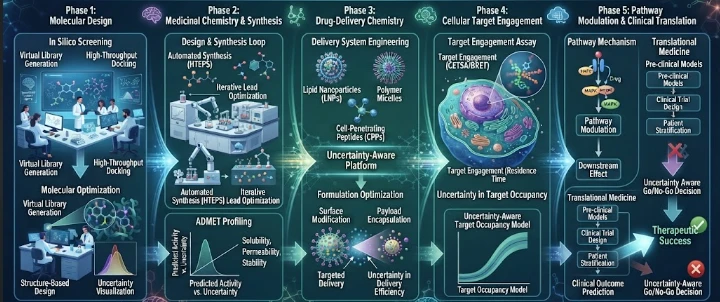
This article describes an uncertainty-aware platform for moving from predicted molecular binding to validated cellular target engagement in medicinal chemistry and drug-delivery research. Docking and machine-learning predictions can rapidly prioritize compounds, but they do not establish that a molecule reaches, occupies, and functionally modulates a target inside relevant cells. The article therefore separates predicted affinity from free intracellular concentration, subcellular localization, t
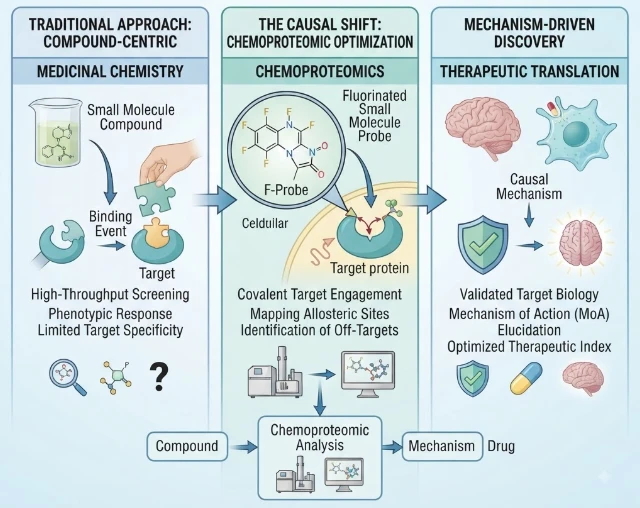
This article explores fluorinated medicinal chemistry through causal chemoproteomics, emphasizing that fluorine substitution can alter far more than potency. A single positional change can modify conformation, pKa, lipophilicity, metabolic stability, target interactions, intracellular exposure, and off-target biology. The article therefore tests whether fluorinated analogues change cellular phenotype through intended target engagement rather than hidden polypharmacology. Matched molecular pairs
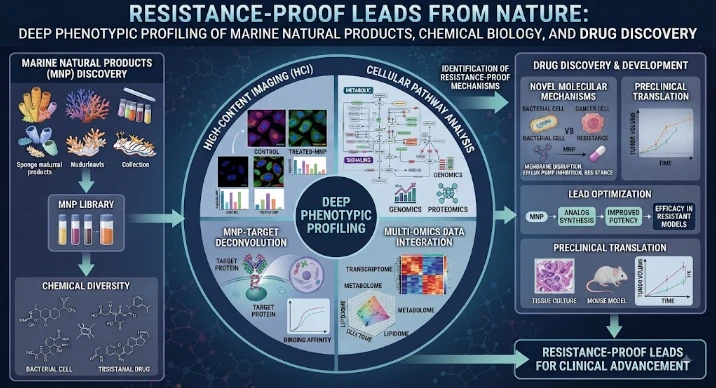
This article presents resistance-aware marine natural-product discovery as a mechanistic process rather than a search for isolated high-potency hits. It explains how activity from marine extracts or fractions can disappear during purification or fail under resistance pressure, making deep phenotypic profiling essential. Morphology, viability kinetics, organelle function, transcriptional state, metabolism, and recovery after washout are combined to connect phenotype with mechanism. The article em