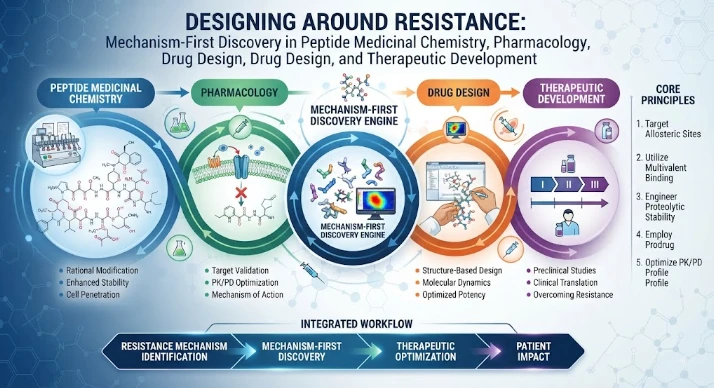
This article presents resistance-aware peptide medicinal chemistry as an early design problem rather than a late-stage response to therapeutic failure. It centers on sequence, conformation, proteolysis, membrane interaction, target recognition, and adaptive resistance, showing how strong potency can collapse when protease exposure, target mutation, biofilm physiology, or membrane remodeling changes. Cyclization, terminal modification, non-natural residues, conjugation, and sequence redesign are discussed as strategies for improving stability and selectivity. Serial passage, resistant-isolate testing, structure–activity mapping, protease stability assays, biophysical binding, and mechanism-specific phenotyping are proposed for identifying accessible escape routes before major resources are committed. Infection site, pathogen genotype, immune status, protease environment, and prior antimicrobial exposure are treated as context variables. Safety concerns include rapid clearance, immunogenicity, aggregation, off-target membrane disruption, and target or envelope resistance. Manufacturing complexity, purification, formulation, and cost of goods are also integrated. Overall, the article argues that durable peptide leads should combine mechanistic clarity, exposure, manufacturability, and a high barrier to resistance.
For example, in the field of peptide medicinal chemistry, resistance-awareness is no longer just about potency, delivery or association, but about the knowledge of why a result is seen and when it will be reliable, which modern therapeutic development relies upon. A central part of this transformation is a mechanistically organized network of sequence, conformation, proteolysis, membrane interaction, target recognition and adaptive resistance. That network is important because if the mutation in the target, exposure to the protease or the state of the biofilm or membrane remodeling changes, then it can collapse and the result is a high potency against a reference system. A better development strategy thus sees mechanism, context and uncertainty as not being independent tasks performed at distinct points in the design process, but as related variables.
Peptide therapeutics have a huge chemical design space, but are also susceptible to biological pressures that are not apparent at first glance. Activity can be diminished due to strong initial activity, but the activity is diminished due to proteolysis, rapid clearance, membrane interactions, target mutation, etc. or due to biofilm physiology, altered cell envelopes. Conjugation, sequence redesign, non-natural residues, terminal modification and cyclization have been the medicinal chemistry reactions that have been used to enhance stability and selectivity. Discovery that is resistance-aware gets to the point of serial challenge and mechanistic profiling as early as possible, providing a clear indication of whether a candidate offers simple evolutionary escape routes before significant development resources are dedicated. This selection pressure is enhanced by early escape mapping.
The reality is a new discovery paradigm, which includes serial passage, resistant-isolate testing, structure-activity mapping, protease stability assays, biophysical binding and mechanism-specific phenotyping. None of these assays is a final arbiter because all are measuring only a portion of a series of biological or clinical events. Independent measurements gain confidence when they all point to a similar causal narrative over the dose, time, model system and the relevant biological context. Disagreement is also important as it may point to mechanisms that are not well understood or to assay artifacts, or to population differences or exposure limitations that should be explored before serious development work begins.
When considering deciding which peptide features retain activity and restrict the number of resistance pathways, the question is which ones? To answer this question, there needs to be an explicit comparison between the mechanism that is being hypothesized and potential alternative mechanisms such as off target activity, parallel pathways, differential exposure, or measurement bias. Perturbation experiments are particularly useful because they determine whether the observed effect can be attributed to a suggested component, by removing, blocking or restoring that component. Reliability and confidence in the mechanism must be derived from challenge tests and not from repeated confirmation within a single convenient assay.
In resistance-aware peptide medicinal chemistry, the meaning of nearly all the results is also context-dependent. Examples of relevant variation include the site of infection, the genotype of the pathogen, the protease environment, immune status, and previous exposure to antimicrobial agents. If an intervention is effective in one set of these circumstances, it may be less effective, more toxic or have a different effect, in another. Stratification can prove more useful in a context of variable(s) related to mechanism or exposure, as descriptive categories alone do not describe the variation in treatment performance.
Risk Assessment is equally important due to Rapid clearance, Immunogenicity, OffTarget Membrane disruption, Aggregation, and Target/Envelope resistance. Early safety work is best when associated with a common mechanistic framework to efficacy so that unexpected effects can be traced to target biology, carrier behavior, exposure, metabolites and/or analytical bias. This will minimize the risk of safety being a last minute checklist, separate from discovery logic. It also facilitates the ease of making trade-offs if there is need for increased exposure, pathway modulation, or tissue persistence to attain increased efficacy.
Another layer is added by translational development as peptides become more durable, well-exposed and have an obvious path towards therapeutic development. Drugs that are successful in the preclinical setting provide a more useful set of clues as long as the studies are designed and conducted with physiologically and clinically relevant timing, concentration ranges, biological barriers, treatment history, and sources of heterogeneity. Going from a convenient model to a complex model is less useful than a series of models that are designed to answer particular uncertainty questions. There is a clear decision therefore needed for each step: either continue, redesign, restrict the scope of the target population, modify the dose or gather a new type of mechanistic information.
The importance of manufacturing and analytical control cannot be overstated, as there are numerous limitations on viable designs, including sequence complexity, cyclization, presence of non-natural residues, purification, formulation and cost of goods. Having a biological explanation becomes less valuable if the tested material has changed from one batch to another, or if the inputs of the assay are not well defined. Critical attributes, then, must be specified with defined ranges, sensitive measurement techniques, and documentation of process conditions and biological performance. In studies involving complex molecules, nanoparticles, biomaterials or data-rich studies, exposure to drugs or their metabolites, signal and apparent response of treatment can vary subtly depending on the molecule, the nanoparticle, the biomaterial type, or the amount of data.
The separation between prediction and confirmation also is enhanced in data analysis for resistance-aware peptide medicinal chemistry. The computational models, machine learning, causal estimators, and mechanistic simulations can rank the hypotheses, combine the high-dimensional measurements, and reveal the uncertainty, but the predictions of the model do not reflect the biological truth. Useful models say assumptions, quantify calibration, flag regions with weak support, and steer next experiment towards being able to alter a decision. A prerequisite for validation is to be prospective, as patterns that have been validated retrospectively can only be maintained if the new populations, new batches and new biological conditions are all favorable.
One other important transition relates with time: many processes which are vital to resistance-aware peptide medicinal chemistry occur after the initial exposure. If an endpoint appears to be positive, the early response, adaptation, clearance, immune programming, tissue remodeling, adherence or resistance can occur on various pathways. Longitudinal measurement provides information on the stability, or on the temporary perturbation or delayed liability of an intervention. Time-resolved data also aid interpretation of cause by allowing one to determine if the proposed mechanism occurs before the downstream phenotype or after when the phenotype is "determined.
When all studies have a definite uncertainty budget associated with them, experimental design becomes more efficient. Questions concerning sequence, conformation, proteolysis, membrane interaction, target recognition, and adaptive resistance can be ranked based on their ability to alter the attributes of the peptides that remain active but have fewer resistance sites accessible instead of on the basis of novelty alone. When done with complementary models, it checks if the outcome is reliant on one assay, one laboratory condition or one population. This discipline drives the efficient use of optimization time and enables negative results to be informative as the mechanism space is further reduced with each failed iteration and the next design cycle can be optimised accordingly.
Traceability is also essential to the regulatory and clinical credibility. In the case of peptide medicinal chemistry, resistance would benefit from a development package that retains its links between the beginning and the end of the experiments and the subsequent processing, between the modeling assumptions and their validation, between these and the modifications performed throughout the process and between these and the properties of the materials. This traceability allows an easy separation of biological variation from technical variation, and facilitates post hoc evaluation of efficacy or safety claims. This also provides a more transparent framework for revising conclusions if new information leads to a change of a previous assumption.
The communication in this field must also be improved to be more precise. The term 'targeted', 'selective', 'durable', 'safe', 'predictive', or 'personalised' do not mean a great deal without the inclusion of a measurement, a comparator, a population and uncertainty range. Using clear reporting, results that are negative are more useful and do not allow for exploratory results to be presented as established mechanisms. This precision enables common standards and guidelines for researchers, developers, clinicians, and regulators to evaluate if a claim is based on direct measurement, calibrated inference or an untested assumption.
Chemistry or formulation, mechanistic measurement, quantitative modeling, safety, manufacturing control and clinically meaningful context—the strongest direction of resistance-aware peptide medicinal chemistry is a tighter loop. Success can accelerate as a result of the early exposure of failed assumptions, and the use of deliberate challenging tests of successful mechanisms. That rationale promotes resistance testing moves to lead design, rather than being found only close to clinical development. The most valuable innovation, across the field, is an innovation system that improves through learnings and allows to keep causal interpretations and ability to repeat and reproduce the experiments in mind, while maintaining their relevance to the real world.
CITE THIS ARTICLE
Kabir, M. H. (2025). Designing Around Resistance: Mechanism-First Discovery in Peptide Medicinal Chemistry, Pharmacology, Drug Design and Therapeutic Development. https://researchbykabir.com/article/024a23bc-4e40-50ff-9ff2-c613bbe9872b
M. H. Kabir, “Designing Around Resistance: Mechanism-First Discovery in Peptide Medicinal Chemistry, Pharmacology, Drug Design and Therapeutic Development,” 2025. [Online]. Available: https://researchbykabir.com/article/024a23bc-4e40-50ff-9ff2-c613bbe9872b
Kabir, M. H. (2025) ‘Designing Around Resistance: Mechanism-First Discovery in Peptide Medicinal Chemistry, Pharmacology, Drug Design and Therapeutic Development’. Available at: https://researchbykabir.com/article/024a23bc-4e40-50ff-9ff2-c613bbe9872b
Kabir, Md. Humayan. “Designing Around Resistance: Mechanism-First Discovery in Peptide Medicinal Chemistry, Pharmacology, Drug Design and Therapeutic Development.” 2025, https://researchbykabir.com/article/024a23bc-4e40-50ff-9ff2-c613bbe9872b.
Md. Humayan Kabir. “Designing Around Resistance: Mechanism-First Discovery in Peptide Medicinal Chemistry, Pharmacology, Drug Design and Therapeutic Development.” (2025). https://researchbykabir.com/article/024a23bc-4e40-50ff-9ff2-c613bbe9872b.
Kabir MH. Designing Around Resistance: Mechanism-First Discovery in Peptide Medicinal Chemistry, Pharmacology, Drug Design and Therapeutic Development. 2025. https://researchbykabir.com/article/024a23bc-4e40-50ff-9ff2-c613bbe9872b
@misc{article_024a23bc4e4050ff9ff2c613bbe9872b,
  title = {Designing Around Resistance: Mechanism-First Discovery in Peptide Medicinal Chemistry, Pharmacology, Drug Design and Therapeutic Development},
  author = {Md. Humayan Kabir},
  year = {2025},
  url = {https://researchbykabir.com/article/024a23bc-4e40-50ff-9ff2-c613bbe9872b},
}
TY  - GEN
AU  - Md. Humayan Kabir
TI  - Designing Around Resistance: Mechanism-First Discovery in Peptide Medicinal Chemistry, Pharmacology, Drug Design and Therapeutic Development
PY  - 2025-09-07
UR  - https://researchbykabir.com/article/024a23bc-4e40-50ff-9ff2-c613bbe9872b
ER  -
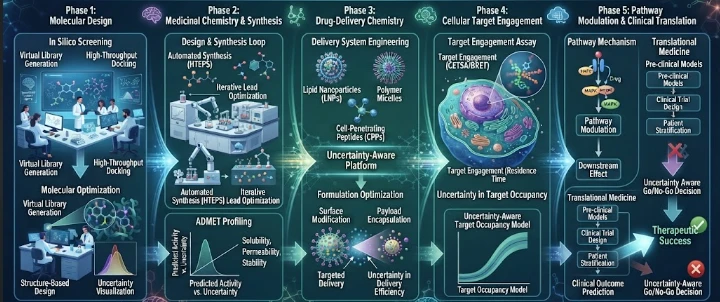
This article describes an uncertainty-aware platform for moving from predicted molecular binding to validated cellular target engagement in medicinal chemistry and drug-delivery research. Docking and machine-learning predictions can rapidly prioritize compounds, but they do not establish that a molecule reaches, occupies, and functionally modulates a target inside relevant cells. The article therefore separates predicted affinity from free intracellular concentration, subcellular localization, t
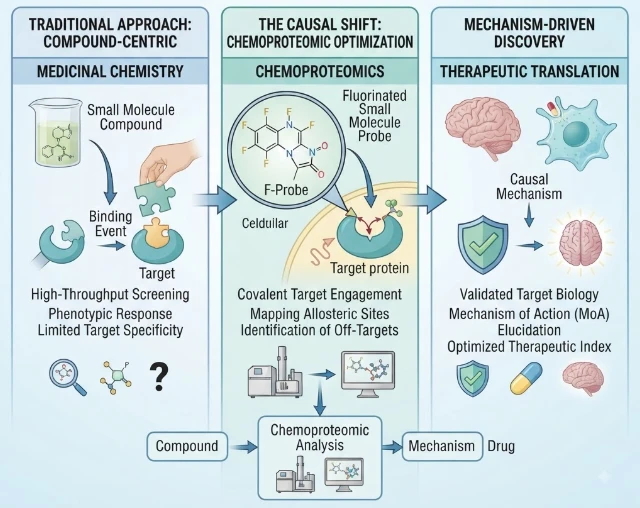
This article explores fluorinated medicinal chemistry through causal chemoproteomics, emphasizing that fluorine substitution can alter far more than potency. A single positional change can modify conformation, pKa, lipophilicity, metabolic stability, target interactions, intracellular exposure, and off-target biology. The article therefore tests whether fluorinated analogues change cellular phenotype through intended target engagement rather than hidden polypharmacology. Matched molecular pairs
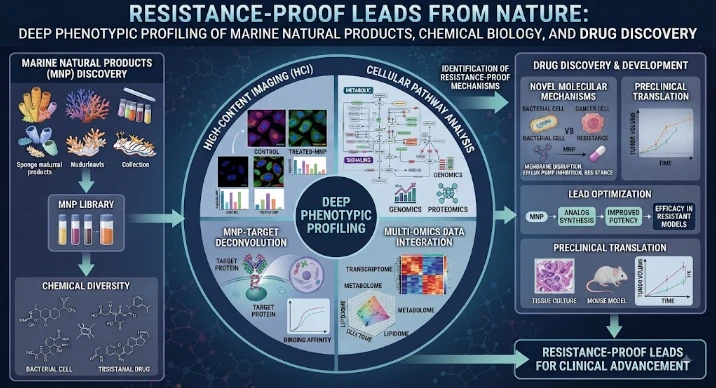
This article presents resistance-aware marine natural-product discovery as a mechanistic process rather than a search for isolated high-potency hits. It explains how activity from marine extracts or fractions can disappear during purification or fail under resistance pressure, making deep phenotypic profiling essential. Morphology, viability kinetics, organelle function, transcriptional state, metabolism, and recovery after washout are combined to connect phenotype with mechanism. The article em