From Formulation to First-in-Human Translation: A Quality by Design (QbD) Digital Twin for Mesoporous Materials, Oral/Targeted Nanomedicine and Advanced Delivery
Md. Humayan Kabir (Master of Science in Pharmaceutical Technology)
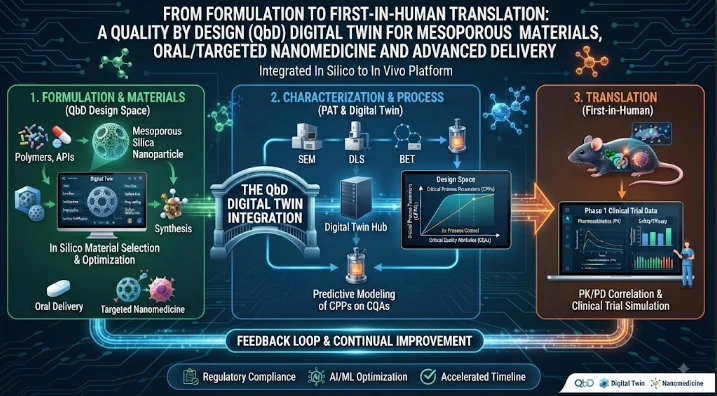
This article applies a quality-by-design digital-twin framework to mesoporous materials used in oral and targeted nanomedicine. It explains that mesoporous carriers offer high surface area, tunable pore structure, surface functionalization, and strong drug-loading capacity, but small manufacturing changes can alter release, degradation, biodistribution, and safety. The development process therefore begins with the intended product profile, distinguishing oral systems from intravenously targeted carriers because the relevant biological barriers differ. Critical material attributes include particle size, shape, pore dimensions, surface charge, functionalization, drug loading, and solid-state form, while critical process parameters include synthesis conditions, washing, drying, functionalization, sterilization, and loading methods. The digital twin links these variables to dissolution, gastrointestinal transport, mucus interaction, tissue retention, organ distribution, degradation, and clearance. Design of experiments, process analytical technology, PBPK modeling, stability studies, scale-up models, imaging, and uncertainty analysis are integrated. The framework supports first-in-human dose selection, comparability after process changes, and performance-based specifications for mesoporous nanomedicine.
The internal surface area, the pore size, and the loading capacity of a mesoporous material are unusually high with an ordered pore network because of the large internal surface area and the tunable pore size and loading capacity that is attractive for drug delivery research. In particular, poorly soluble drugs, targeted delivery, stimuli-responsive delivery, imaging and oral formulations are the areas where mesoporous silica nanoparticles have been explored. The translation of such systems to first in human studies is challenging because of small manufacturing changes that can change surface chemistry, drug release, degradation and biodistribution. A quality-by-design digital twin can provide a way to link those changes to clinical outcomes.
The point of departure is the desired product profile. The formulation of an oral mesoporous carrier with the goal of increasing the bioavailability of a poorly soluble drug has other requirements than an IV tumor-targeted carrier. Oral products must endure challenges from acid, enzymes, mucous secretion, intestinal transport, food influence and variable transit whilst systemically administered nanocarriers are challenged by protein corona formation, engulfment by phagocytes, distribution to organs and elimination from the body. So the digital twin should not be a generic description of the nanoparticle, but rather a route-specific physiological model.
The physical layer is comprised of critical material attributes. Performance can be affected by particle size, aspect ratio, pore diameter, pore volume, surface area, silanol density, surface charge, functionalization, loading of the drug, crystallinity of the drug in the pores, and rate of drug degradation. The biodistribution or gastrointestinal retention has been demonstrated to depend on the shape and surface modification of mesoporous particles. The observed information indicates that morphology and surface chemistry are clinically relevant parameters, and not cosmetic characterization data.
The attributes are decided by critical process parameters. Final material is affected by the precursor concentration, surfactant conditions, pH, temperature, mixing, aging, washing, calcination/extraction, functionalization chemistry, loading method, drying and sterilization. A quality by design program is based on a set of experiments that are designed to determine the factors in the process that have a significant effect on the product properties. Then a statistical design of experiments is used to relate the controllable manufacturing design space.
The digital twin is the link between that manufacturing layer and the drug behaviour. Poorly soluble drugs can be retained in an amorphous or molecularly dispersed state in the pores, to accelerate dissolution. Surface functionalization may cause a reduction in release rate, or impact the interaction with mucus or tissue retention. Mechanistic dissolution and adsorption models then make predictions of doses that are relevant to exposure.
When it comes to oral delivery oral transportation is next up in the layers. The mesoporous carriers may be used to protect payload, affect dissolution behavior, interact with mucus, and affect epithelial exposure. Surface functionalization has been demonstrated to impact the retention and biodistribution in gastrointestinal models including inflamed tissue. There must be parameters describing dissolution, carrier transit, degradation, permeability and any local retention mechanism for a useful twin.
Biodistribution is the most important when systemically delivering targeted drugs. Liver, spleen, lung, tumor or other tissue accumulation is affected by size, shape, charge, protein adsorption, surface ligands and degradability. The imaging and element analysis are complementary measurements. Instead of assuming that the injected dose is proportional to the target exposure, the uptake and clearance parameters of the target tissue can be obtained using a twin.
The degradation process is a process that must be explicitly represented since mesoporous silica cannot be kept in the same state forever. Both the safety and payload release are impacted by silica dissolution, structural fragmentation and elimination. Radio-labeling experiments have shown the need to differentiate the label location when monitoring particle degradation, as a label attached to a core can inform on one aspect of the fate while a label attached to a shell can inform on a different aspect. Which analytical strategy is used will thus have an impact on model interpretation.
These mechanisms add to the quality specifications. When the deviation of a particle size range would modify the uptake or biodistribution, the particle size range is important and needs to be controlled tightly; if the deviation of a pore size range would modify the loading/release, the pore size range is important and needs to be controlled tightly as well. Specifications should, therefore, be based on risk and performance and not be an arbitrary duplication of early laboratory batches. This is consistent with the general regulatory guidance on drug products that contain nanomaterials, in which special physical and biological characteristics need to be well characterized.
During the manufacture, the twin can be kept in place using process analytical technology. Information is provided prior to final release testing through spectroscopy, particle sizing, pH, temperature, mixing energy, moisture and other signals. Deviations are estimated by statistical process models on critical attributes. The emphasis of manufacturing control from the end point moves to a product within a known performance space.
Scale-up is a big challenge. Nucleation, growth, surface treatment or loading may change as a result of mixing and mass transfer as the batch volume increases. A digital twin can include equipment geometry and process kinetics for predicting these changes. Scale-up experiments are then conducted in selected conditions of interest, instead of testing all conditions empirically.
When stability is added, there's a time dimension. Changes in release/exposure during the storage period can occur due to moisture uptake, surface changes, drug recrystallization, oxidation of attached ligands, aggregation, or due to pore blockage. Stability models are based on the relationship between the environmental conditions and material evolution. The clinical impact of a measured change can then be inferred, not assumed, which is a standard approach when changes in the analytical values are assumed to be of equal clinical impact.
To translate to a nonclinical environment, realistic models are needed. Although simple dissolution assays and cell uptake assays continue to be valuable, organ-on-chip, gastrointestinal models, imaging and pharmacokinetic studies offer more complex data. The outputs are then fed to physiologically based models that describe absorption, organ distribution, degradation and elimination. Uncertainty ranges are crucial since the behaviour of nanoparticles is dependent on the biological context.
This allows for model-informed exposure bounds to be employed for first in human dose selection. Simulations examine target or off-target concentrations that are expected and worst case for physiological variability. Safety factors are still required but the model helps to identify which assumptions contribute to the greatest uncertainty. Initial dosing has called these assumptions into question with early clinical pharmacokinetics, imaging, and biomarkers.
The twin also has the advantage of tracking for comparability following process changes. Any change in manufacturing plant, scale, sterilization or raw-material supplier may influence particle attributes. The model does not just compare the analytical profiles, but also predicts if the difference in the observed profile affects the predicted exposure or release. The attributes most closely related to performance are the ones that are targeted in bridging experiments.
The mechanism of drug loading must be explained. While a high percentage loading is attractive, pore occupancy can affect the release, particle density, particle surface exposure, and stability. It is possible to obtain crystalline deposits outside pores or molecular dispersion within pores, at a similar total content level, with different loading methods. Solid state analysis is a consequence of the twin, as location and physical shape of the payload affects performance.
Surface ligands also need to be carefully controlled. The change in colloidal stability and biological recognition can be for targeting peptides, polymers, small molecules, or coatings with stealth molecules, but there is a tendency for the number of ligands per coat to be different in each batch. A low amount of ligand can result in the reduction of desired interactions; excess can change charge or block pore entrance. The data from quantitative surface analysis and functional binding assays is used to establish a range of ligand densities that are useful.
Sterilization is a realistic translational stress. Mesoporous structure and/or surface chemistry, loaded drug, or attached biomolecules can be changed by heat, radiation, filtration or aseptic processing. The suitable way is determined by the architecture of the products. The digital twin can view sterilization as a process transformation and forecast which critical attributes need to be confirmed after sterilization.
The clinical formulation steps also are important. Changes in aggregation and release can occur following reconstitution, dilution, mixing with food, passage through the administration tubing and/or contact with gastrointestinal fluids. Product performance thus has to be modelled at the point of administration and not just at release from manufacturing. The controlled product state becomes if it is used according to the instructions for use.
Economic feasibility should be evident throughout first in human planning. The complexity of the functionalization, yield of low production or extensive purification of mesoporous systems pose risks of cost and scale. Experiments conducted within the framework of quality by design can help to define simpler parts of the design space that retain biological performance. Thus, with translational optimization the goal is to find the simplest material structure that meets the desired clinical performance.
Continuity between materials science and pharmacology is essential for the formulation and translation of mesoporous nanomedicine to first-in-human application. The critical attributes are identified through quality by design, the digital twin connects the critical attributes to manufacturing and physiology and updates with clinical data. This approach doesn't give any clarity about advanced delivery. Rather, it provides a traceable, testable, and meaningful uncertainty, that can be used to determine if a complex mesoporous product is ready to proceed with human studies.
CITE THIS ARTICLE
Kabir, M. H. (2026). From Formulation to First-in-Human Translation: A Quality by Design (QbD) Digital Twin for Mesoporous Materials, Oral/Targeted Nanomedicine and Advanced Delivery. https://researchbykabir.com/article/f0d99576-9ab7-5833-af79-c1bcdb1997ea
M. H. Kabir, “From Formulation to First-in-Human Translation: A Quality by Design (QbD) Digital Twin for Mesoporous Materials, Oral/Targeted Nanomedicine and Advanced Delivery,” 2026. [Online]. Available: https://researchbykabir.com/article/f0d99576-9ab7-5833-af79-c1bcdb1997ea
Kabir, M. H. (2026) ‘From Formulation to First-in-Human Translation: A Quality by Design (QbD) Digital Twin for Mesoporous Materials, Oral/Targeted Nanomedicine and Advanced Delivery’. Available at: https://researchbykabir.com/article/f0d99576-9ab7-5833-af79-c1bcdb1997ea
Kabir, Md. Humayan. “From Formulation to First-in-Human Translation: A Quality by Design (QbD) Digital Twin for Mesoporous Materials, Oral/Targeted Nanomedicine and Advanced Delivery.” 2026, https://researchbykabir.com/article/f0d99576-9ab7-5833-af79-c1bcdb1997ea.
Md. Humayan Kabir. “From Formulation to First-in-Human Translation: A Quality by Design (QbD) Digital Twin for Mesoporous Materials, Oral/Targeted Nanomedicine and Advanced Delivery.” (2026). https://researchbykabir.com/article/f0d99576-9ab7-5833-af79-c1bcdb1997ea.
Kabir MH. From Formulation to First-in-Human Translation: A Quality by Design (QbD) Digital Twin for Mesoporous Materials, Oral/Targeted Nanomedicine and Advanced Delivery. 2026. https://researchbykabir.com/article/f0d99576-9ab7-5833-af79-c1bcdb1997ea
@misc{article_f0d995769ab75833af79c1bcdb1997ea,
  title = {From Formulation to First-in-Human Translation: A Quality by Design (QbD) Digital Twin for Mesoporous Materials, Oral/Targeted Nanomedicine and Advanced Delivery},
  author = {Md. Humayan Kabir},
  year = {2026},
  url = {https://researchbykabir.com/article/f0d99576-9ab7-5833-af79-c1bcdb1997ea},
}
TY  - GEN
AU  - Md. Humayan Kabir
TI  - From Formulation to First-in-Human Translation: A Quality by Design (QbD) Digital Twin for Mesoporous Materials, Oral/Targeted Nanomedicine and Advanced Delivery
PY  - 2026-04-05
UR  - https://researchbykabir.com/article/f0d99576-9ab7-5833-af79-c1bcdb1997ea
ER  -
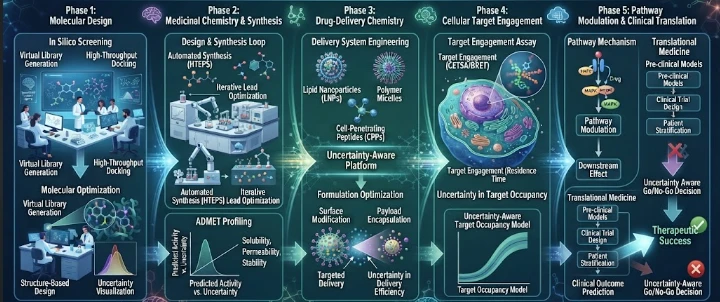
This article describes an uncertainty-aware platform for moving from predicted molecular binding to validated cellular target engagement in medicinal chemistry and drug-delivery research. Docking and machine-learning predictions can rapidly prioritize compounds, but they do not establish that a molecule reaches, occupies, and functionally modulates a target inside relevant cells. The article therefore separates predicted affinity from free intracellular concentration, subcellular localization, t
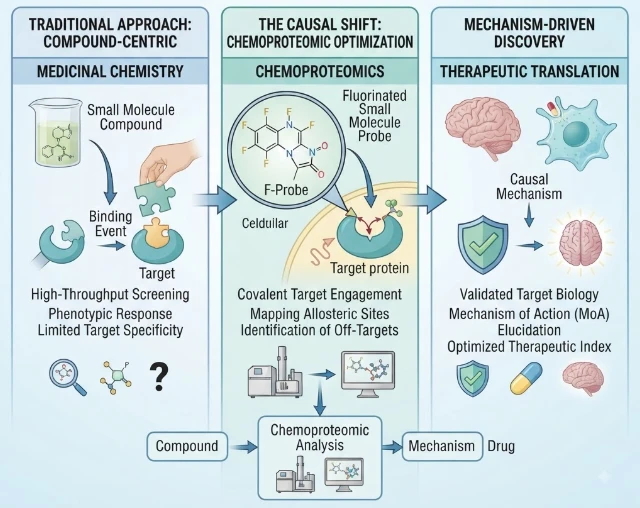
This article explores fluorinated medicinal chemistry through causal chemoproteomics, emphasizing that fluorine substitution can alter far more than potency. A single positional change can modify conformation, pKa, lipophilicity, metabolic stability, target interactions, intracellular exposure, and off-target biology. The article therefore tests whether fluorinated analogues change cellular phenotype through intended target engagement rather than hidden polypharmacology. Matched molecular pairs
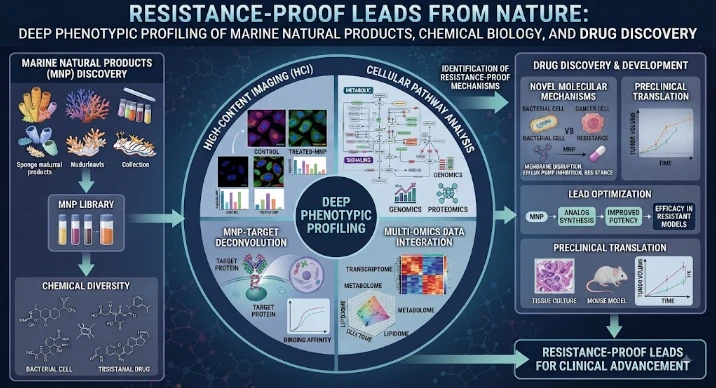
This article presents resistance-aware marine natural-product discovery as a mechanistic process rather than a search for isolated high-potency hits. It explains how activity from marine extracts or fractions can disappear during purification or fail under resistance pressure, making deep phenotypic profiling essential. Morphology, viability kinetics, organelle function, transcriptional state, metabolism, and recovery after washout are combined to connect phenotype with mechanism. The article em