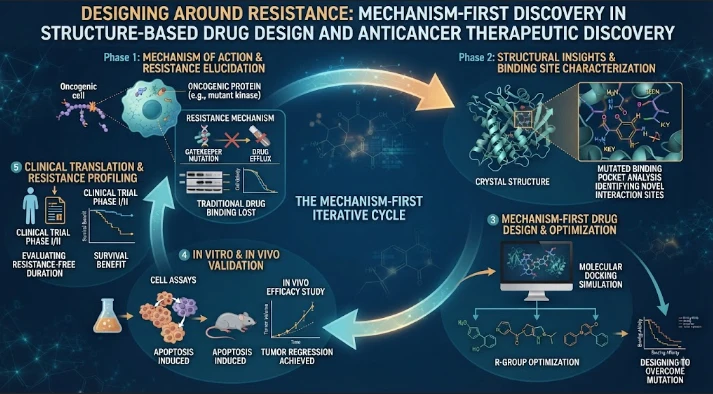
This article frames structure-based anticancer discovery around resistance rather than affinity alone. High-quality binding poses can still fail when tumors acquire target mutations, activate bypass pathways, alter transport, amplify targets, or change lineage state. Mechanism-first design therefore maps atomic contacts onto catalytic necessity, conformational dynamics, mutation hotspots, and fitness constraints before optimization becomes locked around one attractive pose. The article uses kinase inhibitor resistance as a model for how substitutions can weaken binding, stabilize alternative conformations, or preserve catalytic function while removing critical drug contacts. Binding pose, water networks, conformational state, mutation tolerance, target abundance, pathway redundancy, cellular exposure, and tumor genotype are treated as interacting variables. Resistance testing includes gatekeeper mutations, allosteric remodeling, efflux, metabolic rewiring, and phenotypic state changes. Free intracellular concentration, target occupancy, protein binding, active metabolites, tissue penetration, and duration above effective occupancy define meaningful exposure. Co-structures, resistant mutants, genetic epistasis, rescue experiments, pharmacodynamic biomarkers, and uncertainty-aware structural modeling are integrated. The key goal is a structurally precise mechanism with a higher barrier to evolutionary escape.
Designing Around Resistance highlights a major challenge in the structural-based design of anticancer drugs: tumors can develop mutations on the target, and can bypass the target, or change transport or lineage, without being bound by the high affinity of the designed drug. For a good development strategy the focus is on a quantifiable mechanism, not just a single impressive assay result. The change creates a new translation, examining chemistry, biology, exposure, resistance, safety, and production as one argument.
The scientific underpinning is based on binding contacts and catalytic necessity mapping, conformational dynamics, resistance hotspots and fitness constraints, all via a process of mechanism-first structure-based design. Everything is a piece of the puzzle, and none of the components on their own is enough to support the entire mechanistic statement. The connection of evidence mitigates the risk of mistaking potency, binding, formulation performance and/or model fit for understanding of a therapeutic relationship.
The history of cancer drugs provides many examples of successful structures that were later "escaped" (or "exploited") by structures. Structural history in the field of cancer drugs provides repeated examples of structural success, then structural escape (or “exploit”). The substitutions can involve the selection of residues that either reduce the affinity for the drug, stabilize other conformations, or maintain catalytic activity but lose a contact with the drug. The EGFR pathway and other oncogenic kinase pathways were used to show that inhibitors of each generation have to develop alternative binding mechanisms in order to overcome the resistance mutations. The more durable the structure-based design is, the more mutations that are tolerated prior to locking a candidate in place around one attractive pose.
The use of design variables necessitates a joint treatment due to the changes that binding pose, water network, conformational state, mutation tolerance, target abundance, pathway redundancy, cellular exposure and tumor genotype may undergo at the same time. Adopting optimization of a single parameter can impose an unseen penalty on other parameters, such as potency vs stability, potency vs selectivity, potency vs delivery or potency vs manufacturability. Considerable more realistic ranking of candidates can be achieved using multiparameter decision rules than a single numerical endpoint.
Having early measurements of failure routes is also a prerequisite for mechanistic confidence. Escape mechanisms are of critical importance, such as target amplification, allosteric remodeling, bypass signaling, phenotypic state change, gatekeeper mutation, and efflux. Stress testing intentionally makes these routes into design information, which can be used to inform the next chemistry, formulation, dosing or model cycle.
A link between nominal dose and biological effect is exposure. These are all relevant quantities, such as free intracellular concentration, occupancy of the target, plasma protein bound, active metabolites, tissue penetration and time above effective occupancy. A candidate that is active in a simple assay but not active at the causal site can appear as a great candidate for assay, but be unsuitable for translation.
When interpreting the engagement or functional perturbation, it is recommended to do so at realistic concentrations. Side effects, off-target effects or assay artefacts may occur at high doses and give a false positive effect of the desired mechanism. Concentration-response analysis that correlates exposure and occupancy with the proposed causal process to discern the range in which the proposed process is likely to occur.
But interpretation is also biological context dependent, as in the case of oncogenic enzymes, signaling proteins, epigenetic regulators, and protein interaction surfaces. Genotype, cell state, tissue architecture, immune tone, metabolic environment and previous drug exposure may influence both the target dependence and effective exposure. Repeated testing in one convenient system is not as compelling as representative model panels.
Resistance and adaptation should be measured on the prospective and not the retrospective basis. Further selection, serial passage, genetic manipulation, repeated dosing or environmental stress can identify which mechanisms are able to withstand ongoing selection. A slightly weaker, but more blockbuster escape resistant candidate can have greater translational value than a weak screening leader.
A mechanism is a key element in safety assessment, especially to make it more informative. Issues that are important are structural selectivity across homologues, kinome or proteome profiling, exposure in normal cells, genotoxicity, cardiac liability and therapeutic index. A comparison of the desired engagement with unwanted biological responses can be useful to differentiate mechanism-related pharmacology from pharmacomechanic or formulation-related toxicity.
The synthetic tractability, the solid form, the control of impurities, the stereochemical stability, the robustness of the route and the availability of analogues, all have an impact on the product offered to the biological systems and manufacturing cannot be a downstream logistics exercise. Even if the product name is not changed, minor changes in the process can impact the composition, physical state, level of impurities, stability or dose consistency. The critical process attributes are directly connected to the mechanistic performance, adding robustness to development.
Docking, molecular dynamics, free-energy perturbation, mutation scanning, network modelling and uncertainty-aware multiparameter optimization are computational tools that provide leverage. Prediction becomes most useful when the uncertainty and applicability limits are clearly apparent, particularly around new chemical structures, unusual biological states, and when there is limited data. Models that allow for uncertainty will lead to better experiment selection than models that simply rank experiments with a high degree of confidence without revealing where their knowledge is low.
To validate a use in a clinical context, co-structures, resistant mutants, genetic epistasis, rescue experiments, and in vivo pharmacodynamic biomarkers are all needed. Repeated measurements in the same family of assays would introduce the same 'hidden bias' without providing greater evidence of causation because orthogonal tests are important. If the results are in agreement on independent designs it is a more robust chain from design choice to biological consequence and if they disagree, then there is an assumption to be modified.
Data integration should also maintain the traceability of the entire experiment process to the development decision. Chemical structures, conditions of the process, assay metadata, measurement of exposure, features from the omics data, observations of resistance, and signals for safety require stable identifiers and versioned analysis. This discipline helps to avoid subsequent interpretations getting "off the message" from what the result was.
Also, the metrics for decisions must not be showpieces in the lab. To make a scorecard useful, it needs to include these components: reproducability, activity normalized for exposure, mechanist confidence, resistance frequency, safety margin, stability, and manufacturing robustness. This will incentivize balanced candidates, and allow for some kind of trade-offs to be clearly seen before costly development commitments are made.
In this context especially negative results have high values. The boundary of a hypothesis is determined by failed synthesis, target engagement was not accomplished, the exposure was not stable, there was no rescue, there was resistance and, no activity in realistic models, and there was poor batch reproducibility. Documenting those failures aids future experimental design and allows for investment to be made in viable yet more attractive explanations.
Reproducibility of a laboratory to laboratory and also batch to batch is another key filter. Even though statistical significance appears robust, a mechanism which relies on one operator, one preparation, one cell line, or one modeling choice is fragile, since that may be the only one sufficient to obtain significance. When conditions are matched, independent repeating differentiates repeatable biology from local experiments.
There is also a practical aspect of clinic or deployment that needs to be taken into account when doing translation. Technical sophistication doesn't necessarily mean a product with a realistic value if it is difficult to route, administration, diagnostic requirements, storage, monitoring, cost or timing of treatment. When product design is designed to have a biological effect, it needs to be mechanistic excellence to make a difference.
Another added layer is temporal design which involves the response of biological systems, specifically short pulses, long exposure, washout, repeated dosing. Time-resolved measurements can distinguish between the early activity, a primary engagement, and downstream adaptation, and can detect if early activity remains after the initiating signal is gone. The sampling schedules must then be designed to reflect the anticipated kinetics in the discovery of structure-based anticancer drugs, and not just one desired endpoint.
An integrated development record aids in improved communication between medicinal chemistry, formulation science, pharmacology, computation, manufacturing and clinical planning. The record does not have to tell one single story, but can differentiate between known connections, likely assumptions, unknowns, and the next experiment with the most information content. This transparency makes the iterations quicker and lessens the pressure to justify initial statements when conflicting data comes up.
Novelty is kept in check by a benchmarking against credible reference conditions. Whether a new approach will result in better prediction, better mechanism, longer duration or better manufacturability is determined by established compounds (inactive controls), standard formulations, baseline models, or accepted analytical methods. A head-to-head comparison also allows gains to be identified that are lost following exposure, assay sensitivity, batch sensitivity or experimental complexity normalization.
Even more, if there are pre-determined stopping rules to avoid being held up by weak hypotheses, then the quality of the decision increases the more that these are used. Progressive criteria for clearing resources focus resources on reproducible mechanisms as complexity of biological and operational systems increases.
Structural design with resistance is successful if the atomic level of detail is linked to evolutionary constraint and cell mechanism. What is important is not that a candidate be successful in one assay but that the proposed mechanism be consistent throughout exposure, biological variation, resistance, safety, and production. The standard establishes a more structured route from the discovery signal to a therapeutic concept that is capable of enduring the rigors of the real world.
CITE THIS ARTICLE
Kabir, M. H. (2025). Designing Around Resistance: Mechanism-First Discovery in Structure-based drug design and anticancer therapeutic discovery. https://researchbykabir.com/article/ed27df68-d312-599f-9f69-ddfd1657d55a
M. H. Kabir, “Designing Around Resistance: Mechanism-First Discovery in Structure-based drug design and anticancer therapeutic discovery,” 2025. [Online]. Available: https://researchbykabir.com/article/ed27df68-d312-599f-9f69-ddfd1657d55a
Kabir, M. H. (2025) ‘Designing Around Resistance: Mechanism-First Discovery in Structure-based drug design and anticancer therapeutic discovery’. Available at: https://researchbykabir.com/article/ed27df68-d312-599f-9f69-ddfd1657d55a
Kabir, Md. Humayan. “Designing Around Resistance: Mechanism-First Discovery in Structure-based drug design and anticancer therapeutic discovery.” 2025, https://researchbykabir.com/article/ed27df68-d312-599f-9f69-ddfd1657d55a.
Md. Humayan Kabir. “Designing Around Resistance: Mechanism-First Discovery in Structure-based drug design and anticancer therapeutic discovery.” (2025). https://researchbykabir.com/article/ed27df68-d312-599f-9f69-ddfd1657d55a.
Kabir MH. Designing Around Resistance: Mechanism-First Discovery in Structure-based drug design and anticancer therapeutic discovery. 2025. https://researchbykabir.com/article/ed27df68-d312-599f-9f69-ddfd1657d55a
@misc{article_ed27df68d312599f9f69ddfd1657d55a,
  title = {Designing Around Resistance: Mechanism-First Discovery in Structure-based drug design and anticancer therapeutic discovery},
  author = {Md. Humayan Kabir},
  year = {2025},
  url = {https://researchbykabir.com/article/ed27df68-d312-599f-9f69-ddfd1657d55a},
}
TY  - GEN
AU  - Md. Humayan Kabir
TI  - Designing Around Resistance: Mechanism-First Discovery in Structure-based drug design and anticancer therapeutic discovery
PY  - 2025-05-18
UR  - https://researchbykabir.com/article/ed27df68-d312-599f-9f69-ddfd1657d55a
ER  -
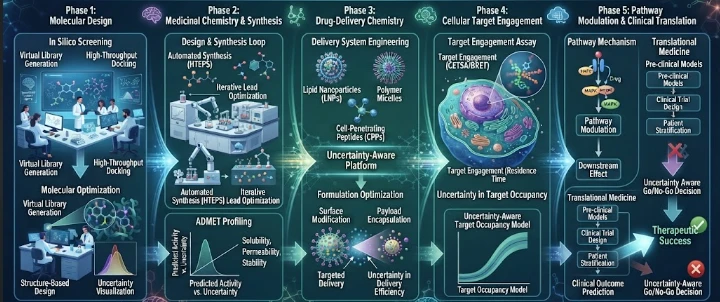
This article describes an uncertainty-aware platform for moving from predicted molecular binding to validated cellular target engagement in medicinal chemistry and drug-delivery research. Docking and machine-learning predictions can rapidly prioritize compounds, but they do not establish that a molecule reaches, occupies, and functionally modulates a target inside relevant cells. The article therefore separates predicted affinity from free intracellular concentration, subcellular localization, t
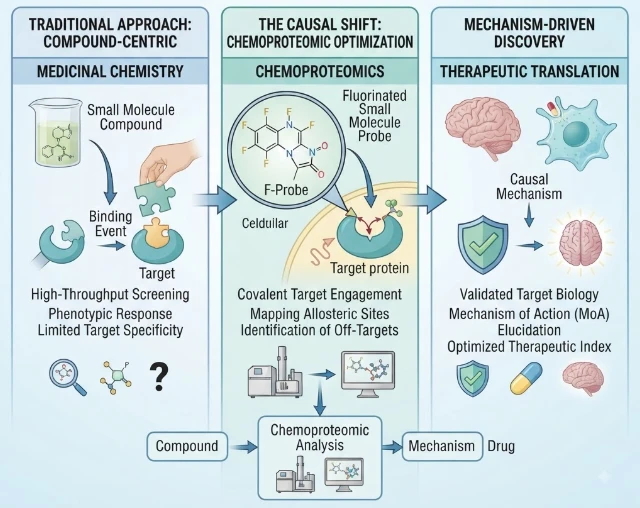
This article explores fluorinated medicinal chemistry through causal chemoproteomics, emphasizing that fluorine substitution can alter far more than potency. A single positional change can modify conformation, pKa, lipophilicity, metabolic stability, target interactions, intracellular exposure, and off-target biology. The article therefore tests whether fluorinated analogues change cellular phenotype through intended target engagement rather than hidden polypharmacology. Matched molecular pairs
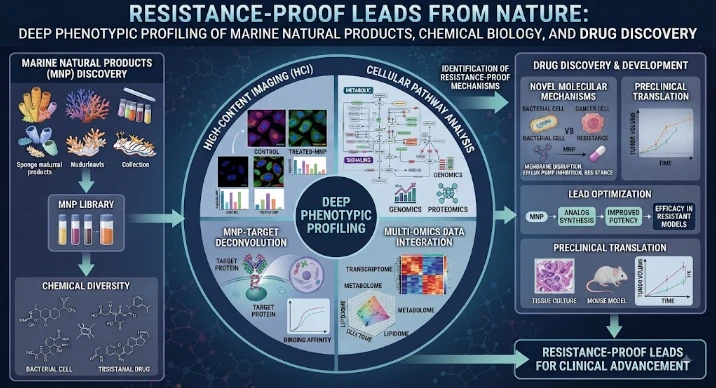
This article presents resistance-aware marine natural-product discovery as a mechanistic process rather than a search for isolated high-potency hits. It explains how activity from marine extracts or fractions can disappear during purification or fail under resistance pressure, making deep phenotypic profiling essential. Morphology, viability kinetics, organelle function, transcriptional state, metabolism, and recovery after washout are combined to connect phenotype with mechanism. The article em