From Predicted Binding to Cellular Target Engagement: An Uncertainty-Aware Platform for Gold/Platinum Anticancer Therapeutics, Synthesis and Electrochemistry
Md. Humayan Kabir (Master of Science in Pharmaceutical Technology)
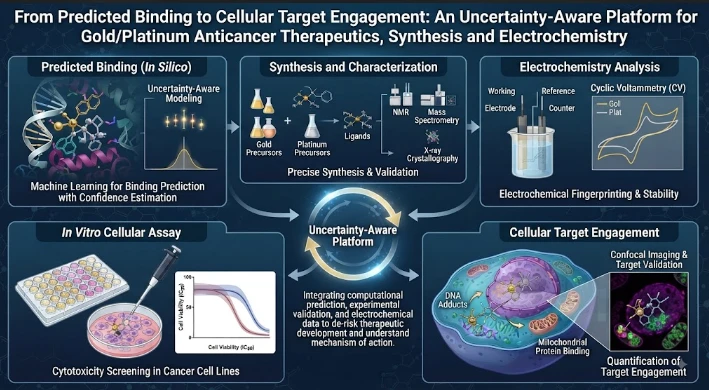
This article presents an uncertainty-aware discovery platform for gold- and platinum-based anticancer therapeutics that connects computational prediction with real cellular target engagement. It begins with the problem of metal-complex speciation, emphasizing that ligand exchange, hydrolysis, redox changes, and binding to cellular nucleophiles can alter chemical identity after exposure. Electrochemistry therefore becomes mechanistically important, helping to clarify oxidation state, reduction potential, ligand stability, and possible active species. Computational tools such as quantum chemistry, docking, molecular dynamics, and machine learning are positioned as hypothesis generators rather than final proof. The article then emphasizes chemoproteomics, thermal profiling, intact-protein mass spectrometry, mutagenesis, genetic perturbation, resistance studies, and functional rescue to establish causal mechanisms. Cellular metal exposure and subcellular localization are also treated as essential because failed engagement may simply reflect poor access. By integrating synthesis, electrochemistry, proteomics, genetics, pharmacology, and uncertainty calibration, the workflow aims to produce mechanistically defensible anticancer leads rather than attractive but unsupported binding predictions.
There has been a longstanding conflict in the relations between beautiful molecule design and dirty cell reality in metal-based anticancer chemistry. The platinum drugs have shown that coordination complexes could be important cancer drugs, whereas new gold compounds developed interest in redox mechanisms and organometallic mechanisms. However, the ability of a metal complex to be bound, to dock with a receptor, or to bind a ligand with a certain biochemical affinity is not a guarantee of what it is binding in a living cell. The prediction, synthesis, electrochemistry, exposure, and direct target engagement would then need to be integrated into a discovery platform that is uncertainty-aware.
The first step in the challenge is chemical speciation. Metal complexes are not necessarily rigid "ligands" that simply transfer from an assay tube to a protein pocket without change. During exposure, the chemical identity changes through ligand exchange, reduction/oxidation, hydrolysis, binding to abundant cellular nucleophiles, and other reactions. Aquation and covalent interactions are key to pharmacology of platinum compounds, many gold complexes are redox sensitive and exhibit strong affinity for cysteine or selenocysteine environments.
No longer is electrochemistry just descriptive, it becomes mechanistically important. Ligand stability and redox cycling, oxidation states, and reduction potentials assist in describing the fate of the complex in reaching a target, or if it changes into another active species. A gold(III) scaffold that reduces quickly at intracellular conditions is another mechanistic challenge compared to a carbon-stabilized gold(III) complex with a better persistence. It is, therefore, necessary to determine the electrochemical signal for each molecular form by electrochemical measurements, before interpreting it biologically.
Computational prediction still has its uses, particularly as a hypothesis generator. Plausible protein interactions are prioritized and structure property relationships estimated by quantum chemical calculations, molecular docking, molecular dynamics and machine-learning models. The difficulties that can arise are when model confidence is equated with biological certainty. The uncertainties in the metal coordination, covalent reactivity, protein microenvironment and/or in the intracellular speciation still need to be placed next to the predicted ranks.
Disagreement is informative with an uncertainty-aware workflow. A protein that is predicted well by docking but not detected by cell-based assays gets a low level of mechanistic priority while a protein which is consistently detected by chemoproteomics, but not docked to the target, gets attention from the cell-based assays, even if it scores less well by docking. Uncertainty can be expressed quantitatively by using a Bayesian approach, ensemble predictions, conformal approaches, or calibrated confidence intervals. The intent of this is not to get rid of uncertainty, but to focus experiments on the most risky assumptions in the decision.
Chemical proteomics is a crucial step between predicted binding and cellular engagement. Proteins affected or bound in complex biological systems are identified by affinity probes, competition experiments, activity-based strategies, thermal proteome profiling and mass spectrometry. Recently, designed probes combined with orthogonal target validation have been proven to be useful in anticancer research for gold. This type of research shows that metal complexes are not limited to interacting with proteins that are primarily concerned with DNA, but can also interact with other proteins that are involved in mitochondrial metabolism, redox regulation and many other pathways.
Target engagement is also required to be orthogonal as it is not enough that a protein is enriched to be causal pharmacology. Cellular thermal shift assays are used to monitor changes in the stability of the protein, intact-protein mass spectrometry is used to monitor adduct formation, mutagenesis studies are used to study critical residues, and genetic perturbation studies are used to assess dependency. An additional layer of functional rescue experiments is performed in which the proposed interaction is disrupted to determine if the phenotype is weakened. When chemistry, engagement, genes and cellular response come together, a credible mechanism springs into existence.
The case of Platinum therapeutics is a good example of the importance of that standard. The mechanisms of action of cisplatin and other agents involve DNA adduct formation, but uptake, efflux, detoxification, DNA repair, apoptosis and tumor-state variables are involved in sensitivity and resistance. New platinum-based complexes are designed to change the distribution of the platinum in the cell, or to overcome known resistance mechanisms. Mechanical claims must be supported by direct evidence of change in the causal chain and not just as a result of nonspecific stress.
There are parallel questions with gold complexes, having different chemistry. There are many gold(I) and gold(III) compounds that have shown activity against thiol-redox systems, the mitochondria, the proteostasis and metabolic signalling, but the scaffolds of the individual compounds are quite different. In more recent chemoproteomic investigations, it has been shown that stabilized gold(III) complexes can interact with different proteins directly, thus highlighting the risk of a generic “gold mechanism.” The interaction network is determined by the ligand architecture and cellular speciation, while metal identity is important.
Synthesis is an integral part of the learning loop as mechanistic hypotheses need to be converted to compounds that can test them. The properties of ligands can be systematically adjusted, such as ligand substitution, steric shielding, lipophilicity, charge, coordination geometry and redox stability. Medicinal chemistry can not only consider synthesizing analogues to maximize the potency, but also create matched probes that can isolate permeability, reactivity, stability and target affinity. These compounds are not only therapeutic candidates, but also mechanistic tools.
The stronger the platform, the more exposure cells. Lack of engagement can be differentiated from lack of access by measuring the concentration of metal in the cell, its sub-cellular localization, time dependent accumulation within the cell, and the presence of extracellular proteins binding the metal. The dose-actual intracellular metal burden connection is established by using inductively coupled plasma mass spectrometry, elemental imaging, and other complementary analytical techniques. A negative target assay is only conclusive if a measurement of the concentration of the target compound has been performed, as it may not reach the target for any type of negative.
The added value test of resistance constraints is another valuable test. Through long-term selection, resistant cell models, CRISPR screens and comparative omics, pathways that change in response to treatment pressure are identified. The greater the number of times resistance has changed a proposed target or pathway, the more confident people are of the mechanism. If resistance arises by general detoxification or transport alteration, optimization should take into account these drawbacks and not be overexotic towards a protein which has already a high affinity.
This strategy is an integrated strategy which alters the nature of a successful prediction. The best computational output is not necessarily the best docking score; it's a scientific testable hypothesis, one that can be tested by chemistry, electrochemical testing, proteomics, genetics and pharmacology. Uncertainty becomes a guide to resource allocation, identify where synthesis and/or biological experiments will yield the best information gain. Failing to make a prediction is helpful, too: the limitations of the model that were made evident by the failure are documented, instead of being concealed.
The same is true for off-target engagement. There may be many proteins that bind the metal complex before it is able to reach the therapeutically useful target, and there may be many nucleophiles in serum that dominate early chemistry, such as serum albumin, glutathione, metallothioneins. Realistic matrices can be used to measure competition to find out if an interaction proposed is likely to be possible at cellular concentration. Proteomic selectivity maps also show whether engagement is targeted (i.e., narrow) or widespread (i.e., diffuse) within proteins.
The other factor is temporal resolution – the metal pharmacology changes after dosing. The complex that remains intact can be taken into cells, change shape, shuffle, and create new species that have different protein preferences. The early and late target engagement therefore provides different information related to the response. Time resolved sampling allows primary chemical events to be correlated with the stress pathways downstream and thus limits the risk of naming a secondary response protein as the initiating target.
At the end of the day, translation will need to be selective between tumor/normal tissue. If engagement is equally seen in healthy cells at tolerated exposures, then there is little advantage from a therapeutic perspective of a mechanistically attractive target. Therapeutic window is determined by comparative target-engagement studies, organ-specific distribution and biomarker of metal exposure. This provides a direct link between medicinal chemistry and pharmacology – since ligand design is aimed at greater engagement, it is aimed at engagement at the right cells at concentrations that will not compromise safety.
Uncertainty-aware reporting also enhances communication between computational chemists, synthetic chemists and the biologists. The platform could give a hierarchy of mechanistic hypotheses, and indicate the percentage confidence of each, and also which experiment will distinguish between the various explanations. Thus, each of these syntheses or assays is a decision-oriented test. Mechanistic understanding then builds up rather than has to be built up after a successful cytotoxic compound has progressed.
Gold and platinum anticancer therapeutic agents are at an ideal crossroads to this philosophy. Tunable reactivity is achieved through rich coordination chemistry, important transformations are described by electrochemistry and interaction networks involving proteins in the cell are unveiled with ever increasing resolution by modern chemoproteomics. Combining those properties yields a discovery platform with causal target engagement, instead of appealing computational pictures. Such a transition is more reliable and provides a better route from metal-complex design to anticancer leads that are mechanistically defensible.
CITE THIS ARTICLE
Kabir, M. H. (2026). From Predicted Binding to Cellular Target Engagement: An Uncertainty-Aware Platform for Gold/Platinum Anticancer Therapeutics, Synthesis and Electrochemistry. https://researchbykabir.com/article/b531abdd-89b0-53d3-b90f-2793d945182d
M. H. Kabir, “From Predicted Binding to Cellular Target Engagement: An Uncertainty-Aware Platform for Gold/Platinum Anticancer Therapeutics, Synthesis and Electrochemistry,” 2026. [Online]. Available: https://researchbykabir.com/article/b531abdd-89b0-53d3-b90f-2793d945182d
Kabir, M. H. (2026) ‘From Predicted Binding to Cellular Target Engagement: An Uncertainty-Aware Platform for Gold/Platinum Anticancer Therapeutics, Synthesis and Electrochemistry’. Available at: https://researchbykabir.com/article/b531abdd-89b0-53d3-b90f-2793d945182d
Kabir, Md. Humayan. “From Predicted Binding to Cellular Target Engagement: An Uncertainty-Aware Platform for Gold/Platinum Anticancer Therapeutics, Synthesis and Electrochemistry.” 2026, https://researchbykabir.com/article/b531abdd-89b0-53d3-b90f-2793d945182d.
Md. Humayan Kabir. “From Predicted Binding to Cellular Target Engagement: An Uncertainty-Aware Platform for Gold/Platinum Anticancer Therapeutics, Synthesis and Electrochemistry.” (2026). https://researchbykabir.com/article/b531abdd-89b0-53d3-b90f-2793d945182d.
Kabir MH. From Predicted Binding to Cellular Target Engagement: An Uncertainty-Aware Platform for Gold/Platinum Anticancer Therapeutics, Synthesis and Electrochemistry. 2026. https://researchbykabir.com/article/b531abdd-89b0-53d3-b90f-2793d945182d
@misc{article_b531abdd89b053d3b90f2793d945182d,
  title = {From Predicted Binding to Cellular Target Engagement: An Uncertainty-Aware Platform for Gold/Platinum Anticancer Therapeutics, Synthesis and Electrochemistry},
  author = {Md. Humayan Kabir},
  year = {2026},
  url = {https://researchbykabir.com/article/b531abdd-89b0-53d3-b90f-2793d945182d},
}
TY  - GEN
AU  - Md. Humayan Kabir
TI  - From Predicted Binding to Cellular Target Engagement: An Uncertainty-Aware Platform for Gold/Platinum Anticancer Therapeutics, Synthesis and Electrochemistry
PY  - 2026-07-26
UR  - https://researchbykabir.com/article/b531abdd-89b0-53d3-b90f-2793d945182d
ER  -
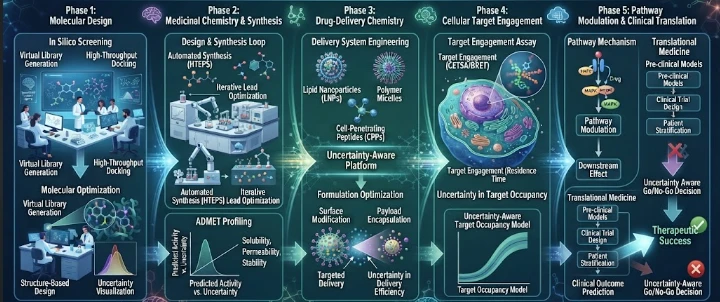
This article describes an uncertainty-aware platform for moving from predicted molecular binding to validated cellular target engagement in medicinal chemistry and drug-delivery research. Docking and machine-learning predictions can rapidly prioritize compounds, but they do not establish that a molecule reaches, occupies, and functionally modulates a target inside relevant cells. The article therefore separates predicted affinity from free intracellular concentration, subcellular localization, t
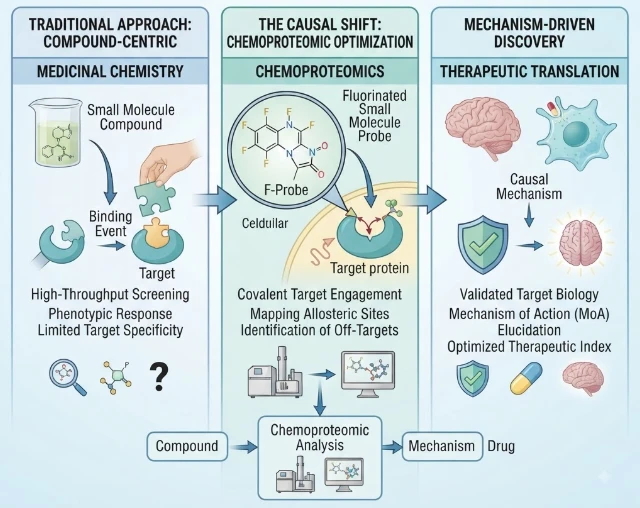
This article explores fluorinated medicinal chemistry through causal chemoproteomics, emphasizing that fluorine substitution can alter far more than potency. A single positional change can modify conformation, pKa, lipophilicity, metabolic stability, target interactions, intracellular exposure, and off-target biology. The article therefore tests whether fluorinated analogues change cellular phenotype through intended target engagement rather than hidden polypharmacology. Matched molecular pairs
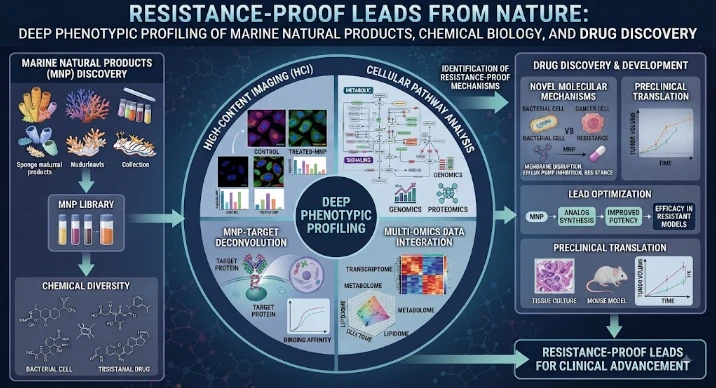
This article presents resistance-aware marine natural-product discovery as a mechanistic process rather than a search for isolated high-potency hits. It explains how activity from marine extracts or fractions can disappear during purification or fail under resistance pressure, making deep phenotypic profiling essential. Morphology, viability kinetics, organelle function, transcriptional state, metabolism, and recovery after washout are combined to connect phenotype with mechanism. The article em