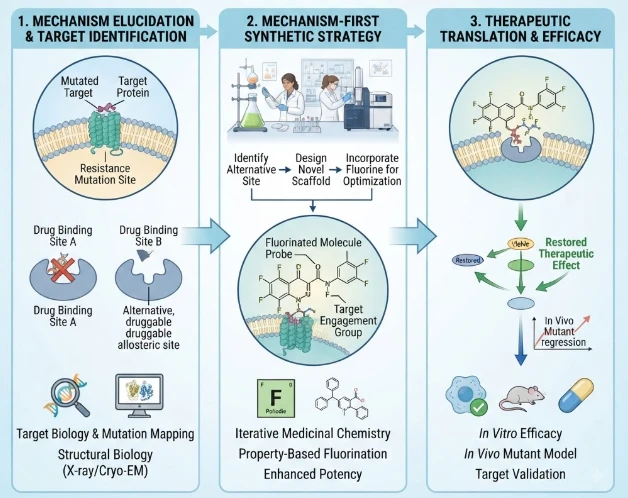
This article treats fluorination as a resistance-aware medicinal-chemistry decision rather than a universal optimization tactic. A fluorine substitution may strengthen binding while increasing dependence on a mutable residue, transporter, metabolic pathway, or activation mechanism. The workflow therefore combines electronic and conformational tuning with structural mutation maps, resistant-cell sequencing, target occupancy, and exposure measurements. Fluorine position, local electrostatics, binding geometry, metabolic blocking, target mutation landscape, transporter sensitivity, and free cellular exposure are treated jointly. Important escape mechanisms include binding-site mutation, pathway bypass, target amplification, efflux, metabolic adaptation, phenotype switching, and altered prodrug activation. Unbound plasma concentration, cell penetration, intracellular retention, active metabolites, tissue distribution, and occupancy duration define the exposure needed for meaningful interpretation. Safety concerns include target-family selectivity, metabolite toxicity, cardiac channels, CYP inhibition, genotoxicity, and persistent fluorinated species. Free-energy calculations, mutation scanning, QSAR, metabolic-site models, and uncertainty-aware resistance scoring support prioritization. Resistant clones, reverse genetics, positional fluorine analogues, combination studies, and exposure-matched testing are required to determine whether stronger affinity also produces more durable pharmacology.
Designing Around Resistance highlights a fundamental issue in resistance studies of fluorinated medicinal products: whilst fluorinated analogues may increase binding, they may also lead to increased fragility with respect to non-covalent contacts, metabolic pathways, or transport processes. The more successful development strategy focuses on a quantifiable mechanism, instead of a single 'lit' assay result. Chemistry, biology, exposure, resistance, safety and production become part of one translational argument as a result of this shift.
The scientific basis is a process of mechanism first design, where fluorine is used to customize the conformation, electronics, pKa, lipophilicity and metabolic stability and evolutionary escape is tested. Each component relates to a specific question and no single measurement would have the entire mechanistic claim. With connected evidence, there's less risk that potency, binding, formulation performance and/or model-fitting might be confused with understanding of the therapeutic action.
The same lesson guides the way for resistance-aware fluorination – that increased affinity doesn't necessarily equal increased durability pharmacology. A fluorine substitution can strengthen one hydrogen-bond network or promote hydrophobicity and reinforce a residue which can be mutated. Structural mutation maps and sequencing of resistant cells are used to determine if that gain is an evolutionary weak point. Then, the fluorinated analogues can be used as probes to evaluate the effects of electronic and conformational tuning on target engagement and available escape routes.
Joint-treatment is required with design variables, as the performance can vary simultaneously due to changes in the position of the fluorine atoms, in the local electrostatics, in the binding geometry, in the blocking of the metabolic pathways, in the target mutation landscape, in the sensitivity of the transporter and in the free cellular exposure. When optimizing one factor alone comes at a cost in another dimension – particularly when potency is traded in for stability, selectivity, delivery, manufacturing or other factors – there is no free lunch. Multi-Parameter decision rules, therefore, were a more realistic approach for ranking candidates than a single number.
The ability to measure failure routes early is another important factor in establishing mechanistic confidence. Escape mechanisms are important such as binding-site mutation, pathway bypass, target amplification, efflux, metabolic adaptation, phenotype switching and altered activation of prodrugs. Stress testing is used to convert the above routes into design data to be used for the next chemistry/ formulation/dosing/ model cycle.
Exposure is the link between nominal dose and impact on the biology. These relevant quantities include: Unbound plasma concentration, penetration into cells, retention in cells, active metabolite profile, tissue distribution, and duration of occupancy. A candidate that is very active on its own, but performs poorly in the simple assays at the causal site may appear to be very good, but may not be suitable for translation.
Direct interaction or disruption of the functionality must be assessed at realistic concentrations. High doses can give rise to secondary stress responses, to off target effects or to artefacts in the assay that simulate a desired response. The concentration-response analysis, coupled with exposure and occupancy, can be used to determine the concentration range in which the proposed causal process is in effect.
Biological context also drives interpretation in synthetic medicinal chemistry programs that focus on making small molecule therapeutics that can last in the body. The target dependence and effective exposure can be altered by differences in genotype, cell state, tissue architecture, immune tone, metabolic environment and prior treatment. The representative model panels thus offer more evidence than multiple testing in a single system.
Adaptation and/or resistance should be assessed in a prospective fashion, not in a retrospective way. By serial passage, long-term selection, genetic perturbation, repeated dosing, or environmental stress, the mechanisms that are able to withstand the continued pressure can be revealed. A less powerful candidate, yet with a higher escaping power, may have more 'translation value' than a weak screening leader.
When safety assessment is linked to mechanism, it provides more information. The following are of particular concern: Target family selectivity, metabolites toxicity, cardiac channels, CYP inhibition, genotoxicity and accumulation of persistent fluorinated species. To distinguish mechanism linked pharmacology from broad cellular injury and/or formulation induced toxicity, comparison of desired engagement versus unwanted biological responses is useful.
Selective fluorination chemistry, reagent handling, robustness of routes, control of impurities, cost and access of analogues series all have an impact on the product delivered to the biological systems and cannot be a downstream logistics exercise in manufacturing. Even with a nominal product name, slight process changes can have an impact on the composition, physical state, level of impurities, product stability, and/or dose reproducibility. Robustness is gained with development if there are direct connections between critical process attributes and mechanistic behavior.
Free energy calculations, mutation scanning, QSAR, physicochemical prediction, metabolic-site models and uncertainty-aware resistance scoring are computational techniques that provide leverage. Prediction can be most useful if there is some ambiguity and uncertainty in the response, and where the limits of applicability and uncertainty are still apparent, particularly near novel chemical structures, unusual biological states, or sparse datasets. Decisions about which experiments to select that incorporate uncertainty into models are better than those based on models that provide rankings of experiments with high levels of certainty without providing any indication that the evidence is uncertain.
To validate the models, resistant clones, reverse genetics, target occupancy, positional fluorine analogues, combination studies, and exposure matched phenotypical testing are needed. Orthogonal tests are important because the same underlying bias could be present in the different measures of the same family of tests without refuting the causality. When there is agreement across independent methods, this is a good indicator of a robust link from design choice to biological consequences, while disagreement indicates where there are assumptions that should be revised.
Data integration shall be able to maintain the traceability from raw experiments to development decisions. Chemical structures, analysis metadata from assays, exposure data, omics features, resistance data, and safety signals should be identified and analysed in a versioned manner. Such discipline makes later interpretation from the result to be within the exact conditions that gave rise to the result.
Some of the metrics for making decisions also should be translated, not laboratory show. It is useful to have scorecards that include factors of reproducibility, exposure-normalized activity, mechanistic confidence, resistance frequency, safety margin, stability, and manufacturing robustness. This will encourage candidates who have a balanced approach and will show any compromises before embarking on costly development commitments.
In this context negative results have an unusually high value. I'm in the process of creating a boundary to a hypothesis, and so far, the following elements seem to be responsible for that failure: Failed synthesis, no target engagement, unstable exposure, lack of rescue, emergence of resistance and poor batch reproducibility, loss of activity in realistic models. By recording those failures, experimental design can be improved in future experiments and unnecessary reinvestment of time to support less appealing explanations can be avoided.
Another critical filter, reproducibility across laboratories/batches. Even if there is a high degree of statistical significance, a mechanism that relies on the operator, the preparation, the cell line or the modeling option has built in fragility. When independent repetitions are done under exposure matched conditions, durable biology is distinguished from local experimental success.
There is also a tactical perspective of clinical or deployment environments that needs to be considered in relation to translation. Whether or not there is a realistic value to a product that is technically sophisticated depends on route, administrative burden, diagnostic requirements, storage, monitoring and cost, and timing of treatment. Mechanistic excellence has impact in the context of product design—where a biological benefit would need to happen.
The additional layer of temporal design comes with varying responses of biological systems to short pulses, a sustained exposure, washout and repeated dosing. Time-resolved measurements can discriminate between primary engagement and adaptation occurring downstream and show if the early activity remains when the initiating stimuli is removed. Resistance monitoring sampling schedules should therefore be aligned to the anticipated kinetics of resistance rather than a single convenient endpoint in the case of fluorinated medicinal chemistry.
An integrated development record helps with better communication throughout the medicinal chemistry, formulation science, pharmacology, computation, manufacturing, and clinical planning aspects of drug development. The record could present multiple links, rather than one absolute record, and delineate what is known, what is a reasonable hypothesis, what is uncertain, and the next experiment with highest information value. By being transparent, the iteration process becomes quicker and pressure decreases to defend early assumptions when conflicting data appears.
Novelty is put into perspective by using credible reference conditions. New approach is better in predicting, mechanism, durability or manufacturability defined by established compounds which are known inactive, standard formulations, baseline models or accepted analytical methods. Head-to-head comparison also reveals gains that are not observed following exposure normalization, assay sensitivity, batch quality normalization or experimental complexity normalization.
Better still, if stopping rules are built in to the decision-making process it will not waste repeated cycles of synthesis and testing of weak hypotheses. Progressive criteria to identify clear progression of the resources remain reproducible at increasing biological and operational complexity.
The resistance-aware fluorination approach considers all of the carbon-fluorine bonds as a design choice that is connected to the mechanism, exposure, and evolutionary pressure. The determining factor is not whether the candidate is successful in one assay, but the proposed mechanism must be valid through exposure, biological, resistance, safety and production. That standard provides a more rigorous track through the discovery signal to a therapeutic concept that can withstand the rigors of reality.
CITE THIS ARTICLE
Kabir, M. H. (2025). Designing Around Resistance: Mechanism-First Discovery in Synthetic medicinal chemistry, fluorinated molecules and therapeutic discovery. https://researchbykabir.com/article/8f11a479-a378-551e-b669-4c019b03db5c
M. H. Kabir, “Designing Around Resistance: Mechanism-First Discovery in Synthetic medicinal chemistry, fluorinated molecules and therapeutic discovery,” 2025. [Online]. Available: https://researchbykabir.com/article/8f11a479-a378-551e-b669-4c019b03db5c
Kabir, M. H. (2025) ‘Designing Around Resistance: Mechanism-First Discovery in Synthetic medicinal chemistry, fluorinated molecules and therapeutic discovery’. Available at: https://researchbykabir.com/article/8f11a479-a378-551e-b669-4c019b03db5c
Kabir, Md. Humayan. “Designing Around Resistance: Mechanism-First Discovery in Synthetic medicinal chemistry, fluorinated molecules and therapeutic discovery.” 2025, https://researchbykabir.com/article/8f11a479-a378-551e-b669-4c019b03db5c.
Md. Humayan Kabir. “Designing Around Resistance: Mechanism-First Discovery in Synthetic medicinal chemistry, fluorinated molecules and therapeutic discovery.” (2025). https://researchbykabir.com/article/8f11a479-a378-551e-b669-4c019b03db5c.
Kabir MH. Designing Around Resistance: Mechanism-First Discovery in Synthetic medicinal chemistry, fluorinated molecules and therapeutic discovery. 2025. https://researchbykabir.com/article/8f11a479-a378-551e-b669-4c019b03db5c
@misc{article_8f11a479a378551eb6694c019b03db5c,
  title = {Designing Around Resistance: Mechanism-First Discovery in Synthetic medicinal chemistry, fluorinated molecules and therapeutic discovery},
  author = {Md. Humayan Kabir},
  year = {2025},
  url = {https://researchbykabir.com/article/8f11a479-a378-551e-b669-4c019b03db5c},
}
TY  - GEN
AU  - Md. Humayan Kabir
TI  - Designing Around Resistance: Mechanism-First Discovery in Synthetic medicinal chemistry, fluorinated molecules and therapeutic discovery
PY  - 2025-04-13
UR  - https://researchbykabir.com/article/8f11a479-a378-551e-b669-4c019b03db5c
ER  -
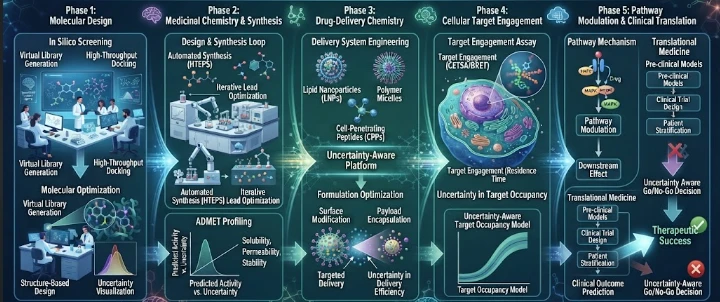
This article describes an uncertainty-aware platform for moving from predicted molecular binding to validated cellular target engagement in medicinal chemistry and drug-delivery research. Docking and machine-learning predictions can rapidly prioritize compounds, but they do not establish that a molecule reaches, occupies, and functionally modulates a target inside relevant cells. The article therefore separates predicted affinity from free intracellular concentration, subcellular localization, t
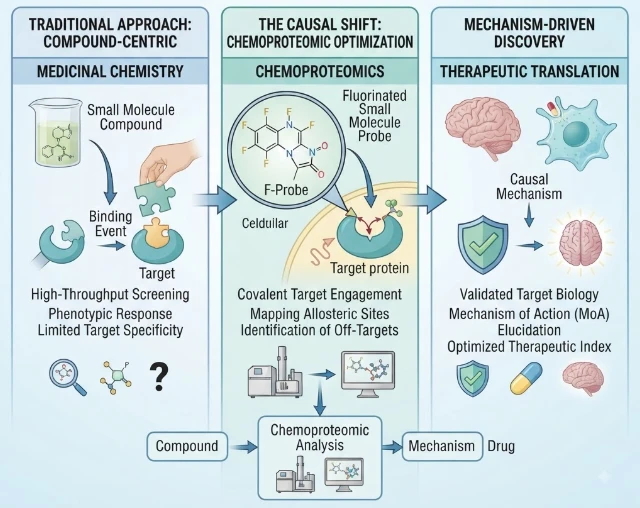
This article explores fluorinated medicinal chemistry through causal chemoproteomics, emphasizing that fluorine substitution can alter far more than potency. A single positional change can modify conformation, pKa, lipophilicity, metabolic stability, target interactions, intracellular exposure, and off-target biology. The article therefore tests whether fluorinated analogues change cellular phenotype through intended target engagement rather than hidden polypharmacology. Matched molecular pairs
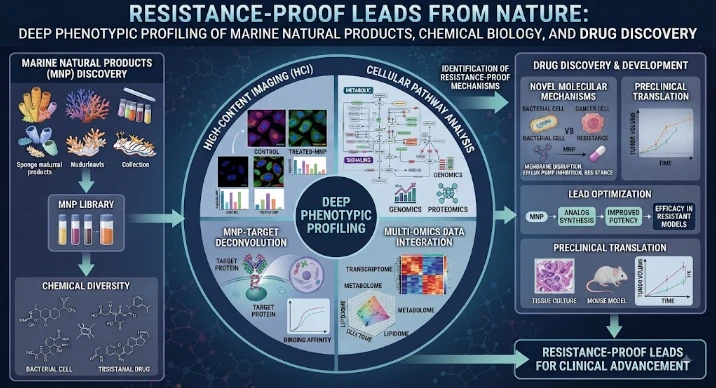
This article presents resistance-aware marine natural-product discovery as a mechanistic process rather than a search for isolated high-potency hits. It explains how activity from marine extracts or fractions can disappear during purification or fail under resistance pressure, making deep phenotypic profiling essential. Morphology, viability kinetics, organelle function, transcriptional state, metabolism, and recovery after washout are combined to connect phenotype with mechanism. The article em