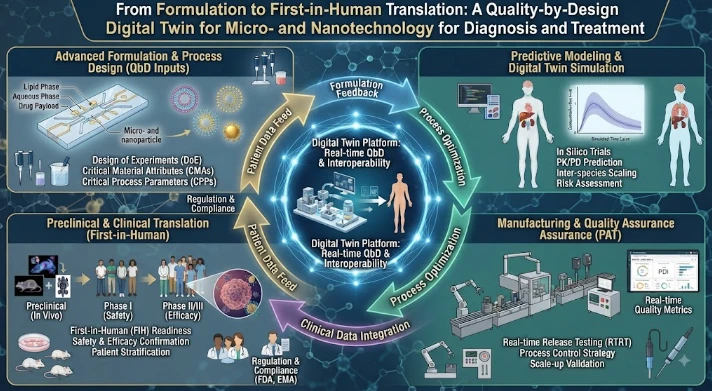
This article proposes a quality-by-design digital twin as a framework for translating micro- and nanotechnology products from formulation to first-in-human studies. It begins with a target product profile and uses that to identify critical quality attributes rather than treating every measurable property as equally important. For nanotechnology, relevant attributes may include particle size, morphology, surface charge, ligand density, drug loading, release kinetics, residual solvent, aggregation, sterility, and degradation; for microtechnology, dimensional tolerances, flow resistance, sensor calibration, and reagent stability are emphasized. The digital twin then links formulation and process variables to biological behavior using mechanistic equations, response surfaces, machine learning, process models, and pharmacokinetic simulations. Design of experiments, process analytical technology, PBPK modeling, uncertainty propagation, scale-up modeling, and stability data continuously update the system. The article also highlights Bayesian updating after human dosing, cybersecurity, data governance, interoperability, comparability, and risk assessment. Overall, it frames the digital twin as living evidence connecting manufacturing history, product quality, exposure, safety, and clinical performance.
First in Human translation occurs when a successful micro/nanotechnology faces the challenges of manufacturing, human biology, safety and regulation. There are many candidates that arrive at this point having good lab data, but poor knowledge of how material properties affect exposure and functionality. With a quality-by-design digital twin, a new development approach is used. The digital twin approach does not consider the formulation, the process, the pharmacology, and the clinical behaviour as individual packages but links them together via an iterative quantitative modelization of the product.
The starting point for quality by design (QbD) is the desired clinical performance. ROA, dose, release, biodistribution, storage, and safety expectations are some of the characteristics considered in the TPP of a nanocarrier. The performance of a microfluidic diagnostics could need to rely on the amount of the sample to be diagnosed, the detection range, the tolerance of the sample matrix, the turn around time, and the robustness of the device. These are the goals that are considered as critical quality attributes and must be controlled, not all measurable properties.
There are many different attributes that have been proposed as candidates for nanotechnology. The performance is affected by particle size, size distribution, morphology, surface charge, ligand density, drug loading, encapsulation efficiency, release kinetics, residual solvent, aggregation, sterility, endotoxin and degradation. Microtechnology includes channel dimensions, surface treatment, flow resistance, sensor calibration, reagent stability and fabrication tolerances. The task for the quality-by-design is to identify the attributes that are fundamentally different from clinical function.
A digital twin condenses those relationships into a model that is dynamic. Mechanistic equations, empirical response surfaces, machine learning, process models, and pharmacokinetic simulations can be included in the twin. Uncertainty is high and twin is more of a hypothesis at an early point of development. Experimental and manufacturing data is gathered and is used to update parameters and make more specific predictions.
Efficient basis are design of experiments studies. The difference between single and multivariable experiments is that single experiments look at interactions among formulation and process parameters. Designed combinations of these will show combinations which will lead to instability, poor loading, altered release or undesirable changes in particle size. The resulting response surfaces will be used to describe a design space in which manufacturing conditions will ensure the product quality will remain acceptable.
The twin is enhanced by the addition of real-time or near-real-time measurements, which is referred to as process analytical technology. Deviations can be identified before final product testing with particle size monitoring, spectroscopy, temperature, pressure, mixing energy, flow rate, and/or other process signals. In microfabricated systems, imaging and dimensional metrology serves as a similar type of control. The digital representation can be used to trace the impact of manufacturing history, with continuous data.
The most critical piece of the puzzle is to correlate quality attributes to biology. If the change in particle size does not impact on the biodistribution, uptake, release or safety of the particle, it does not matter. Surface-ligand density is important if the engagement of the receptor varies in a relevant window. Mechanistic assays, organ-on-chip models, pharmacokinetics, imaging, and toxicology are necessary to establish these connections, not formulation characterization.
Physiological layer of the twin can be PBPK modeling. The feed parameters are related to release, absorption, tissue distribution, cellular uptake and clearance. The simulated concentration-time profiles then estimate the exposure in target and off-target tissues. Variability can be generated in the population by distributions of body size, organ function, blood flow, disease state, and other physiological parameters.
Uncertainty propagation is relevant as much as the central prediction when planning is to occur in a first-in-human setting. This is very convenient when the points used to create the exposure curve model are accurate and the formulation and biological points are uncertain. Probabilistic simulation allows for determination of ranges and worst case combinations. Sensitivity analysis then identifies those attributes that are the most influential in determining human exposure or safety margins which are uncertain.
The digital twin can also be scaled up. Mixing conditions in the laboratory do not scale to larger equipment as the shear, heat transfer, residence time, and efficiency of mixing varies with scale. Mechanistic process models link equipment settings to particle formation or properties of material. Then, there are scale-up experiments that can be directed to the areas identified as a risk, instead of "trial and error".
Then there are data on stability. Product properties can be altered during storage due to temperature, humidity, light, oxidation, hydrolysis, aggregation and interactions with the container. Kinetic models calculate the rates for those changes under intended and accelerated conditions. The twin can then correlate a stability change with a predicted biological change, aiding to differentiate between analytical drift and a clinically relevant change.
A model-use definition is needed for clinical translation. A twin to focus on formulation experiments will have fewer regulatory ramifications than one that will be used to support dose/limits specifications. Thus, verification, validation, version control and documented assumptions must reflect the decision to be supported. All updates must maintain links between the source data, the model structure, the changes in parameters, and the predictions in the model.
After being first dosed, human data transform the twin. Data from the pharmacokinetics, imaging, biomarkers, device performance and safety observations can provide an update on the previous assumptions. The natural framework is Bayesian updating as the prior distribution of parameters is based on preclinical knowledge and the clinical measurements will update the parameter estimates. Not having a match between prediction and observation is not a failure, but instead it points to areas where there is a lack of translation understanding.
A parallel strategy is the best approach to diagnostics. Preclinical sample panels are used to define matrix effects and analytical ranges; manufacturing data provide information on the variance of the sensors; and early clinical samples provide information about actual distributions in the real world. A digital twin can link tolerances of devices with probability of false positive or false negative results for expected sample conditions. Quality control, then, is aimed at the attributes of manufacturing that will ensure the preservation of the diagnostic decisions, and not at some random technical specification.
Digital twins may rely on connected manufacturing or connected clinical systems, bringing cybersecurity and data governance into the mix. Product quality is enhanced with model integrity, access control, audit trails, software validation and data provenance. Decisions can be compromised even if the actual product stays the same if a data stream becomes corrupted or an update to the model is not controlled. Thus, governance should always be included in a mature program for digital-twin formation.
Material characterisation must also be a continuous process. The size of a nanoparticle immediately after preparation may differ from the size after sterile filtration, filling, shipping, storage, dilution or contact with an administration device. These transitions can be represented on the digital twin as connected states. That way it becomes possible to make the history of the process visible and to specify what has gone into the synthesis vessel and not just what comes out.
Risk assessment transforms to more quantitative when failure modes are included in the model. Each of these can have its initiating factors and its consequences identified downstream. Combinations that can't be exhaustively tested is then explored through simulations. Experimental work is concentrated around high impact scenarios, and low risk areas in which less intensive investigation is required.
Another practical requirement is interoperability. Data is often stored in incompatible formats in manufacturing systems, laboratory information systems, imaging platforms, pharmacokinetic databases and statistical software. An useful twin requires some standard identifiers, units, metadata and versioning to ensure that updates can be tracked. A lack of disciplined data architecture makes complicated modeling difficult to manage and unpredictable to results.
The first clinical cohort is a very important calibration point. With even a few of the participants, it can be determined if the predicted exposure range, device behavior or biomarker response is reflective of human reality. Model updating should be done in accordance to rules, and not on an ad hoc basis to achieve desirable outcomes. Recalibration that is transparent is useful as a learning tool rather than an "after-the-fact" explanation of all observations.
The main advantage of the central system is that it is continuous. The underlying idea of quality by design is what is important; experiments reveal the relationships; process data provide track record on manufacturing; and clinical observations revise the assumptions. The twin is a living documentation of the formulation process and its impact on humans. In the case of micro- and nanotechnology, that continuity provides a more definitive link for getting from advanced engineering to first-in-human translation where the complexity of the product is not a hodgepodge of isolated tests.
CITE THIS ARTICLE
Kabir, M. H. (2026). From Formulation to First-in-Human Translation: A Quality-by-Design Digital Twin for Micro- and Nanotechnology for Diagnosis and Treatment. https://researchbykabir.com/article/6b27f96d-9ea0-5b68-b6eb-4ed887adc51a
M. H. Kabir, “From Formulation to First-in-Human Translation: A Quality-by-Design Digital Twin for Micro- and Nanotechnology for Diagnosis and Treatment,” 2026. [Online]. Available: https://researchbykabir.com/article/6b27f96d-9ea0-5b68-b6eb-4ed887adc51a
Kabir, M. H. (2026) ‘From Formulation to First-in-Human Translation: A Quality-by-Design Digital Twin for Micro- and Nanotechnology for Diagnosis and Treatment’. Available at: https://researchbykabir.com/article/6b27f96d-9ea0-5b68-b6eb-4ed887adc51a
Kabir, Md. Humayan. “From Formulation to First-in-Human Translation: A Quality-by-Design Digital Twin for Micro- and Nanotechnology for Diagnosis and Treatment.” 2026, https://researchbykabir.com/article/6b27f96d-9ea0-5b68-b6eb-4ed887adc51a.
Md. Humayan Kabir. “From Formulation to First-in-Human Translation: A Quality-by-Design Digital Twin for Micro- and Nanotechnology for Diagnosis and Treatment.” (2026). https://researchbykabir.com/article/6b27f96d-9ea0-5b68-b6eb-4ed887adc51a.
Kabir MH. From Formulation to First-in-Human Translation: A Quality-by-Design Digital Twin for Micro- and Nanotechnology for Diagnosis and Treatment. 2026. https://researchbykabir.com/article/6b27f96d-9ea0-5b68-b6eb-4ed887adc51a
@misc{article_6b27f96d9ea05b68b6eb4ed887adc51a,
  title = {From Formulation to First-in-Human Translation: A Quality-by-Design Digital Twin for Micro- and Nanotechnology for Diagnosis and Treatment},
  author = {Md. Humayan Kabir},
  year = {2026},
  url = {https://researchbykabir.com/article/6b27f96d-9ea0-5b68-b6eb-4ed887adc51a},
}
TY  - GEN
AU  - Md. Humayan Kabir
TI  - From Formulation to First-in-Human Translation: A Quality-by-Design Digital Twin for Micro- and Nanotechnology for Diagnosis and Treatment
PY  - 2026-06-21
UR  - https://researchbykabir.com/article/6b27f96d-9ea0-5b68-b6eb-4ed887adc51a
ER  -
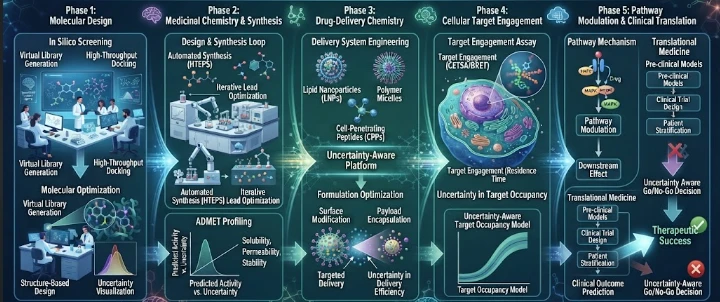
This article describes an uncertainty-aware platform for moving from predicted molecular binding to validated cellular target engagement in medicinal chemistry and drug-delivery research. Docking and machine-learning predictions can rapidly prioritize compounds, but they do not establish that a molecule reaches, occupies, and functionally modulates a target inside relevant cells. The article therefore separates predicted affinity from free intracellular concentration, subcellular localization, t
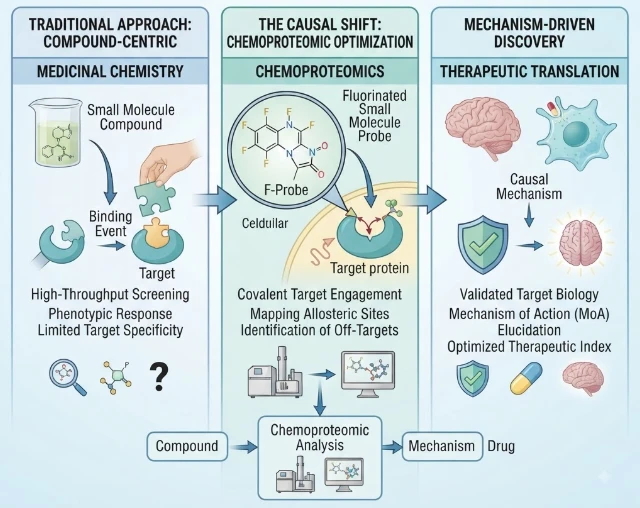
This article explores fluorinated medicinal chemistry through causal chemoproteomics, emphasizing that fluorine substitution can alter far more than potency. A single positional change can modify conformation, pKa, lipophilicity, metabolic stability, target interactions, intracellular exposure, and off-target biology. The article therefore tests whether fluorinated analogues change cellular phenotype through intended target engagement rather than hidden polypharmacology. Matched molecular pairs
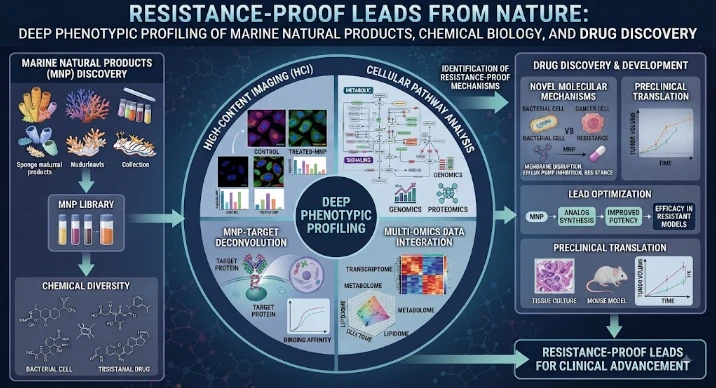
This article presents resistance-aware marine natural-product discovery as a mechanistic process rather than a search for isolated high-potency hits. It explains how activity from marine extracts or fractions can disappear during purification or fail under resistance pressure, making deep phenotypic profiling essential. Morphology, viability kinetics, organelle function, transcriptional state, metabolism, and recovery after washout are combined to connect phenotype with mechanism. The article em