This article presents causal chemoproteomics as a strategy for identifying and validating mechanisms in novel antifungal drug development. Because fungal cells are eukaryotic and share many biological features with human cells, growth inhibition alone cannot distinguish a fungus-selective mechanism from membrane damage, metabolic stress, or general toxicity. The article describes affinity probes, photoaffinity labeling, activity-based approaches, competition experiments, thermal proteome profiling, and mass spectrometry as tools for mapping direct protein interactions in fungal cells. It stresses careful probe validation because altered permeability can change antifungal activity. Genetics then provides causal evidence through target knockdown, overexpression, allele replacement, resistant-mutant sequencing, and CRISPR-based approaches. Resistance evolution, pathway adaptation, biofilm state, species diversity, human homolog selectivity, fungal cell-wall penetration, structural biology, and combination design are all integrated into the optimization process. Medicinal chemistry is guided by target occupancy, proteomic selectivity, intracellular exposure, growth inhibition, and resistance profile. The central goal is a mechanism that is directly engaged, genetically supported, selective, reproducible, and pharmacologically actionable.
The discovery of new antifungals is a unique mechanistic problem since fungal cells are eukaryotic and have many similarities to human cells. There are several possible mechanisms by which a compound may act on Candida or Aspergillus growth including a desirable fungus-selective mechanism of action, damage to the membranes, metabolic stress, or general toxicity. Those possibilities are difficult to differentiate by growth inhibition. Causal chemoproteomics offers the potential of a path that leads from an active molecule to direct protein engagement then to a defensible antifungal mechanism.
This need is acute, as old drugs have become less effective due to resistance. Mutations in ERG11, efflux regulation and sterol homeostasis are mechanisms of azole resistance, and efflux regulation and mutations at the hot-spots of FKS are mechanisms of echinocandin resistance. Candida auris has shown the ability to develop resistance to more than one type of drug. Therefore, new compounds must have differentiated targets and also have a clear path to early detection of potential escape routes.
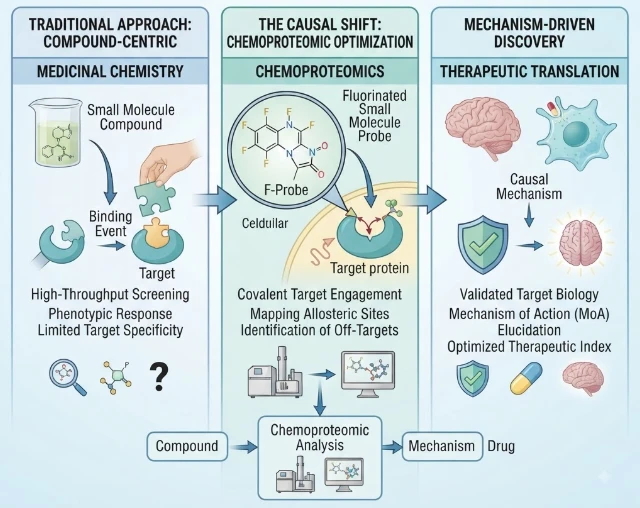
Chemoproteomics starts by mapping of physical interactions within fungal cells. Protein(s) that bind to the antifungal scaffold can be identified using affinity-based probes, photoaffinity labeling, activity-based probes, competition experiments and thermal profiling. The advantage of mass spectrometry is that it gives a view of the proteome, not discovery being narrowed to a preselected target. This is useful if the compounds being identified through a phenotypic screen are not obviously biochemically related.
Probe design is still a prime source of error. Cell walls and membranes of fungi already pose permeability problems and the inclusion of a bulky linker can make a significant difference to the uptake. If the affinity probe is less active on fungi than the parent compound, it should not be taken as the parent compound. Genuine target enrichment as a result of probe chemistry can be distinguished from true target enrichment by using matched inactive analogues, parental compound competition, and measurement of the intracellular exposure.
The thermal proteome profiling method mitigates some of the problems associated with the modification of proteins by measuring the stability changes of native proteins when bound to a ligand. This method doesn't pick up all interactions because sometimes binding does not affect thermal behaviour, but it provides an orthogonal dataset. The candidate targets can then be tested by focused cellular thermal shift assays at varying concentrations and at varying times. There is more confidence if there is agreement between affinity-based and thermal methods.
Causality requires genetics. Target knockdown, overexpression, allele replacement, haploinsufficiency profiling, or resistant-mutant sequencing and CRISPR approaches can demonstrate whether target abundance or changes in target sequence confer drug sensitivity. A recent discovery program for Candida auris, for instance, used chemical screening, profiling, transcriptomics and metabolomics to also suggest that fungal delta-9 fatty acid desaturase Ole1 is a candidate. This convergence is a good illustration of the importance of integrating activity with multiple mechanistic layers.
Resistance selection is particularly useful to perform as an experiment. When compound pressure is applied, serial passage may result in mutants which are able to withstand increasing pressure. Recurrent changes linked to resistance are then identified via whole genome sequencing. Unusual mechanistic evidence comes from the case where the proposed target is a protein and the evolved resistance is reproduced by a mutation that is engaged in both physical contact and escape to the target.
Target mutations aren't present, either. Resistance by efflux pumps, modifications of the membrane, activation of stress pathways, or metabolic bypass indicates that efficacy may not just depend on the target of the compound. Optimization of chemical probes to target and systems-level adaptation is thus important for chemoproteomics. The strongest binding compound is not necessarily the best lead, rather the compound which would work in a realistic resistance route.
Proteomic response data aid in mapping those adaptations. Genetic studies of fluconazole resistance have revealed a wide range of changes in ergosterol biosynthesis and transport processes. Compensatory pathways can be identified by similar profiling conducted for new compounds before the onset of clinical resistance. Combination partners can then be selected to prevent predictable escape mechanisms, rather than based on a synergy screen.Combination partners can then be selected to block predictable escape mechanisms instead of only being selected through an empirical synergy screen.
The issue of the dependence of the cell-state is added on. The fungi in a biofilm can have a very different appearance from a rapidly growing planktonic culture, due to differences in culture conditions, such as fungi in the biofilm, nutrient limitation, hypoxia or host tissues. Abundance, metabolic state, membrane composition and stress response change. The validation of a chemoproteomic target should only be performed in rich media, lab-grown conditions and then confirmed under conditions that more closely represent infection.
Species diversity is important also. A gene that is essential in Candida albicans may not be essential or regulated differently in Candida auris, Cryptococcus or Aspergillus. Conservation can be defined through comparative genomics and proteomics, and can be confirmed through susceptibility panels that test a mechanism for broad-spectrum or species-specific development. Both are good strategies, but claims must correspond to the true biological width.
Selectivity against human homologs is central as proteins in fungi have a similar ancestry to those in humans. Structural biology can find pockets, conformation or accessory interactions which are present in fungi but not in humans that provide a therapeutic window. Human cells can be used for chemoproteomics, and thus a direct map of the off-target nature of the fungal occupancy can be compared to that of the host. This is more powerful than just using sequence identity.
Medicinal chemistry is then the optimization for target engagement. Fungal exposure, occupancy, proteomic selectivity, growth inhibition and resistance profile of analogue series is evaluated. Must re-examine the mechanism if there is increased antifungal activity with no increased binding to the proposed target. When the occupancy, pathway effects, and efficacy are correlated, confidence is greater and the structure-activity relationships become more meaningful.
The ability to exploit differentiated biology has been shown with novel antifungal classes. Olorofim acts on dihydroorotate dehydrogenase in pyrimidine biosynthesis while other recently developed agents have pursued different pathways in the fungal cell or enhanced the utility of existing classes of agents. Studies of resistance to such agents show that in such cases there is need for early identification of potential resistance substitutions. Novelty is not sufficient to make a high barrier.
The final link is the pharmacokinetic translation. In order to attain desired target occupancy with an acceptable host toxicity, the compound must be sufficiently free for a certain period of exposure at the infection site. That relationship is affected by tissue distribution, protein binding, and metabolism and formulation. Mechanistic biomarkers are useful to correlate plasma concentrations with actual modulation of the fungal target, particularly when the clinical response is delayed.
Chemical genetic profiling can speed up the association of binding and function. Patterns of hypersensitivities in libraries of strains in which important genes have been silenced provide hints to pathways targeted by a compound. These fingerprints are particularly valuable in the case of direct target capture being difficult. Chemical-genetic similarity and proteomic engagement can help to restrict the number of mechanisms to be considered and provide a parallel confidence line prior to extensive structural efforts.
The ability to penetrate the cell wall should also be specifically measured. A high intracellular concentration of a potent biochemical inhibitor may not cause an effect, as fungal envelopes prevent enough exposure. On the other hand, membrane-disruptive agents can cause large-scale proteomic changes which are similar to those produced by the inhibition of specific pathways. A quantitative approach to uptake, integrity of the membrane and intracellular concentration can help to distinguish these cases. When medicinal chemistry is then consulted, they will determine if it is desirable to enhance target affinity, permeability, or selectivity.
Target structural biology is an additional optimization loop. The co-crystal or cryogenic electron microscopy structures provide binding contacts, water networks and funnel-shaped cavities that are unique to fungi which are not reliably deduced from activity. Resistant substitutions can be applied to the same structure to see which interactions are escape prone. New analogues will then “recruit” contacts from conserved regions and not rely on contact residues that are prone to mutation.
Mechanistic work also enhances combination selection. Combination therapy is the option for those responses that are identified as an upregulation of sterol biosynthesis, cell-wall repair or oxidative-stress pathway after the inhibition of the targets as identified by proteomics. Experimental perturbation differentiates between protective adaptation and irrelevant stress. Combinations from these causal maps are more enticing than those simply chosen because two compounds are found to be synergistic in one assay, in terms of the biological basis.
An additional important test on each proposed interaction comes from the reproducibility of the results from independent isolates of fungi.
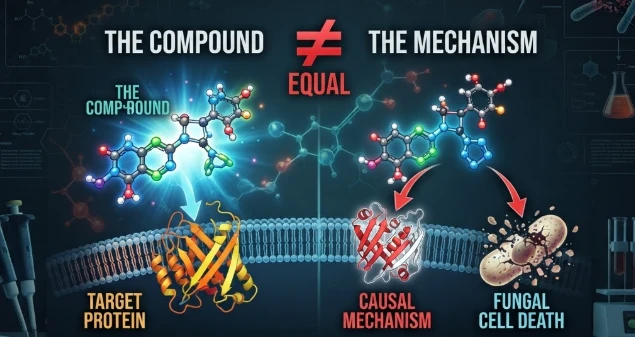
Therefore, the compound is not the mechanism, it is a perturbation that is used to show the mechanism. Causal chemoproteomics is an integrated approach to the aspects of direct engagement, fungal genetics, adaptation, resistance evolution, and medicine. That rigor is advantageous in the development of new antifungals since there are many possible explanations for growth inhibition and host selectivity remains difficult. It is not until a molecular interaction which underlies the fungal control is known, measurable and strong enough to be optimized upon, that a lead can be really differentiated.
CITE THIS ARTICLE
Kabir, M. H. (2026). The Compound Is Not the Mechanism: Causal Chemoproteomic Optimization of Novel Antifungal Drug Development. https://researchbykabir.com/article/47e05fcf-8ae7-5ea0-afe1-5ea2589bcd2e
M. H. Kabir, “The Compound Is Not the Mechanism: Causal Chemoproteomic Optimization of Novel Antifungal Drug Development,” 2026. [Online]. Available: https://researchbykabir.com/article/47e05fcf-8ae7-5ea0-afe1-5ea2589bcd2e
Kabir, M. H. (2026) ‘The Compound Is Not the Mechanism: Causal Chemoproteomic Optimization of Novel Antifungal Drug Development’. Available at: https://researchbykabir.com/article/47e05fcf-8ae7-5ea0-afe1-5ea2589bcd2e
Kabir, Md. Humayan. “The Compound Is Not the Mechanism: Causal Chemoproteomic Optimization of Novel Antifungal Drug Development.” 2026, https://researchbykabir.com/article/47e05fcf-8ae7-5ea0-afe1-5ea2589bcd2e.
Md. Humayan Kabir. “The Compound Is Not the Mechanism: Causal Chemoproteomic Optimization of Novel Antifungal Drug Development.” (2026). https://researchbykabir.com/article/47e05fcf-8ae7-5ea0-afe1-5ea2589bcd2e.
Kabir MH. The Compound Is Not the Mechanism: Causal Chemoproteomic Optimization of Novel Antifungal Drug Development. 2026. https://researchbykabir.com/article/47e05fcf-8ae7-5ea0-afe1-5ea2589bcd2e
@misc{article_47e05fcf8ae75ea0afe15ea2589bcd2e,
  title = {The Compound Is Not the Mechanism: Causal Chemoproteomic Optimization of Novel Antifungal Drug Development},
  author = {Md. Humayan Kabir},
  year = {2026},
  url = {https://researchbykabir.com/article/47e05fcf-8ae7-5ea0-afe1-5ea2589bcd2e},
}
TY  - GEN
AU  - Md. Humayan Kabir
TI  - The Compound Is Not the Mechanism: Causal Chemoproteomic Optimization of Novel Antifungal Drug Development
PY  - 2026-05-17
UR  - https://researchbykabir.com/article/47e05fcf-8ae7-5ea0-afe1-5ea2589bcd2e
ER  -
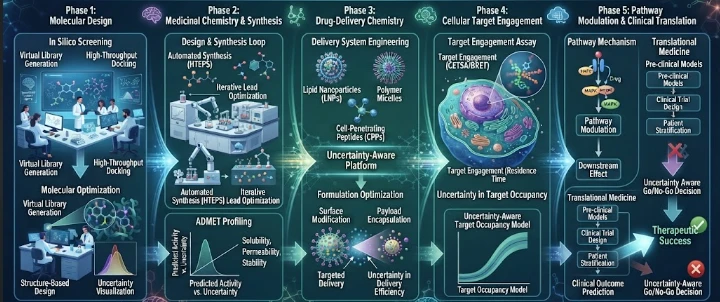
This article describes an uncertainty-aware platform for moving from predicted molecular binding to validated cellular target engagement in medicinal chemistry and drug-delivery research. Docking and machine-learning predictions can rapidly prioritize compounds, but they do not establish that a molecule reaches, occupies, and functionally modulates a target inside relevant cells. The article therefore separates predicted affinity from free intracellular concentration, subcellular localization, t
This article explores fluorinated medicinal chemistry through causal chemoproteomics, emphasizing that fluorine substitution can alter far more than potency. A single positional change can modify conformation, pKa, lipophilicity, metabolic stability, target interactions, intracellular exposure, and off-target biology. The article therefore tests whether fluorinated analogues change cellular phenotype through intended target engagement rather than hidden polypharmacology. Matched molecular pairs
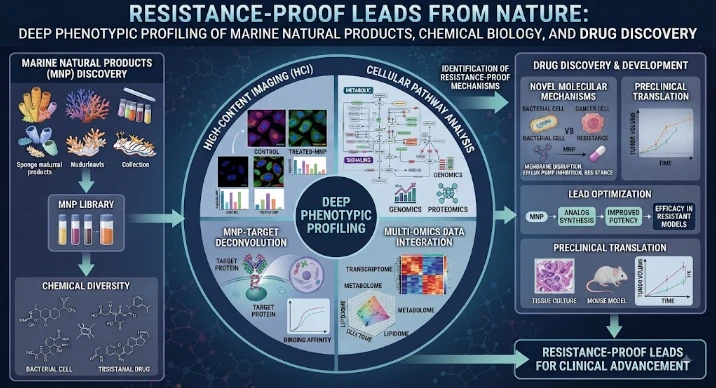
This article presents resistance-aware marine natural-product discovery as a mechanistic process rather than a search for isolated high-potency hits. It explains how activity from marine extracts or fractions can disappear during purification or fail under resistance pressure, making deep phenotypic profiling essential. Morphology, viability kinetics, organelle function, transcriptional state, metabolism, and recovery after washout are combined to connect phenotype with mechanism. The article em