From Formulation to First-in-Human Translation: A Quality-by-Design Digital Twin for Advanced Drug Delivery Systems, Nanomedicine, Formulation and Cancer Therapeutics
Md. Humayan Kabir (Master of Science in Pharmaceutical Technology)
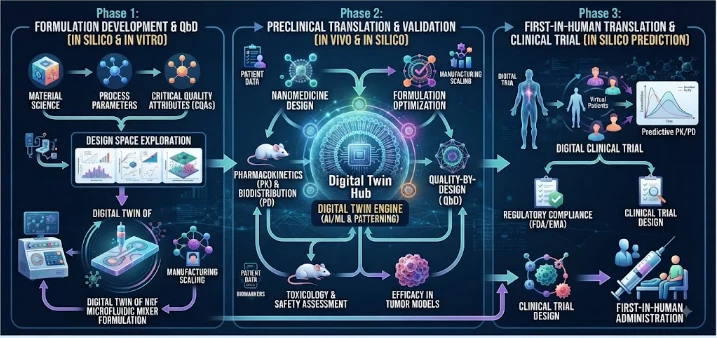
This article proposes a quality-by-design digital twin for connecting advanced cancer drug-delivery formulation, manufacturing, pharmacokinetics, and first-in-human translation. Material attributes, process parameters, release kinetics, biodistribution, tumor exposure, and safety are treated as a single mechanistic network rather than separate development packages. Particle size, encapsulation, release, mixing conditions, purification, sterilization, storage, and scale-up can change exposure even when nominal composition remains constant. Design-of-experiments, mechanistic release models, PBPK components, Bayesian updating, process analytical data, and virtual population simulation are used to identify which critical quality attributes most strongly influence clinically relevant exposure. The model is intended to update as new measurements arrive, reducing uncertainty through targeted experiments. Tumor perfusion, organ function, body size, disease burden, prior therapy, and clearance pathways are treated as context variables. Risks include model misspecification, sparse human data, scale-up shifts, particle heterogeneity, and overconfidence in virtual predictions. Overall, the digital twin is framed as a living decision model linking product quality with predicted human performance.
With today's excitement in the development of new therapeutics, questions of potency, delivery, and association are no longer the only factors to consider for quality-by-design digital twins for advanced cancer drug delivery, but rather why the result seems and when the result is reliable. This transition is fundamentally characterized by a mechanistic network that links together properties of the material, process parameters, release kinetics, biodistribution, pharmacokinetics, tumour exposure and safety. That network is important because often the formulation development, biological modeling (biological knowledge), and manufacturing knowledge are not connected when moving from first-in-human to patient use. A robust development strategy thus does not separate the processes of designing mechanisms, of designing context, and of designing uncertainty, but rather sees them as interwoven.
Advanced drug delivery translation builds on the concept of quality by design, since there are interactions between material and process. Even if the nominal composition is constant, the exposure may change, depending on the particle size, the manner of encapsulation, the release, the mixing conditions, the purification, the storage conditions, and the scale-up. In the digital twin, this is expanded to include process knowledge and to connect mechanistic release, biodistribution, pharmacokinetic and clinical models. The best version is continually updated as new measurements are received; uncertainty with important quality attributes and predicted human exposures are reduced by focusing experiments.
The practical outcome is a novel discovery workflow which incorporates design-of-experiments, mechanistic release models, PBPK components, Bayesian updating, process analytical data and virtual population simulation. None of these is the only tool by which that process is defined, as each assay represents a smaller component of a larger process in biology or in the clinic. Independent measurements, across dose, time, model system and relevant biological context, converge to the same causal narrative and this increases confidence. Inconsistencies are still useful since they may be related to hidden mechanisms, assay artifacts, population differences, or exposure limitations that should be explored prior to further and costly development.
The focus then shifts to determining those critical quality attributes that have the greatest impact on clinically relevant exposure, and the uncertainties that necessitate further experiments for decision making. To answer this question, it is necessary to make a clear comparison with the mechanism that could be involved and possible alternative mechanisms such as off-target activity, parallel pathways, differential exposure, or measurement bias. Perturbation experiments are particularly useful because if a proposed component is removed, blocked, or restored, it will allow to determine if the observed effect is due to the proposed component. Mechanistic confidence is therefore provided by successful challenge tests and not by repeated confirmation in one assay that is favourable.
Nearly all of the outcomes also differ based on context in digital twins of advanced cancer drug delivery for quality. Variation that is relevant incorporates tumour perfusion, organ function, body size, previous therapy, disease burden, and clearance pathways. An intervention that is effective with one set of these factors might have a less effective or more toxic or different biological response with another set of conditions. When applied, stratification is more useful when based on variables associated with mechanism/exposure, because the categories to describe the change in treatment performances are usually inadequate to explain the change.
The importance of risk assessment is equal since model miss-specification, limited human data, scale-up shifts, lack of consideration of particle heterogeneity, and over-confidence in virtual predictions. Early safety work is most valuable when associated with the same mechanistic approach as efficacy work, enabling undesirable activities to be linked to target biology, carrier behavior, exposure, metabolites or analytical bias. This will minimize the risk that safety will be an end-of-the-checklist item unrelated to discovery logic. It also enables better elucidation of the trade-offs if greater efficacy needs to be achieved at the cost of increased exposure, increased pathway modulation or increased persistence in sensitive tissues.
A connected development framework that links formulation decisions to expected human performance is added by translational development. It becomes more informative to pre clinically succeed if the experiments mimic clinically relevant time, concentration range, biological barriers, history of treatment, and sources of heterogeneity. It is not as valuable to move from an easy model to a more complicated one as it is to follow a series of models to address particular uncertainty questions. Every step requires a decision to either continue, redesign, focus the target population, change the dosing or gather another type of mechanistic data.
The importance of manufacturing and analytical control is the same as before, as the condition of mixing, removal of solvents, filtration, sterilization, condition of particles, condition of encapsulations, release and storage conditions are now explicit model inputs. If the material being tested varies from batch to batch or the inputs to an assay are poorly understood, a biological explanation would be of little value. Critical attributes thus must be defined within a range, measured with sensitivity and linked to biological performance and documented. This discipline becomes particularly crucial for complex molecules, nanoparticles, biomaterials, and for studies with a lot of data because subtle changes in exposure, signaling, or apparent treatment response can occur.
The separation between prediction and confirmation also facilitates data analysis in a quality by design, advanced cancer drug delivery digital twin. Computational modeling, machine learning, causal estimators and mechanistic simulation can prioritize hypotheses, combine complex measurements, and reveal uncertainty, but none are synonymous with biology. Useful models make assumptions, quantify calibration, mark regions with few examples, and point to other experiments that would yield information that would affect a decision. Prospective validation is still necessary because patterns which fit back into the population are not necessarily those that will fit into the next population or new biological conditions.
Another key change involves time – many of the vital processes for a digital twin that would enable quality-by-design advanced cancer drug delivery are dynamic following first exposure. Early response and adaptation, clearance, immune programming, tissue remodeling, adherence, or resistance can have different courses of action even if the endpoint may appear beneficial. Longitudinal measurement will demonstrate if an intervention causes a stable state, a temporary perturbation or a delayed liability. Time-resolved data also aid causal interpretation, as it determine if the proposed mechanism occurs prior to the establishment of the downstream phenotype or follows.
Efficient experimental design when each study is linked to a definite uncertainty budget. Questions with the potential to impact the most important critical quality attribute that affects clinically relevant exposure can be ranked more based on their relevance to exposure or the need for new experiments than on their novelty. Replication across complementary models is then carried out to test the outcome for the one assay, the one laboratory condition, or the one population. This discipline prevents wasted optimization and enables the discovery to be informative: the more that is not working, the more the next design cycle benefits from a reduction in the possible mechanism space.
Also traceability from claims to measurements is important for regulatory and clinical credibility. A development package is more robust if there are connections between the results of early experiments and the results of the translation studies, as well as between raw observations, processing decisions, model assumptions, deviations from the protocol, and material properties for advanced cancer drug delivery digital twins. Such traceability allows for better identification of true biological variability, as well as future analysis of claims of safety or efficacy. It also provides a more clear-cut ground for revising conclusions on the basis of changing data for an earlier assumption.
Precisions in communication in this field are also needed. The value of terms like “targeted,” “safe,” “predictive,” or “personalized” is not very meaningful without a measurement, comparator, population, and uncertainty range. Negative findings are more useful if clearly reported and help to avoid exploratory findings being reported as mechanisms. Precise often provides a common basis for evaluation for researchers, developers, clinicians and regulators to assess whether a claim is based on direct measurement, calibrated inference or an assumption that has not been tested.
Thus, the most promising direction for digital twins of advanced cancer drugs is not a new technology, but a more complete and tighter feedback loop between chemistry/formulation, mechanistic measurement, quantitative modeling, safety, manufacturing control and clinically relevant context. It's easier to progress when assumptions that have been proven wrong are uncovered early and mechanisms that have been proven to succeed are deliberately tested for failure. This logic becomes a living decision model as it is updated with the growing product and clinical information. In the field, the most valuable innovation is a development system that adapts to each experiment while maintaining the focus of causal interpretation, reproducibility, and relevance to the real world in all decisions.
CITE THIS ARTICLE
Kabir, M. H. (2025). From Formulation to First-in-Human Translation: A Quality-by-Design Digital Twin for Advanced Drug Delivery Systems, Nanomedicine, Formulation and Cancer Therapeutics. https://researchbykabir.com/article/2841de53-2fac-5496-8853-76e754484cfc
M. H. Kabir, “From Formulation to First-in-Human Translation: A Quality-by-Design Digital Twin for Advanced Drug Delivery Systems, Nanomedicine, Formulation and Cancer Therapeutics,” 2025. [Online]. Available: https://researchbykabir.com/article/2841de53-2fac-5496-8853-76e754484cfc
Kabir, M. H. (2025) ‘From Formulation to First-in-Human Translation: A Quality-by-Design Digital Twin for Advanced Drug Delivery Systems, Nanomedicine, Formulation and Cancer Therapeutics’. Available at: https://researchbykabir.com/article/2841de53-2fac-5496-8853-76e754484cfc
Kabir, Md. Humayan. “From Formulation to First-in-Human Translation: A Quality-by-Design Digital Twin for Advanced Drug Delivery Systems, Nanomedicine, Formulation and Cancer Therapeutics.” 2025, https://researchbykabir.com/article/2841de53-2fac-5496-8853-76e754484cfc.
Md. Humayan Kabir. “From Formulation to First-in-Human Translation: A Quality-by-Design Digital Twin for Advanced Drug Delivery Systems, Nanomedicine, Formulation and Cancer Therapeutics.” (2025). https://researchbykabir.com/article/2841de53-2fac-5496-8853-76e754484cfc.
Kabir MH. From Formulation to First-in-Human Translation: A Quality-by-Design Digital Twin for Advanced Drug Delivery Systems, Nanomedicine, Formulation and Cancer Therapeutics. 2025. https://researchbykabir.com/article/2841de53-2fac-5496-8853-76e754484cfc
@misc{article_2841de532fac5496885376e754484cfc,
  title = {From Formulation to First-in-Human Translation: A Quality-by-Design Digital Twin for Advanced Drug Delivery Systems, Nanomedicine, Formulation and Cancer Therapeutics},
  author = {Md. Humayan Kabir},
  year = {2025},
  url = {https://researchbykabir.com/article/2841de53-2fac-5496-8853-76e754484cfc},
}
TY  - GEN
AU  - Md. Humayan Kabir
TI  - From Formulation to First-in-Human Translation: A Quality-by-Design Digital Twin for Advanced Drug Delivery Systems, Nanomedicine, Formulation and Cancer Therapeutics
PY  - 2025-06-29
UR  - https://researchbykabir.com/article/2841de53-2fac-5496-8853-76e754484cfc
ER  -
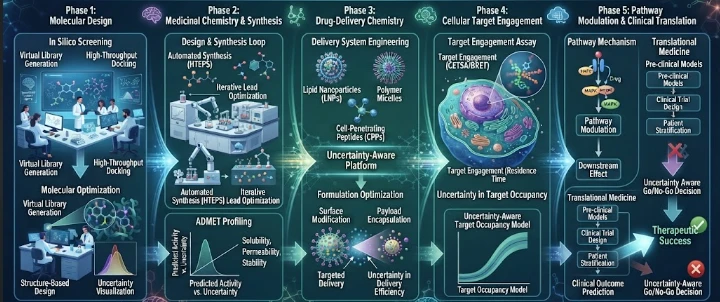
This article describes an uncertainty-aware platform for moving from predicted molecular binding to validated cellular target engagement in medicinal chemistry and drug-delivery research. Docking and machine-learning predictions can rapidly prioritize compounds, but they do not establish that a molecule reaches, occupies, and functionally modulates a target inside relevant cells. The article therefore separates predicted affinity from free intracellular concentration, subcellular localization, t
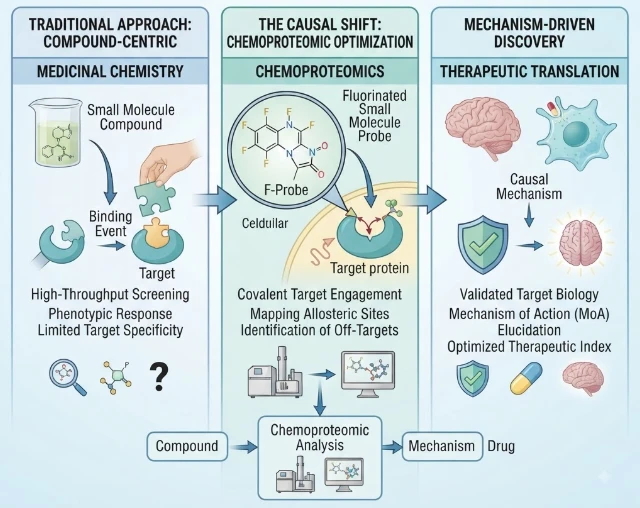
This article explores fluorinated medicinal chemistry through causal chemoproteomics, emphasizing that fluorine substitution can alter far more than potency. A single positional change can modify conformation, pKa, lipophilicity, metabolic stability, target interactions, intracellular exposure, and off-target biology. The article therefore tests whether fluorinated analogues change cellular phenotype through intended target engagement rather than hidden polypharmacology. Matched molecular pairs
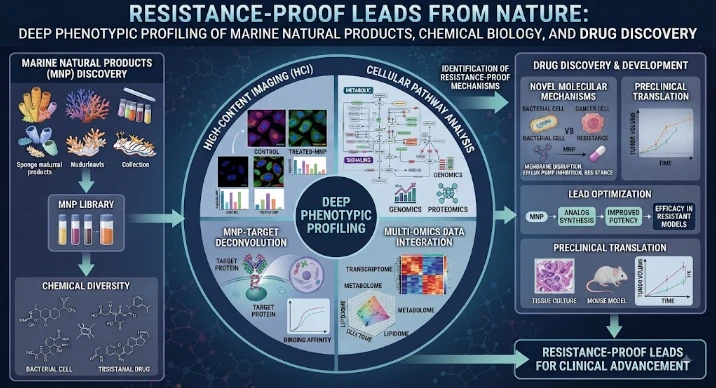
This article presents resistance-aware marine natural-product discovery as a mechanistic process rather than a search for isolated high-potency hits. It explains how activity from marine extracts or fractions can disappear during purification or fail under resistance pressure, making deep phenotypic profiling essential. Morphology, viability kinetics, organelle function, transcriptional state, metabolism, and recovery after washout are combined to connect phenotype with mechanism. The article em