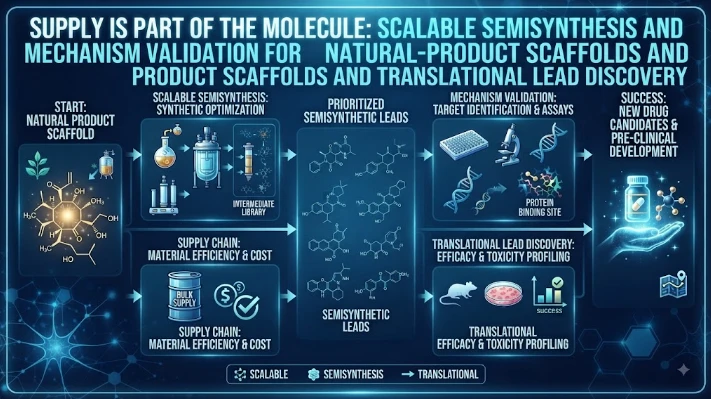
This article argues that supply strategy is part of the therapeutic identity of a natural product, not merely a later manufacturing concern. Complex natural scaffolds can provide unique stereochemistry and biological activity, but their value depends on whether they can be produced reproducibly at useful scale. Semisynthesis is presented as a practical bridge between extraction and total synthesis, combining biologically generated structural complexity with chemical optimization of potency, selectivity, solubility, and stability. The article discusses selecting abundant advanced precursors, improving fermentation, engineering biosynthetic pathways, using late-stage functionalization, and integrating biocatalysis for selective transformations. Process robustness becomes increasingly important as development moves beyond milligram scale, with attention to purification, hazardous chemistry, solvent use, crystallization, telescoping, raw-material variation, and technology transfer. Mechanism validation is developed in parallel so medicinal chemists know which scaffold features are essential and which can be simplified. Sustainability, supply security, cost of goods, demand forecasting, and scalable route design are treated as core translational criteria.
In the case of natural products, biology can create structures that aren't mirrored in synthetic libraries and these are often a part of drug discovery. The complex stereochemistry, functional density, macrocycles, polycycles and pharmacophores are responsible for strong interactions with biological targets. The complexity that gives rise to activity can also lead to a supply problem. Thus, the mere potential of a natural-product scaffold to be potent and novel is not sufficient to weigh the therapeutic offering; the march to grams, kilograms and reliable derivatives is part of the marching.
There are a number of reminders from the past. However, the development of paclitaxel required a shift in sourcing and semisynthetic production, and microbial production of artemisinic acid driven by the need for artemisinin supply led to a shift in production towards scalable chemical conversion. The examples show that manufacturing strategy may have a profound influence on the destiny of a natural-product medicine. A lead with a good supply chain is not inherently more or less risky than a lead with a not-so-sound supply chain, depending on the pharmacology.
Semisynthesis is between extraction and total synthesis. A complex core is provided by a natural source, by fermentation or by an engineered organism, and then features are added by chemical reactions to meet the demands for potency, selectivity, solubility, stability, and/or intellectual differentiation. This strategy takes advantage of the biosynthesis for structural complexity, and the synthetic chemistry for optimization. The balance is particularly appealing when total synthesis is too lengthy to carry out the routine preparation of the analogue.
Therefore, it is a matter of strategy which starting material you will select. The optimal precursor should be readily available and stable, structurally advanced, and potentially chemically modified at the sites that matter to medicinal chemistry. The lower yield natural product that needs a lot of purification is not as leveraged as a related metabolite produced at high yield. Upstream intermediates or congeners can be determined by genome mining and pathway analysis that can be used as better semisynthetic feedstocks.
This is complemented by fermentation engineering. Optimization of media, promoter, refactoring of pathways, supply of precursors, engineering of transporters, and selection of host strain can increase titers or alter product distributions. A new way to make a chemical product can be developed from a new chemical invention. Partnering between natural-product chemists and metabolic engineers early on minimizes the chances for optimizing a scaffold that cannot be developed in the given biological source.
Robustness should be emphasized in Semisynthetic route design. Transformations should be able to accept reasonable purity profiles, be reagent-free (or at least have inexpensive reagents), be free of chromatography, and have good stereochemical control at useful scale. Once the synthesis goes beyond milligrams, protecting group burden, dangerous chemistry, solvent volume, temperature control and waste are all important. An effective process in the medicinal-chemistry lab is not necessarily scalable.
For late-stage functionalization, this is of special value as an advantage, as it provides analogue diversity from a common advanced intermediate. Chemical space can be explored without rebuilding the core via selective oxidation, reduction, acylation, alkylation, cross-coupling, biocatalysis, or click-type transformations. This allows for a faster structure/activity relationship studies, yet without losing the supply benefit of the natural scaffold. Chemoselectivity is an important enabling technology for highly functionalized molecules.
The toolbox is broadened even more by biocatalysis. Enzymes are able to carry out regioselective and stereoselective modifications that are somewhat challenging chemically such as oxidation, glycosylation, halogenation, and selective bond formation. Pathway enzymes also act as models for designed enzymes with new substrate range. Routes consisting of fermentation, enzymatic tailoring and chemical steps represent hybrid routes that are neither classical extraction nor conventional total synthesis.
The mechanism validation should be in parallel to the development of supply strategy. A complex cellular activity, found naturally, is susceptible to too many speculations for claims to be made earlier than they should be. Causal interactions are established by chemoproteomics, resistant-mutant mapping, genetic perturbation, biochemical assays and orthogonal target engagement. This mechanistic certainty leads then to the determination of which fragments of the scaffold(s) must stay unchanged in semisynthetic simplification.
This connection is crucial as potency-preserving simplification can be lost if the targeted functional group affects the geometry, cell localization or covalent reactivity. In the opposite case, the structurally complex area that does not contribute much on the mechanistic level provides an opportunity for the lessening of synthetic complexity. Mechanism-guided semisynthesis thus poses the question of what atoms convey biological information and what atoms convey biosynthetic history.
Limited resources can even help to make better medicinal chemistry. A limited range of scalable transformations pushes analogue designs into space that is manufacturable and dissuades attention-grabbing but impractical alternative designs. This gives some more realistic optimization landscape at an earlier stage. The quality of candidates is enhanced when potency, selectivity and pharmacokinetics are taken into account along with the route length, availability of raw-materials, yield and process safety.
For natural-product based feedstocks, analytical control is more challenging. Downstream chemistry can be affected by closely-related congeners, epimers, oxidation products, residual biomass components and changing impurity profiles. Establishment of a reproducible starting material using orthogonal chromatography, mass spectrometry, NMR, water content and residual solvent testing. Process specifications must ensure chemical conversion and the final biological performance.
Sustainability should be in that equation too. Rare plants, marine species or slow-growing plants raise concerns of harvesting. Fermentation, cultivated biomass, semisynthetic precursors and synthetic biology provide alternatives which bypass natural populations. A route that is dependent on the destructive collection is not robust if its short term supply seems adequate.
Economic resilience also is important. The variability of agriculture, the geopolitical concentration of raw materials, the seasonal harvest and the purification process that requires a lot of energy, as well as the use of single-source reagents, can interfere with production. Several sourcing sources/fermentation on platforms minimizes vulnerability. Cost of goods and supply security is directly linked to access for drugs for large populations in the world.
Mechanism validation is helpful in this context because it can help avoid investing in a wrong scaffold feature. If target engagement is based on a small pharmacophore surrounded by a very complex molecule, simplified analogues might replace the natural core structure in the future. When the entire three dimensional architecture is needed, supply engineering is even more critical. Accordingly, mechanism-oriented trials early in the development process inform not only pharmacology, but manufacturing strategy as well.
Telescoped operations also help in process development. Solvent use, handling loss and cycle time decrease when intermediate isolation is avoided. However, sometimes there are sensitive natural-product intermediates that are not amenable to telescoping, and the early scouting of the route may help identify transformations that will allow carryover impurities. Often the route, as actually run, is shorter even though the number of transformations (steps) does not change.
Crystallization is a special case as chromatography gets expensive at large scale. A semisynthetic intermediate or final active ingredient that crystallizes cleanly provides significant benefits in terms of purification, impurity rejection, drying and solid form control. Then, variables for development become formation of solvates, polymorphism and amorphous content. It is becoming more common to make a route design that is chemistry friendly and will lead to physical isolation rather than pretty but chromatography dependent conversions.
The need for demand scenarios in supply planning. A single company might produce both kinds of drugs: for a very limited number of people, an oncology medicine, and for the general population, an anti-infective. For extraction, fermentation, semisynthesis and total synthesis of a compound to be economically credible, forecasts of the dose, length of treatment, yield and market volume of the compound are necessary. Early calculations are appropriate because a route which will work for kg might not work for g and might not work for tons.
Further reduction in supply pressure can be provided by mechanism based analog design. If a smaller substructure can be found using pharmacophore mapping that is able to achieve target engagement, then the medicinal chemist can pursue simplified variants that retain the key 3D structure. Success transforms a natural product that is difficult to get into a model that is more manageable synthetically. Failure is still informative, as failure means that the biosynthetic complexity has a valuable function that it's important to preserve through process engineering.
Scalability is put to the ultimate test in technology transfer. Reliance on tacit knowledge, specialized glassware or one expert operator makes such a route fragile. A second site can duplicate the chemistry with the help of standard operating procedures, in-process controls, impurity fate maps and specific raw material specifications. Strong transfer indicates that supply is no longer an artisanal characteristic of discovery chemistry but is a designed characteristic.
Supply is included in the molecule because there is a therapeutic structure in the production system. Several processes—such as biosynthesis, fermentation, semisynthesis, process chemistry, analytics, mechanism and medicinal chemistry—all influence whether the natural-product activity is a sustainable lead. The best translation programs plan these elements out. Producing a natural scaffold is most effective when the biological originality is coupled with a believable roadmap for repeatable, scalable and mechanism-preserving production.
CITE THIS ARTICLE
Kabir, M. H. (2026). Supply Is Part of the Molecule: Scalable Semisynthesis and Mechanism Validation for Natural-Product Scaffolds and Translational Lead Discovery. https://researchbykabir.com/article/0a61b6f2-3fc3-5941-aa38-21728503702a
M. H. Kabir, “Supply Is Part of the Molecule: Scalable Semisynthesis and Mechanism Validation for Natural-Product Scaffolds and Translational Lead Discovery,” 2026. [Online]. Available: https://researchbykabir.com/article/0a61b6f2-3fc3-5941-aa38-21728503702a
Kabir, M. H. (2026) ‘Supply Is Part of the Molecule: Scalable Semisynthesis and Mechanism Validation for Natural-Product Scaffolds and Translational Lead Discovery’. Available at: https://researchbykabir.com/article/0a61b6f2-3fc3-5941-aa38-21728503702a
Kabir, Md. Humayan. “Supply Is Part of the Molecule: Scalable Semisynthesis and Mechanism Validation for Natural-Product Scaffolds and Translational Lead Discovery.” 2026, https://researchbykabir.com/article/0a61b6f2-3fc3-5941-aa38-21728503702a.
Md. Humayan Kabir. “Supply Is Part of the Molecule: Scalable Semisynthesis and Mechanism Validation for Natural-Product Scaffolds and Translational Lead Discovery.” (2026). https://researchbykabir.com/article/0a61b6f2-3fc3-5941-aa38-21728503702a.
Kabir MH. Supply Is Part of the Molecule: Scalable Semisynthesis and Mechanism Validation for Natural-Product Scaffolds and Translational Lead Discovery. 2026. https://researchbykabir.com/article/0a61b6f2-3fc3-5941-aa38-21728503702a
@misc{article_0a61b6f23fc35941aa3821728503702a,
  title = {Supply Is Part of the Molecule: Scalable Semisynthesis and Mechanism Validation for Natural-Product Scaffolds and Translational Lead Discovery},
  author = {Md. Humayan Kabir},
  year = {2026},
  url = {https://researchbykabir.com/article/0a61b6f2-3fc3-5941-aa38-21728503702a},
}
TY  - GEN
AU  - Md. Humayan Kabir
TI  - Supply Is Part of the Molecule: Scalable Semisynthesis and Mechanism Validation for Natural-Product Scaffolds and Translational Lead Discovery
PY  - 2026-05-24
UR  - https://researchbykabir.com/article/0a61b6f2-3fc3-5941-aa38-21728503702a
ER  -
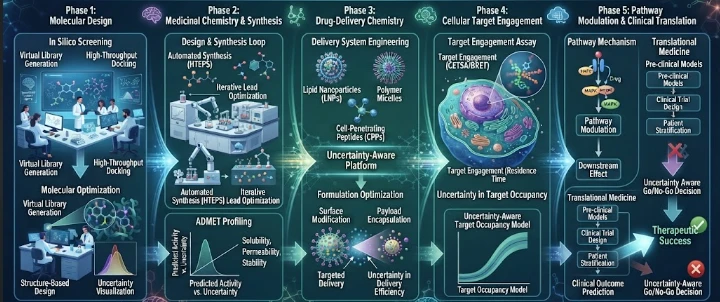
This article describes an uncertainty-aware platform for moving from predicted molecular binding to validated cellular target engagement in medicinal chemistry and drug-delivery research. Docking and machine-learning predictions can rapidly prioritize compounds, but they do not establish that a molecule reaches, occupies, and functionally modulates a target inside relevant cells. The article therefore separates predicted affinity from free intracellular concentration, subcellular localization, t
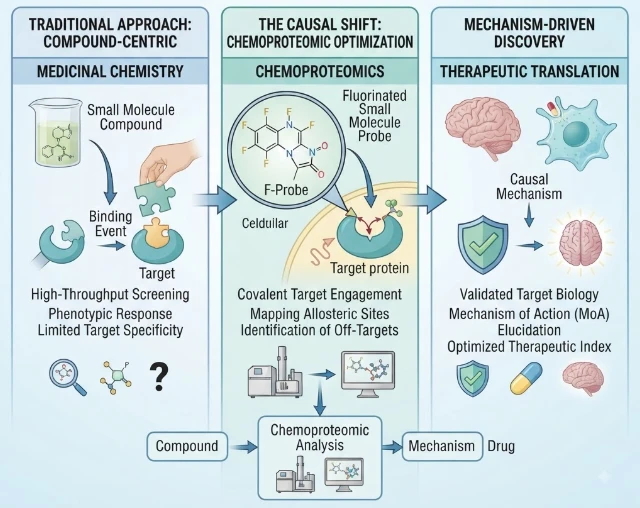
This article explores fluorinated medicinal chemistry through causal chemoproteomics, emphasizing that fluorine substitution can alter far more than potency. A single positional change can modify conformation, pKa, lipophilicity, metabolic stability, target interactions, intracellular exposure, and off-target biology. The article therefore tests whether fluorinated analogues change cellular phenotype through intended target engagement rather than hidden polypharmacology. Matched molecular pairs
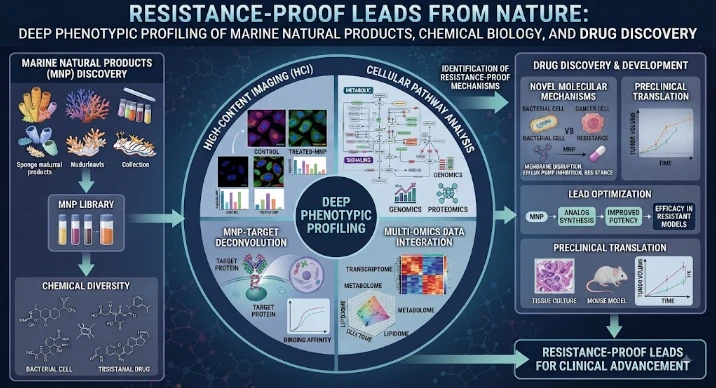
This article presents resistance-aware marine natural-product discovery as a mechanistic process rather than a search for isolated high-potency hits. It explains how activity from marine extracts or fractions can disappear during purification or fail under resistance pressure, making deep phenotypic profiling essential. Morphology, viability kinetics, organelle function, transcriptional state, metabolism, and recovery after washout are combined to connect phenotype with mechanism. The article em