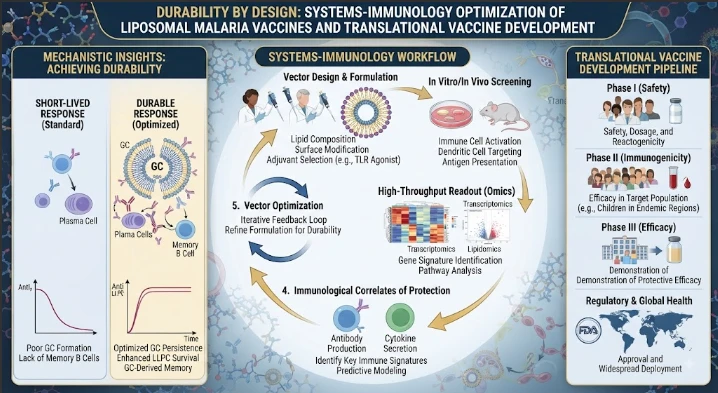
This article focuses on designing malaria vaccines for durable protection rather than simply maximizing early immunogenicity. It argues that long-term protection depends on the architecture of the immune response, including affinity maturation, long-lived plasma cells, memory B cells, helper T-cell support, and functional antibody quality. Liposomal adjuvant systems are highlighted because their lipid composition, innate agonists, particle properties, and antigen presentation can be deliberately tuned to influence early immune programming and later memory. The article proposes systems immunology as the main optimization framework, combining transcriptomics, cytokine profiling, flow cytometry, repertoire sequencing, proteomics, metabolomics, and longitudinal sampling. Particular attention is given to germinal-center quality, the balance between productive innate stimulation and reactogenicity, antibody function, dose and booster schedule, and differences between malaria-naive and repeatedly exposed populations. It also connects durability to manufacturing consistency, storage stability, antigen display, challenge models, field studies, and deployment economics. The core argument is that durable immunity should be an upfront design objective.
Malaria vaccine development has progressed to a point where the only obstacle is getting the vaccine to produce an immune response. The difficult one is writing the correct answer, maintaining it and formulating it so as to be manufacturable and deployable at scale. The trajectory is controlled by the composition of the lipids, the innate immune agonists, the characteristics of the particles and the presentation of the antigens, all of which can be manipulated to alter the early events after vaccination. Therefore, formulation selection is a key starting point in the design of a durable formulation, long before any antibody level drop is seen in follow-on data.
Protection is durable more because of immune architecture than any one lab measurement. These were good antibody titres soon after vaccination, but long term protection also requires affinity maturation, long-lived plasma cells, memory B cells, activation of the helper T cells and functional antibody quality. Malaria complicates things due to its geographical and seasonal variation in exposure to the parasite; as well as the fact that various vaccine targets are at various stages of the parasite lifecycle. Formulation optimization for maximum immunogenicity ignores mechanisms required months following.
The advantages of liposomal adjuvants are that immune activation is possible to be spatially controlled in a particulate system. Defined ratios can be used for the incorporation or association of immunostimulatory components such as Toll-like receptor agonists and saponins. Then, the uptake of the particles leads to the transfer of antigen and innate signals to related cellular landscapes, which enhances the likelihood of antigen presentation in the presence of proper activation. There is a mechanistic pathway for the effect of this co-delivery principle on the downstream T-cell and B-cell responses.
Experimental trials of malaria vaccines with liposomal adjuvant (Lt) systems have shown that the strength and type of the immune response induced are affected by the composition of the vaccine. Circumsporozoite protein antigens have been supported by strong responses in preclinical and translational work using the derivatives of army Liposome Formulation containing monophosphoryl lipid A analogues and QS-21. Immune signatures have also been different when comparing various adjuvant platforms, even though the same antigen is used. Those findings result in formulation being a causal variable rather than a background ingredient.
Systems immunology increases the amount of signals that can be optimized. Early innate programs can be captured in transcriptomic profiling, cellular activation can be mapped in flow cytometry, inflammatory balance can be described in a cytokine panel and B-cell evolution can be characterized in repertoire sequencing. Other layers concern cell state and pathway activity, provided by Proteomics and Metabolomics. The real issue is integration – useful biomarkers need to link early measurements with later functional protection beyond contributing to larger datasets.
A program with a focus on durability, then, takes immune courses. Innate activation can be detected by samples taken shortly after vaccination, germinal-center and memory development by later samples, and persistence and functional activity by long-term measurements. Then, statistical models look for early signatures that indicate rapid antibody decline or robust antibody responses. This is more informative than comparing individual time points because the process of immune maturation is a process and not a set of phenotypes.
Of particular interest is germinal-center (GC) quality. B-cells fight for antigen and T-cell support, then undergo somatic hypermutation and generate clones that have a higher affinity. This evolutionary process is affected by delivery vectors, which determine antigen persistence and cellular access. A liposomal system that is tolerogenic but still allows for sufficient antigen presentation could help to enhance affinity maturation even if the initial antibody peak is not the highest of the formulations tested.
The balance of innate signaling is also important. Too strong an activation can improve antigen presentation and contribute to helper responses, whereas hyper activation can cause more reactogenicity and thus affect immune differentiation. Therefore, the composition of the lipids, the identity of the agonist and the dose and the particle structure constitute a multidimensional optimization space. At the systems level, measurements can be used to find formulations that trigger protective pathways without triggering inflammatory pathways.
Antibody function is also included in the concept of durability. The recognition described by binding assays is just one of the ways in which malaria protection is achieved, depending on the target, and others include neutralization, inhibition of sporozoite invasion, opsonic activity, complement interactions, and transmission blocking effects. Functional assays should thus be used in addition to quantitative antibody assays. It may be more useful to have a smaller number of antibodies that are highly functional rather than a larger number of poorly protective antibodies.
Translation is difficult due to difference in population. Vaccine responsiveness is influenced by age, prior exposure to malaria, maternal antibodies, nutritional status, co-infections and baseline inflammation. In malaria-naive adults, immune signatures identified are not necessarily representative of durability in repeated-exposure infants or populations. System-immunology studies across relevant groups enable identification of stable signals that are triggered by the formulation and strong host-specific signals.
Other design levers are dose and schedule. The number of prime boost intervals impacts memory formation, and the amount of antigen/adj will impact peak response and persistence. System models can be used to test if a lower dose given more frequently will give better maturation than a higher dose given more sparsely. Optimization is now the goal, not just a single maximal measurement, of an immune trajectory.
The manufacturing should be kept within the optimization framework. Biological behavior can be changed by lipid purity, vesicle size, polydispersity, association with antigens, concentration of the adjuvant, mixing conditions, filtration and storage. However, a long-lasting immune profile only is useful if the product can replicate the profile across manufacturing lots. Mechanistic links between critical quality attributes and immune outcomes then must be established, enabling that process to be controlled within limits to maintain immune function.
There's another translational dimension; storage stability. Delivery properties can be altered before administration by lipid oxidation, hydrolysis, aggregation, leakage, and/or changes in particle size. Gross degradation is not the only type of degradation detectable by assays used to monitor stability programs, as changes that might impact how the product activates naturally or presents antigen should also be monitored. This is particularly crucial for malnourished children in malaria vaccination programmes where cold chain coverage and reliability is not consistent.
Caution should be taken with the use of machine learning in the systems immunology field. The problem of overfitting is exacerbated by small cohorts and correlated measurements, and can be detected by high dimensional datasets that can find combinations of early features that correlate with later durability. Validation with predefined validation, interpretable models, with external cohorts, and biological plausibility are still crucial. The predictive performance that is most important is the one in an experiment that follows a formulation decision which is successful.
Ultimately, causal experiments serve to identify valuable biomarkers from passengers. Formulation changes that affect a particular cytokine pathway would give a direct test of the durability if it is an early cytokine response that predicts durability. Other perturbations can explore antigen persistence, activation of innate receptors, engagement of particles, or programming of helper cells. Observation shall return to controlled engineering, not merely to correlation – this is where systems immunology will be most powerful.
Another factor of durability is antigen display. Repetitive or surface-associated presentation can lead to increased B-cell receptor clustering, and soluble antigen can lead to a different geometry of antigen presentation. The antigen density and the orientation of the antigen can be investigated as formulation parameters on liposomal platforms. Linking these nanoscale structures with germinal-center output offers a direct experimental pathway from the design of the particles to the quality of the antibodies they produce.
Durable laboratory signals are important and are still used in challenge models. Studying the persistence of immunity can be done in animals with controlled infections and in carefully controlled human challenge experiments to determine whether persisting antibody levels relate to delayed infection or reduced parasite loads. This is then supplemented by natural exposure given in field studies, with the heterogeneous transmission and diversity of populations. Bigger, more complex data sets are more likely to provide a candidate with a translational credential when mechanistic signatures are still informative in these increasingly uncontrolled environments.
Optimization is further honed through deployment economics. Even with good immunology, a formulation that needs special lipids or complex mixing or special storage can restrict the impact of the formulation on the population level. Simplification of the platform, dose saving, stable source of raw materials, reproducible fill-finish processes, therefore, should belong in durability planning. Products with long-lasting protection are most valuable when they can be manufactured and marketed in sufficient and consistent quantities to meet the need of malaria control programs.
Thus, durability by design is associated with lipid chemistry, intrinsic sensing, adaptive maturation, functional assays, host variation, production, and deployment. The layers can be modified and systematically measured in liposomal malaria vaccines. It's not just about the highest early titer, but the one that will produce a consistent immune trajectory towards durable protection. That standard is about to make durability more of an up-front design goal than just a consequence of the process.
CITE THIS ARTICLE
Kabir, M. H. (2026). Durability by Design: Systems-Immunology Optimization of Liposomal Malaria Vaccines and Translational Vaccine Development. https://researchbykabir.com/article/f8b442c1-559b-5588-a794-75d99f2b6d8d
M. H. Kabir, “Durability by Design: Systems-Immunology Optimization of Liposomal Malaria Vaccines and Translational Vaccine Development,” 2026. [Online]. Available: https://researchbykabir.com/article/f8b442c1-559b-5588-a794-75d99f2b6d8d
Kabir, M. H. (2026) ‘Durability by Design: Systems-Immunology Optimization of Liposomal Malaria Vaccines and Translational Vaccine Development’. Available at: https://researchbykabir.com/article/f8b442c1-559b-5588-a794-75d99f2b6d8d
Kabir, Md. Humayan. “Durability by Design: Systems-Immunology Optimization of Liposomal Malaria Vaccines and Translational Vaccine Development.” 2026, https://researchbykabir.com/article/f8b442c1-559b-5588-a794-75d99f2b6d8d.
Md. Humayan Kabir. “Durability by Design: Systems-Immunology Optimization of Liposomal Malaria Vaccines and Translational Vaccine Development.” (2026). https://researchbykabir.com/article/f8b442c1-559b-5588-a794-75d99f2b6d8d.
Kabir MH. Durability by Design: Systems-Immunology Optimization of Liposomal Malaria Vaccines and Translational Vaccine Development. 2026. https://researchbykabir.com/article/f8b442c1-559b-5588-a794-75d99f2b6d8d
@misc{article_f8b442c1559b5588a79475d99f2b6d8d,
  title = {Durability by Design: Systems-Immunology Optimization of Liposomal Malaria Vaccines and Translational Vaccine Development},
  author = {Md. Humayan Kabir},
  year = {2026},
  url = {https://researchbykabir.com/article/f8b442c1-559b-5588-a794-75d99f2b6d8d},
}
TY  - GEN
AU  - Md. Humayan Kabir
TI  - Durability by Design: Systems-Immunology Optimization of Liposomal Malaria Vaccines and Translational Vaccine Development
PY  - 2026-07-05
UR  - https://researchbykabir.com/article/f8b442c1-559b-5588-a794-75d99f2b6d8d
ER  -
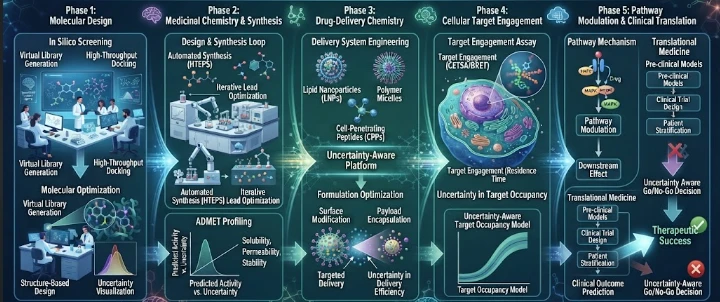
This article describes an uncertainty-aware platform for moving from predicted molecular binding to validated cellular target engagement in medicinal chemistry and drug-delivery research. Docking and machine-learning predictions can rapidly prioritize compounds, but they do not establish that a molecule reaches, occupies, and functionally modulates a target inside relevant cells. The article therefore separates predicted affinity from free intracellular concentration, subcellular localization, t
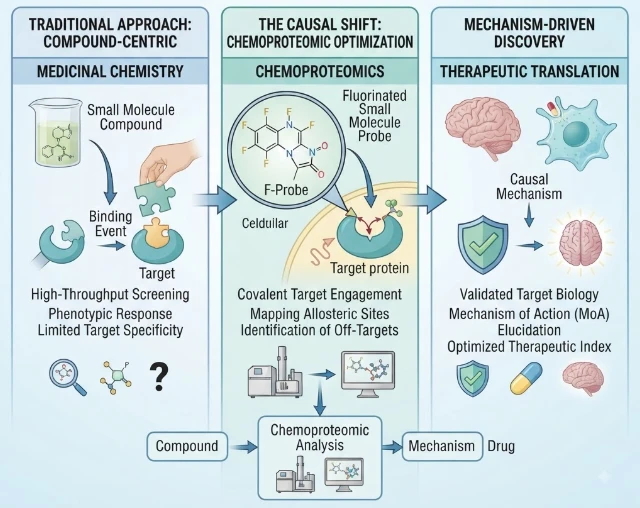
This article explores fluorinated medicinal chemistry through causal chemoproteomics, emphasizing that fluorine substitution can alter far more than potency. A single positional change can modify conformation, pKa, lipophilicity, metabolic stability, target interactions, intracellular exposure, and off-target biology. The article therefore tests whether fluorinated analogues change cellular phenotype through intended target engagement rather than hidden polypharmacology. Matched molecular pairs
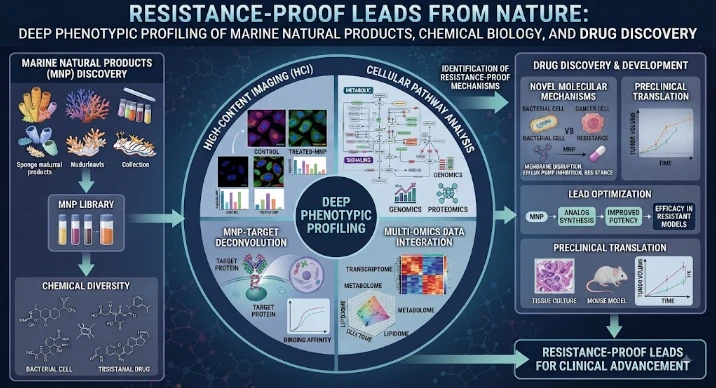
This article presents resistance-aware marine natural-product discovery as a mechanistic process rather than a search for isolated high-potency hits. It explains how activity from marine extracts or fractions can disappear during purification or fail under resistance pressure, making deep phenotypic profiling essential. Morphology, viability kinetics, organelle function, transcriptional state, metabolism, and recovery after washout are combined to connect phenotype with mechanism. The article em