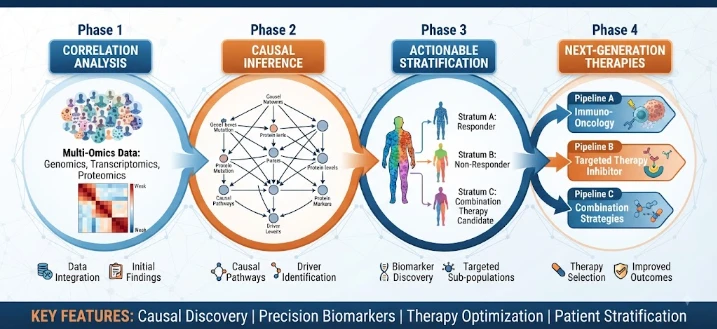
This article argues that precision oncology must move from correlated multi-omics signatures to causally actionable patient stratification. Genomic, transcriptomic, proteomic, metabolomic, imaging, and clinical features can describe tumors in great detail, but they do not automatically identify which patients will benefit from a specific treatment. The article links molecular alteration, pathway state, treatment exposure, target engagement, response, and clinical outcome using integrated omics, organoid testing, pharmacodynamic biomarkers, and functional screening. Causal graphs, propensity methods, doubly robust estimation, multimodal learning, latent-factor models, and counterfactual prediction are presented as analytical tools, with calibration and transportability emphasized. External cohorts, prospective testing, negative controls, functional perturbation, and treatment-interaction analysis help distinguish predictive biomarkers from merely prognostic ones. Longitudinal multi-omics, circulating tumor DNA, resistant organoids, and evolutionary modeling address clonal adaptation after treatment. The framework also incorporates safety, assay standardization, specimen handling, batch correction, missing data, and real-world clinical actionability. Its central goal is to identify subgroups whose molecular characteristics genuinely modify treatment benefit and can support reproducible clinical decisions.
Multi-omics can provide a detailed description of cancer but this is not sufficient to identify which patients respond to a treatment. The landscape of causal multi-omics for actionable precision-oncology stratification is no longer limited to finding hits as correlated genomic, transcriptomic, proteomic, metabolomic, imaging and clinical features can generate unstable biomarkers that lack causal interpretation by treatment. The more interesting question is whether a subset of patients with molecular characteristics that confer differential treatment benefit, as opposed to prognosis, is consistent under “realistic biological and development conditions”. This change is from a ranking activity to a discovery program based on exposure, cause and repeatability. As the time to publication nears, the need to correlate molecular structure with experiments to elucidate the mechanism of action of a candidate, to identify performance shortcomings, and to establish priorities for constraints becomes more and more important for causal precision oncology.
Therapeutic vulnerabilities are identified at a large scale, integrated cohorts are appearing, yet the assignment of treatments in observational studies, missing modalities, and high dimensionality of the data makes it hard to get causal inferences. Past experience and recent development demonstrates that as biological complexity (neurons, etc.) increases, it is hard to find a nice laboratory signal that remains as is. A promising research approach is then to keep the activity signal and to gradually increase the realism of the conditions for the test to identify the features that are really necessary in the activity.
Mechanistic depth begins with linking molecular modification to pathway state to treatment exposure to engagement of a target to response to clinically relevant outcome. This structure can be concealed in simple endpoint assays where similar read out occurs from a variety of causal pathways. The combination of genomics, transcriptomics, proteomics, metabolomics, pathway analysis, organoid response, pharmacodynamically oriented markers and functional screening provides more complete information, allowing for the differentiation of direct action from downstream adaptation, non-specific stress, or delivery failures. These measurements allow for the creation of an attractive response that can be tested as a chain of chemistry, biological state and functional outcome.
Design variables should also be considered in an interactive manner, rather than as separate factors. All of the above can affect performance, and there can be a trade-off between improvement in one and a deterioration in another. Therefore, it is more practical to try to optimize trade-offs, rather than a single maximum. Multi-parameter profiles are particularly useful when considering the translational value is impacted by multiple parameters: potency, selectivity, stability, tissue exposure, and manufacturability.
When uncertainty is visible, causal graphs, propensity methods, doubly robust estimation, multimodal learning, latent factors and counterfactual prediction provide additional computational leverage but remain useful for prediction. When applied to an unfamiliar chemical or biological region, models learnt from a familiar region are frequently not reliable when presented with new scaffolds, unusual materials or underrepresented patient states. Fragile predictions are identified early with calibration, prospective testing, checks of domain of applicability and disagreements from disparate model families before costly experiments build up.
Orthogonal validation is a valuable tool in experimental design. These are external cohorts, prospective testing, functional perturbation in the cohort, negative controls, treatment interaction testing and assay reproducibility all address different aspects of the causal question and mitigate reliance on any given assay technology. Consensus in the field of chemistry, imaging, omics, genetics and functional biology leads to a more solid mechanistic argument than multiple repeat measurements of the same endpoint. Discussed also, however, is disagreement as an informative element, for different outcomes can be indicators of hidden exposure thresholds, assay artifacts, compensatory pathways, or context-dependent pharmacology.
Another challenge arises due to biological diversity. In any case, the typical abundance of the targets, the barrier properties, metabolism, immune tone, or pathway dependence may be different for different populations, in the same stage of disease, regardless of prior treatment, sample quality, missing modalities, or availability of treatment. Average responses thus may not reflect subgroups that may have different exposure-response relationships. Biological variation is incorporated into the design and is not a late justification for inconsistent results – it is analyzed on a stratified basis, there are representative model panels, and there are explicit checks for biological variation.
Resistance and adaptation should be included in the attention given early, as clonal evolution and pathway adaptation can lead to a change of molecular state post baseline profile stratification. Longitudinal multi-omics, circulating tumor DNA, post-treatment sampling, resistant organoids and evolutionary modeling determine the survival of activity in evolutionary or compensatory pressure. Even if a candidate is not as potent, but would inhibit common escape routes, it may have more value in the long run than a weak, but potent, lead. Resistance-aware development also can hone mechanism as recurrent escapes often will point to the proteins, pathways or exposure processes with the most causal influence.
Molecular promise to reachable biology through delivery and pharmacokinetics. The concentration and duration of the active form in the desired tissue reach a level consistent with the suggested mechanism depends on dose intensity, ability to penetrate tissue, compliance, metabolism, target occupancy, and treatment modification. This relationship is not reproducible in terms of nominal dose, as the effective dose is the result of absorption, distribution, binding, transformation, clearance and local barriers. Mechanistic exposure measurements should be placed next to efficacy data during the earliest development stages.
Mechanism is a powerful tool that can enhance the safety assessment. Target-linked pharmacology is separated from broad cellular injury, immune activation, reactive chemistry, and formulation-driven toxicity by organ function, pharmacogenomics, off-target toxicity, immune adverse events, drug interactions and exposure to sub-populations of the target organ. Comparative testing in diseased and healthy systems determines the therapeutic activity from the undesirable one. The latter is because this method leaves a desirable efficacy signal to develop a program without the same effect gradually closing the exposure window in the program.
Manufacturing is another variable of science, not downstream logistics. Even if it seems the nominal composition is unchanged, the product quality, biological activity and exposure can be different as a result from assay standardization, specimen handling, sequencing depth, batch correction, reference materials, and computational version control. QbD thinking is a process to connect critical attributes of materials, process parameters, to measurable performance, rather than simply at the end of the process. Industry success that's independent of raw material variation, larger equipment, storage and transport, and independent production runs makes for more believable scalability.
Realistic models of the clinical use of translation are also needed. Treatment time, tissue availability, treatment line, competing options, assay cost, interpretability and action thresholds influence treatment timing, dose frequency and route, diagnostic needs, and acceptable level of complexity. A technically beautiful platform, which is not useful in the setting where treatment is required, because its administration requirements, storage conditions or monitoring requirements are too high, or because of the cost, is not of practical value. Thus, the judicious choice of development decisions can be optimized in early stage commitments when it is easier to change than when we are near the end of the process.
Data integration is the link between these layers. Multi-omics profiles, treatment assignment, covariates, pharmacology, response trajectory, survival, and adverse outcomes can be structured around a common causal framework and not as distinct, independent and separate assays. Iterative learning is reproducible thanks to traceable metadata, versioned models, standardized controls and prospective decision rules. This means that the candidate's development record will not only provide the information on the candidate's first ranking, but it will also provide information on which assumptions were used to back up that ranking and which uncertainties were not resolved.
In addition to the treatment-interaction effect, treatment stratification requires calibration, treatment-subgroup transportability, treatment decision benefit, external replication, missing data robustness, and functional confirmation. The higher the quality of a decision, the more success criteria will be met: durability, reproducibility, exposure margin, biological breadth, manufacturing robustness, as well as potency. These metrics incentivize candidates to optimize for a specific assay, instead of a general one, and make it more likely that a candidate will be retained if they are found to be credible by an independent assay. The rationale of a less dramatic outcome being the development option is also made clear by a transparent scorecard.
Also, a strong program specifies a constructive way of failure. Negative results of prognostic markers mislabeled as predictive, approach confounded comparisons, overfit signatures, batch effects, missing-modality bias, and small subgroups for stable decisions place limits on the boundaries of the mechanism and limit repeated investments in weak hypotheses. These factors can lead to a lack of synthesis, to a lack of target engagement, to unstable exposure, to the emergence of resistance, or to the loss of effect in subgroups.The absence of synthesis, a lack of target engagement, unstable exposure, emergence of resistance or lack of effect in subgroups can all give a future model a more realistic view of the search space. Discovery is quicker if the negative experiments teach as much as the positive ones.
Precision oncology shifts from correlation to counterfactual clinical questions and mechanisms with causal multi-omics. The main advantage of the central advantage is that it allows to connect isolated performance claims with the mechanism, exposure, biological diversity, safety and production aspects of the explanation. This organization makes it easier to select candidates since there is a test for every major development claim. Forward progress will no longer rely on spectacular single experiments, but rather on a logical sequence of successful demonstrations that will be convincing as complexity shifts from laboratory systems to the real clinical environment.
CITE THIS ARTICLE
Kabir, M. H. (2025). From Correlation to Actionable Stratification: Causal Multi-Omics of Precision Oncology, Molecular Medicine, Biomarkers and Next-Generation Therapies. https://researchbykabir.com/article/f37a18bd-b315-5eb7-a06d-0d9b6603f6f8
M. H. Kabir, “From Correlation to Actionable Stratification: Causal Multi-Omics of Precision Oncology, Molecular Medicine, Biomarkers and Next-Generation Therapies,” 2025. [Online]. Available: https://researchbykabir.com/article/f37a18bd-b315-5eb7-a06d-0d9b6603f6f8
Kabir, M. H. (2025) ‘From Correlation to Actionable Stratification: Causal Multi-Omics of Precision Oncology, Molecular Medicine, Biomarkers and Next-Generation Therapies’. Available at: https://researchbykabir.com/article/f37a18bd-b315-5eb7-a06d-0d9b6603f6f8
Kabir, Md. Humayan. “From Correlation to Actionable Stratification: Causal Multi-Omics of Precision Oncology, Molecular Medicine, Biomarkers and Next-Generation Therapies.” 2025, https://researchbykabir.com/article/f37a18bd-b315-5eb7-a06d-0d9b6603f6f8.
Md. Humayan Kabir. “From Correlation to Actionable Stratification: Causal Multi-Omics of Precision Oncology, Molecular Medicine, Biomarkers and Next-Generation Therapies.” (2025). https://researchbykabir.com/article/f37a18bd-b315-5eb7-a06d-0d9b6603f6f8.
Kabir MH. From Correlation to Actionable Stratification: Causal Multi-Omics of Precision Oncology, Molecular Medicine, Biomarkers and Next-Generation Therapies. 2025. https://researchbykabir.com/article/f37a18bd-b315-5eb7-a06d-0d9b6603f6f8
@misc{article_f37a18bdb3155eb7a06d0d9b6603f6f8,
  title = {From Correlation to Actionable Stratification: Causal Multi-Omics of Precision Oncology, Molecular Medicine, Biomarkers and Next-Generation Therapies},
  author = {Md. Humayan Kabir},
  year = {2025},
  url = {https://researchbykabir.com/article/f37a18bd-b315-5eb7-a06d-0d9b6603f6f8},
}
TY  - GEN
AU  - Md. Humayan Kabir
TI  - From Correlation to Actionable Stratification: Causal Multi-Omics of Precision Oncology, Molecular Medicine, Biomarkers and Next-Generation Therapies
PY  - 2025-11-23
UR  - https://researchbykabir.com/article/f37a18bd-b315-5eb7-a06d-0d9b6603f6f8
ER  -
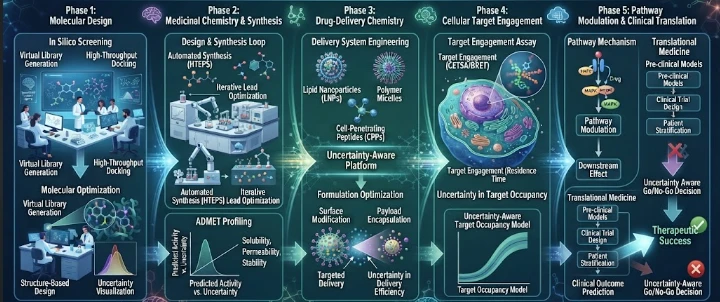
This article describes an uncertainty-aware platform for moving from predicted molecular binding to validated cellular target engagement in medicinal chemistry and drug-delivery research. Docking and machine-learning predictions can rapidly prioritize compounds, but they do not establish that a molecule reaches, occupies, and functionally modulates a target inside relevant cells. The article therefore separates predicted affinity from free intracellular concentration, subcellular localization, t
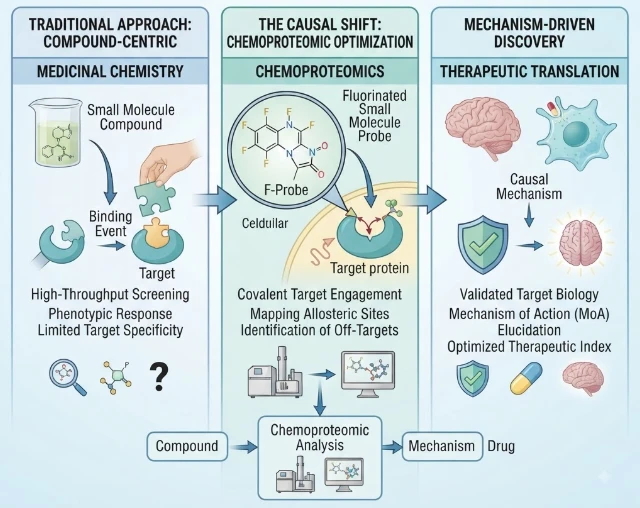
This article explores fluorinated medicinal chemistry through causal chemoproteomics, emphasizing that fluorine substitution can alter far more than potency. A single positional change can modify conformation, pKa, lipophilicity, metabolic stability, target interactions, intracellular exposure, and off-target biology. The article therefore tests whether fluorinated analogues change cellular phenotype through intended target engagement rather than hidden polypharmacology. Matched molecular pairs
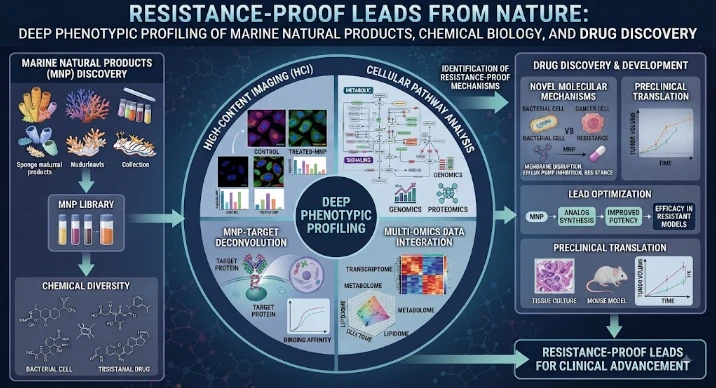
This article presents resistance-aware marine natural-product discovery as a mechanistic process rather than a search for isolated high-potency hits. It explains how activity from marine extracts or fractions can disappear during purification or fail under resistance pressure, making deep phenotypic profiling essential. Morphology, viability kinetics, organelle function, transcriptional state, metabolism, and recovery after washout are combined to connect phenotype with mechanism. The article em