From Receptor Mechanism to Patient Stratification: Single-Cell Systems Pharmacology of Neuroimmune Pharmacology, Pain, Sensory Neurons and Therapeutic Targets
Md. Humayan Kabir (Master of Science in Pharmaceutical Technology)
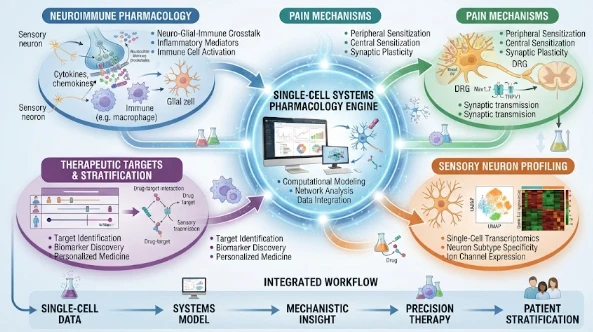
This article applies single-cell systems pharmacology to neuroimmune pain and patient stratification. It centers on sensory-neuron subtypes, immune-cell states, receptor expression, ligand release, tissue context, and temporal signaling, showing that the same pain behavior can arise from different cellular circuits. Bulk tissue measurements may conceal these differences, while single-cell transcriptomics, spatial profiling, electrophysiology, ligand–receptor inference, perturbation experiments, and behavioral pharmacology can reveal mechanism-linked subgroups. The article emphasizes that receptor abundance alone is insufficient because functional coupling depends on cell identity, inflammatory state, and anatomical location. The main decision question is which cellular circuit predicts response to receptor-directed therapy rather than merely correlating with pain intensity. Pain mechanism, chronicity, sensory phenotype, prior analgesic exposure, and inflammatory status are treated as important sources of context. Species differences, dissociation artifacts, unstable cell-state signatures, and receptor expression without functional coupling are identified as risks. Standardized tissue processing, prospective modeling, traceability, and longitudinal measurements support translation. Overall, the article argues for patient stratification based on mechanistic neuroimmune states rather than broad diagnostic labels.
The emergence of system pharmacology of neuroimmune pain in single-cell systems is shifting the paradigm from mere questions of potency, delivery or association, but rather to understanding why a result occurs, and when it is reliable. This change largely hinges on a mechanistic network of sensory-neuron subtypes, immune-cell states, receptor expression, ligand release, tissue context, and temporal signaling. It is that network because the same receptor is part of different circuits of pain according to identity, inflammatory status and location of the cells. A better development strategy thus sees mechanism, context and uncertainty as not being independent tasks performed at distinct points in the design process, but as related variables.
Bulk tissue measurements have masked the amount of neuroimmune diversity that can be revealed by single-cell studies. Clinical data from inflammatory pain models have revealed both inflammatory patterns of immune activation and unique populations of sensory-neurons capable of producing similar pain behavior, indicating that same pain behavior can occur from different cellular conversations. Receptor expression also differs between different types of neurons and different immune conditions; and functional coupling is also sensitive to local signalling context. Single-cell transcriptomics in combination with spatial information, electrophysiology, ligand–receptor analysis, and perturbation therefore has additional value for systems pharmacology, because it provides a basis for considering receptor abundance as a complete explanation of a signaling system.
As a result, a new discovery paradigm centered on single-cell transcriptomics, spatial profiling, electrophysiology, ligand–receptor inference, perturbations and behavioral pharmacology has emerged. None of these assays is the key determinant alone, as each reflects a small, but important, fragment of a process that is much larger in the biology or clinical disease. The more independent measurements all suggest the same causal narrative, the more confident one can be that the story is true. Non-concordant results are also important because it is often only when results are inconsistent that there are mechanisms, assay artifacts, population differences, or exposures that are not being captured in the development that have to be investigated before continuing the development.
When making decisions, it is important to distinguish which circuit in the cell predicts response to receptor-targeted therapy, and not just associate with pain intensity. To answer the question, it's necessary to explicitly compare the intended mechanism to likely alternate mechanisms, such as off-target activity, parallel pathways, differential exposure, or measurement bias. Perturbation experiments are particularly informative as they help to determine if the observed effect is really attributable to a proposed component. It is therefore better to gain a sense of mechanistic confidence from challenge tests, not repeated confirmation in one assay, which is so favorable.
Almost all outcomes in a single-cell system pharmacology of neuroimmune pain are modified by the context. Relevant variation includes pain mechanisms, inflammatory status, anatomical source, chronicity, sensory phenotype and prior analgesic exposure. If an intervention is effective in one set of these circumstances, it may be less effective, more toxic or have a different effect, in another. When stratifying is used, it is helpful to have a basis for the stratification that is related to a mechanism or exposure, as descriptive categories often don't give a good understanding of why treatment performance is changing.
Consideration for risk assessment should also be given due to species differences, unstable cell-state signatures, dissociation artifacts, receptor expression without functional coupling and heterogeneous pain phenotypes. Early safety work is most useful if integrated with the same mechanistic approach that is applied to efficacy, so that unwanted effects can be referred back to target biology, carrier behavior, exposure, metabolites and/or analytical bias. This will minimise the risk of safety being felt as a late checklist, unrelated to discovery logic. It additionally helps with better and more clear considerations of how to make the trade-offs when greater efficacy demands greater exposure, more pathway modulation, or more persistence in sensitive tissues.
This is a further layer of complication due to patient stratification by mechanism linked neuroimmune states, rather than simple categorisation by diagnosis. Preclinical success is more meaningful if experiments accurately mimic clinically relevant timings, concentrations, biological barriers, treatment history, and sources of heterogeneity. Going from a convenient model to a complex model is less useful than a series of models that are designed to answer particular uncertainty questions. A decision, therefore, must be made at each step whether to continue, redesign, target a smaller population, change the dosage or obtain a different kind of mechanistic information.
Manufacturing and analytical control are both crucial; standardisation of the assays and reproducible processing of tissues is crucial as the state of the cells is very sensitive to handling. A biological explanation is less useful when the biological material being tested changes from one lot to another and/or the assay inputs are poorly defined. The critical attributes, thus, must be predetermined ranges, and they should be measured with sensitivity and kept in records which should relate process conditions to biological performance. In studies involving complex molecules, nanoparticles, biomaterials or data-rich studies, exposure to drugs or their metabolites, signal and apparent response of treatment can vary subtly depending on the molecule, the nanoparticle, the biomaterial type, or the amount of data.
Also, a better distinction between prediction and confirmation is valuable for data analysis in single-cell systems pharmacology for neuroimmune pain. The computational models, machine learning, causal estimators, and mechanistic simulations can rank the hypotheses, combine the high-dimensional measurements, and reveal the uncertainty, but the predictions of the model do not reflect the biological truth. Useful models say assumptions, quantify calibration, flag regions with weak support, and steer next experiment towards being able to alter a decision. Prospective validation is crucial because there are patterns that are likely to be fit in the past but not in the future due to new populations, new batches or new biological conditions.
Another change that is important is regarding time; for example, some of the processes that are key in the single-cell systems pharmacology of neuroimmune pain are slow to develop following initial exposure. When there is only one endpoint that is favorable, the responses to early response, adaptation, clearance, immune programming, tissue remodeling, adherence, or resistance can take on different paths. Longitudinal measurement determines if an intervention is associated with a stable state, a temporal perturbation or a delayed liability. Time-resolved data also allow to better understand the causality of the proposed mechanism since it is observed before the downstream phenotype and not only after its establishment.
It is more efficient to have every study related to a specific uncertainty budget when designing experiments. Questions about the role of sensory-neuron subtypes, immune-cell states, receptor expression, ligand release, tissue context and temporal signaling can be prioritized based on their ability to modify which cellular circuit predicts response to a receptor-directed therapy as opposed to simply correlating with pain intensity, and not just because they are new. Subsequently, replication across complementary models tests the effectiveness of the conclusion with respect to one assay, one laboratory condition, or one population. This discipline also helps to prevent over-optimization and turns negative results useful - each time they fail to predict reduces the space of possible mechanisms and enhances the subsequent optimization cycle.
The regulatory or clinical credibility also relies on traceability of claims to measures. A development package is reinforced by maintaining links between the following aspects of experiments: raw observations, processing choices, model assumptions, protocol deviations and material attributes, from early experiments to the translational studies. This traceability allows an easy separation of biological variation from technical variation, and facilitates post hoc evaluation of efficacy or safety claims. This also provides a more transparent framework for revising conclusions if new information leads to a change of a previous assumption.
There is a need for more accuracy in communication around this field. The term 'targeted', 'selective', 'durable', 'safe', 'predictive', or 'personalised' do not mean a great deal without the inclusion of a measurement, a comparator, a population and uncertainty range. Using clear reporting, results that are negative are more useful and do not allow for exploratory results to be presented as established mechanisms. This precision enables common standards and guidelines for researchers, developers, clinicians, and regulators to evaluate if a claim is based on direct measurement, calibrated inference or an untested assumption.
A tighter loop joining chemistry and/or formulation, mechanistic measurement, quantitative modelling, safety, manufacturing control, and clinically relevant context is therefore the best direction for single cell systems pharmacology of neuroimmune pain. Rapid progress is achieved if assumptions are exposed as early as possible and mechanisms that work are tested intentionally to ensure their success. This logic is extended to receptor pharmacology, cellular context and stratified treatment. The best innovation in the field is a development system that learns from each experiment and maintains an identity of causality, reproducibility, and the relevance of the experiments in the real world at the heart of every experiment.
CITE THIS ARTICLE
Kabir, M. H. (2025). From Receptor Mechanism to Patient Stratification: Single-Cell Systems Pharmacology of Neuroimmune Pharmacology, Pain, Sensory Neurons and Therapeutic Targets. https://researchbykabir.com/article/ad8f8ac2-9ca9-5fc0-ada3-5a3e9133933f
M. H. Kabir, “From Receptor Mechanism to Patient Stratification: Single-Cell Systems Pharmacology of Neuroimmune Pharmacology, Pain, Sensory Neurons and Therapeutic Targets,” 2025. [Online]. Available: https://researchbykabir.com/article/ad8f8ac2-9ca9-5fc0-ada3-5a3e9133933f
Kabir, M. H. (2025) ‘From Receptor Mechanism to Patient Stratification: Single-Cell Systems Pharmacology of Neuroimmune Pharmacology, Pain, Sensory Neurons and Therapeutic Targets’. Available at: https://researchbykabir.com/article/ad8f8ac2-9ca9-5fc0-ada3-5a3e9133933f
Kabir, Md. Humayan. “From Receptor Mechanism to Patient Stratification: Single-Cell Systems Pharmacology of Neuroimmune Pharmacology, Pain, Sensory Neurons and Therapeutic Targets.” 2025, https://researchbykabir.com/article/ad8f8ac2-9ca9-5fc0-ada3-5a3e9133933f.
Md. Humayan Kabir. “From Receptor Mechanism to Patient Stratification: Single-Cell Systems Pharmacology of Neuroimmune Pharmacology, Pain, Sensory Neurons and Therapeutic Targets.” (2025). https://researchbykabir.com/article/ad8f8ac2-9ca9-5fc0-ada3-5a3e9133933f.
Kabir MH. From Receptor Mechanism to Patient Stratification: Single-Cell Systems Pharmacology of Neuroimmune Pharmacology, Pain, Sensory Neurons and Therapeutic Targets. 2025. https://researchbykabir.com/article/ad8f8ac2-9ca9-5fc0-ada3-5a3e9133933f
@misc{article_ad8f8ac29ca95fc0ada35a3e9133933f,
  title = {From Receptor Mechanism to Patient Stratification: Single-Cell Systems Pharmacology of Neuroimmune Pharmacology, Pain, Sensory Neurons and Therapeutic Targets},
  author = {Md. Humayan Kabir},
  year = {2025},
  url = {https://researchbykabir.com/article/ad8f8ac2-9ca9-5fc0-ada3-5a3e9133933f},
}
TY  - GEN
AU  - Md. Humayan Kabir
TI  - From Receptor Mechanism to Patient Stratification: Single-Cell Systems Pharmacology of Neuroimmune Pharmacology, Pain, Sensory Neurons and Therapeutic Targets
PY  - 2025-08-24
UR  - https://researchbykabir.com/article/ad8f8ac2-9ca9-5fc0-ada3-5a3e9133933f
ER  -
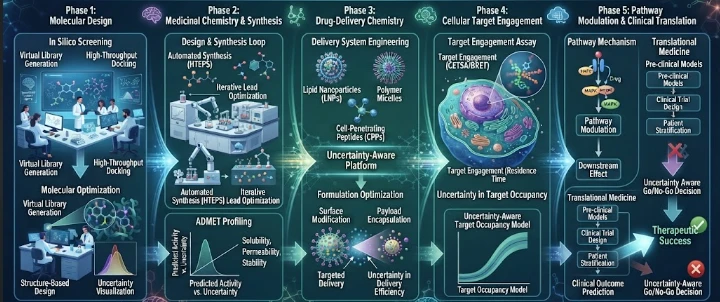
This article describes an uncertainty-aware platform for moving from predicted molecular binding to validated cellular target engagement in medicinal chemistry and drug-delivery research. Docking and machine-learning predictions can rapidly prioritize compounds, but they do not establish that a molecule reaches, occupies, and functionally modulates a target inside relevant cells. The article therefore separates predicted affinity from free intracellular concentration, subcellular localization, t
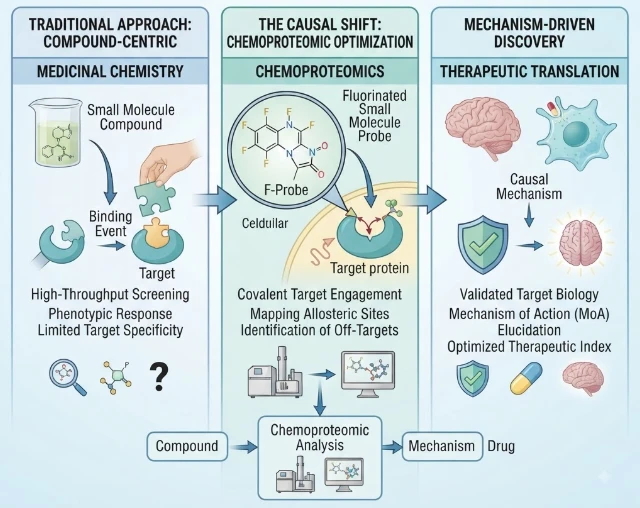
This article explores fluorinated medicinal chemistry through causal chemoproteomics, emphasizing that fluorine substitution can alter far more than potency. A single positional change can modify conformation, pKa, lipophilicity, metabolic stability, target interactions, intracellular exposure, and off-target biology. The article therefore tests whether fluorinated analogues change cellular phenotype through intended target engagement rather than hidden polypharmacology. Matched molecular pairs
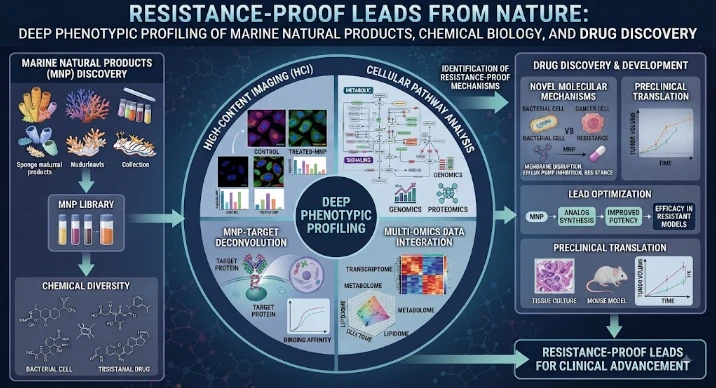
This article presents resistance-aware marine natural-product discovery as a mechanistic process rather than a search for isolated high-potency hits. It explains how activity from marine extracts or fractions can disappear during purification or fail under resistance pressure, making deep phenotypic profiling essential. Morphology, viability kinetics, organelle function, transcriptional state, metabolism, and recovery after washout are combined to connect phenotype with mechanism. The article em