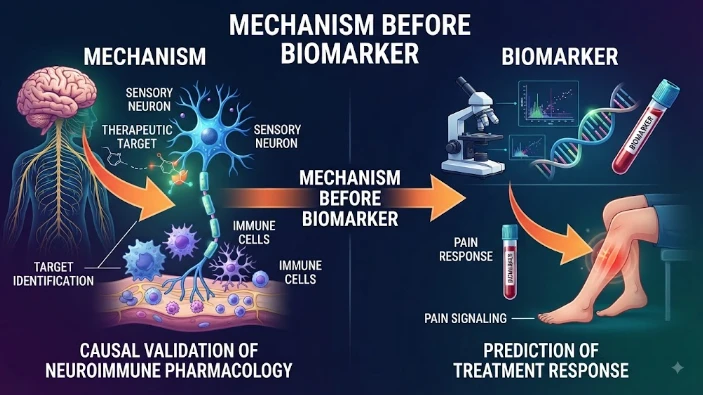
This article argues that a treatment biomarker in neuroimmune pain should not be promoted until its causal relationship with therapeutic mechanism has been tested. Cytokines, transcriptional signatures, imaging signals, sensory thresholds, and circulating proteins can correlate with response while reflecting disease severity, tissue injury, or parallel inflammatory pathways. The proposed framework connects receptor activity, sensory-neuron excitability, immune signaling, tissue inflammation, biomarker change, and treatment response. Prospective perturbation, mediation analysis, receptor-specific pharmacology, longitudinal sampling, single-cell profiling, and independent replication are presented as the main validation tools. A useful biomarker should change in the expected direction when the proposed mechanism is altered, precede the clinical or behavioral response, and maintain analytical reliability across relevant contexts. Pain subtype, chronicity, medication history, tissue source, inflammatory state, and comorbidity are treated as key modifiers. Reverse causation, confounding by severity, temporal mismatch, batch effects, and unstable thresholds are major risks. The article emphasizes validated assays, reference materials, locked pipelines, and traceability. Overall, mechanism must be established before a biomarker becomes a treatment-selection rule.
The era of asking ‘is it sufficiently potent, delivered, or associated' is over for causal biomarker validation in neuroimmune pain as the modern therapeutic development process increasingly requires an understanding of 'why' the result has occurred, and when this result is valid. The core of this transition is a mechanistic network of receptor activity, sensory-neuron excitability, immune signaling, tissue inflammation and therapeutic response. This is because that network is important because a biomarker that was involved in pain or response can be downstream of multiple processes, and thus may not be effective when used as a rule for treatment selection. A better development strategy thus sees mechanism, context and uncertainty as not being independent tasks performed at distinct points in the design process, but as related variables.
In pain research, much of the time biomarkers are one or more steps removed from the mechanism being targeted by treatment. Cytokines, transcriptional signatures, imaging signals, sensory thresholds, and circulating proteins can correlate with response and can reflect disease severity, as well as parallel inflammatory pathways and tissue injury. The question of whether the proposed mechanism can be intentionally perturbed to alter the biomarker before the therapeutic response and if the relationship is replicated is called causal validation. Thus, a treatment biomarker should be temporally ordered and mechanistically linked to the treatment, analytically reliable, and have a threshold that is stable in the clinical context that is relevant to the treatment.
The actual implication of this is a new paradigm of discovery based on prospective perturbation, mediation analysis, receptor-specific pharmacology, longitudinal sampling, single-cell profiling, and independent replication. None of these tools is definitive by itself, as each of the assays is only part of a larger biological or clinical process. Independent measurements gain confidence when they all point to a similar causal narrative over the dose, time, model system and the relevant biological context. Discordant results are valuable, as inconsistencies may point to hidden mechanisms, assay artifacts, differences in populations, or limits of exposure, which may warrant further investigation prior to costly development.
In a decision-making process, the key issue is whether it is believed that the change in the proposed mechanism results in a change in the biomarker and the clinical/behavioral response in the desired direction. To answer that question, the intended mechanism has to be explicitly compared to alternative mechanisms that are known to exist, such as off-target activity, alternative pathways, differential exposure, measurement bias, etc. Perturbation experiments are particularly revealing because their elimination, blocking or restoration can help determine whether or not the observed effect is dependent upon the specific component. Therefore, the confidence in the mechanism is provided by challenge tests that are successful, and not by repeated blind confirmation in a single favorable assay.
Also, the meaning of nearly all results in causal biomarker validation in neuroimmune pain is changed by context. These factors are relevant to the variations, such as pain subtype, inflammatory state, medication history, tissue source, chronicity, and comorbidity. If an intervention is effective in one set of these circumstances, it may be less effective, more toxic or have a different effect, in another. The more stratification is based on variables related to mechanism or exposure, the more useful it becomes because it is often insufficient to explain the changes in treatment performance with descriptive categories.
Risk assessment must be addressed alongside, since the reverse causation, confounding effect of severity, mismatch of time, batch effects, and changing thresholds. Early safety work is best connected to the same mechanistic approach as efficacy, with unwanted effects being linked to target biology, carrier behaviour, exposure, metabolites or analytical bias. This will lower the risk of safety being a late checklist that is not related to the discovery logic. It also helps to facilitate more transparent trade-offs in regard to trade-offs between efficacy and exposure, pathway modulation and pathway breadth, as well as persistent and long-lasting effects in sensitive tissues.
Then there is the complication of "translation" because there are biomarkers that are associated to actionable mechanisms instead of descriptive correlation. It is better to have preclinical success when experiments mimic clinically relevant concentrations, time course, biological barriers, treatment history, and sources of heterogeneity. Going from a convenient model to a complex model is less useful than a series of models that are designed to answer particular uncertainty questions. As a result, each step has to be accompanied with a statement of the decision to be taken: continue, redesign, reduce the target population, change dosing, or gather a different kind of mechanistic information.
Manufacturing and analytical control are both equally critical as valid assays, reference materials, preanalytical controls and locked analysis pipelines provide a credible biomarker deployment. Having a biological explanation becomes less valuable if the tested material has changed from one batch to another, or if the inputs of the assay are not well defined. In order to be able to monitor critical attributes, therefore, a range of values must be defined, a sensitive measurement must be selected, and a record which will link process conditions with biological performance must be developed. In studies involving complex molecules, nanoparticles, biomaterials or data-rich studies, exposure to drugs or their metabolites, signal and apparent response of treatment can vary subtly depending on the molecule, the nanoparticle, the biomaterial type, or the amount of data.
There is also a greater distinction between prediction and confirmation in data analysis for causal biomarker validation in neuroimmune pain. The computational models, machine learning, causal estimators, and mechanistic simulations can rank the hypotheses, combine the high-dimensional measurements, and reveal the uncertainty, but the predictions of the model do not reflect the biological truth. Useful models involve stating assumptions, quantifying calibration, identifying regions with limited support, and suggesting the next experiment in the right direction for getting information to change a decision. Prospective validation is crucial because there are patterns that are likely to be fit in the past but not in the future due to new populations, new batches or new biological conditions.
Yet another aspect that needs to be changed is time as many processes involved in the causal biomarker validation for neuroimmune pain occurs after the initial exposure. When the endpoint is good, the stages of early response, adaptation, clearance, immune programming, tissue remodeling, adherence or resistance may develop in different ways. The impact of an intervention can be determined from a longitudinal measurement: either a stable state, a temporary perturbation or a delayed liability. Time-resolved data also allows for a better causal interpretation, as the proposed mechanism can occur before the downstream phenotype or not.
An efficient experimental design is achieved if each study is associated with a definite uncertainty budget. The questions may be ranked by how they affect the biomarker and the clinical or behavioral outcome if the proposed mechanism was altered, in the intended direction versus the opposite direction, instead of the novelty of the question. Replication across complementary models is then used to determine if the conclusion is dependent on one assay, one laboratory condition or one population. This discipline drives the efficient use of optimization time and enables negative results to be informative as the mechanism space is further reduced with each failed iteration and the next design cycle can be optimised accordingly.
The regulatory or clinical credibility also relies on traceability of claims to measures. For causal biomarker validation in the field of neuroimmune pain, the stronger the development package, the more this raw data, processing choices, model assumptions, protocol deviations and material properties will be linked together from initial experiments to translational studies. This traceability allows an easy separation of biological variation from technical variation, and facilitates post hoc evaluation of efficacy or safety claims. This also provides a more transparent framework for revising conclusions if new information leads to a change of a previous assumption.
Precisions also need to be improved in the communication around this field. The term 'targeted', 'selective', 'durable', 'safe', 'predictive', or 'personalised' do not mean a great deal without the inclusion of a measurement, a comparator, a population and uncertainty range. Using clear reporting, results that are negative are more useful and do not allow for exploratory results to be presented as established mechanisms. This precision enables common standards and guidelines for researchers, developers, clinicians, and regulators to evaluate if a claim is based on direct measurement, calibrated inference or an untested assumption.
Rather than one new technology, the best direction to validate a biomarker in neuroimmune pain is to create a tighter cycle of chemistry or formulation, mechanistic measurement, quantitative modeling, safety, manufacturing control, and clinically relevant context. Rapid progress is achieved if assumptions are exposed as early as possible and mechanisms that work are tested intentionally to ensure their success. That is logic for mechanism prior to the promotion of a biomarker for guiding therapy. In the field, the most important innovation is a system that learns from every trial and trial-and-error process, and that always interprets the causes of the results and maintains a focus on the ability to replicate and apply the findings in the real world.
CITE THIS ARTICLE
Kabir, M. H. (2025). Mechanism Before Biomarker: Causal Validation of Treatment Response in Neuroimmune Pharmacology, Pain, Sensory Neurons and Therapeutic Targets. https://researchbykabir.com/article/884b4685-884f-51cd-84d5-020cfde79736
M. H. Kabir, “Mechanism Before Biomarker: Causal Validation of Treatment Response in Neuroimmune Pharmacology, Pain, Sensory Neurons and Therapeutic Targets,” 2025. [Online]. Available: https://researchbykabir.com/article/884b4685-884f-51cd-84d5-020cfde79736
Kabir, M. H. (2025) ‘Mechanism Before Biomarker: Causal Validation of Treatment Response in Neuroimmune Pharmacology, Pain, Sensory Neurons and Therapeutic Targets’. Available at: https://researchbykabir.com/article/884b4685-884f-51cd-84d5-020cfde79736
Kabir, Md. Humayan. “Mechanism Before Biomarker: Causal Validation of Treatment Response in Neuroimmune Pharmacology, Pain, Sensory Neurons and Therapeutic Targets.” 2025, https://researchbykabir.com/article/884b4685-884f-51cd-84d5-020cfde79736.
Md. Humayan Kabir. “Mechanism Before Biomarker: Causal Validation of Treatment Response in Neuroimmune Pharmacology, Pain, Sensory Neurons and Therapeutic Targets.” (2025). https://researchbykabir.com/article/884b4685-884f-51cd-84d5-020cfde79736.
Kabir MH. Mechanism Before Biomarker: Causal Validation of Treatment Response in Neuroimmune Pharmacology, Pain, Sensory Neurons and Therapeutic Targets. 2025. https://researchbykabir.com/article/884b4685-884f-51cd-84d5-020cfde79736
@misc{article_884b4685884f51cd84d5020cfde79736,
  title = {Mechanism Before Biomarker: Causal Validation of Treatment Response in Neuroimmune Pharmacology, Pain, Sensory Neurons and Therapeutic Targets},
  author = {Md. Humayan Kabir},
  year = {2025},
  url = {https://researchbykabir.com/article/884b4685-884f-51cd-84d5-020cfde79736},
}
TY  - GEN
AU  - Md. Humayan Kabir
TI  - Mechanism Before Biomarker: Causal Validation of Treatment Response in Neuroimmune Pharmacology, Pain, Sensory Neurons and Therapeutic Targets
PY  - 2025-08-17
UR  - https://researchbykabir.com/article/884b4685-884f-51cd-84d5-020cfde79736
ER  -
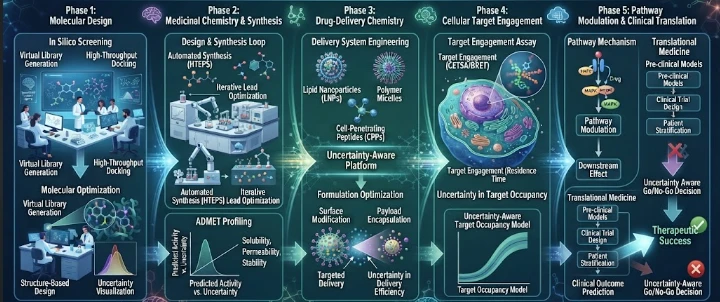
This article describes an uncertainty-aware platform for moving from predicted molecular binding to validated cellular target engagement in medicinal chemistry and drug-delivery research. Docking and machine-learning predictions can rapidly prioritize compounds, but they do not establish that a molecule reaches, occupies, and functionally modulates a target inside relevant cells. The article therefore separates predicted affinity from free intracellular concentration, subcellular localization, t
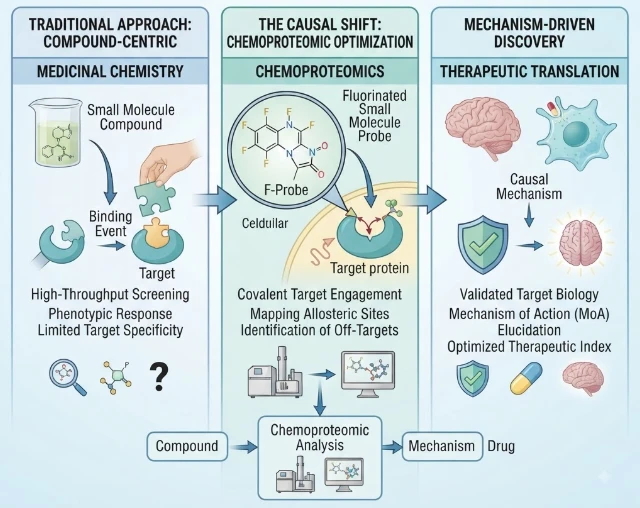
This article explores fluorinated medicinal chemistry through causal chemoproteomics, emphasizing that fluorine substitution can alter far more than potency. A single positional change can modify conformation, pKa, lipophilicity, metabolic stability, target interactions, intracellular exposure, and off-target biology. The article therefore tests whether fluorinated analogues change cellular phenotype through intended target engagement rather than hidden polypharmacology. Matched molecular pairs
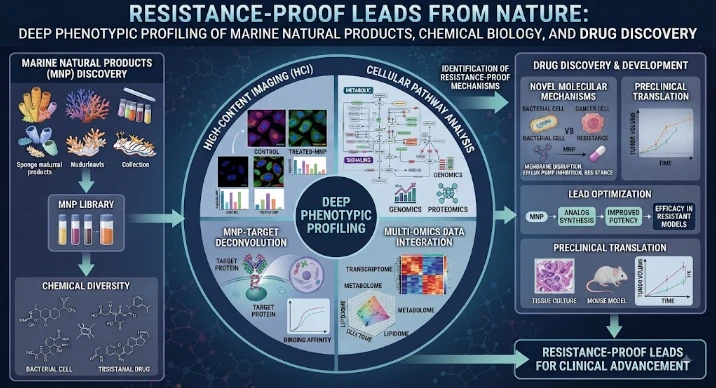
This article presents resistance-aware marine natural-product discovery as a mechanistic process rather than a search for isolated high-potency hits. It explains how activity from marine extracts or fractions can disappear during purification or fail under resistance pressure, making deep phenotypic profiling essential. Morphology, viability kinetics, organelle function, transcriptional state, metabolism, and recovery after washout are combined to connect phenotype with mechanism. The article em