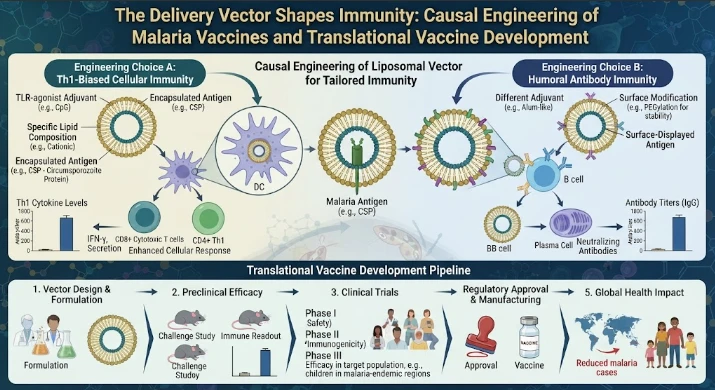
This article explains why the delivery vector itself should be treated as a causal component of malaria vaccine immunology. Using liposomal vaccine systems as the main example, it shows how lipid composition, particle structure, immunostimulatory molecules, antigen association, and post-injection behavior can shape innate signaling and downstream adaptive immunity. The article discusses malaria’s complex life cycle and argues that effective vaccination requires more than high antibody concentration; antibody quality, T-cell support, tissue distribution, functional activity, and durability must align with the targeted parasite stage. Liposomes are presented as tunable platforms in which particle size, membrane composition, antigen display, and adjuvant combinations can influence drainage, antigen-presenting-cell uptake, cytokine environments, germinal-center activity, and memory formation. Systems-immunology tools such as transcriptomics, proteomics, cytokine profiling, flow cytometry, and repertoire analysis are proposed for identifying causal immune signatures. Manufacturing consistency, safety, reactogenicity, dose sparing, storage, population differences, and deployment realities are also integrated into the translational framework.
The antigen of a vaccine tends to be the most prominent, but the presentation of the antigen is of equal importance. Liposomal malaria vaccine platforms are tangible examples that illustrate this principle as the level of lipids, the structure of the particles, the presence of immunostimulatory molecules, the association of the antigen, and the behavior of the particle after injection all affect the immune program that ensues. Thus, the delivery vector is not a passive packaging. The vector is used in the context of translational vaccine development, as a part of the biological instruction set.
Malaria is an example of the importance of delivery design. Plasmodium parasites undergo various stages of their life cycle, shed different antigens and have mechanisms that make durable protective immunity challenging. Different functional responses are required for sporozoite, liver stage, blood stage and transmission vaccines. It is not sufficient, however, that the antibody has high concentration, if it is not matched with the quality, cellular support, tissue distribution, and persistence of the antibody with the stage of the biological process targeted.
Liposomes offer a flexible engineering platform as their formulation can be modified simply by changing the composition of the membrane and the adjuvants used without the necessary redesign of the antigen. Phospholipids can form bilayers, which can bear a hydrophilic or lipophilic component, and immunostimulants are able to be bound to the lipid phase. Drainage, uptake and cellular processing are influenced by particle size and surface properties. These factors may affect the activation of innate pathways and/or the way antigens access antigen-presenting cells.
A malaria example of the Army Liposome Formulation family is available. Monophosphoryl lipid A derived formulations and QS-21 have been able to support good immunological responses to circumsporozoite protein vaccine candidates. In preclinical studies, the composition of the adjuvants of FMP013 and similar systems was shown to influence the production of antibodies, cellular responses and protection. The carrier design and antigen design go hand-in-hand, further emphasized by translation to nonhuman primate and clinical development.
Comparative studies with the R21 malaria antigen reaffirm the same. Even if the antigen is fixed, there are different adjuvants that produce different immune profiles. Combinations of Toll-like receptor (TLR) agonists with QS-21 are not based on emulsion or saponin-particle systems, but elicit patterns of innate activation that are distinct. Contrasts are beneficial for reinforcing a causal engineering perspective: changes in delivery chemistry change innate signaling, which changes adaptive response quality.
That causal chain begins just after the vaccination. Liposomal particles modulate antigen persistence, local inflammation, recruitment of immune cells and by dendritic cells and other antigen presenting cells. Incorporated immunostimulants of innate receptors alter the cytokine environment, which affects the differentiation of T-cells and the support of B-cells. The outcome is not a simple ‘stronger' immune response, but a more complex programme of antibody subclasses, polarization of T cells, germinal centre activity, and memory formation.
Tools for mapping that program are provided by systems immunology. Early signatures of subsequent immunogenicity are identified at the transcriptome, proteome, cytokine level, high-dimensional flow cytometry, B-cell repertoire and computational integration level. Such strategies can help to transcend endpoint antibody levels in the development of malaria vaccines. The goal is to identify immune pathways that help elucidate why one liposomal formulation leads to more long-lasting or effective protection than another.
To do causal engineering, there must be controlled comparisons. Concomitant changes in antigen dose, lipid composition, adjuvant dose, particle size and immunization schedule makes mechanistic interpretation difficult. Individual vector attributes can be associated with immune outcomes by using factorial experimental designs and matched formulations.Matched formulations and factorial experimental designs enable the association of individual vector attributes to immune outcomes. Then comes a series of tests to see if those relationships endure to more complex biology: animal models, nonhuman primates, and carefully designed early clinical studies.
A separate consideration is the durability as malaria exposures may occur in a seasonal and repetitive pattern. The effectiveness of vaccination is not just related to the slope of the total antibody concentration, as antibody titers can also decrease following vaccination. Sustained protection is due to affinity maturation, long-lived plasma cells, memory B cells, quality of the help T cell and functional antibody activity. This would be more beneficial than a formulation which elicits a higher initial peak, due to the added values of a liposomal vector that generates a better quality germinal center or long-lived cellular support.
Practical limits are set on this biological optimization by manufacturing. An identity, purity, particle-size distribution, encapsulation or association efficiency, content of adjuvants, mixing conditions, filtration, stability during storage and consistency between different vials should be maintained at scale. A formulation that works well in a small research sample, but fails in scale up is NOT translationally robust. Causal engineering thus involves process parameters due to changes in the delivery vector that can affect the immune outcome.
Safety is not a last step in design, but a design dimension. There is a balance between immunogenicity (good innate stimulation) and reactogenicity (not too strong for acceptability, not so strong that dosing flexibility is hampered). The idea behind the liposomal adjuvants is to find a proper balance, arranging immunostimulants in particle structures and regulating local presentation. The dose sparing strategies are attractive as they allow to either lessen the burden of manufacturing or achieve functional immunity at lower doses of antigen and/or adjuvants.
There are other restrictions set by the malaria context in the world. A vaccine program needs to be able to be deployed in areas, where there is a significant disease burden, varying levels of transmission, limited cold chains and large paediatric populations. Immunological performance is not the only factor involved; considerations are cost, supply, storage issues, dosing schedule and compatibility with existing immunization programs. Effectiveness and realism of the vector therefore are crucial for the success of translation.
This expanded perspective of the vaccine optimization changes. Development is not only asking for which adjuvant elicits the greatest response, it is asking for which vector-antigen combination will elicit the desired protective mechanism, with an acceptable durability, safety profile, manufacturability, and deployment profile. The advantage of liposomal systems is the possibility to deliberately variate the multiple design levers. Systems level measurements then indicate which levers are truly responsible for generating beneficial immunity.
A geometric layer is added on to the mechanism of antigen display. The cross-linking of B-cell receptors may be increased by density or repetitive presentation, and the change in the way that antigens are encountered and processed by the cells due to membrane anchorage is also known. Liposomal surfaces can thus not only transport cargo, but also form a nanoscale arrangement which can affect the very first events in B-cell activation. Modulation of antigen orientation and density may lead to a targeting of response to protective epitopes as opposed to immunodominant but less beneficial regions.
Population biology is also an important factor. Malaria exposure history, age, nutrition, maternal antibody levels, co-infections and immune activation are all factors that can modify vaccine responses. The liposomal formulation that works best in malaria-free adults could be different in infants or in populations that are repeatedly exposed to malaria. The challenge then is to bridge these findings to other relevant populations and transmission settings by conducting the appropriate tests, which use vector-driven immune signatures.
Correlates of protection link the formulation to the public health value. All functional antibody assays, inhibition of sporozoite invasion, T.B.A, C.H.M and field efficacy are ways to measure a portion of the protection. These functional endpoints are when these systems-immunology signatures are most useful. Next, delivery-vector optimization transitions from an immunogenicity description to a measurable chain from formulation attributes to immune mechanisms and protection.
The dose efficiency is also dependent on vector engineering. For large vaccination programs, it is important to consider that the amount of antigen required for a desired immune response can be decreased by strong antigen presentation and appropriately localised innate stimulation. Dose sparing provides manufacturing capacity, supply flexibility and may reduce the cost of providing immunizations. Those operational benefits turn into performance translation and are not ancillary logistics in malaria endemic areas.
Another benefit is that it's modular. It is possible to compare antigens or immune stimulants using a validated liposomal backbone with relatively constant other formulation parameters. The modular approach allows mechanistic attribution to be cleaner, and could reduce development cycles for next generation malaria candidates. Standardized platform knowledge also facilitates manufacturing transfer, as key parameters such as lipid, size and stability are known prior to a new antigen going into late stage development.
A gradual progress has been made in developing malaria vaccines and the understanding of delivery as part of mechanism. Liposomes are used to show the effect of physical structure and innate stimulation on downstream adaptive responses while comparative formulations show that the same antigens can induce different immunity. By considering the delivery vector as a causal variable a more stringent path from formulation science to protection is achieved. The main message is that vaccine immunity is not just achieved through antigen selection, but also through the physical and immunological environment in which the antigen is delivered.
CITE THIS ARTICLE
Kabir, M. H. (2026). The Delivery Vector Shapes Immunity: Causal Engineering of Liposomal Malaria Vaccines and Translational Vaccine Development. https://researchbykabir.com/article/75546ca5-a8a3-5edf-ba15-705e11d3efd3
M. H. Kabir, “The Delivery Vector Shapes Immunity: Causal Engineering of Liposomal Malaria Vaccines and Translational Vaccine Development,” 2026. [Online]. Available: https://researchbykabir.com/article/75546ca5-a8a3-5edf-ba15-705e11d3efd3
Kabir, M. H. (2026) ‘The Delivery Vector Shapes Immunity: Causal Engineering of Liposomal Malaria Vaccines and Translational Vaccine Development’. Available at: https://researchbykabir.com/article/75546ca5-a8a3-5edf-ba15-705e11d3efd3
Kabir, Md. Humayan. “The Delivery Vector Shapes Immunity: Causal Engineering of Liposomal Malaria Vaccines and Translational Vaccine Development.” 2026, https://researchbykabir.com/article/75546ca5-a8a3-5edf-ba15-705e11d3efd3.
Md. Humayan Kabir. “The Delivery Vector Shapes Immunity: Causal Engineering of Liposomal Malaria Vaccines and Translational Vaccine Development.” (2026). https://researchbykabir.com/article/75546ca5-a8a3-5edf-ba15-705e11d3efd3.
Kabir MH. The Delivery Vector Shapes Immunity: Causal Engineering of Liposomal Malaria Vaccines and Translational Vaccine Development. 2026. https://researchbykabir.com/article/75546ca5-a8a3-5edf-ba15-705e11d3efd3
@misc{article_75546ca5a8a35edfba15705e11d3efd3,
  title = {The Delivery Vector Shapes Immunity: Causal Engineering of Liposomal Malaria Vaccines and Translational Vaccine Development},
  author = {Md. Humayan Kabir},
  year = {2026},
  url = {https://researchbykabir.com/article/75546ca5-a8a3-5edf-ba15-705e11d3efd3},
}
TY  - GEN
AU  - Md. Humayan Kabir
TI  - The Delivery Vector Shapes Immunity: Causal Engineering of Liposomal Malaria Vaccines and Translational Vaccine Development
PY  - 2026-07-12
UR  - https://researchbykabir.com/article/75546ca5-a8a3-5edf-ba15-705e11d3efd3
ER  -
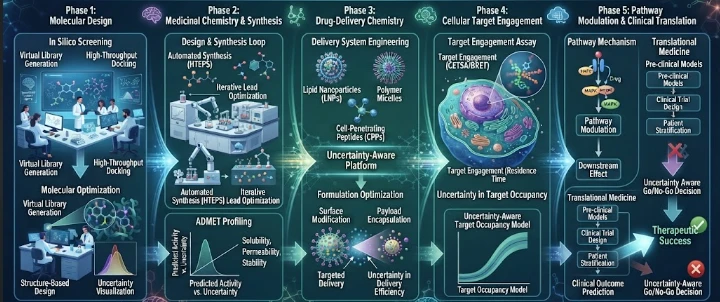
This article describes an uncertainty-aware platform for moving from predicted molecular binding to validated cellular target engagement in medicinal chemistry and drug-delivery research. Docking and machine-learning predictions can rapidly prioritize compounds, but they do not establish that a molecule reaches, occupies, and functionally modulates a target inside relevant cells. The article therefore separates predicted affinity from free intracellular concentration, subcellular localization, t
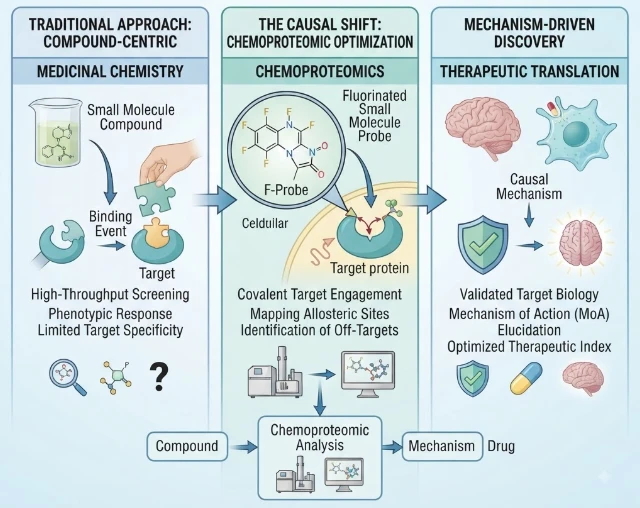
This article explores fluorinated medicinal chemistry through causal chemoproteomics, emphasizing that fluorine substitution can alter far more than potency. A single positional change can modify conformation, pKa, lipophilicity, metabolic stability, target interactions, intracellular exposure, and off-target biology. The article therefore tests whether fluorinated analogues change cellular phenotype through intended target engagement rather than hidden polypharmacology. Matched molecular pairs
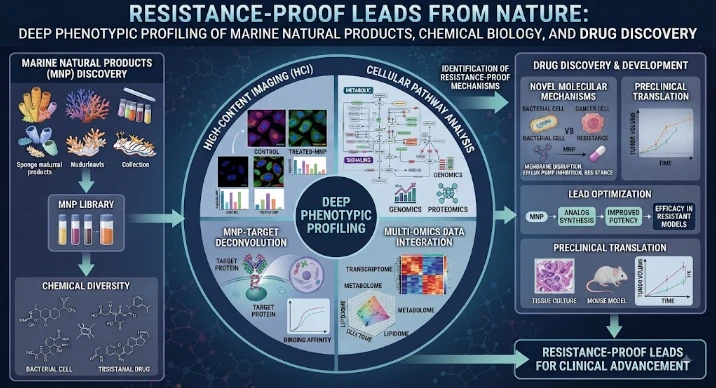
This article presents resistance-aware marine natural-product discovery as a mechanistic process rather than a search for isolated high-potency hits. It explains how activity from marine extracts or fractions can disappear during purification or fail under resistance pressure, making deep phenotypic profiling essential. Morphology, viability kinetics, organelle function, transcriptional state, metabolism, and recovery after washout are combined to connect phenotype with mechanism. The article em