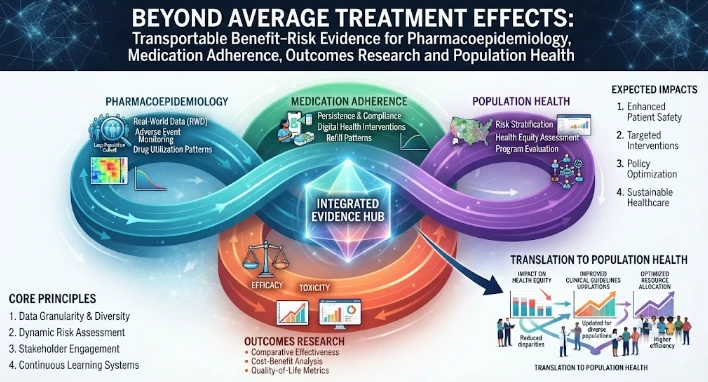
Beyond Average Treatment Effects: Transportable Benefit–Risk Evidence for Pharmacoepidemiology, Medication Adherence, Outcomes Research and Population Health
Md. Humayan Kabir (Master of Science in Pharmaceutical Technology)
This article examines when treatment-effect and benefit–risk estimates from population pharmacoepidemiology can be transported to new settings. It argues that baseline risk, treatment indication, adherence, competing therapies, healthcare context, and outcome definitions can differ enough between populations to change both relative and absolute effects. Transportability therefore requires defining a target population, identifying relevant effect modifiers, checking overlap between source and target patients, and recognizing where extrapolation becomes weak. Target-trial emulation, standardization, transport weighting, active comparators, quantitative bias analysis, and external validation are presented as key methods. Age, multimorbidity, socioeconomic context, prior treatment, adherence patterns, and healthcare access are treated as important sources of heterogeneity. Positivity violations, residual confounding, coding drift, treatment-channel differences, and heterogeneous follow-up are major risks. The article also stresses common variable definitions, data provenance, reproducible workflows, prospective validation, and uncertainty reporting. Its central message is that real-world benefit–risk evidence should be explicitly conditional on transport assumptions rather than assumed to generalize automatically.
The modern approach to therapeutic development increasingly requires understanding why a result is seen and when it will be reliable, making transportable benefit–risk evidence in population pharmacoepidemiology go beyond just potency, delivery, and association. The central axis of this evolution is a mechanistic network that is constituted by baseline risk, indication for treatment, adherence, competing treatments, health-system context and the definition of outcomes. The reason why that network is important is that it is not the same network as would be used for an association derived in another cohort, in which treatment patterns and baseline hazards are different. The more robust development strategy thus considers mechanism, context and uncertainty all as intertwined design variables in one process rather than being distinct processes carried out at various stages.
Transportability examines a question that only implicit in real world analyses, but is explicit in transportability: where does an estimated treatment effect hold? Relative and absolute benefit–risk profiles can change due to differences in baseline risk, prescribing guidelines, adherence, disease severity, competing treatments and access to health care. If important effect modifiers are not measured and there is no overlap in patient characteristics, then statistical standardization/transport weighting is unlikely to be helpful. A credible analysis begins with a definition of the target population, a review of support for the transport assumptions, and a review of extrapolation issues.
The implication is a new discovery paradigm, which is based on target-trial emulation, standardization, transport weighting, active comparator, quantitative bias analysis and external validation. None of these assays is game changers on its own because each assay only measures a subset of the larger biological/clinical process. Trust increases as independent measurements agree on a common causal narrative for a range of doses, time points, model systems, and relevant biological context. While this is the case, discordant results are still useful, as inconsistencies provide clues to other processes, assay artifacts, population differences, or exposure limitations that should be explored before more time and money are invested in development.
The question then becomes with decision making, where exactly does an effect estimate flow reliably and where does it need to be recalibrated or new data is needed. A definitive answer to this question requires explicit and clear comparison to a "best estimate" of possible alternatives such as off target effects, parallel pathways, differential exposure, or measurement bias. The effect of perturbation experiments is particularly useful because if the component is removed, blocked or restored, the observed effect is tested to see if it is dependent on the removed or blocked component. Therefore, the confidence in the mechanism is from challenge tests and not from repeated confirmation within one favorable assay.
In population pharmacoepidemiology, the meaning of nearly all outcomes of transportable benefit-risk evidence is dependent on the context. Variation relevant to the context includes age, multimorbidity, socioeconomic context, adherence pattern, prior treatment, and access to healthcare. A successful intervention with one set of these conditions might give a weaker effect, higher toxic effects, or another biological response with another set of conditions. Stratification is more useful when based on variables related to mechanism or exposure, rather than just descriptions categories, which provide little insight into the reasons for changes in treatment performance.
Risk assessment is on par with it, as positivity issues, residual confounding, coding drift, treatment-channel differences, and heterogeneous follow-up. Early safety work has been more successful when associated with the same mechanistic paradigm as efficacy and unwanted effects can be linked to target biology, carrier behavior, exposure, metabolites or analytical bias. This helps to minimise the likelihood that safety becomes an ‘afterthought' off the end of a checklist, unrelated to discovery logic. It also provides more transparent trade-offs on how to achieve greater effectiveness from increased exposure, a wider modulation of pathways, or the more extended persistence in a sensitive tissue.
More defensible treatment policy and formulary decisions, adherence programs, and population-health guidance adds an additional layer, namely the element of translational development. Preclinical success is more informative if experiments are conducted under clinically relevant conditions with relevant concentration ranges, biological barriers, treatment history and sources of biological heterogeneities. An easy progression from a convenient model to a complex model is of limited value compared to a series of models designed to address particular questions of uncertainty. Therefore for each step, there must be a clear decision that will be made: to continue, to redesign, to narrow the target population, to change dosing, or to gather another sort of mechanistic information.
The manufacturing and analytical control are also important as common variable definitions, data provenance and transparent reproducible workflows aid transport analyses. A biological explanation loses its value if the material being tested changes from batch to batch or if the inputs of the assay are not well characterised. Therefore critical attributes must have specific ranges, be sensitive to measure and link process conditions to biological performance. This discipline is particularly relevant for complex molecules, nanomaterials, biomaterials, and studies involving large amounts of data, which may result in very small changes to exposure, signaling, and/or response to treatment.
In the transportable benefit–risk evidence from population pharmacoepidemiology, data analysis takes advantage of the greater separation between prediction and confirmation as well. Model output is not the same as biological truth but can rank hypotheses, integrate high dimensional measurements, and reveal uncertainty, via computational models, machine learning, causal estimators, and mechanistic simulations. Useful models set up assumptions, measure calibration, mark down over-framed areas and suggest experiments that will provide information to alter a decision. It is important to also validate results in the future, as patterns that are best fit in the past might not be best fit in the future.
Another relevant change is also with regard to time because many mechanisms that are basic to the development of transportable benefit–risk evidence in population pharmacoepidemiology occur after first exposure. Even if there is a single endpoint that is favorable, the early response, adaptation, clearance, immune programming, tissue remodeling, adherence, and/or resistance may take different trajectories. Longitudinal measurement determines if the intervention has an effect that is stable, upheaval, or liability. Time-resolved information also facilitates the interpretation of causality as it allows to determine if the proposed mechanism occurs before the downstream phenotype or only after the phenotype has been determined.
The more efficient the experimental design, the more efficient the study will be when associated with a concrete uncertainty budget. Questions can be prioritised based on their ability to move an effect estimate with a high degree of reliability as well as where it needs to be recalibrated or new data. Replication across complementary models, then in order to test whether the conclusion is dependent on one assay, one laboratory condition or one population. Such discipline would preclude wasted optimization and informative failures as each failure reduces the design space of what may be happening and the next design iteration would be more successful.
It is also important that claims are traceable to measurements in order to build regulatory and clinical credibility. In population pharmacoepidemiology, where benefits and risks must be transported, a development package gains strength by maintaining observational links from early experiments to population-based studies.In the population pharmacoepidemiology context, where benefits and risks need to be transported, a development package is strengthened by retaining observations through processing decisions, model assumptions, protocol deviations, and material characteristics in the experiments from which the population studies are derived. That traceability can be helpful to differentiate real biological variation from technical noise, and aid in subsequent safety or efficacy testing. It also provides a more logical framework to revise conclusions if new data change an assumption.
There is also a need for more precision in communicating around this field. The terms targeted, selective, durable, safe, predictive, or personalized alone don't have much meaning without including a measurement, a comparator, a population, and an uncertainty range. Having negative reports is more useful and avoids having false-positive findings reported as mechanisms. Such precision is a common language to determine if a claim is based on direct measurement or calibrated inference or on an untested assumption for researchers, developers, clinicians and regulators.
A tighter loop between chemistry and/or formulation, measurement of the mechanism, quantitative modeling, safety, manufacturing control, and clinically relevant context is the best direction for transportable benefit–risk evidence in population pharmacoepidemiology, as opposed to any single new technology. The rate of progress increases if failed assumptions are uncovered early, and successful mechanisms are the subject of conscious testing with difficulty. This logic can drive real-world evidence of benefit/risk to be dependent on specific transport assumptions. Throughout the field, the most useful innovation is a development regimen that evolves with each experiment and always maintains causal understanding, reproducibility, and applicability as top priorities.
CITE THIS ARTICLE
Kabir, M. H. (2025). Beyond Average Treatment Effects: Transportable Benefit–Risk Evidence for Pharmacoepidemiology, Medication Adherence, Outcomes Research and Population Health. https://researchbykabir.com/article/5de90890-8f99-56a4-bc76-6e8b59a2b549
M. H. Kabir, “Beyond Average Treatment Effects: Transportable Benefit–Risk Evidence for Pharmacoepidemiology, Medication Adherence, Outcomes Research and Population Health,” 2025. [Online]. Available: https://researchbykabir.com/article/5de90890-8f99-56a4-bc76-6e8b59a2b549
Kabir, M. H. (2025) ‘Beyond Average Treatment Effects: Transportable Benefit–Risk Evidence for Pharmacoepidemiology, Medication Adherence, Outcomes Research and Population Health’. Available at: https://researchbykabir.com/article/5de90890-8f99-56a4-bc76-6e8b59a2b549
Kabir, Md. Humayan. “Beyond Average Treatment Effects: Transportable Benefit–Risk Evidence for Pharmacoepidemiology, Medication Adherence, Outcomes Research and Population Health.” 2025, https://researchbykabir.com/article/5de90890-8f99-56a4-bc76-6e8b59a2b549.
Md. Humayan Kabir. “Beyond Average Treatment Effects: Transportable Benefit–Risk Evidence for Pharmacoepidemiology, Medication Adherence, Outcomes Research and Population Health.” (2025). https://researchbykabir.com/article/5de90890-8f99-56a4-bc76-6e8b59a2b549.
Kabir MH. Beyond Average Treatment Effects: Transportable Benefit–Risk Evidence for Pharmacoepidemiology, Medication Adherence, Outcomes Research and Population Health. 2025. https://researchbykabir.com/article/5de90890-8f99-56a4-bc76-6e8b59a2b549
@misc{article_5de908908f9956a4bc766e8b59a2b549,
  title = {Beyond Average Treatment Effects: Transportable Benefit–Risk Evidence for Pharmacoepidemiology, Medication Adherence, Outcomes Research and Population Health},
  author = {Md. Humayan Kabir},
  year = {2025},
  url = {https://researchbykabir.com/article/5de90890-8f99-56a4-bc76-6e8b59a2b549},
}
TY  - GEN
AU  - Md. Humayan Kabir
TI  - Beyond Average Treatment Effects: Transportable Benefit–Risk Evidence for Pharmacoepidemiology, Medication Adherence, Outcomes Research and Population Health
PY  - 2025-08-14
UR  - https://researchbykabir.com/article/5de90890-8f99-56a4-bc76-6e8b59a2b549
ER  -
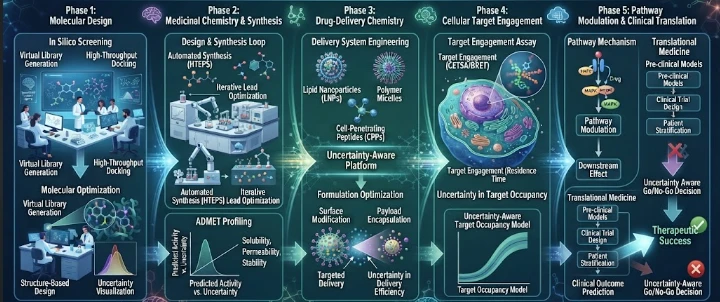
This article describes an uncertainty-aware platform for moving from predicted molecular binding to validated cellular target engagement in medicinal chemistry and drug-delivery research. Docking and machine-learning predictions can rapidly prioritize compounds, but they do not establish that a molecule reaches, occupies, and functionally modulates a target inside relevant cells. The article therefore separates predicted affinity from free intracellular concentration, subcellular localization, t
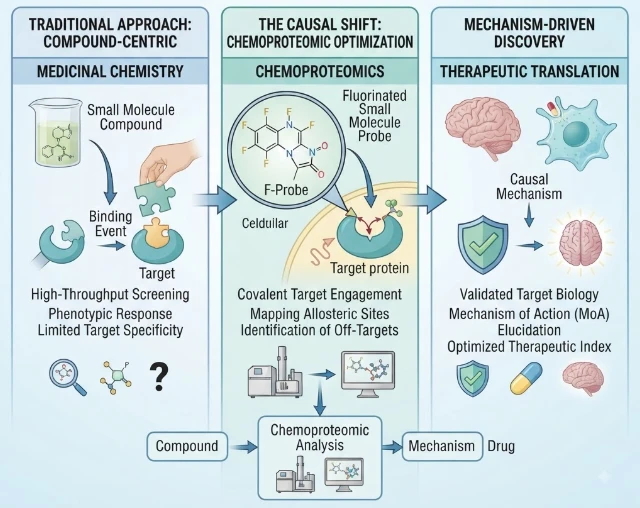
This article explores fluorinated medicinal chemistry through causal chemoproteomics, emphasizing that fluorine substitution can alter far more than potency. A single positional change can modify conformation, pKa, lipophilicity, metabolic stability, target interactions, intracellular exposure, and off-target biology. The article therefore tests whether fluorinated analogues change cellular phenotype through intended target engagement rather than hidden polypharmacology. Matched molecular pairs
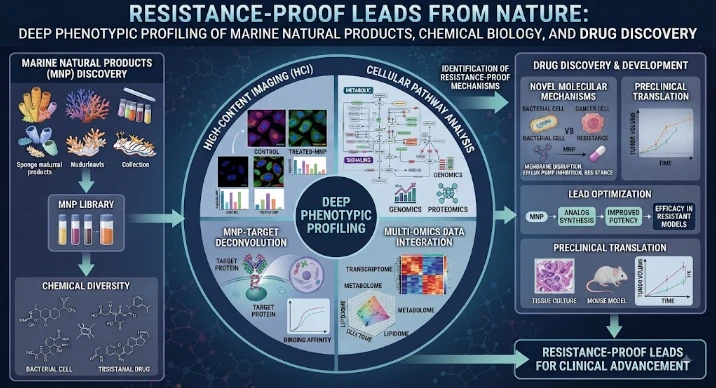
This article presents resistance-aware marine natural-product discovery as a mechanistic process rather than a search for isolated high-potency hits. It explains how activity from marine extracts or fractions can disappear during purification or fail under resistance pressure, making deep phenotypic profiling essential. Morphology, viability kinetics, organelle function, transcriptional state, metabolism, and recovery after washout are combined to connect phenotype with mechanism. The article em