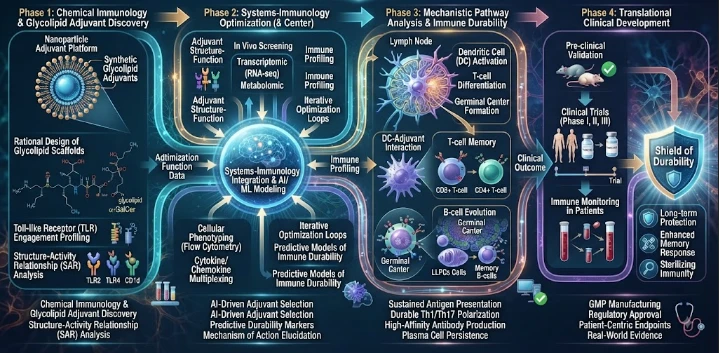
This article focuses on designing glycolipid vaccine adjuvants for durable immunity rather than maximizing short-lived antibody or cytokine peaks. It frames durability as a systems-immunology problem involving innate priming, follicular T-cell help, germinal-center selection, affinity maturation, long-lived plasma cells, memory B cells, recall responses, and functional protection. Longitudinal flow cytometry, single-cell sequencing, systems serology, neutralization assays, B-cell receptor analysis, challenge models, memory depletion, and booster studies are proposed for identifying immune trajectories that persist. The article emphasizes that glycolipid structure, formulation, release timing, antigen presentation, and dosing schedule interact, creating trade-offs between early activation, reactogenicity, and long-term memory. Computational tools such as trajectory modeling, network analysis, and causal mediation can help identify predictive signatures when prospectively validated. Biological variation, antigenic evolution, repeat dosing, safety, manufacturing consistency, and deployment constraints are also integrated. The core argument is that successful adjuvant design should optimize the complete immune trajectory, ensuring that protection remains functional, broad, reproducible, and manufacturable well beyond the initial immunogenicity peak.
The course of immunity is more important than the peak of a temporary immunity. Optimization of glycolipid vaccine adjuvants for systems immunology is not a matter of just finding the right hit, as early antibody or cytokine responses may drop and fail to create lasting plasma cells, memory B cells, effective T-cell support and/or functional immunity. The more interesting question is if an engineered persistent functional protection response with balanced immune memory is stable under realistic bio and dev conditions, using a glycolipid-adjuvanted response. It alters a ranking process to a mechanistic program geared to exposure, causality and reproducibility. As durability-based chemical immunology evolves and grows more reliant on the relationship between molecular design and experiments that provide insight into how a candidate performs and where it fails, and which constraints should be given priority, the need for non-computational methods becomes more and more obvious.
In a coordinated way, systems immunology quantifies durability by examining germinal-center biology, clonal evolution, T-cell states, antibody function and longitudinal memory, all of innate activation. The past and contemporary history of lab development has demonstrated that an attractive lab signal generally doesn't remain so as you add more biological complexity. An effective methodology for research, then, is to keep the signal of the activity in the same form and see what features are still necessary under increasingly realistic testing conditions.
Mechanistic depth begins with the linking of glycolipid sensing, presentation, innate priming, follicular help, germinal-center selection/affinity maturation, persistence of plasma cells, and recall of memory. This can be masked by simple endpoint assays, which result from similar pathways to the same endpoint. The combination of longitudinal flow cytometry, single cell sequencing, serum systems serology, neutralization, B-cell receptor analysis and recall assays reveal a more complete story because they allow for the distinction of direct action from downstream adaptation or nonspecific stress or delivery failure. These types of measurements enable a beautiful answer to become a provable causal pathway from chemistry to biological state to functional outcome.
Design variables should also be considered as interacting and not as separate variables. Performance is influenced by the combination of the above; changes in the structure of the glycolipid may lead to a penalty in the timing of its release, in the particle presentation, in the timing of its boost, etc. A sensible optimization technique aims at the trade-off so it does not seek the optimum. For drugs where potency, selectivity, stability, tissue exposure and manufacturability all influence translational value, multi-parameter profiles are particularly useful.
Computational leverage is provided by longitudinal clustering, network analysis, latent-trajectory models, causal mediation, and multivariate correlates of durability—but prediction is useful only when there is uncertainty that is visible. Predictive models based on similar chemical or biological regions can fail to perform well if a new scaffold or strange material is used, or when the patient state is not well represented. Calibration, prospective testing, Domains of Applicability (DoA) checking and disagreement across the model families help to identify fragile predictions early, before extensive tests take place.
Orthogonal validation of experimental design is beneficial. Independent cohorts, challenge models, memory depletion and booster studies address various questions of the causal question, as do functional antibody tests and cross-antigen evaluation that help to mitigate reliance on any one assay technology. A more convincing mechanistic case than repeated measurements of the same endpoint is to be found in agreement across the chemical, imaging, omics, genetics and functional biology fields. Disagreement is also informative because discordant findings can provide clues on hidden exposure limits, assay artifacts, compensatory pathways, and/or context-dependent pharmacology.
Another challenge is caused by biological diversity. The nominal treatment might achieve the same effect on the microbiome even though the abundance of the targets, the barrier properties, the metabolism, the immune tone, or the pathway dependence is changing due to differences in age, prior infection, baseline inflammation, microbiome, genetic background, nutritional status, or vaccine history. Average responses also have the potential to obscure subgroups with varying exposure-response relationships. Biological variation is part of the design and not an after thought explanation of variation.
Resistance and adaptation need to be considered early as there can be antigenic evolution that will reveal limited immunity that seemed sufficient against the original antigen. Variant neutralization, epitope mapping, T-cell breadth, repeated challenge, memory recall, and heterologous antigen testing indicate survival of evolutionary and/or compensatory pressure. High potency but easily escapable leads might not be as valuable as candidates that become less potent but still prevent the escape routes. Resistance-aware development also helps to further refine mechanism as the recurring escape changes frequently highlight the proteins, pathways, or exposure processes with the most causal influence.
The connection between delivery and pharmacokinetics brings the molecular promise to the reachable biology. The active form may or may not reach the desired location at the right level and duration of concentration to support the proposed mechanism: depend on the type of the antigen, the dendritic-cell uptake, the glycolipid presentation, and the duration of stimulation of the germinal center. This relationship can only be captured by nominal dose; however, the absorption, distribution, binding, transformation, clearance, and local barriers will alter the effective dose. Mechanistic exposure assays should thus be placed in the line of efficacy measurements that are gathered during the very early development stages.
Mechanism and safety assessment complement each other. Target linked pharmacology can be distinguished from broad cell injury, immune activation, reactive chemistry or formulation-driven toxicity by persistent inflammation, cytokine imbalance, local reactogenicity, auto-reactive signals, liver effects, and repeat-dose tolerance. Comparative testing is used in disease relevant and healthy systems to determine if therapeutic activity is distinct from undesirable effects.
In addition to being a 'logistics' issue downstream, manufacturing is also a scientific variable. Exposure to the product, biological activity and product quality can be influenced by changes in product quality that can occur during glycolipid purification, particle composition, antigen association, process reproducibility, during storage, fill-finish, or during product release testing, even if the nominal composition does not change. Quality-by-design thinking involves linking critical material attributes and process parameters to measurable performance as opposed to specification testing at the end of the process. Scalability can be more convincing after raw-material variations, with larger equipment, storage and transport and after independent production runs in the laboratory are successful.
There also need to be realistic models of clinical use for translation. Treatment timing, dose, frequency, route, diagnostic needs, and complexity are determined by booster spacing, population risk, endemic exposure, dose sparing, administration route and duration of protection. The elegance of the platform is of little value when there are admin requirements, storage needs, monitoring requirements or cost issues that do not align with the environment where treatment is required. Combination of the best of both worlds – mechanism and deployment, hence development decisions – before it becomes hard to come back on a commitment at late stage.
Data integration is the link between these layers. Assays of innate signatures, cell states, clonotypes, antibody features, neutralization, memory kinetics, safety, and the outcomes of challenge can be grouped under a wider umbrella of a causal model, as opposed to being stored as isolated assay outputs. Iterative learning is reproducible with traceable metadata, versioned models, standardized controls and prospective decision rules. The outcome is a development timeline which not only provides a record of the first candidate but also reveals which assumptions were made to support that choice and which uncertainties were not addressed.
Durability parameters are defined as memory-cell persistence, antibody half-life, breadth, recall speed, clonal maturation, functional protection, reactogenicity and lot-to-lot reproducibility. Durability, reproduceability, exposure margin, biological breadth, and manufacturing robustness are also important success criteria when combined with potency.When assessing success alongside potency, durability, reproduceability, exposure margin, biological breadth and manufacturing robustness are important. This type of measurements incentivizes optimization for a specific assay, and rewards candidates who are still viable in independent assays. A clear scorecard also provides a rationale for how a less spectacular outcome can be the preferable development option.
An effective programme also gives a positive definition of failure. Bad results from short-lived titers, limited epitope focus, too much innate activation, insufficient germinal centers, lack of recall and immune drift depending on formulation indicate limits of the mechanism and limit reinvestment in weak hypotheses. A synthesis that failed because of a recording error, absence of target engagement, changing exposure, emergence of resistance and the loss of effect in sub-groups provides a more realistic search space for future models. It is easier to discover when the negative experiments give the investigator as much information as the positive ones.
A question raised by durability by design is whether glycolipid chemistry generates an immune trajectory that will continue to work beyond the first peak in immunity. The key benefit of the central advantage is that it moves away from the performance advantage to one rooted in mechanism, exposure, biological diversity, safety, and production. This structure assists in the selection of candidates as each important development claim is matched with a test. Instead of spectacular single experiments, it is a series of results that is coherent and convincing, and is persuasive as the complexity of the system is incremented, from the lab to clinical practice.
CITE THIS ARTICLE
Kabir, M. H. (2026). Durability by Design: Systems-Immunology Optimization of Chemical Immunology, Glycolipid Vaccine Adjuvants and Translational Clinical Development. https://researchbykabir.com/article/3e158a57-ea5c-589f-a8aa-c9f2ea30c487
M. H. Kabir, “Durability by Design: Systems-Immunology Optimization of Chemical Immunology, Glycolipid Vaccine Adjuvants and Translational Clinical Development,” 2026. [Online]. Available: https://researchbykabir.com/article/3e158a57-ea5c-589f-a8aa-c9f2ea30c487
Kabir, M. H. (2026) ‘Durability by Design: Systems-Immunology Optimization of Chemical Immunology, Glycolipid Vaccine Adjuvants and Translational Clinical Development’. Available at: https://researchbykabir.com/article/3e158a57-ea5c-589f-a8aa-c9f2ea30c487
Kabir, Md. Humayan. “Durability by Design: Systems-Immunology Optimization of Chemical Immunology, Glycolipid Vaccine Adjuvants and Translational Clinical Development.” 2026, https://researchbykabir.com/article/3e158a57-ea5c-589f-a8aa-c9f2ea30c487.
Md. Humayan Kabir. “Durability by Design: Systems-Immunology Optimization of Chemical Immunology, Glycolipid Vaccine Adjuvants and Translational Clinical Development.” (2026). https://researchbykabir.com/article/3e158a57-ea5c-589f-a8aa-c9f2ea30c487.
Kabir MH. Durability by Design: Systems-Immunology Optimization of Chemical Immunology, Glycolipid Vaccine Adjuvants and Translational Clinical Development. 2026. https://researchbykabir.com/article/3e158a57-ea5c-589f-a8aa-c9f2ea30c487
@misc{article_3e158a57ea5c589fa8aac9f2ea30c487,
  title = {Durability by Design: Systems-Immunology Optimization of Chemical Immunology, Glycolipid Vaccine Adjuvants and Translational Clinical Development},
  author = {Md. Humayan Kabir},
  year = {2026},
  url = {https://researchbykabir.com/article/3e158a57-ea5c-589f-a8aa-c9f2ea30c487},
}
TY  - GEN
AU  - Md. Humayan Kabir
TI  - Durability by Design: Systems-Immunology Optimization of Chemical Immunology, Glycolipid Vaccine Adjuvants and Translational Clinical Development
PY  - 2026-01-18
UR  - https://researchbykabir.com/article/3e158a57-ea5c-589f-a8aa-c9f2ea30c487
ER  -
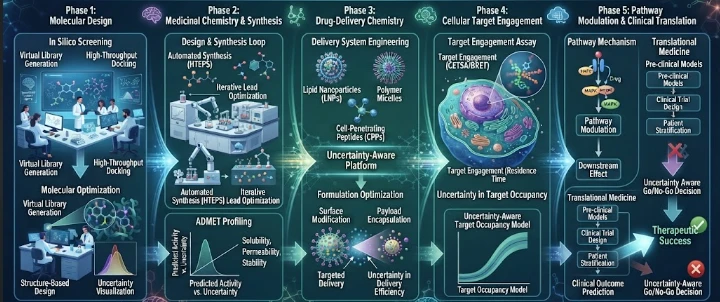
This article describes an uncertainty-aware platform for moving from predicted molecular binding to validated cellular target engagement in medicinal chemistry and drug-delivery research. Docking and machine-learning predictions can rapidly prioritize compounds, but they do not establish that a molecule reaches, occupies, and functionally modulates a target inside relevant cells. The article therefore separates predicted affinity from free intracellular concentration, subcellular localization, t
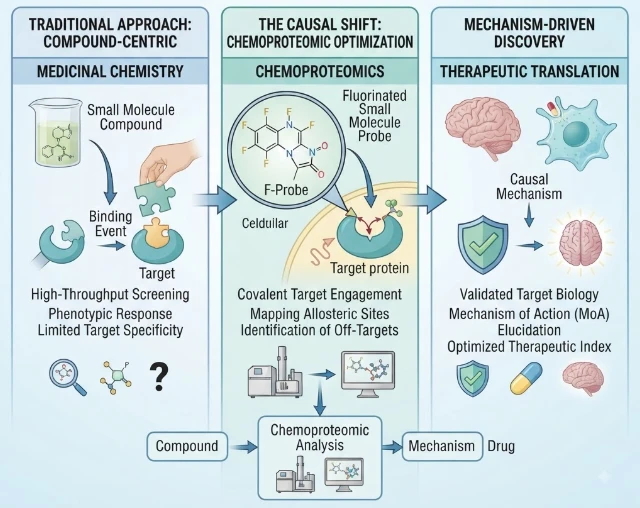
This article explores fluorinated medicinal chemistry through causal chemoproteomics, emphasizing that fluorine substitution can alter far more than potency. A single positional change can modify conformation, pKa, lipophilicity, metabolic stability, target interactions, intracellular exposure, and off-target biology. The article therefore tests whether fluorinated analogues change cellular phenotype through intended target engagement rather than hidden polypharmacology. Matched molecular pairs
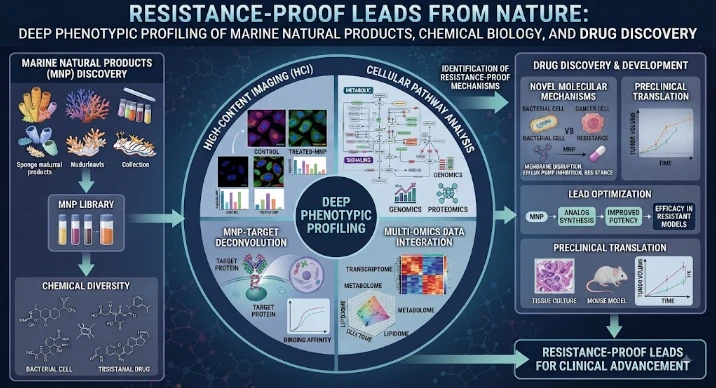
This article presents resistance-aware marine natural-product discovery as a mechanistic process rather than a search for isolated high-potency hits. It explains how activity from marine extracts or fractions can disappear during purification or fail under resistance pressure, making deep phenotypic profiling essential. Morphology, viability kinetics, organelle function, transcriptional state, metabolism, and recovery after washout are combined to connect phenotype with mechanism. The article em