Fairness Is a Safety Outcome: Cross-System Real-World Evaluation of Perinatal Pharmacoepidemiology, Medication Safety, Real-World Evidence and Outcomes
Md. Humayan Kabir (Master of Science in Pharmaceutical Technology)
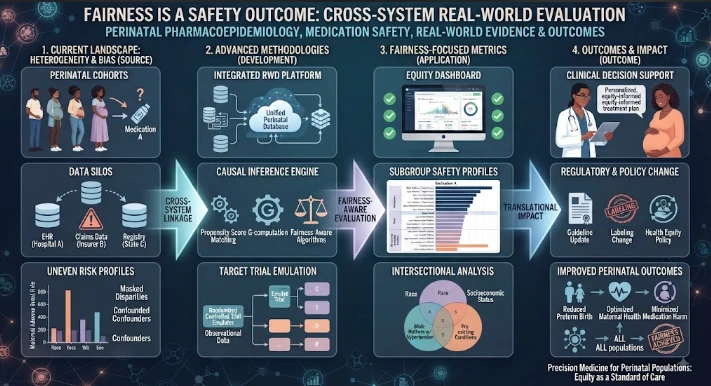
This article frames fairness as part of medication-safety validity in perinatal pharmacoepidemiology rather than as a separate reporting exercise. It argues that real-world pregnancy data are not equally complete across populations because prenatal care continuity, insurance structure, specialist access, pharmacy capture, maternal–infant linkage, and outcome coding vary between systems. As a result, a pooled safety estimate can appear precise while some groups remain sparsely or systematically represented. Cross-database replication, harmonized definitions, subgroup calibration, missing-data diagnostics, outcome validation, and sensitivity analysis are proposed as core methods. The article emphasizes examining credibility across race and ethnicity proxies, socioeconomic strata, insurance settings, regions, and clinical systems while avoiding assumptions that descriptive categories alone explain causal differences. Structural missingness, residual confounding, small subgroup counts, privacy restrictions, and algorithmic underperformance are treated as key risks. Reproducible analytic pipelines, transparent phenotype definitions, prospective validation, and traceability from raw data to conclusions support stronger evidence. The main message is that fairness is a safety property because unequal data quality can distort clinical conclusions.
Fairness in the safety of perinatal medications is going beyond just the issues of potency, delivery, and association; in recent years, the safety of new medicines is increasingly reliant on an understanding of why a result occurs and when that result is reliable. The key to this change lies in a network of mechanisms that underlie the disparities in how data is captured, accessed, prescribed, followed up, maternal risk is determined, and infant outcomes are ascertained across health systems. It's important because a safety estimate can be fairly good when looking at the big picture, but be underrepresentative of groups with less data, irregular time periods, or varying baseline risks. In such a stronger development strategy, mechanism, context and uncertainty are not mutually exclusive conditions that are dealt with at different phases of the development process.
The first step in ensuring medication safety is fairness in the context of the data collected in real world settings, which is not complete for all pregnancies. Factors impacting exposure and outcomes in an analysis include prenatal care continuity, insurance structure, use of specialist services, infant linkage, and coding of outcomes. It may therefore appear to be a precise estimate when in reality it is only a partial or systematic representation from some groups. Cross-system evaluation is more robust when accompanied with reports of strengths in subgroups sample support, missingness, coding validity, calibration and sensitivity to unmeasured factors in addition to conventional effect estimates.
This means a new discovery process enabled by cross-database replication, standardized definitions, subgroup calibration, missing data analysis, outcomes validation and sensitivity analysis. None of these tools can be used for a specific decision in isolation – each only measures a portion of a larger biological or clinical process. As a variety of independent measurements reach the same conclusion about a cause and effect relationship across dose, time, model system and relevant biological context, confidence increases. It is important to note that discordant results do not necessarily mean that they are of no value, as the lack of consistency can sometimes be due to hidden mechanisms, assay artefacts, population differences or exposure constraints, and should be explored before further development of the assay becomes too costly.
When making decisions, the key question is whether safety findings are valid in terms of race and ethnicity proxies, socioeconomic status, insurance status, geographic region, and clinical systems. The answer to that question will necessitate a clear comparison with the intended mechanism and plausible alternatives that could be off-target activity, parallel pathways, differential exposure, or measurement bias. Perturbation experiments are particularly informative because the removal, blocking or restoration of a proposed component may test the observed effect in terms of whether or not it is dependent on that component. Thus, the best way to gain confidence is by successful challenge testing instead of by testing repeatedly within a single favorable assay.
The meaning of nearly all results is also different depending on the context in fairness in perinatal medication safety. Care setting, socioeconomic factors, burdens of comorbidities, availability of medications, timing and continuity of prenatal care are all relevant variations. A good intervention in one set of these factors may yield a less significant effect, have more side effects, or cause a different biological reaction in another configuration of these factors. When it comes to explanation, however, stratification is more helpful if it is based on variables that are related to mechanism or exposure; description is not enough to account for changes in treatment performance.
Risk assessment should be considered equally important as structural missingness, differential coding, small subgroup numbers, residual confounding and privacy constraints which restricts linkage. Early safety work is at its best when it follows the same mechanism as efficacy, enabling unwanted effects to be attributed to target biology, carrier behavior, exposure, metabolites or analytical bias. This way, there is a lower risk that safety will be a late checklist that's unrelated to discovery logic. It also can help with better trade-offs if there's a need for greater efficacy that demands increased exposure, greater pathway modulation, or increased persistence in sensitive tissues.
A further level of complexity is added by transformation, as safer counselling and surveillance is not equivalent in data quality or opportunity for equal treatment. Experiments are more informative for preclinical success when they replicate clinically relevant time frame, concentration dose range, biological barriers, treatment history, and/or sources of heterogeneity. It is not especially helpful to obtain a "complex" model from a "simple" model, but it is helpful to obtain a series of models that will provide answers to specific uncertainty questions. A clear decision to either continue, redesign, restrict the target population, change the dose, or gather a new kind of mechanistic data is required for each step.
Common data models, transparent phenotype definitions, and reproducible analytic pipelines enable cross-system comparison, and manufacturing and analytical control are both essential. If the tested material is not stable from batch to batch or if the inputs to the assays aren't well defined, a biological explanation becomes of limited value. Therefore, critical attributes must be set to a range, measured with a high level of sensitivity and documented to link process conditions to biological activity. For complex molecules, nanoparticles, biomaterials and data-rich studies, where a small shift in exposure, signaling, or apparent treatment response, can produce a greater effect, this discipline is particularly critical.
Separation of prediction and confirmation is also more effective in data analysis for medication safety in the case of fairess in perinatal data. While computational models, machine learning, causal estimators and mechanistic simulations can rank hypotheses, combine high-dimensional measurements, and quantify uncertainties, the output of models is not a form of truth. Useful models make assumptions explicit, quantify calibration, flag weak support regions, and steer the next experiment in the direction which provides information that affects a decision. Prospective validation is still crucial as retrospective fit can be beneficial for a pattern that doesn't take hold in new populations, new batches, or new biotic conditions.
A second change is with regards to time, with many processes integral to fairness in the safety of perinatal medication occurring after the initial exposure. The initial response and adaptive clearance, reprogramming of T cells, remodeling of tissues, adherence to or resistance to the target tissue can diverge even if an early endpoint appears positive. In a longitudinal study the change induced by an intervention can be classified as a stable state, a short-term perturbation, or a liability effect. Time-resolved data also help to provide causal interpretation because the proposed mechanism comes into play before the downstream phenotype and not after the phenotype is realized.
When all the studies are coupled with a specific uncertainty budget, the experimental design becomes more efficient. Not all differences in how data is captured and accessed, prescribed, followed up, maternal risk and infant outcome are ascertained across health systems are new; some are more likely to impact whether safety conclusions are credible across race/ethnicity proxies, socioeconomic strata, insurance settings, regions and clinical systems. Replication across complementary models is then used to determine the robustness of the conclusion, in the sense that it does not rely on one assay, one laboratory condition or one population. Such discipline keeps wasted optimization to a minimum and makes negative findings useful as each failure of a prediction reduces the design space of possible mechanisms and serves to advance the next design iteration.
There is an additional need for traceability between claims and measurements for regulatory and clinical credibility. A development package is stronger if the information recorded in the original experiments is retained and linked to the processing decisions, model assumptions, protocol deviations and material characteristics from early experiments to the translational studies, to ensure fairness in perinatal medication safety. This traceability can aid in the understanding of the biological variability as opposed to technical noise and can facilitate subsequent review of safety or effectiveness claims. It also provides a more solid foundation for revising conclusions with new data when they affect an earlier assumption.
There is a need for more precise communication on this field as well. Terms like targeted, selective, durable, safe, predictive or personalized have very little meaning unless accompanied by a measurement, a comparator, a population and a uncertainty range. Negative results are more valuable when well reported and exploratory results are not presented as mechanisms. Precision for researchers, developers, clinicians and regulators provides a common ground to evaluate whether the claim is based on direct measurement, calibrated inference or on an untested assumption.
Closer loop closure between chemistry/formulation, mechanistic measurement, quantitative modelling, safety, manufacturing control and clinically meaningful context is therefore the strongest direction for fairness in the arena of perinatal medication safety. Inducing failures to assumptions early in the process and letting mechanisms that work survive purposeful challenges is an effective way to accelerate progress. Such logic translates to fairness and becomes a component of medication safety, not an isolated reporting activity. The most useful innovation that can be spread throughout the field is a system that learns from each experiment, but always makes decisions while maintaining a focus on causal interpretation, reproducibility and real world relevance.
CITE THIS ARTICLE
Kabir, M. H. (2025). Fairness Is a Safety Outcome: Cross-System Real-World Evaluation of Perinatal Pharmacoepidemiology, Medication Safety, Real-World Evidence and Outcomes. https://researchbykabir.com/article/18b5fa7f-5ef0-5720-b9ad-2fe5f6da6d8b
M. H. Kabir, “Fairness Is a Safety Outcome: Cross-System Real-World Evaluation of Perinatal Pharmacoepidemiology, Medication Safety, Real-World Evidence and Outcomes,” 2025. [Online]. Available: https://researchbykabir.com/article/18b5fa7f-5ef0-5720-b9ad-2fe5f6da6d8b
Kabir, M. H. (2025) ‘Fairness Is a Safety Outcome: Cross-System Real-World Evaluation of Perinatal Pharmacoepidemiology, Medication Safety, Real-World Evidence and Outcomes’. Available at: https://researchbykabir.com/article/18b5fa7f-5ef0-5720-b9ad-2fe5f6da6d8b
Kabir, Md. Humayan. “Fairness Is a Safety Outcome: Cross-System Real-World Evaluation of Perinatal Pharmacoepidemiology, Medication Safety, Real-World Evidence and Outcomes.” 2025, https://researchbykabir.com/article/18b5fa7f-5ef0-5720-b9ad-2fe5f6da6d8b.
Md. Humayan Kabir. “Fairness Is a Safety Outcome: Cross-System Real-World Evaluation of Perinatal Pharmacoepidemiology, Medication Safety, Real-World Evidence and Outcomes.” (2025). https://researchbykabir.com/article/18b5fa7f-5ef0-5720-b9ad-2fe5f6da6d8b.
Kabir MH. Fairness Is a Safety Outcome: Cross-System Real-World Evaluation of Perinatal Pharmacoepidemiology, Medication Safety, Real-World Evidence and Outcomes. 2025. https://researchbykabir.com/article/18b5fa7f-5ef0-5720-b9ad-2fe5f6da6d8b
@misc{article_18b5fa7f5ef05720b9ad2fe5f6da6d8b,
  title = {Fairness Is a Safety Outcome: Cross-System Real-World Evaluation of Perinatal Pharmacoepidemiology, Medication Safety, Real-World Evidence and Outcomes},
  author = {Md. Humayan Kabir},
  year = {2025},
  url = {https://researchbykabir.com/article/18b5fa7f-5ef0-5720-b9ad-2fe5f6da6d8b},
}
TY  - GEN
AU  - Md. Humayan Kabir
TI  - Fairness Is a Safety Outcome: Cross-System Real-World Evaluation of Perinatal Pharmacoepidemiology, Medication Safety, Real-World Evidence and Outcomes
PY  - 2025-10-12
UR  - https://researchbykabir.com/article/18b5fa7f-5ef0-5720-b9ad-2fe5f6da6d8b
ER  -
This article describes an uncertainty-aware platform for moving from predicted molecular binding to validated cellular target engagement in medicinal chemistry and drug-delivery research. Docking and machine-learning predictions can rapidly prioritize compounds, but they do not establish that a molecule reaches, occupies, and functionally modulates a target inside relevant cells. The article therefore separates predicted affinity from free intracellular concentration, subcellular localization, t
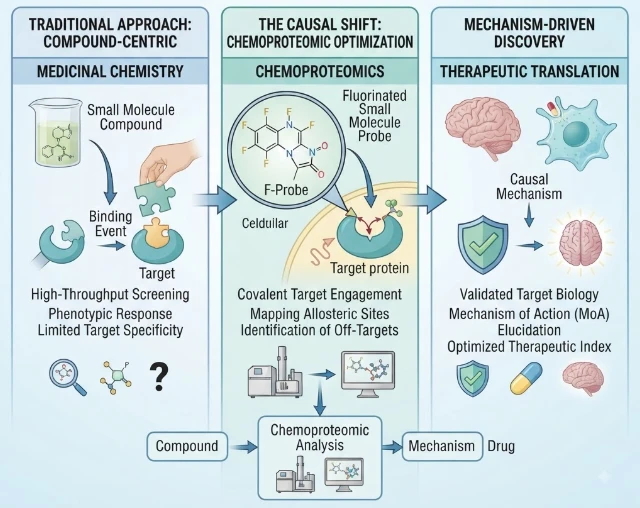
This article explores fluorinated medicinal chemistry through causal chemoproteomics, emphasizing that fluorine substitution can alter far more than potency. A single positional change can modify conformation, pKa, lipophilicity, metabolic stability, target interactions, intracellular exposure, and off-target biology. The article therefore tests whether fluorinated analogues change cellular phenotype through intended target engagement rather than hidden polypharmacology. Matched molecular pairs
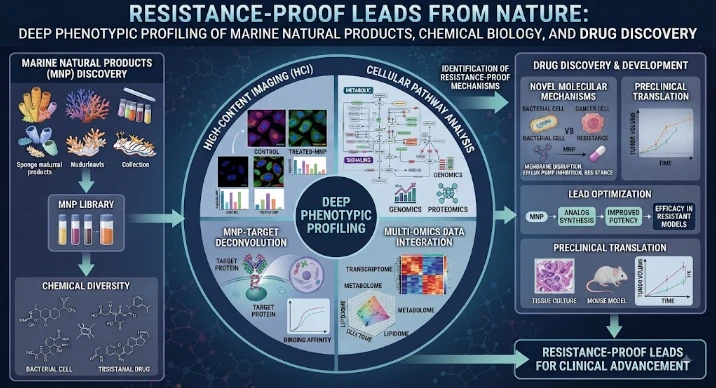
This article presents resistance-aware marine natural-product discovery as a mechanistic process rather than a search for isolated high-potency hits. It explains how activity from marine extracts or fractions can disappear during purification or fail under resistance pressure, making deep phenotypic profiling essential. Morphology, viability kinetics, organelle function, transcriptional state, metabolism, and recovery after washout are combined to connect phenotype with mechanism. The article em