Closed-Loop Medicinal Chemistry: Active Learning with Synthesis and Resistance Constraints for Cancer drug discovery, epigenetic targets and translational medicinal chemistry
Md. Humayan Kabir (Master of Science in Pharmaceutical Technology)
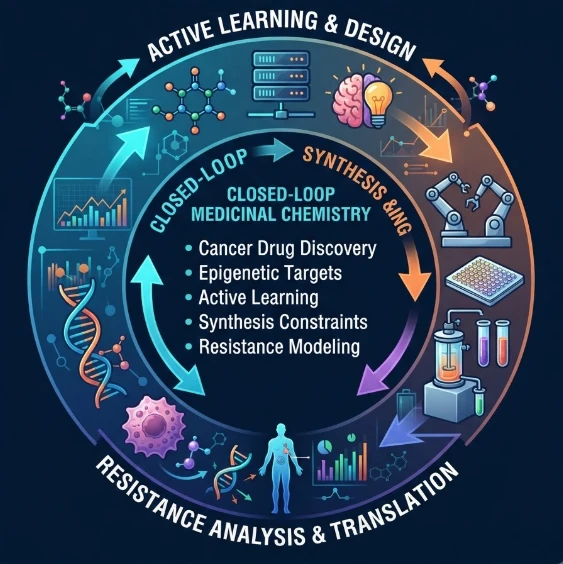
This article applies closed-loop medicinal chemistry to cancer programs targeting adaptive epigenetic biology. Epigenetic targets operate within chromatin networks that can rewire transcription and cell lineage under treatment, so isolated enzyme potency may not predict durable response. The proposed loop integrates active learning, synthesis feasibility, chromatin pharmacodynamics, target engagement, resistance evolution, and translational constraints. Binding motif, selectivity, chromatin context, target occupancy, residence time, cell lineage, combination partner, and synthetic tractability are treated jointly. Failure routes include target mutation, paralog compensation, chromatin rewiring, drug efflux, target re-expression, lineage plasticity, and alternative transcriptional programs. Free intracellular and nuclear concentration, target occupancy, pharmacodynamic persistence, active metabolites, and tumor penetration define relevant exposure. Active learning, multiobjective optimization, transcriptional signature models, resistance-aware ranking, uncertainty estimation, and retrosynthetic constraints support compound selection. Chromatin biomarkers, genetic rescue, resistant clones, washout studies, independent cell lineages, and in vivo pharmacodynamics provide prospective validation. The central argument is that chemical optimization should follow adaptive chromatin biology, with every cycle testing whether the mechanism remains durable under evolving cellular state.
Closed-Loop Medicinal Chemistry: Adaptive chromatin networks and epigenetic targets are a key issue in closed-loop cancer drug discovery – the activity of an epigenetic target can disappear after transcriptional rewiring or lineage-state change even if it is the most potent activity against an isolated enzyme. The good development strategy is focused on a tangible mechanism instead of a single stunning assay result. That shift encompasses the argument of chemistry, biology, exposure, resistance, and safety, as well as production, into one.
The scientific principles are based on a process of closed-loop medicinal chemistry, encompassing elements of active learning, synthesis feasibility, chromatin pharmacodynamics, target engagement and resistance evolution. There is no single measurement that can encompass all the mechanistic claims. With connected evidence, the risk of misinterpreting potency, binding, formulation performance or model fit as therapeutic understanding, is minimized.
The focus of epigenetic oncology encompasses already known clinically relevant target classes like DNA methyltransferases and histone deacetylases, and new research is emerging about chromatin readers, writers, erasers and remodelers. The targets of these enzymes are different from many classic enzymes, in that they can be inhibited and lead to widespread transcriptional over time. Hence, with active-learning cycles it is necessary to have chromatin and expression biomarkers along with potency. In addition to mutations in the binding site, resistance mapping should also account for lineage plasticity, and compensatory transcription.
The performance of design variables can vary simultaneously, such as warhead or binding motif, selectivity, chromatin context, target occupancy, residence time, cell lineage, combination partner, and synthetic tractability, thus necessitating the need to treat them in a joint fashion. When potency is optimized on one axis, it may result in a "penalty" in another axis, particularly when considering another aspect such as stability, selectivity, delivery or manufacturability. In contrast to a single numerical endpoint, multiparameter decision rules offer a more realistic basis to rank candidates.
Confidence in the mechanistic understanding also relies on the ability to measure failure routes at an early stage. Target mutation, paralog compensation, chromatin rewiring, drug efflux, target re-expression, lineage plasticity and alternative transcriptional programs are all important escape mechanisms. If the routes are deliberately stressed, they become design data, and can feed into the next chemistry or formulation, dosing or model cycle.
The "dose-biological effect" link comes in the form of exposure. The quantity that is important include free intracellular concentration, nuclear distribution, target occupancy, pharmacodynamic persistence, active metabolites and tumor penetration. Candidates that produce excellent intrinsic activity scores on simplified assays but don't perform well at the causal sites may appear great on paper but will not be suitable for translation.
The concentrations used for interpretation of the direct engagement or functional perturbation is realistic. The high doses may cause artifacts in assays, off-target effects or secondary stress response that may simulate a desired mechanism. Concentration-response relationship coupled with exposure and occupancy is useful to define the range of the proposed causal pathway where it is likely to be at work.
Epigenetic dependencies in cancer also are influenced by biological context, such as DNA methylation, histone modification, chromatin readers, writers and erasers. Genotype variation, cell state, tissue architecture, immune tone, metabolic environment, and previous treatment may alter the targets and/or effective exposures. Representative model panels, therefore, constitute a more convincing test than repeated tests in one system.
The concept of resistance and adaptation should be measured in the future not in the past. After repeated passage, continued selection, or genetic perturbations or after repeated dosing or environmental stress, which mechanisms survive the continued pressure? A weaker candidate that needs a stronger kick to clear the barrier has more potential for the translatability than a weak screening leader.
Mechanism can be used to inform safety assessment. Important considerations are: hematopoietic effects; normal tissue epigenetic disruption; target-family selectivity; genotoxic stress; cardiac liability; and long duration exposure risk. The difference between desired engagement with unwanted biological responses enables a distinction to be made between mechanism-linked pharmacology and broad cell injury and formulation-driven toxicity.
Analogue synthesis, route robustness, purity, stereochemical control, solid form, stability, and the availability of combinations ready material are important factors affecting the product delivered to the biological systems and thus manufacturing cannot be considered a downstream logistics exercise. The composition, physical state, impurity load, stability or dose reproducibility of a product may change with small changes in the process, even if the product name is not changed. Robustness of development increases if the critical attributes of a process are mechanistically tied to process performance.
Active learning, multi-objective optimization, resistance-aware ranking, transcriptional signature modeling, uncertainty estimation and retrosynthetic constraints are all provided by computational tools to add leverage. Prediction is most helpful when uncertainty and applicability limits are still apparent, particularly in close proximity to novel chemical structures, unusual biological states or when there are limited data sets. Models that give indications of uncertainty help to calculate rankings that are more useful for choosing experiments than models that rank experiments with confidence without indicating where the evidence is weak.
Future validation will need to be done via chromatin biomarkers, target occupancy, genetic rescue, resistant clones, washout studies, independent cell lineages and in vivo pharmacodynamics. Orthogonal tests are important because performing the same type of assays repeatedly on the same sample may introduce the same underlying bias that does not enhance the validity of the causal inference. When there is agreement between independent methods, there is a more robust chain from design choice to biological consequence and when there is disagreement there is some room for reevaluating assumptions.
Data integration needs to maintain traceability of data which must go from raw experiment to development decision. Chemical structures, process conditions, assay metadata, exposure measurements, omics features, resistance observations and safety signals must be available to be identified and versioned. This discipline helps to avoid the danger of interpretation later being removed from the exact conditions which have given a result.
Decision metrics should also be in line with translation and not the laboratory show. Worthwhile scorecards include reproduction, exposure normalized activity, mechanistic certainty, resistance frequency, safety margin, stability, and manufacturing robustness. This way, candidates who are balanced will be rewarded and trade-offs will be made apparent before significant commitments are made in the costly development process.
In this context, bad news is good news. The edge of a hypothesis is defined by failed synthesis, the absence of target engagement, unstable exposure, the absence of rescue, emergence of resistance, or loss of activity in realistic models. This is because such failures lead to better experimental design at later stages and also eliminate the need to invest in “attractive” explanations that are not supported by the data.
Another filter is reproducibility from laboratory to laboratory, from batch to batch. Even when it seems as if there is high statistical significance, a mechanism relying on one operator, one preparation, one cell line or one modeling choice is fragile. When a biological success occurs independently under similarly exposed conditions, it is no longer just a biological success, it's a durable biology success.
In addition to a practical perspective of clinical or deployment conditions, translation also needs a certain sense. The value of a technically complex product can be determined by route, administration burden, diagnostic requirements, storage, monitoring, cost and timing of treatment. When product design is right for the context in which some benefit to biology is needed, then mechanistic excellence makes an impact.
Another difficulty arises in temporal design since the effects of short pulses are different from those of extended exposure, washout, and repeated doses of biological systems. Time-resolved measurements can distinguish between primary activity and adaptation that occurs downstream, and can detect whether the primary activity continues after the initiating signal has gone away. Closed-loop cancer drug discovery targeting epigenetic targets should be based on a sampling schedule designed in accordance with the expected closed-loop kinetics, with the one convenient endpoint being the least important factor.
An integrated development record allows for more effective communication between the medicinal chemistry, formulation science, pharmacology, computation, manufacturing, and clinical planning. With the record, a single definitive story is not presented, but instead, the record identifies already established links, possible hypotheses, unsolved questions, and the next experiment of greatest information value. That transparency helps to speed up iteration and lessens the risk of having to justify initial decisions when contradictory information becomes available.
Novelty is checked by reference conditions that are credible. Whether a new approach will be more predictive, provide more mechanism of action, be more durable, or be more manufacturable is defined by established compounds (known inactive controls), standard formulations, baseline models, or accepted analytical methods. A head-to-head comparison also points to gains that are hidden once you take into account the differing levels of exposure, sensitivity of the assays, batch quality, or complexity of the experiments.
Closed-loop epigenetic discovery is optimally done based on the optimization of a chemical that is guided by the adaptive nature of chromatin biology and not by the isolated enzyme potency. The criteria are not based on the ability to pass one assay – but on the ability to make sense of the proposed mechanism of action from exposure through biological variation to resistance, safety and production. Under that standard, a more disciplined signal to a therapeutic concept that can make it through the real world complexity.
CITE THIS ARTICLE
Kabir, M. H. (2025). Closed-Loop Medicinal Chemistry: Active Learning with Synthesis and Resistance Constraints for Cancer drug discovery, epigenetic targets and translational medicinal chemistry. https://researchbykabir.com/article/f959cc44-f781-52a9-95b3-576f016faac2
M. H. Kabir, “Closed-Loop Medicinal Chemistry: Active Learning with Synthesis and Resistance Constraints for Cancer drug discovery, epigenetic targets and translational medicinal chemistry,” 2025. [Online]. Available: https://researchbykabir.com/article/f959cc44-f781-52a9-95b3-576f016faac2
Kabir, M. H. (2025) ‘Closed-Loop Medicinal Chemistry: Active Learning with Synthesis and Resistance Constraints for Cancer drug discovery, epigenetic targets and translational medicinal chemistry’. Available at: https://researchbykabir.com/article/f959cc44-f781-52a9-95b3-576f016faac2
Kabir, Md. Humayan. “Closed-Loop Medicinal Chemistry: Active Learning with Synthesis and Resistance Constraints for Cancer drug discovery, epigenetic targets and translational medicinal chemistry.” 2025, https://researchbykabir.com/article/f959cc44-f781-52a9-95b3-576f016faac2.
Md. Humayan Kabir. “Closed-Loop Medicinal Chemistry: Active Learning with Synthesis and Resistance Constraints for Cancer drug discovery, epigenetic targets and translational medicinal chemistry.” (2025). https://researchbykabir.com/article/f959cc44-f781-52a9-95b3-576f016faac2.
Kabir MH. Closed-Loop Medicinal Chemistry: Active Learning with Synthesis and Resistance Constraints for Cancer drug discovery, epigenetic targets and translational medicinal chemistry. 2025. https://researchbykabir.com/article/f959cc44-f781-52a9-95b3-576f016faac2
@misc{article_f959cc44f78152a995b3576f016faac2,
  title = {Closed-Loop Medicinal Chemistry: Active Learning with Synthesis and Resistance Constraints for Cancer drug discovery, epigenetic targets and translational medicinal chemistry},
  author = {Md. Humayan Kabir},
  year = {2025},
  url = {https://researchbykabir.com/article/f959cc44-f781-52a9-95b3-576f016faac2},
}
TY  - GEN
AU  - Md. Humayan Kabir
TI  - Closed-Loop Medicinal Chemistry: Active Learning with Synthesis and Resistance Constraints for Cancer drug discovery, epigenetic targets and translational medicinal chemistry
PY  - 2025-02-09
UR  - https://researchbykabir.com/article/f959cc44-f781-52a9-95b3-576f016faac2
ER  -
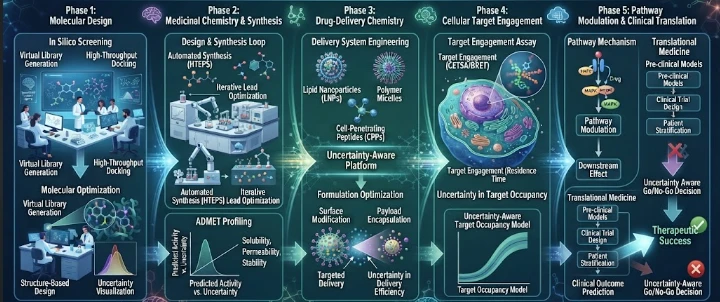
This article describes an uncertainty-aware platform for moving from predicted molecular binding to validated cellular target engagement in medicinal chemistry and drug-delivery research. Docking and machine-learning predictions can rapidly prioritize compounds, but they do not establish that a molecule reaches, occupies, and functionally modulates a target inside relevant cells. The article therefore separates predicted affinity from free intracellular concentration, subcellular localization, t
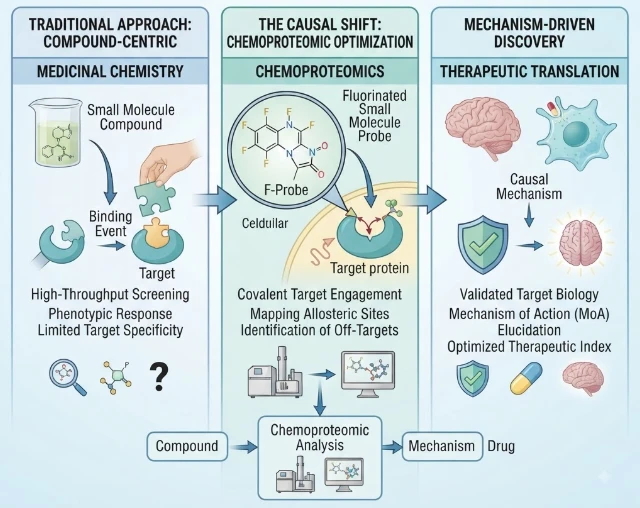
This article explores fluorinated medicinal chemistry through causal chemoproteomics, emphasizing that fluorine substitution can alter far more than potency. A single positional change can modify conformation, pKa, lipophilicity, metabolic stability, target interactions, intracellular exposure, and off-target biology. The article therefore tests whether fluorinated analogues change cellular phenotype through intended target engagement rather than hidden polypharmacology. Matched molecular pairs
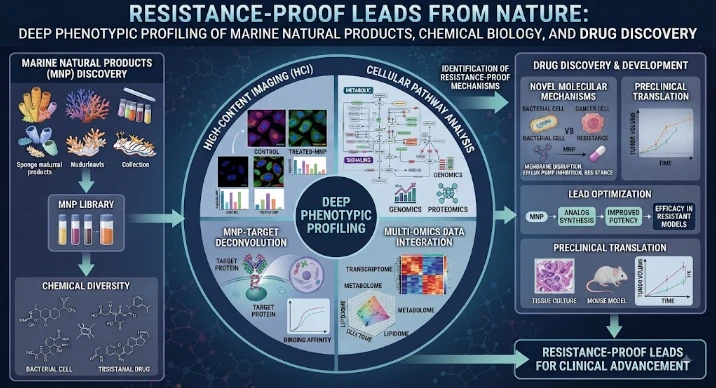
This article presents resistance-aware marine natural-product discovery as a mechanistic process rather than a search for isolated high-potency hits. It explains how activity from marine extracts or fractions can disappear during purification or fail under resistance pressure, making deep phenotypic profiling essential. Morphology, viability kinetics, organelle function, transcriptional state, metabolism, and recovery after washout are combined to connect phenotype with mechanism. The article em