Closed-Loop Medicinal Chemistry: Active Learning with Synthesis and Resistance Constraints for Medicinal Chemistry, Molecular Design and Drug-Delivery Chemistry
Md. Humayan Kabir (Master of Science in Pharmaceutical Technology)
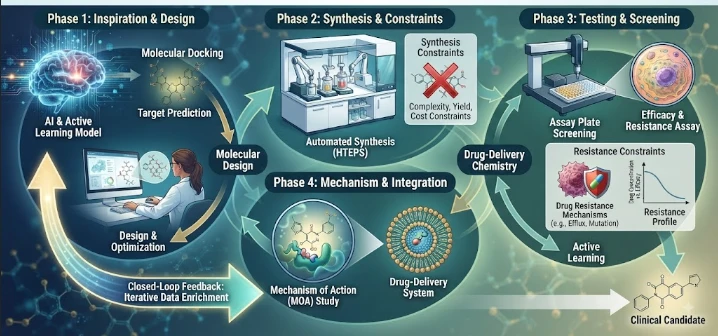
This article presents closed-loop medicinal chemistry as an integrated learning system connecting molecular design, synthesis, formulation, biological testing, resistance, and delivery. It argues that compounds should not be optimized for potency alone because a strong in vitro lead may still fail through poor synthesis feasibility, low solubility, inadequate tissue penetration, unstable formulation, safety liabilities, or rapid resistance. Graph learning, active learning, Bayesian optimization, retrosynthesis, property prediction, and multi-objective acquisition are proposed to prioritize compounds that can provide both performance and information gain. Mechanistic measurements include biochemical potency, target engagement, permeability, solubility, microsomal stability, formulation behavior, imaging, and resistant-model testing. The article also incorporates ADME, intracellular exposure, efflux, metabolism, formulation release, and pharmacokinetics into the optimization loop. Reaction yield, route length, purification, reagent availability, solid form, scale-up, and storage are treated as scientific constraints. Traceable datasets and prospective design–make–test cycles allow each iteration to improve the model. The main goal is a reproducible discovery process that learns efficiently while balancing mechanism, exposure, safety, resistance, and manufacturability.
The efficiency of medicinal chemistry is enhanced when molecular design, synthesis, delivery and biological feedback are part of a closed loop operation. Closed loop medicinal chemistry for molecular design and drug delivery chemistry has progressed from just the hit finding stage due to the possibility of compounds gaining potency but failing to be synthesised, to be formulation stable, to penetrate well into the tissue or to develop rapid resistance. The more important question is if a compound that is selected through active learning over the activity, synthesis, delivery, safety and resistance targets is stable under realistic biological and developmental conditions. It alters a ranking process to a mechanistic program geared to exposure, causality and reproducibility. As the scheduled publication time approaches, the importance of correlating molecular design with experiments that explain the mechanism of the candidate's success, failure and the need to prioritize constraints in the design grows.
To better optimize the use of synthetic resources and to accelerate the process of discovery, multiple activities of predictive chemistry, automated synthesis, high throughput assays, formulation screening and repetitive data collection are increasingly being packaged together in modern discovery. The past and contemporary history of lab development has demonstrated that an attractive lab signal generally doesn't remain so as you add more biological complexity. An effective methodology for research, then, is to keep the signal of the activity in the same form and see what features are still necessary under increasingly realistic testing conditions.
Mechanistic depth begins with building a connection between chemical structures and target engagement, physicochemical properties, formulation behaviour, cellular exposure and phenotype. This can be masked by simple endpoint assays, which result from similar pathways to the same endpoint. These assays give a richer picture by differentiating direct action from adaptation to the target, nonspecific stress, or delivery failure, such as biochemical potency, target engagement, permeability, solubility, microsomal stability, formulation screens, imaging, and resistant models. These types of measurements enable a beautiful answer to become a provable causal pathway from chemistry to biological state to functional outcome.
Design variables should also be considered as interacting and not as separate variables. Performance is affected by all these factors in concert and an improvement in one dimension can result in a penalty in another. A sensible optimization technique aims at the trade-off so it does not seek the optimum. For drugs where potency, selectivity, stability, tissue exposure and manufacturability all influence translational value, multi-parameter profiles are particularly useful.
When uncertainty is noticeable, prediction remains useful, and can be enhanced by graph learning, active learning, Bayesian optimization, retrosynthesis, property prediction and multi-objective acquisition. Predictive models based on similar chemical or biological regions can fail to perform well if a new scaffold or strange material is used, or when the patient state is not well represented. Calibration, prospective testing, Domains of Applicability (DoA) checking and disagreement across the model families help to identify fragile predictions early, before extensive tests take place.
Orthogonal validation of experimental design is beneficial. Prospective design-make-test cycles, external test sets, matched pairs, orthogonal biology, formulation challenge and resistant-cell testing address various aspects of the causal question, and minimize reliance on any one assay technology. Consensus is more compelling than repeated measurements of the same endpoint, as is seeing the same endpoint through varying lenses of chemistry, imaging, omics, genetics and functional biology. Disagreement is also informative because discordant findings can provide clues on hidden exposure limits, assay artifacts, compensatory pathways, and/or context-dependent pharmacology.
A further complication is the biological diversity. Target abundance, barrier properties, metabolism, immune tone or path dependence can be modified without changing the nominal treatment by chemical series, assay platform, formulation class, cell state, metabolic phenotype, disease model, or synthesis route. The average response will, therefore, tend to obscure groups of subjects with varying exposure-response relationships. Biological variation is part of the design and not an after thought explanation of variation.
Optimization towards a single sensitive model should not be left to chance, as this course of action may help to maintain common escape routes or accentuate transporter and metabolic vulnerabilities. Activity is seen as it is affected by evolutionary or compensatory pressure, as determined by the serial selection, target mutants, efflux panels, pathway profiling, combination studies and exposure-adjusted resistance testing. A weak candidate that obstructs common escape routes may be more valuable in the long run than a weak, high potency lead. Resistance-aware development also helps to further refine mechanism as the recurring escape changes frequently highlight the proteins, pathways, or exposure processes with the most causal influence.
The connection between delivery and pharmacokinetics brings the molecular promise to the reachable biology. The bioavailability of the active form at the target site and for the appropriate duration of time within the mechanism depends on the permeability, solubility, protein binding, metabolism, transporter effects, formulation release, tissue penetration and intracellular concentration. This relationship is not captured by nominal dose alone as effective dose is modified by absorption, distribution, binding, transformation, clearance and local barriers. Mechanistic exposure assays should thus be placed in the line of efficacy measurements that are gathered during the very early development stages.
Safety assessment is enhanced by the inclusion of mechanism. Distinguishing target-linked pharmacology from broad cell injury, immune activation, reactive chemistry or formulation chemistry driven toxicity can be accomplished through off target pharmacology, reactive metabolite studies, mitochondrial assays, ion-channel screens, genotoxicity, and exposure margin. Comparative testing is used in disease relevant and healthy systems to determine if therapeutic activity is distinct from undesirable effects.
Another scientific variable, not a downstream logistics issue, is manufacturing. Even if the product's nominal composition does not change, product quality, biological activity, and exposure can change because of the following: reaction yield, route length, purification, availability of reagents, solid form, process of formulation, scale-up, and product storage. Quality by design thinking is a new approach to the design and packaging of a product or process that involves the identification and control of key material properties and process factors, but not just testing the product at the end. Scalability can be more convincing after raw-material variations, with larger equipment, storage and transport and after independent production runs in the laboratory are successful.
There also need to be realistic models of clinical use for translation. The timing, dose frequency, route, diagnostic requirements, acceptable complexity and treatment duration are dependent on the route, dose frequency, treatment duration, disease site, combination use, adherence, and manufacturing economics. A technically good platform is of little value if the demands of administration, storage requirements, monitoring requirements, or cost objectionable in the setting where treatment is required. Making development decisions, therefore, is best done with the best of both mechanical and deployment characteristics in hand, rather than by late stage where it may be hard to recoup the investment.
Data integration is the link between these layers. As well as having chemical structures, reaction data, properties, target engagement, ADME, formulation performance, resistance and safety stored as separate assays, they can be mapped to a common causal model. Iterative learning is reproducible with traceable metadata, versioned models, standardized controls and prospective decision rules. This will give a development record which will not only identify the first candidate but will also provide the reasons for that candidate and what further questions remained unanswered.
It is better to be successful in closed loops with the additional criterion that you gain information with each cycle, that you synthesize success, that your prospective prediction is successful, that you improve your exposure, that you maintain resistance in your experiments, and that you minimize low-value experiments. Mixed metrics, such as the addition of durability, reproducibility, exposure margin, biological breadth, and manufacturing robustness to traditional potency, help make decisions regarding success. This type of measurements incentivizes optimization for a specific assay, and rewards candidates who are still viable in independent assays. A clear scorecard also provides a rationale for how a less spectacular outcome can be the preferable development option.
An effective programme also gives a positive definition of failure. If the results are negative using high concentration insoluble compounds, if a route is not found, if the compound does not work in the formulation, if the exposure is not stable, if the result is not calibrated, or if the compound is in a resistance sensitive series, they will mark boundaries of the mechanism and limit repeated investment in weak hypotheses. If models record a failure to synthesize, if there is no target engagement, or if the exposure is unstable or resistance emerges, or if there is a loss of effect for the subgroups, then the future models will have a better idea of what the search space looks like. It is easier to discover when the negative experiments give the investigator as much information as the positive ones.
Closed loop medicinal chemistry is a learning system that continuously changes both the chemistry design and delivery approach based on the results of each experiment. The key benefit of the central advantage is that it moves away from the performance advantage to one rooted in mechanism, exposure, biological diversity, safety, and production. This structure assists in the selection of candidates as each important development claim is matched with a test. Instead of spectacular single experiments, it is a series of results that is coherent and convincing, and is persuasive as the complexity of the system is incremented, from the lab to clinical practice.
CITE THIS ARTICLE
Kabir, M. H. (2026). Closed-Loop Medicinal Chemistry: Active Learning with Synthesis and Resistance Constraints for Medicinal Chemistry, Molecular Design and Drug-Delivery Chemistry. https://researchbykabir.com/article/eea753c3-a6b3-5203-9ded-2accf9b3f7ed
M. H. Kabir, “Closed-Loop Medicinal Chemistry: Active Learning with Synthesis and Resistance Constraints for Medicinal Chemistry, Molecular Design and Drug-Delivery Chemistry,” 2026. [Online]. Available: https://researchbykabir.com/article/eea753c3-a6b3-5203-9ded-2accf9b3f7ed
Kabir, M. H. (2026) ‘Closed-Loop Medicinal Chemistry: Active Learning with Synthesis and Resistance Constraints for Medicinal Chemistry, Molecular Design and Drug-Delivery Chemistry’. Available at: https://researchbykabir.com/article/eea753c3-a6b3-5203-9ded-2accf9b3f7ed
Kabir, Md. Humayan. “Closed-Loop Medicinal Chemistry: Active Learning with Synthesis and Resistance Constraints for Medicinal Chemistry, Molecular Design and Drug-Delivery Chemistry.” 2026, https://researchbykabir.com/article/eea753c3-a6b3-5203-9ded-2accf9b3f7ed.
Md. Humayan Kabir. “Closed-Loop Medicinal Chemistry: Active Learning with Synthesis and Resistance Constraints for Medicinal Chemistry, Molecular Design and Drug-Delivery Chemistry.” (2026). https://researchbykabir.com/article/eea753c3-a6b3-5203-9ded-2accf9b3f7ed.
Kabir MH. Closed-Loop Medicinal Chemistry: Active Learning with Synthesis and Resistance Constraints for Medicinal Chemistry, Molecular Design and Drug-Delivery Chemistry. 2026. https://researchbykabir.com/article/eea753c3-a6b3-5203-9ded-2accf9b3f7ed
@misc{article_eea753c3a6b352039ded2accf9b3f7ed,
  title = {Closed-Loop Medicinal Chemistry: Active Learning with Synthesis and Resistance Constraints for Medicinal Chemistry, Molecular Design and Drug-Delivery Chemistry},
  author = {Md. Humayan Kabir},
  year = {2026},
  url = {https://researchbykabir.com/article/eea753c3-a6b3-5203-9ded-2accf9b3f7ed},
}
TY  - GEN
AU  - Md. Humayan Kabir
TI  - Closed-Loop Medicinal Chemistry: Active Learning with Synthesis and Resistance Constraints for Medicinal Chemistry, Molecular Design and Drug-Delivery Chemistry
PY  - 2026-01-11
UR  - https://researchbykabir.com/article/eea753c3-a6b3-5203-9ded-2accf9b3f7ed
ER  -
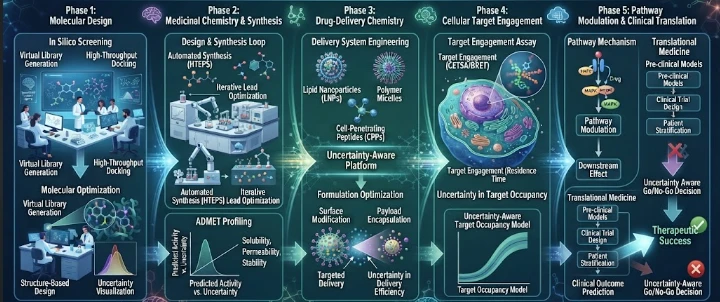
This article describes an uncertainty-aware platform for moving from predicted molecular binding to validated cellular target engagement in medicinal chemistry and drug-delivery research. Docking and machine-learning predictions can rapidly prioritize compounds, but they do not establish that a molecule reaches, occupies, and functionally modulates a target inside relevant cells. The article therefore separates predicted affinity from free intracellular concentration, subcellular localization, t
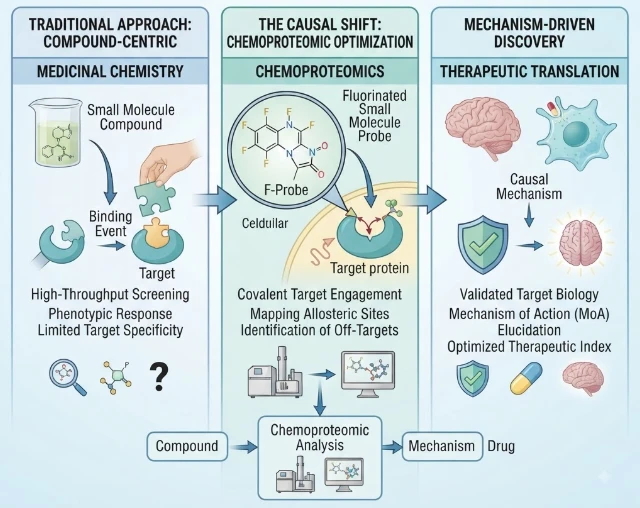
This article explores fluorinated medicinal chemistry through causal chemoproteomics, emphasizing that fluorine substitution can alter far more than potency. A single positional change can modify conformation, pKa, lipophilicity, metabolic stability, target interactions, intracellular exposure, and off-target biology. The article therefore tests whether fluorinated analogues change cellular phenotype through intended target engagement rather than hidden polypharmacology. Matched molecular pairs
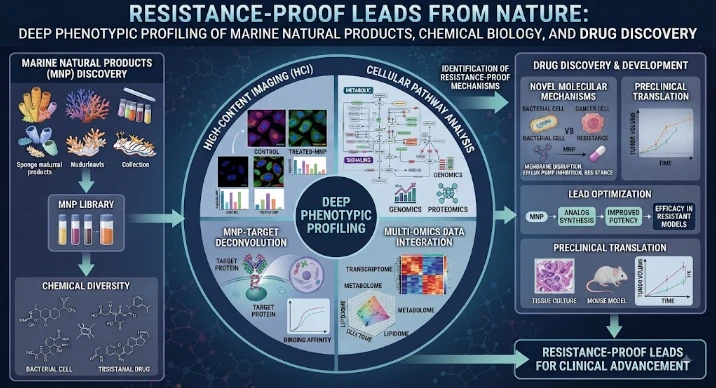
This article presents resistance-aware marine natural-product discovery as a mechanistic process rather than a search for isolated high-potency hits. It explains how activity from marine extracts or fractions can disappear during purification or fail under resistance pressure, making deep phenotypic profiling essential. Morphology, viability kinetics, organelle function, transcriptional state, metabolism, and recovery after washout are combined to connect phenotype with mechanism. The article em