Closed-Loop Medicinal Chemistry: Active Learning with Synthesis and Resistance Constraints for Natural-Product-Inspired Medicinal Chemistry and Small-Molecule Drug Discovery
Md. Humayan Kabir (Master of Science in Pharmaceutical Technology)
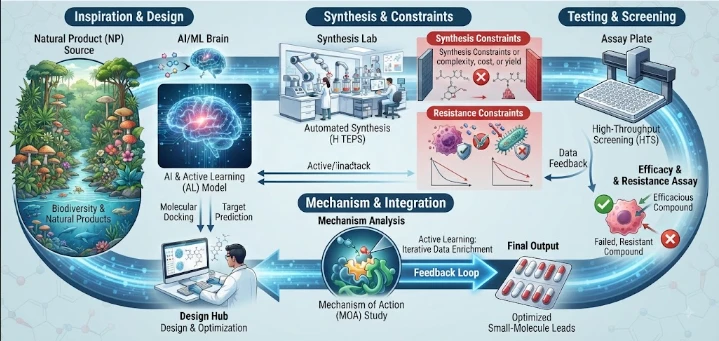
This article describes closed-loop medicinal chemistry for natural-product-inspired small-molecule discovery as an iterative learning system that links design, synthesis, testing, resistance, and exposure. Natural scaffolds often occupy complex three-dimensional chemical space and may be difficult to synthesize, simplify, or optimize using conventional analogue-by-analogue approaches. The article proposes active learning, graph models, Bayesian optimization, retrosynthesis prediction, and uncertainty-aware property models to prioritize compounds that are both promising and informative. Mechanistic measurements such as target engagement, high-content imaging, ADME profiling, resistant-cell testing, and metabolite analysis are used to distinguish genuine improvements from potency gains caused by fragile or nonspecific effects. Synthesis feasibility, route robustness, stereochemical control, purification, and scale-up are treated as explicit optimization constraints. The framework also incorporates resistance evolution, pharmacokinetics, safety, manufacturing, and clinical-use practicality. Data integration and traceable model versions make each design–make–test cycle reproducible. The central message is that closed-loop discovery should maximize information gain and translational quality, not simply the numerical potency of the next analogue.
Chemistry inspired by nature merges biology with a freedom of design offered by synthetic small molecules used in medicine. Beyond hit discovery, closed-loop medicinal chemistry has come of age in the small molecule discovery of natural product-based structures, where structures can be complex, there is scarce analogue information, and it may be difficult to synthesize and resistance may develop quickly. The more intriguing question is whether an analogue series that is learned actively, but can still be synthesized easily and is still plausible mechanistically is going to survive under the real biological and developmental conditions. That transition moves discovery from a ranking to a computational program that is designed around the notions of exposure, causation, and reproducibility. Linking molecular design to experiments that expound the mechanisms of action of a candidate, the reasons for its failure to act, and the limitations that should be prioritized for further improvement are vital for the progress of natural-product-inspired medicinal chemistry by the time a compound is published.
Natural scaffolds frequently fill huge and stereochemically complex chemical space and translation requires the use of simplified analogues, tractable synthesis, and unambiguous structure-activity relationships. Observations over the history of the earth and in recent times demonstrate that an attractive laboratory signal quickly doesn't stand the test of increasing biological sophistication. A valuable research strategy is thus to keep the original activity signal and gradually introduce more realistic test conditions to identify the features that are vital in these more realistic settings.
Mechanistic depth starts with connecting scaffold features with target engagement, cellular phenotype, resistance route, and exposure. This structure can be hidden in a simple endpoint assay due to similar endpoints from different causal pathways. A more complete picture can be obtained using potency panels, target-engagement assays, high-content imaging, ADME measurements, resistant models, and metabolite profiling, which remove the effects of downstream adaptations or non-specific stress and/or delivery failure. These measures allow for an attractive response to be converted to a testable chain between chemistry, biological state and functional outcome.
Design variables also have to be considered as interacting instead of as independent variables. These factors all affect performance in concert, and a positive gain in one aspect can result in a negative gain in another.These factors all affect performance as a group, and a gain in one aspect can lead to a loss in others. Therefore a practical optimization strategy will consider a trade-off between the different values rather than seeking the highest value. Multi-parameter profiles are particularly useful when the following all influence the translational value of a compound: potency, selectivity, stability, tissue exposure, manufacturability.
Active learning, graph models, Bayesian optimization, retrosynthesis prediction, uncertainty-aware property models: These bring computational benefits but prediction is only helpful when uncertainty is “exposed.” Using models trained on known chemicals or biological structures, may result in poor performance on new scaffolds, unusual materials and underrepresented patient states. Expensive experiments don't build up until calibration, prospective testing, domain-of-applicability checks, and disagreement across model families are able to surface fragile predictions.
Orthogonal validation is a valuable technique in experimental design. The various proposed synthesis cycles, matched molecular pairs, orthogonal binding assays, resistant-cell testing, and blinded property prediction each provide an aspect of the answer to the causal question, as well as decreasing reliance on a single assay technology. A single experiment measuring the same endpoint multiple times is not as compelling as agreement across the various disciplines involving chemistry, imaging, omics, genetics and functional biology. Even disagreement is educational: when the results disagree, it can mean there are unknown limits of exposure or an assay artifact in one study, a compensatory pathway in the other, or context-dependent pharmacology.
Another challenge is added by biological diversity. Target abundance, barrier properties, metabolism, immune tone, pathway dependence, or resistance background can be altered without changing the nominal treatment in scaffold class, target family, cell state, metabolic phenotype, assay platform, or resistance background. This makes it difficult to detect subgroups that may have different exposure-response relationships by averaging the responses. Biological variation is part of design not an afterthought to explain inconsistent results with stratified analysis, representative model panels and explicit covariate testing.
Earlier focus should be placed on resistance and adaptation since minor structural changes can result in increased potency without a change in the weak interaction or in introduction of exposure liability. Serial selection, mutant panels, target-site sequencing, efflux studies, pathway profiling and combination experiments determine if there is evolutionary or compensatory resistance to activity. A weaker, but more potent inhibitor of common escape routes may be a better candidate than a weak, high potency lead. In addition, resistance-aware development also focuses mechanism because proteins, pathways, or exposure processes that change most often during resistance are likely to have the most causal significance.
Molecular promise to reachable biology through delivery and pharmacokinetics. The ability to be soluble, permeable, protein bound, stable to microsomal enzymes, interact with transporters, distribute to tissues, and generate metabolites determines if there's a concentration and duration of the active form at the intended site, and if it's appropriate to the proposed mechanism. This is not possible with a single dose number, as absorption, distribution, binding, transformation, clearance and barriers in the tissues affect effective exposure. Mechanistic exposure measures should then be included with efficacy measures from the earliest development stages.
Mechanism enhances the information provided by safety assessment. Reactive-metabolite testing, selectivity panels, mitochondrial assays, genotoxicity screens and exposure-margin assessments assist in differentiating target-linked pharmacology from a broad spectrum of cellular damage, immune activation, reactive chemistry, and formulation-induced toxicity. Testing in disease relevant and healthy systems provides a comparator to determine if therapeutic activity is separable from unwanted effects. This will keep a potential signal of efficacy from progressing through a program, while the very same mechanism will suppress the window of exposure, without being noticed.
Another scientific variable, not a downstream logistics issue is manufacturing. Product quality, biological activity and exposure might change if the nominal product composition remains the same but the route length, robustness of the reaction, chiral control, reagent availability, burden involved in the purification and scale-dependent formation of impurities is different. Quality-by-design thinking is based on the concept that a set of important material properties and process parameters are correlated with measurable performance, rather than solely end-stage specification testing. Laboratory success is achieved and even more believable when it passes raw-material variations, larger equipment, storage and transport, and independent production runs.
Realistic models of clinical use are also required for the translation. Treatment timing and dose frequency, route, diagnostic requirements, and acceptable complexity are influenced by indication, resistance prevalence, treatment duration, oral exposure requirements, and compatibility of combinations with treatment.Treatment timing and dose frequency, route, diagnostic requirements and acceptable complexity are influenced by indication, resistance prevalence, treatment duration, oral exposure requirements, and compatibility of combinations with treatment. A sophisticated platform that is elegant but impractical for administration, storage, monitoring or cost conflicts with where treatment is needed is not of any value. Thus, a decision in the development process that has the advantage of mechanical efficiency and deployment viability is advantageous before it is too late to go back on a commitment.
The layers are connected by data integration. Structures, reactions results, physicochemical properties, biological activity, target engagement, resistance labels, and ADME can be grouped around a single causal model, instead of as individual outputs from assays. It is possible to learn iteratively and repeat the process with the help of traceable metadata, versioned models, standardized controls and prospective decision rules. The outcome is a development record that not only indicates who got the top ranking but also the assumptions made and the uncertainties not overcome.
A helpful closed loop keeps tabs on information gained by the synthesis, prospective hit rate, resistance retention, route success, exposure improvement, chemical diversity, and reduction in failed experiments. Success metrics are enhanced by incorporating durability, reproducibility, exposure margin, biological breadth and manufacturing robustness as well as conventional potency into decision quality when considering success. These benchmarks prevent optimization for a single assay, and benefit candidates who are still viable with different tests. A clear scorecard also helps to explain why a more subdued outcome may manifest as the better developmental option.
A good program also provides a constructive notion of failure. Negative results of unmakeable virtual compounds, unstable analogue, non-generalizing model, resistance-sensitive leads, and potency gain without exposure gain provide limits of the mechanism and help to avoid re-investment in bad ideas. Failure to successfully synthesize, the lack of target engagement, exposure instability, emergence of resistance, or lost effect in a particular subgroup provides a more realistic picture of the search space to future models. When experiments fail to add to knowledge as well as those that succeed, discovery is quickened.
Closed-loop design enables natural-product inspired chemistry to have a methodical path to small molecule optimization that is both experimentally efficient and complexly inspired. The key benefit of the central advantage is that it is based on a connected explanation, moving from the mechanism to the exposure to the biological diversity to the safety to the production. That organization helps with taking away the guesswork when selecting candidates for development, since each and every important development claim has an appropriate test. Instead of dazzling single experiments, progress will be judged by the consistency of a string of results that will be convincing as the complexity of the conditions change from laboratory to clinical.
CITE THIS ARTICLE
Kabir, M. H. (2026). Closed-Loop Medicinal Chemistry: Active Learning with Synthesis and Resistance Constraints for Natural-Product-Inspired Medicinal Chemistry and Small-Molecule Drug Discovery. https://researchbykabir.com/article/ad5d3dbc-9d18-5d65-9be9-4a319d4a4f0f
M. H. Kabir, “Closed-Loop Medicinal Chemistry: Active Learning with Synthesis and Resistance Constraints for Natural-Product-Inspired Medicinal Chemistry and Small-Molecule Drug Discovery,” 2026. [Online]. Available: https://researchbykabir.com/article/ad5d3dbc-9d18-5d65-9be9-4a319d4a4f0f
Kabir, M. H. (2026) ‘Closed-Loop Medicinal Chemistry: Active Learning with Synthesis and Resistance Constraints for Natural-Product-Inspired Medicinal Chemistry and Small-Molecule Drug Discovery’. Available at: https://researchbykabir.com/article/ad5d3dbc-9d18-5d65-9be9-4a319d4a4f0f
Kabir, Md. Humayan. “Closed-Loop Medicinal Chemistry: Active Learning with Synthesis and Resistance Constraints for Natural-Product-Inspired Medicinal Chemistry and Small-Molecule Drug Discovery.” 2026, https://researchbykabir.com/article/ad5d3dbc-9d18-5d65-9be9-4a319d4a4f0f.
Md. Humayan Kabir. “Closed-Loop Medicinal Chemistry: Active Learning with Synthesis and Resistance Constraints for Natural-Product-Inspired Medicinal Chemistry and Small-Molecule Drug Discovery.” (2026). https://researchbykabir.com/article/ad5d3dbc-9d18-5d65-9be9-4a319d4a4f0f.
Kabir MH. Closed-Loop Medicinal Chemistry: Active Learning with Synthesis and Resistance Constraints for Natural-Product-Inspired Medicinal Chemistry and Small-Molecule Drug Discovery. 2026. https://researchbykabir.com/article/ad5d3dbc-9d18-5d65-9be9-4a319d4a4f0f
@misc{article_ad5d3dbc9d185d659be94a319d4a4f0f,
  title = {Closed-Loop Medicinal Chemistry: Active Learning with Synthesis and Resistance Constraints for Natural-Product-Inspired Medicinal Chemistry and Small-Molecule Drug Discovery},
  author = {Md. Humayan Kabir},
  year = {2026},
  url = {https://researchbykabir.com/article/ad5d3dbc-9d18-5d65-9be9-4a319d4a4f0f},
}
TY  - GEN
AU  - Md. Humayan Kabir
TI  - Closed-Loop Medicinal Chemistry: Active Learning with Synthesis and Resistance Constraints for Natural-Product-Inspired Medicinal Chemistry and Small-Molecule Drug Discovery
PY  - 2026-03-08
UR  - https://researchbykabir.com/article/ad5d3dbc-9d18-5d65-9be9-4a319d4a4f0f
ER  -
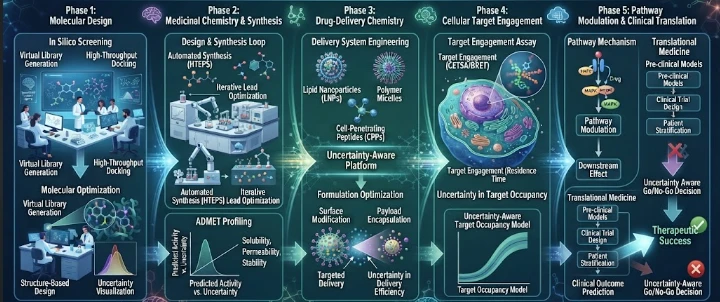
This article describes an uncertainty-aware platform for moving from predicted molecular binding to validated cellular target engagement in medicinal chemistry and drug-delivery research. Docking and machine-learning predictions can rapidly prioritize compounds, but they do not establish that a molecule reaches, occupies, and functionally modulates a target inside relevant cells. The article therefore separates predicted affinity from free intracellular concentration, subcellular localization, t
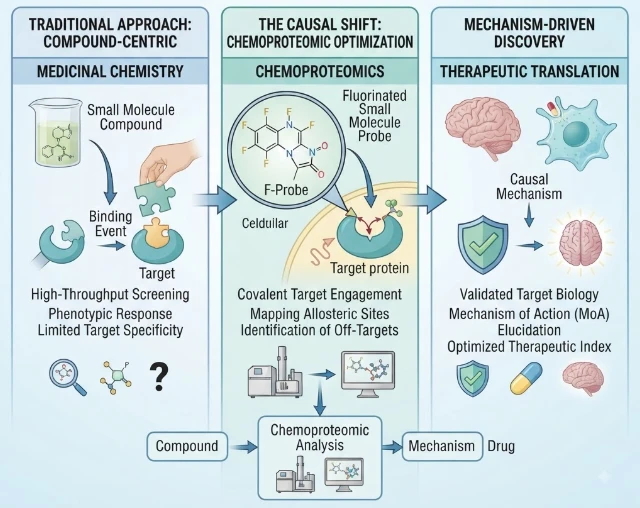
This article explores fluorinated medicinal chemistry through causal chemoproteomics, emphasizing that fluorine substitution can alter far more than potency. A single positional change can modify conformation, pKa, lipophilicity, metabolic stability, target interactions, intracellular exposure, and off-target biology. The article therefore tests whether fluorinated analogues change cellular phenotype through intended target engagement rather than hidden polypharmacology. Matched molecular pairs
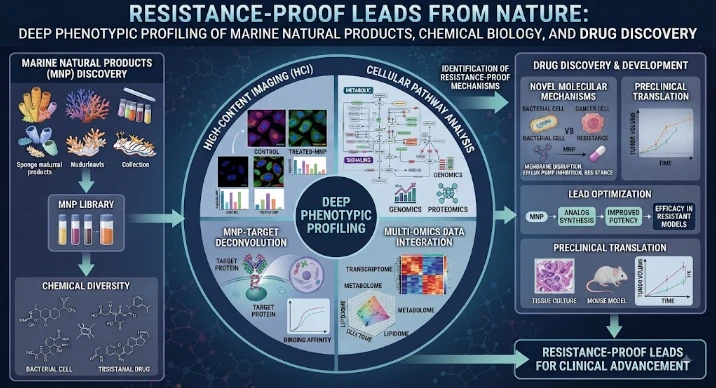
This article presents resistance-aware marine natural-product discovery as a mechanistic process rather than a search for isolated high-potency hits. It explains how activity from marine extracts or fractions can disappear during purification or fail under resistance pressure, making deep phenotypic profiling essential. Morphology, viability kinetics, organelle function, transcriptional state, metabolism, and recovery after washout are combined to connect phenotype with mechanism. The article em