From Predicted Binding to Cellular Target Engagement: An Uncertainty-Aware Platform for Cannabinoid Pharmacology, Receptor Signalling, Drug Discovery and Translational Therapeutics
Md. Humayan Kabir (Master of Science in Pharmaceutical Technology)
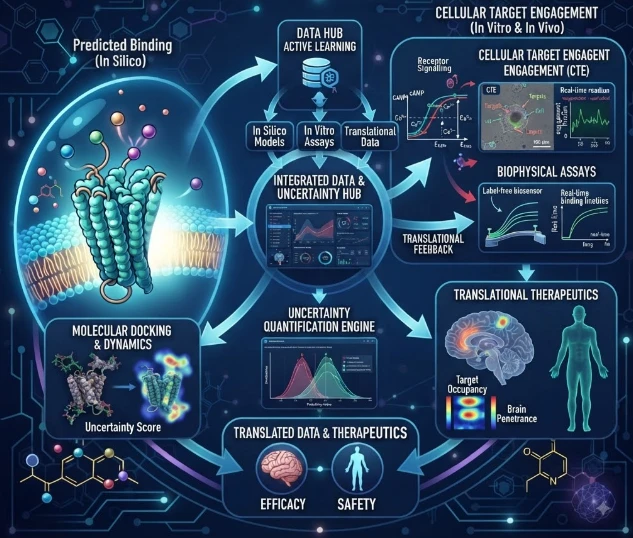
This article examines the gap between predicted cannabinoid receptor binding and experimentally verified cellular target engagement. It centers on predicted affinity, receptor conformation, G-protein coupling, arrestin recruitment, allosteric modulation, and cellular occupancy, emphasizing that high docking scores or model confidence do not establish biological mechanism. CB1 and CB2 pharmacology can change with receptor density, coupling partners, assay format, species orthologue, ligand efficacy, and allosteric context. Ensemble prediction, uncertainty calibration, radioligand assays, cellular biosensors, NanoBRET-style engagement approaches, multipathway signaling, and orthogonal pharmacology are proposed for testing which computational predictions deserve synthesis and which experiments meaningfully reduce uncertainty. Target distribution, central exposure, inflammatory state, prior cannabinoid exposure, and disease mechanism are important context variables. Risks include model overconfidence, assay-system bias, receptor reserve, species differences, off-target activity, and metabolite pharmacology. Compound identity, stereochemistry, solubility, aggregation control, and synthesis reproducibility are also required for interpretable results. Overall, prediction is treated as a prioritized hypothesis that must survive direct cellular validation.
The goal of target engagement in the cannabinoid drug discovery space is no longer solely about how well you hit the target, how you deliver it or whether you are associated with it; today's advanced therapeutic development relies heavily on the understanding of not just how well you hit the target but why the result is there and when it will still be valid. A mechanistic network centered on predicted binding/receptor conformation, g-protein coupling, recruitment of arrestin, allosteric modulation and cellular engagement is located at the heart of this shift. The reason that that network is relevant is that docking scores or model confidence do not guarantee receptor occupancy and hence, the signaling program that is generated inside living cells. A more robust development strategy, then, would consider the mechanism, the context, and the uncertainty as interdependent design variables and not design activities that are carried out at different phases of development.
With the increasingly helpful computational prediction of the priority of cannabinoid ligands, it is important to note that predicting binding does not predict occupancy in living cells or functional signaling. Allosteric context, ligand efficacy, species orthologue, assay format, coupling partners and receptor density are all factors that affect CB1 and CB2 pharmacology. Direct binding and cellular biosensor capabilities are thus still crucial for determining if a presumed interaction is biologically relevant. In addition, uncertainty-aware workflows enable prediction to become more useful; if a prediction is weak, it can be flagged as such and experiments can be designed to test the chemical space that is poorly understood, or to test a particular compound to validate or reveal a blind spot.
The ultimate implication is that the discovery process is now a new process centered on ensemble prediction, uncertainty calibration, radioligand assays, biosensors, NanoBRET-style engagement strategies and multipathway signaling and orthogonal pharmacology. None of these tools can be considered to be a single definitive test, as each assay reflects a component of a larger biological or clinical process. Independent measurements that arrive at the same causal interpretation over time, dose, model system and relevant biological context reinforce confidence that this interpretation is correct. Not all of the results are consistent, and that is important because when there are conflicting results there may be hidden mechanisms, assay artifacts, population differences, or exposure limitations that are worth exploring before expensive development efforts are undertaken.
When deciding what to do, the question is what predictions should be combined and what experimental outcomes should decrease uncertainty. Questioning that will require explicit comparison to other potential mechanisms (on or off-target activity, parallel pathways, differential exposure, measurement bias). A very informative type of experiment is the perturbation experiment in which a proposed component is removed, blocked (for a while), or restored to test the dependence of the observed effect upon it. But confidence in the mechanism is gained by challenge tests, not by repeated confirmation in a single assay that is favorable for the mechanism.
In addition, the meaning of nearly every outcome in an uncertainty-aware target engagement in the field of cannabinoid drug discovery is altered by context. Relevant variations include disease mechanism, prior cannabinoid exposure, inflammatory state, central exposure and target distribution. A treatment that works well in one setting of these factors may not work as well in another setting, or may have a different effect, or be more toxic, in another setting. Stratification can be more useful if based on variables that relate to mechanism or exposure, and not just descriptive categories, because the latter often do not provide a valid explanation for variation in treatment performance.
All five of the following: risk assessment, assay-system bias, receptor reserve, species differences, off-target activity, and metabolite pharmacology are equally important. Early safety work is best when tied to the same mechanistic framework as efficacy, enabling an understanding of unwanted effects to be linked to target biology, carrier behavior, exposure, metabolites or analytical bias. This helps to minimize the risk of safety being a late checklist, out of the stream of discovery. It also helps to make clearer trade-offs when efficacy is needed to be increased by increasing the amount of exposure, spreading the modulation of the pathway across more tissues, or lengthening the persistence in sensitive tissues.
In addition, cannabinoid leads that were supported by direct engagement and functional data were ranked more highly than those that were not, in the case of translational development. Experiments that replicate clinically-relevant doses, timing, biological barriers, treatment history, and sources of heterogeneity contribute to the information that comes from preclinical success. It is less useful to have a sequence of models that are candidates for 'escalation' from a convenient model to a complex model, than to have a sequence of models that answer particular questions of uncertainty. There will then be a clear decision point for each step - which will be to continue, redesign, reduce the study population, change the dose, or gather a new set of mechanistic data.
Important: Manufacturing and analytical control are both crucial as the compound identity, stereochemistry, solubility, aggregation control and reproducible compound manufacturing are essential pre-requisites for interpretable engagement measurements. A biological explanation is of little value if the material used in the test batch varies from one batch to another or if the material used in the test is not well characterized. Critical attributes must, therefore, have ranges of acceptability, measurable attributes and records linking process conditions to the biological performance. This discipline is particularly critical in the case of complex molecules, nanoparticles, biomaterials, and studies with a large amount of data where small changes in exposure, signaling, or apparent treatment response can mean the difference between success and failure.
Another advantage of a better separation of prediction and confirmation in data analysis during uncertainty-aware target engagement in cannabinoid drug discovery is that it allows for better separation of the two. Though a computational model, a machine learning algorithm, a causal estimator, a mechanistic simulation can rank hypotheses, integrate high-dimensional measurements, and highlight uncertainty, the output of the model is not biological truth. Modelling that is useful includes making assumptions, quantifying calibration, indicating areas with weak support and suggesting the next experiment for information that alters a decision. Prospective validation is still necessary since sometimes patterns will do well in a retrospective fit, but fail in a new population, new batch or new biological conditions.
The other major change relates to time: for many processes vital to engaging a target with uncertainty in the context of a cannabinoid drug discovery project, these occur in the wake of initial exposure. There are many different pathways to achieving early response, adaptation, clearance, programming of immunity, remodeling of tissue, adherence, or resistance, even when a single endpoint appears to be favorable. The effect of an intervention on the stability of the state revealed by the longitudinal measure will determine if an intervention results in a stable state, a temporary perturbation, or a delayed liability. Time-resolved information also helps with causal interpretation since the proposed mechanism does not seem to occur after the downstream phenotype has been set, but before.
An experimental design is more efficient if all studies are associated with a specific uncertainty budget. These questions can be prioritized according to their ability to alter predictions that can be synthesized and not because of their novelty, but because they can help reduce uncertainty about the predictions that have been made. Complementary models are then replicated to determine if the conclusion is dependent on one assay, one laboratory condition or one population. This discipline can reduce wasted optimization and is useful for reporting negative results as they reduce the number of plausible mechanisms and enhance the following design iteration.
Traceability between claims and measurements is also a factor for regulatory and clinical credibility. A development package can be strengthened if the original observations, processing decisions, model assumptions, protocol deviations and material attributes are followed throughout the process from initial experiments to translational studies, especially when dealing with uncertainty-aware target engagement in cannabinoid drug discovery. This traceability is useful to differentiate biological variations from technical noise and can help with further investigations of claims for safety or effectiveness. It also provides a framework for revising conclusions in the event that new information alters a previous assumption.
There is also a need to be more accurate in communicating around this field. The term targeted, selective, durable, safe, personalized, predictive, etc. is of little value if it is not accompanied by a measure, a comparator, a population, and an uncertainty range. Clear reporting helps with effective use of negative results and avoids the introduction of new discoveries as mechanisms. Precision provides a common metric for assessing the validity of a claim based on direct measurement, calibrated inference, or an untested assumption for researchers, developers, clinicians and regulators alike.
It is not a single new technology, but rather a closer loop between chemistry and/or formulation, mechanistic measurement, quantitative modeling, safety, manufacturing control and contextually relevant clinical outcomes that is the best direction for uncertainty-aware target engagement in the field of cannabinoid drug discovery. Where assumptions have gone wrong, they should be uncovered early and mechanisms which have proved successful should be subjected to a planned set of tough tests. This reasoning helps in prediction and is thus a priority hypothesis which needs to be validated at the cell level. There are a few valuable innovations across the field, all of which are based on a development system that learns from each experiment, with causal understanding, real world relevance and reproducibility as core principles guiding every decision.
CITE THIS ARTICLE
Kabir, M. H. (2025). From Predicted Binding to Cellular Target Engagement: An Uncertainty-Aware Platform for Cannabinoid Pharmacology, Receptor Signalling, Drug Discovery and Translational Therapeutics. https://researchbykabir.com/article/3db1541e-744b-5879-b610-40eb15e9da14
M. H. Kabir, “From Predicted Binding to Cellular Target Engagement: An Uncertainty-Aware Platform for Cannabinoid Pharmacology, Receptor Signalling, Drug Discovery and Translational Therapeutics,” 2025. [Online]. Available: https://researchbykabir.com/article/3db1541e-744b-5879-b610-40eb15e9da14
Kabir, M. H. (2025) ‘From Predicted Binding to Cellular Target Engagement: An Uncertainty-Aware Platform for Cannabinoid Pharmacology, Receptor Signalling, Drug Discovery and Translational Therapeutics’. Available at: https://researchbykabir.com/article/3db1541e-744b-5879-b610-40eb15e9da14
Kabir, Md. Humayan. “From Predicted Binding to Cellular Target Engagement: An Uncertainty-Aware Platform for Cannabinoid Pharmacology, Receptor Signalling, Drug Discovery and Translational Therapeutics.” 2025, https://researchbykabir.com/article/3db1541e-744b-5879-b610-40eb15e9da14.
Md. Humayan Kabir. “From Predicted Binding to Cellular Target Engagement: An Uncertainty-Aware Platform for Cannabinoid Pharmacology, Receptor Signalling, Drug Discovery and Translational Therapeutics.” (2025). https://researchbykabir.com/article/3db1541e-744b-5879-b610-40eb15e9da14.
Kabir MH. From Predicted Binding to Cellular Target Engagement: An Uncertainty-Aware Platform for Cannabinoid Pharmacology, Receptor Signalling, Drug Discovery and Translational Therapeutics. 2025. https://researchbykabir.com/article/3db1541e-744b-5879-b610-40eb15e9da14
@misc{article_3db1541e744b5879b61040eb15e9da14,
  title = {From Predicted Binding to Cellular Target Engagement: An Uncertainty-Aware Platform for Cannabinoid Pharmacology, Receptor Signalling, Drug Discovery and Translational Therapeutics},
  author = {Md. Humayan Kabir},
  year = {2025},
  url = {https://researchbykabir.com/article/3db1541e-744b-5879-b610-40eb15e9da14},
}
TY  - GEN
AU  - Md. Humayan Kabir
TI  - From Predicted Binding to Cellular Target Engagement: An Uncertainty-Aware Platform for Cannabinoid Pharmacology, Receptor Signalling, Drug Discovery and Translational Therapeutics
PY  - 2025-07-20
UR  - https://researchbykabir.com/article/3db1541e-744b-5879-b610-40eb15e9da14
ER  -
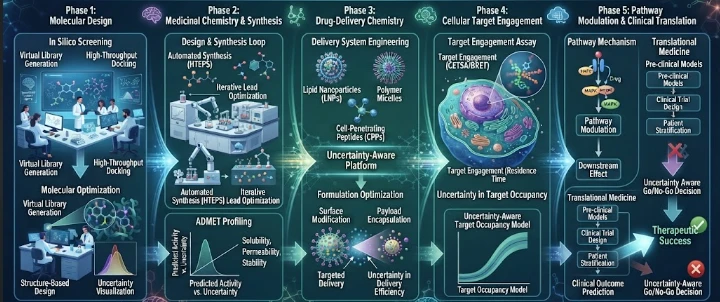
This article describes an uncertainty-aware platform for moving from predicted molecular binding to validated cellular target engagement in medicinal chemistry and drug-delivery research. Docking and machine-learning predictions can rapidly prioritize compounds, but they do not establish that a molecule reaches, occupies, and functionally modulates a target inside relevant cells. The article therefore separates predicted affinity from free intracellular concentration, subcellular localization, t
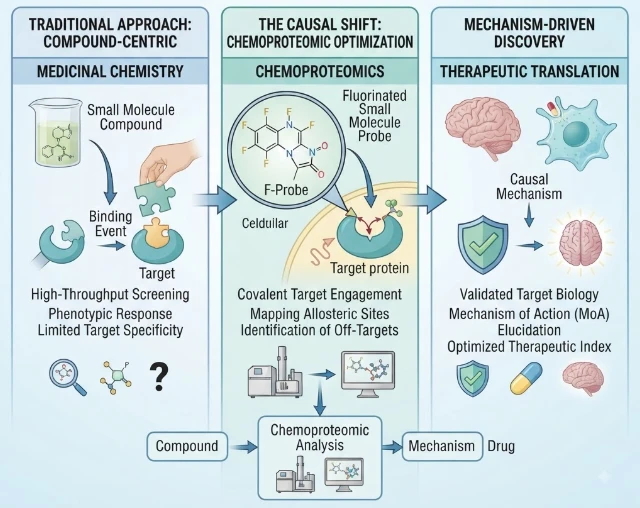
This article explores fluorinated medicinal chemistry through causal chemoproteomics, emphasizing that fluorine substitution can alter far more than potency. A single positional change can modify conformation, pKa, lipophilicity, metabolic stability, target interactions, intracellular exposure, and off-target biology. The article therefore tests whether fluorinated analogues change cellular phenotype through intended target engagement rather than hidden polypharmacology. Matched molecular pairs
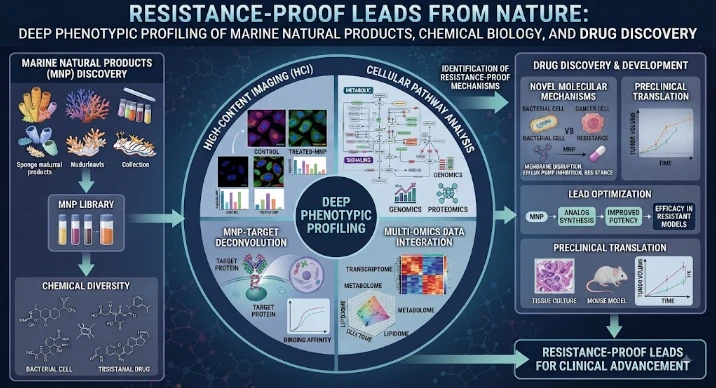
This article presents resistance-aware marine natural-product discovery as a mechanistic process rather than a search for isolated high-potency hits. It explains how activity from marine extracts or fractions can disappear during purification or fail under resistance pressure, making deep phenotypic profiling essential. Morphology, viability kinetics, organelle function, transcriptional state, metabolism, and recovery after washout are combined to connect phenotype with mechanism. The article em